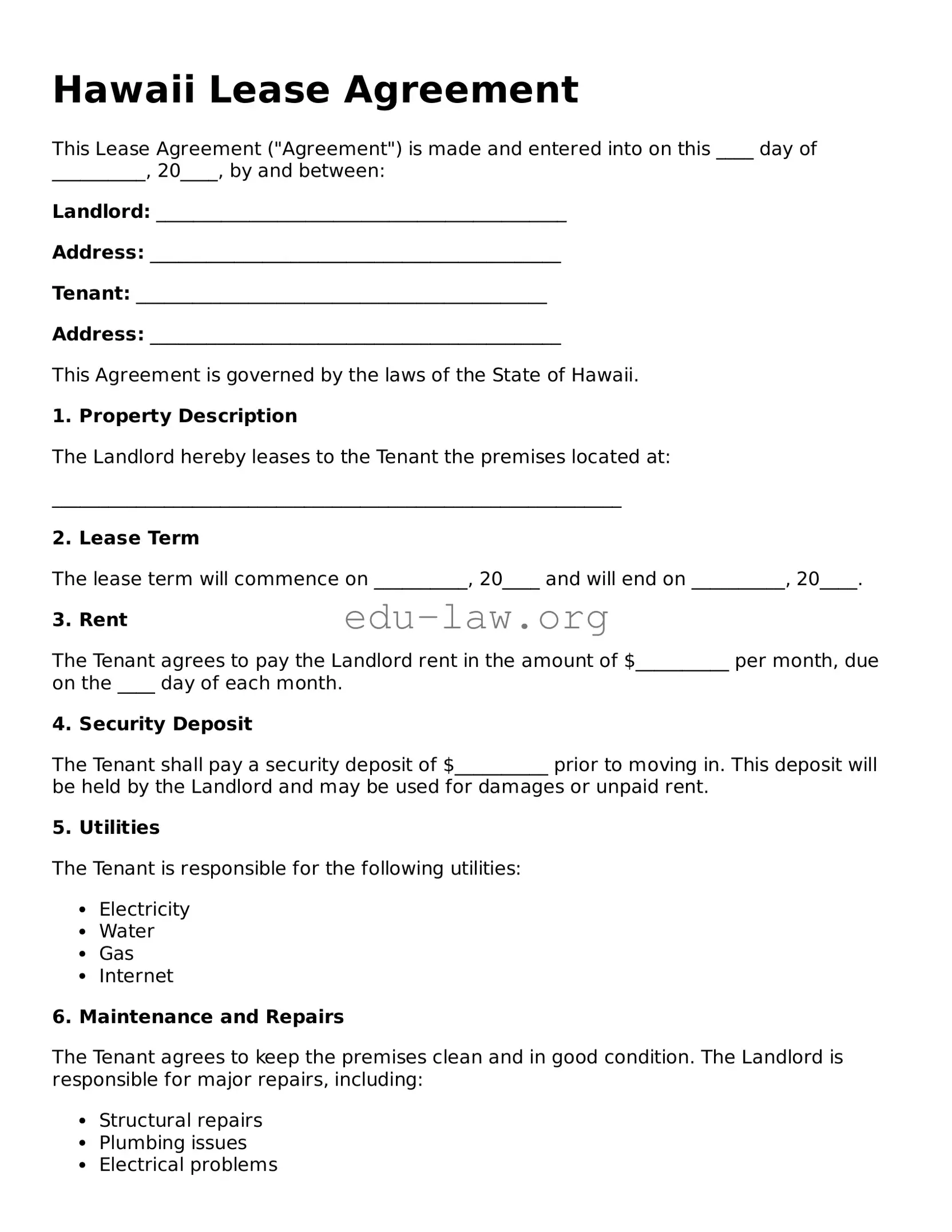
When it comes to renting property in the beautiful state of Hawaii, understanding the Hawaii Lease Agreement form is essential for both landlords and tenants. This document serves as a legally binding contract that outlines the terms and conditions of the rental arrangement. Key aspects include the duration of the lease, the amount of rent due, and the responsibilities of both parties. It typically specifies details such as security deposits, maintenance obligations, and rules regarding pets and guests. Additionally, the form addresses what happens if either party fails to uphold their end of the agreement, providing a clear framework for resolving disputes. By familiarizing yourself with this important document, you can navigate the rental process with confidence and ensure a smooth and enjoyable experience in the Aloha State.
Hawaii Lease Agreement
This Lease Agreement ("Agreement") is made and entered into on this ____ day of __________, 20____, by and between:
Landlord: ____________________________________________
Address: ____________________________________________
Tenant: ____________________________________________
Address: ____________________________________________
This Agreement is governed by the laws of the State of Hawaii.
1. Property Description
The Landlord hereby leases to the Tenant the premises located at:
_____________________________________________________________
2. Lease Term
The lease term will commence on __________, 20____ and will end on __________, 20____.
3. Rent
The Tenant agrees to pay the Landlord rent in the amount of $__________ per month, due on the ____ day of each month.
4. Security Deposit
The Tenant shall pay a security deposit of $__________ prior to moving in. This deposit will be held by the Landlord and may be used for damages or unpaid rent.
5. Utilities
The Tenant is responsible for the following utilities:
6. Maintenance and Repairs
The Tenant agrees to keep the premises clean and in good condition. The Landlord is responsible for major repairs, including:
7. Termination
Either party may terminate this Agreement by providing written notice of at least ____ days prior to the intended termination date.
8. Governing Law
This Agreement shall be governed by the laws of the State of Hawaii.
9. Signatures
By signing below, both parties agree to the terms of this Lease Agreement:
Landlord Signature: ________________________________ Date: ___________
Tenant Signature: _________________________________ Date: ___________
This Lease Agreement represents the entire understanding between the parties and supersedes all prior agreements, whether written or oral.
| Fact Name | Details |
|---|---|
| Governing Law | The Hawaii Lease Agreement is governed by the laws of the State of Hawaii. |
| Types of Leases | It can be used for residential, commercial, or agricultural leases. |
| Duration | Leases can vary in duration, typically ranging from 6 months to several years. |
| Security Deposit | Landlords may require a security deposit, usually not exceeding one month's rent. |
| Rent Payment | The agreement should specify the amount of rent and the due date each month. |
| Maintenance Responsibilities | The lease outlines maintenance responsibilities for both landlords and tenants. |
| Termination Clause | It includes conditions under which either party can terminate the lease. |
| Subletting | The lease may restrict or allow subletting, depending on the terms agreed upon. |
| Dispute Resolution | Provisions for resolving disputes are often included, such as mediation or arbitration. |
| Disclosure Requirements | Landlords must disclose certain information, such as lead paint hazards, if applicable. |
Filling out the Hawaii Lease Agreement form is an important step in securing a rental property. Ensure that you have all necessary information ready before you start. This will help you complete the form accurately and efficiently.
What is a Hawaii Lease Agreement?
A Hawaii Lease Agreement is a legal document that outlines the terms and conditions under which a landlord rents property to a tenant in Hawaii. It specifies the rights and responsibilities of both parties, including rent amount, payment due dates, and property maintenance obligations.
What should be included in a Hawaii Lease Agreement?
The agreement should include essential details such as the names of the landlord and tenant, property address, lease duration, rent amount, payment terms, security deposit requirements, and any rules or regulations regarding the property. Additionally, it should address maintenance responsibilities and procedures for handling disputes.
How long is a typical lease term in Hawaii?
A typical lease term in Hawaii can vary, but it often ranges from six months to one year. Some leases may be month-to-month, allowing for greater flexibility. It is important to clearly state the lease duration in the agreement.
What happens if I need to break my lease early?
If you need to break your lease early, you may be subject to penalties as outlined in the agreement. Common consequences include losing your security deposit or having to pay rent until a new tenant is found. Always communicate with your landlord to discuss your situation and explore possible solutions.
Is a security deposit required in a Hawaii Lease Agreement?
Yes, a security deposit is commonly required. In Hawaii, the maximum amount a landlord can charge is typically equivalent to one month's rent. The deposit is held to cover potential damages or unpaid rent and must be returned to the tenant within a specified timeframe after the lease ends.
Can landlords increase rent during the lease term?
Generally, landlords cannot increase rent during the lease term unless the lease agreement explicitly allows for such increases. Rent increases are more common in month-to-month agreements. Always review your lease for specific terms regarding rent adjustments.
What should I do if I have a dispute with my landlord?
If a dispute arises, start by discussing the issue directly with your landlord. Clear communication can often resolve misunderstandings. If that does not work, you may want to refer to the lease agreement for guidance or seek mediation services. Legal action is a last resort and should be considered carefully.
Incomplete Information: One of the most common mistakes is leaving sections blank. Every part of the lease agreement should be filled out completely. Missing information can lead to misunderstandings or disputes down the line.
Incorrect Dates: It’s crucial to ensure that the lease dates are accurate. This includes the start and end dates of the lease. Incorrect dates can create confusion about when the lease actually begins or ends, potentially leading to legal issues.
Not Understanding Terms: Some individuals may sign the lease without fully understanding the terms and conditions. It’s important to read through the entire document and clarify any confusing language. Ignoring this can result in unintended obligations.
Forgetting Signatures: A lease agreement is not valid unless it is signed by both parties. Sometimes, one party might forget to sign, which can invalidate the agreement. Always double-check that all required signatures are present.
Neglecting to Document Conditions: Before signing, it’s essential to document the condition of the property. Failing to do so can lead to disputes about security deposits or damages when the lease ends. Take photos or write down any existing issues.
When entering into a rental agreement in Hawaii, several forms and documents may accompany the Hawaii Lease Agreement. These documents help clarify the terms of the lease, protect the rights of both parties, and ensure compliance with local regulations. Below is a list of commonly used forms that may be relevant.
Utilizing these forms and documents alongside the Hawaii Lease Agreement can enhance communication and understanding between landlords and tenants. It is essential to ensure that all parties are clear on their rights and responsibilities to foster a positive rental experience.
The Hawaii Lease Agreement form shares similarities with a Residential Lease Agreement. Both documents outline the terms and conditions under which a tenant can occupy a property. They detail the rental amount, duration of the lease, and responsibilities of both the landlord and tenant. Each agreement serves to protect the interests of both parties, ensuring that expectations are clear and legally enforceable.
Another document that resembles the Hawaii Lease Agreement is the Commercial Lease Agreement. This type of lease is specifically tailored for business properties. Like the Hawaii Lease Agreement, it specifies the rent, lease term, and maintenance obligations. However, it often includes additional clauses relevant to commercial activities, such as zoning regulations and permitted uses of the space.
The Rental Agreement is also similar to the Hawaii Lease Agreement. While a lease typically covers a longer term, a rental agreement is often for a shorter duration, such as month-to-month. Both documents outline the rental price and responsibilities of the tenant and landlord, ensuring that both parties understand their obligations.
A Sublease Agreement shares key features with the Hawaii Lease Agreement as well. This document allows a tenant to lease their rented space to another party. Like the original lease, it must include details about rent, duration, and responsibilities. It also requires the landlord's consent, ensuring that all parties are aware of the arrangement.
The Roommate Agreement is another document that has similarities with the Hawaii Lease Agreement. This agreement is often used when multiple tenants share a rental property. It outlines the terms of the shared living situation, including rent division, responsibilities for utilities, and rules for common areas. Both agreements aim to create a clear understanding among parties to prevent disputes.
The Lease Option Agreement is akin to the Hawaii Lease Agreement but includes an option for the tenant to purchase the property at a later date. It contains similar terms regarding rent and responsibilities, but it also specifies the purchase price and the timeframe in which the tenant can exercise the option. This adds a layer of complexity while still serving the primary purpose of defining the rental relationship.
Finally, the Tenancy Agreement is comparable to the Hawaii Lease Agreement in that it governs the rental of residential properties. It outlines the rights and responsibilities of both landlords and tenants. While it may vary by jurisdiction, the core elements—such as rental terms and maintenance duties—remain consistent, ensuring that both parties are protected under the law.
When filling out the Hawaii Lease Agreement form, it is essential to approach the task with care. Here are some important guidelines to follow:
Following these guidelines will help ensure a smoother leasing process and protect your interests as a tenant or landlord.
Many people have misunderstandings about the Hawaii Lease Agreement form. Here are six common misconceptions:
This is not true. Lease agreements can vary significantly based on the property type, landlord preferences, and specific terms agreed upon by both parties.
While oral agreements can be enforceable, they are often difficult to prove. A written lease agreement provides clear documentation of the terms and protects both parties.
In Hawaii, landlords have a specific timeframe to return security deposits, usually within 14 days after the lease ends. However, deductions for damages or unpaid rent may extend this period.
Most lease agreements require tenants to obtain landlord approval before making any significant alterations. Unauthorized changes can lead to penalties or eviction.
Not all leases have automatic renewal clauses. Tenants should review their lease terms carefully to understand renewal options and deadlines.
Landlords must provide reasonable notice before entering a rental unit, typically 24 hours. This protects tenants' privacy and rights.
When filling out and using the Hawaii Lease Agreement form, keep the following key takeaways in mind:
By paying attention to these points, both landlords and tenants can ensure a smoother leasing process in Hawaii.