Creating a Last Will and Testament is an essential step in ensuring that your wishes are honored after your passing. In Hawaii, this legal document serves as a guide for distributing your assets, appointing guardians for minor children, and designating an executor to manage your estate. The form typically includes sections for naming beneficiaries, specifying how property should be divided, and outlining any specific bequests. It is crucial to ensure that the will is signed and witnessed according to state laws to validate its enforceability. Furthermore, individuals may also include provisions for funeral arrangements and trusts, allowing for greater control over how their affairs are handled. Understanding these components can help you craft a comprehensive will that reflects your intentions and provides peace of mind for you and your loved ones.
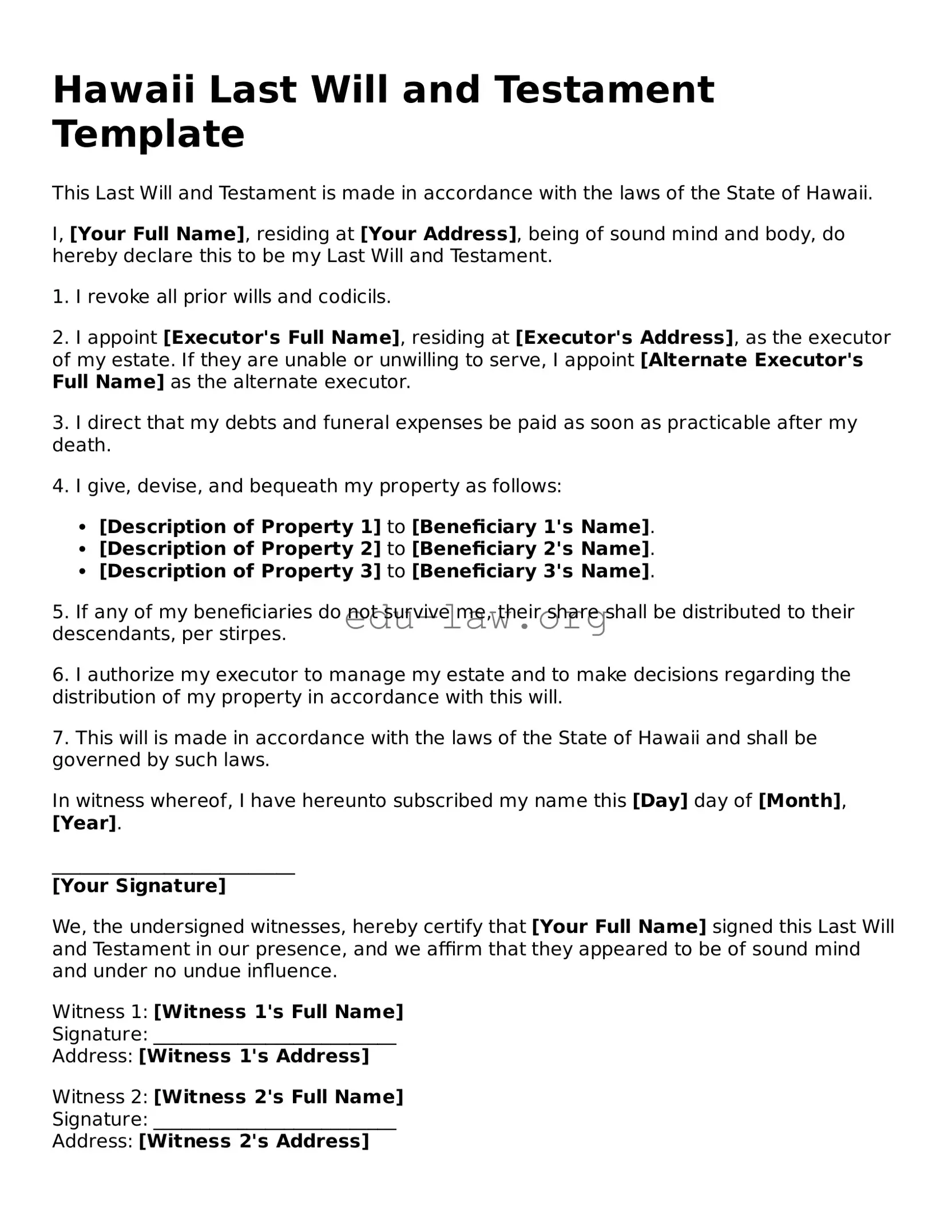
Hawaii Last Will and Testament Template
This Last Will and Testament is made in accordance with the laws of the State of Hawaii.
I, [Your Full Name], residing at [Your Address], being of sound mind and body, do hereby declare this to be my Last Will and Testament.
1. I revoke all prior wills and codicils.
2. I appoint [Executor's Full Name], residing at [Executor's Address], as the executor of my estate. If they are unable or unwilling to serve, I appoint [Alternate Executor's Full Name] as the alternate executor.
3. I direct that my debts and funeral expenses be paid as soon as practicable after my death.
4. I give, devise, and bequeath my property as follows:
5. If any of my beneficiaries do not survive me, their share shall be distributed to their descendants, per stirpes.
6. I authorize my executor to manage my estate and to make decisions regarding the distribution of my property in accordance with this will.
7. This will is made in accordance with the laws of the State of Hawaii and shall be governed by such laws.
In witness whereof, I have hereunto subscribed my name this [Day] day of [Month], [Year].
__________________________
[Your Signature]
We, the undersigned witnesses, hereby certify that [Your Full Name] signed this Last Will and Testament in our presence, and we affirm that they appeared to be of sound mind and under no undue influence.
Witness 1: [Witness 1's Full Name]
Signature: __________________________
Address: [Witness 1's Address]
Witness 2: [Witness 2's Full Name]
Signature: __________________________
Address: [Witness 2's Address]
| Fact Name | Description |
|---|---|
| Governing Law | The Hawaii Last Will and Testament is governed by the Hawaii Revised Statutes, specifically Chapter 560. |
| Age Requirement | Individuals must be at least 18 years old to create a valid will in Hawaii. |
| Witness Requirement | A will must be signed by at least two witnesses who are present at the same time. |
| Signature Requirement | The testator must sign the will, or if unable, another person may sign on their behalf in their presence. |
| Revocation | A will can be revoked by creating a new will or by physically destroying the original document. |
| Holographic Wills | Hawaii recognizes holographic wills, which are handwritten and signed by the testator, without the need for witnesses. |
| Self-Proving Wills | Wills can be made self-proving by including a notarized affidavit from the witnesses, simplifying the probate process. |
| Probate Process | All wills must go through the probate process in Hawaii to be validated and executed, ensuring proper distribution of assets. |
Once you have the Hawaii Last Will and Testament form in hand, you'll need to complete it carefully to ensure that your wishes are clearly expressed. Follow the steps outlined below to fill out the form correctly.
After completing the form, store it in a safe place and inform your executor of its location. Regularly review and update your will as necessary to reflect any changes in your circumstances or wishes.
What is a Last Will and Testament in Hawaii?
A Last Will and Testament is a legal document that outlines how a person's assets and affairs should be handled after their death. In Hawaii, this document allows you to specify who will inherit your property, name guardians for minor children, and appoint an executor to manage your estate. Having a will ensures that your wishes are respected and can help prevent disputes among family members.
Who can create a Last Will and Testament in Hawaii?
In Hawaii, any person who is at least 18 years old and of sound mind can create a Last Will and Testament. This means you must be able to understand the nature of the document and its implications. Additionally, you should be free from undue influence or coercion when making your will.
What are the requirements for a valid will in Hawaii?
To be considered valid in Hawaii, a Last Will and Testament must be in writing, signed by the testator (the person making the will), and witnessed by at least two individuals. These witnesses must be present at the same time when the testator signs the will. Importantly, the witnesses should not be beneficiaries of the will to avoid any potential conflicts of interest.
Can I change my will after it's created?
Yes, you can change your will at any time while you are still alive. This can be done by creating a new will that revokes the previous one or by making amendments called codicils. A codicil must also be signed and witnessed in the same manner as the original will. Regularly reviewing and updating your will ensures that it reflects your current wishes and circumstances.
What happens if I die without a will in Hawaii?
If you pass away without a will, you are considered to have died "intestate." In this case, Hawaii's intestacy laws will determine how your assets are distributed. Typically, your estate will be divided among your closest relatives, which may not align with your wishes. This can lead to complications and disputes among family members, making it crucial to have a will in place.
How can I ensure my will is properly executed?
To ensure your will is properly executed, follow the legal requirements for signing and witnessing in Hawaii. It's also wise to store your will in a safe place, such as a safe deposit box or with your attorney. Inform your loved ones of its location and consider discussing your wishes with them to minimize confusion after your passing.
Is it necessary to hire a lawyer to create a will in Hawaii?
While it is not legally required to hire a lawyer to create a will in Hawaii, doing so can provide peace of mind. An attorney can help ensure that your will meets all legal requirements and accurately reflects your wishes. If your estate is complex or if you have specific concerns, consulting with a legal professional may be beneficial.
Not clearly identifying the testator. It's crucial to state your full name and address at the beginning of the will. Omitting this information can lead to confusion about who the will belongs to.
Failing to specify beneficiaries. Be specific about who will inherit your assets. Vague language can lead to disputes among family members.
Neglecting to update the will after major life changes. Events such as marriage, divorce, or the birth of a child should prompt a review and possible revision of your will.
Not having the required witnesses. In Hawaii, you must have at least two witnesses present when you sign your will. If this step is skipped, the will may be deemed invalid.
Using outdated forms. Laws change, and using an old version of the Last Will and Testament form can lead to legal issues. Always ensure you are using the most current form.
Overlooking the signing process. Simply filling out the form isn’t enough. The will must be signed in front of witnesses, and you must also sign each page in some cases.
Failing to include a residuary clause. This clause is important for addressing any assets not specifically mentioned in the will, ensuring nothing is left out unintentionally.
Not storing the will in a safe place. After completing the will, it’s essential to keep it in a secure location where your loved ones can easily find it when needed.
When preparing a Last Will and Testament in Hawaii, individuals often need to consider additional forms and documents that can complement their estate planning. Each of these documents serves a specific purpose and can help ensure that your wishes are carried out effectively.
By considering these additional documents alongside your Hawaii Last Will and Testament, you can create a comprehensive estate plan that addresses your needs and protects your loved ones. It's essential to ensure that all documents are up-to-date and reflect your current wishes.
The Living Will is a document that outlines an individual's preferences regarding medical treatment in the event they become incapacitated. Similar to a Last Will and Testament, it serves to express personal wishes, but focuses specifically on healthcare decisions rather than the distribution of assets. Both documents require clear language to ensure that the individual's intentions are understood and respected, highlighting the importance of personal autonomy in decision-making.
A Power of Attorney (POA) grants another person the authority to make decisions on behalf of the individual. Like a Last Will and Testament, it is a legal document that requires careful consideration and specificity. While a Last Will deals with posthumous asset distribution, a POA is effective during the individual's lifetime, allowing someone to manage financial or healthcare decisions if the individual is unable to do so. This creates a framework for managing personal affairs in a way that aligns with the individual's wishes.
The Trust Agreement is another document that shares similarities with a Last Will and Testament. Both serve to manage the distribution of assets, but a Trust can take effect during the individual's lifetime and can help avoid probate. Trusts can provide more control over when and how assets are distributed, potentially offering tax advantages and protecting assets from creditors. This flexibility can be appealing for individuals looking to ensure their wishes are honored both during their lifetime and after their passing.
The Advance Healthcare Directive combines elements of a Living Will and a Power of Attorney for healthcare decisions. It allows individuals to specify their medical preferences and appoint someone to make healthcare decisions on their behalf. Like a Last Will, it emphasizes the importance of personal choice and ensures that an individual's values and wishes are respected in critical situations. Both documents are vital for ensuring that one's desires are carried out, particularly when the individual cannot communicate them directly.
The Codicil is a legal document that amends an existing Last Will and Testament. It allows individuals to make changes without needing to create an entirely new will. Similar to a Last Will, a Codicil must be executed with the same formalities to ensure its validity. This document is essential for those who want to update their wishes regarding asset distribution or change executors while maintaining the original will's integrity. The ability to modify an existing will can simplify the estate planning process and keep it aligned with current intentions.
When filling out the Hawaii Last Will and Testament form, it is crucial to follow certain guidelines to ensure that your will is valid and reflects your wishes. Here are four things you should and shouldn't do:
Many people hold misconceptions about the Hawaii Last Will and Testament form. Understanding the facts can help ensure that your estate planning is effective. Below are six common misconceptions.
Addressing these misconceptions can lead to better estate planning and peace of mind for individuals and their families.
When filling out and using the Hawaii Last Will and Testament form, keep these key takeaways in mind: