In the beautiful state of Hawaii, families seeking to educate their children at home must navigate a specific process to ensure compliance with state regulations. Central to this process is the Homeschool Letter of Intent form, a vital document that communicates a family's intention to homeschool their children. This form serves several important functions: it notifies the state of the parents' choice to provide an alternative education, outlines the educational philosophy and curriculum planned for the child, and establishes a record that can be referenced in the future. By completing this form, parents take a significant step in affirming their commitment to their children's education while also fulfilling legal obligations. Understanding the nuances of this form is essential for families embarking on the homeschooling journey, as it not only sets the stage for educational freedom but also ensures that they remain within the bounds of state law. The process may seem daunting at first, but with the right information and support, families can navigate it with confidence and clarity.
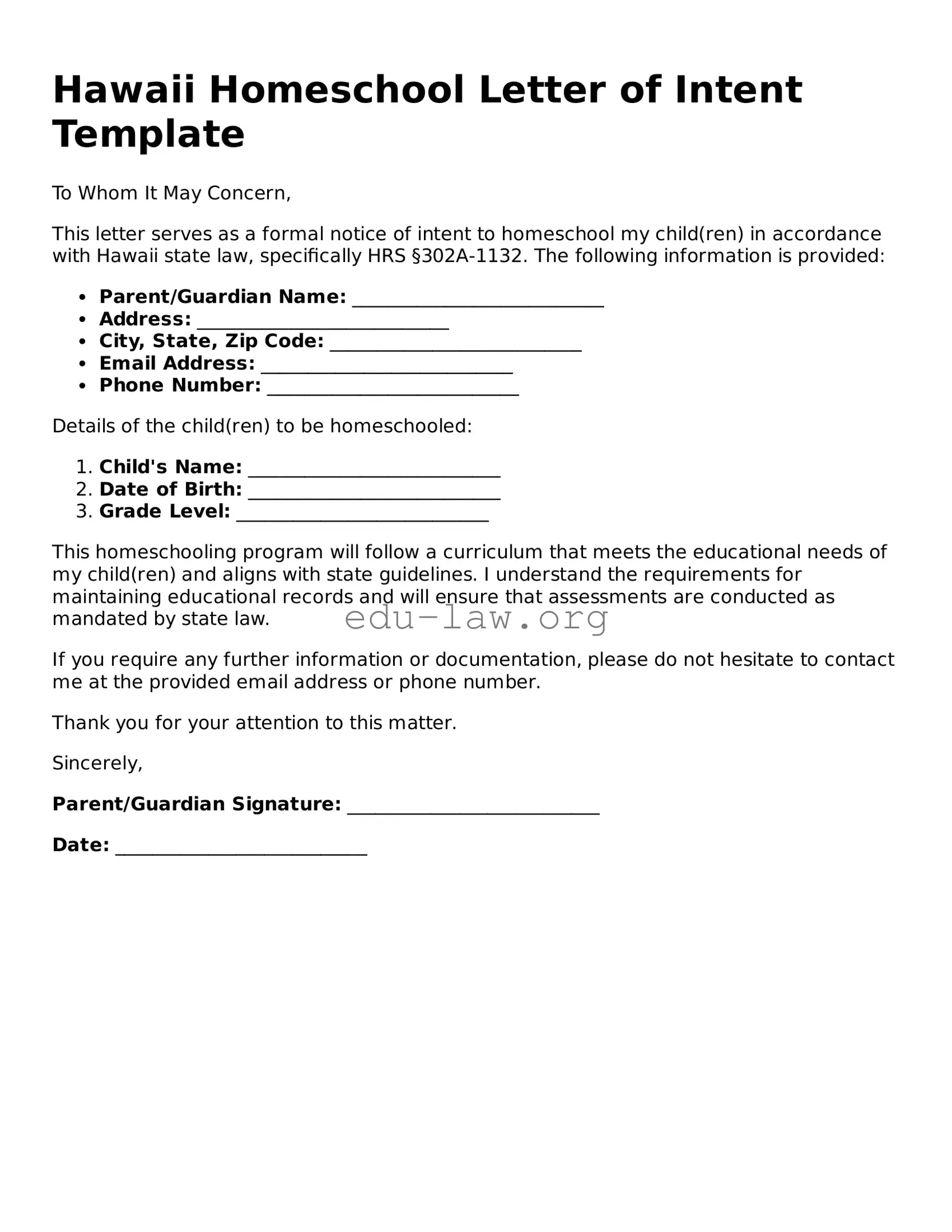
Hawaii Homeschool Letter of Intent Template
To Whom It May Concern,
This letter serves as a formal notice of intent to homeschool my child(ren) in accordance with Hawaii state law, specifically HRS §302A-1132. The following information is provided:
Details of the child(ren) to be homeschooled:
This homeschooling program will follow a curriculum that meets the educational needs of my child(ren) and aligns with state guidelines. I understand the requirements for maintaining educational records and will ensure that assessments are conducted as mandated by state law.
If you require any further information or documentation, please do not hesitate to contact me at the provided email address or phone number.
Thank you for your attention to this matter.
Sincerely,
Parent/Guardian Signature: ___________________________
Date: ___________________________
| Fact Name | Description |
|---|---|
| Purpose | The Hawaii Homeschool Letter of Intent form is used to notify the state of a parent's intention to homeschool their child. |
| Governing Law | The form is governed by Hawaii Revised Statutes, Chapter 302A-1132, which outlines the requirements for homeschooling. |
| Submission Deadline | Parents must submit the form within 10 days of starting the homeschool program. |
| Information Required | The form requires basic information such as the child's name, age, and the address of the homeschooling location. |
| Annual Updates | Families must submit an updated Letter of Intent each school year to continue homeschooling. |
| Resources | The Hawaii Department of Education provides resources and guidance for families who choose to homeschool. |
After completing the Hawaii Homeschool Letter of Intent form, you will submit it to the appropriate educational authorities. This step is crucial for formally notifying the state of your intention to homeschool your child. Following submission, you will receive further instructions or confirmation regarding your homeschooling status.
What is the Hawaii Homeschool Letter of Intent form?
The Hawaii Homeschool Letter of Intent form is a document that parents or guardians must submit to inform the state of Hawaii that they intend to homeschool their children. This form serves as a formal notification to the Department of Education and outlines the family's commitment to providing an educational experience outside of the traditional school system. It is an essential first step in the homeschooling process in Hawaii.
Who needs to fill out the Letter of Intent?
Any parent or guardian who wishes to homeschool their child in Hawaii must complete the Letter of Intent. This requirement applies to children of compulsory school age, typically between 6 and 18 years old. It is important to ensure that the form is filled out accurately and submitted on time to avoid any potential issues with compliance.
When should the Letter of Intent be submitted?
The Letter of Intent should be submitted at least 10 days before the start of the homeschooling program. For families who are transitioning from a public or private school, it is advisable to submit the form as soon as the decision to homeschool is made. This proactive approach helps to ensure a smooth transition and allows for any necessary adjustments to be made before the educational year begins.
What information is required on the form?
The form typically requires basic information such as the name and address of the parent or guardian, the names and ages of the children being homeschooled, and the educational plan or curriculum that will be used. Providing complete and accurate information is crucial, as it allows the Department of Education to understand the educational framework being implemented.
What happens after the Letter of Intent is submitted?
Once the Letter of Intent is submitted, the Department of Education will review the information provided. Families will receive a confirmation that their intent to homeschool has been acknowledged. It is important to keep a copy of the submitted form for your records. Additionally, parents will be responsible for maintaining educational records and ensuring that their children receive an appropriate education according to state guidelines.
Failing to include all required information. Each section of the form must be completed. Missing details can lead to delays in processing.
Not providing accurate student information. Ensure that the names and ages of all students are correct. Inaccuracies can cause confusion.
Submitting the form after the deadline. Timeliness is crucial. Late submissions may not be accepted, impacting your homeschooling plans.
Neglecting to sign the form. A signature is necessary to validate the document. Without it, the form is incomplete.
Using outdated forms. Always check for the most current version of the Letter of Intent. Using old forms can lead to issues with acceptance.
Overlooking additional documentation requirements. Some situations may require supporting documents. Ensure you check if any are needed.
When families decide to homeschool in Hawaii, they often need to submit various forms and documents alongside the Homeschool Letter of Intent. Each of these documents serves a specific purpose, ensuring that the homeschooling process is organized and compliant with state regulations. Below is a list of commonly used forms and documents that can accompany the Letter of Intent.
By preparing these documents, families can create a comprehensive and organized approach to homeschooling. This not only meets legal requirements but also supports a positive learning environment for children. Ensuring that all necessary paperwork is in order helps to alleviate stress and allows families to focus on what truly matters: the education and well-being of their children.
The Hawaii Homeschool Letter of Intent form shares similarities with the Notice of Intent to Homeschool form used in many states. Both documents serve as official notifications to the local education authorities that a parent or guardian intends to educate their child at home. They typically require basic information about the student, such as name and age, and may ask for details about the educational approach the family plans to take. This ensures that authorities are informed and can provide any necessary guidance or resources.
Another document that resembles the Hawaii Homeschool Letter of Intent is the Educational Plan or Curriculum Outline. While the Letter of Intent indicates the intention to homeschool, the Educational Plan outlines the specific subjects and materials the family will use. This document often includes a schedule or timeline for the academic year, helping parents organize their teaching methods and ensuring that they cover required subjects. Both documents reflect a commitment to providing a structured educational experience for the child.
The Affidavit of Homeschooling is another related document. This affidavit serves as a sworn statement confirming that the parent is taking full responsibility for the child's education. Similar to the Letter of Intent, it is submitted to the local school district. However, the affidavit often includes more detailed information about the parent’s qualifications and the educational philosophy they plan to implement. Both documents aim to establish a formal record of the homeschooling arrangement.
The Declaration of Intent to Homeschool is also akin to the Hawaii Homeschool Letter of Intent. This declaration is often used in states with specific homeschooling laws and requires parents to formally declare their intent to educate their children at home. Like the Letter of Intent, it typically includes the child’s name and age, and it may require parents to affirm their understanding of the legal obligations associated with homeschooling. This document helps ensure compliance with state regulations.
The Homeschool Registration form found in some states is similar in purpose to the Hawaii Homeschool Letter of Intent. This form typically requires parents to register their homeschooling program with the local school district. It may ask for similar information about the student and the educational approach. The registration process helps maintain oversight and ensures that families are following state homeschooling laws.
Finally, the Annual Assessment form is comparable to the Hawaii Homeschool Letter of Intent. This document is often required at the end of the academic year and serves to report the progress of the homeschooled child. While the Letter of Intent indicates the start of homeschooling, the Annual Assessment provides evidence of educational outcomes. Both documents are essential for maintaining compliance with homeschooling regulations and ensuring that children receive a quality education.
When filling out the Hawaii Homeschool Letter of Intent form, it is important to follow certain guidelines to ensure a smooth process. Here are some things you should and shouldn't do:
The Hawaii Homeschool Letter of Intent form is an essential document for families choosing to homeschool their children. However, several misconceptions exist regarding this form. Below is a list of common misunderstandings:
This is incorrect. Homeschooling is a legal option for education in Hawaii, provided families follow the necessary guidelines, including submitting the Letter of Intent.
While parents typically complete the form, guardians or other responsible adults can also submit it on behalf of the child.
This is a misconception. Families can choose to change their educational approach at any time, including returning to public school or switching to a different homeschooling method.
This is not true. The Letter of Intent does not provide access to state funding for homeschooling. Families are responsible for their educational expenses.
After submitting the form, families must still adhere to educational standards and submit annual progress reports to the state.
This is a misconception. Families can submit the Letter of Intent at any time during the year, as long as it is completed before starting homeschooling.
While families have the freedom to choose their curriculum, they are still required to provide a comprehensive education that meets state standards.
This is not accurate. Families from diverse backgrounds and situations choose homeschooling for various reasons, and it is accessible to all.
This is misleading. In addition to the Letter of Intent, families must also comply with other state regulations, such as maintaining educational records and submitting progress reports.
Understanding these misconceptions can help families navigate the homeschooling process more effectively and ensure compliance with state regulations.
When considering homeschooling in Hawaii, filling out the Homeschool Letter of Intent form is a crucial step. Here are some key takeaways to keep in mind:
By following these guidelines, you can ensure a smooth start to your homeschooling journey in Hawaii.