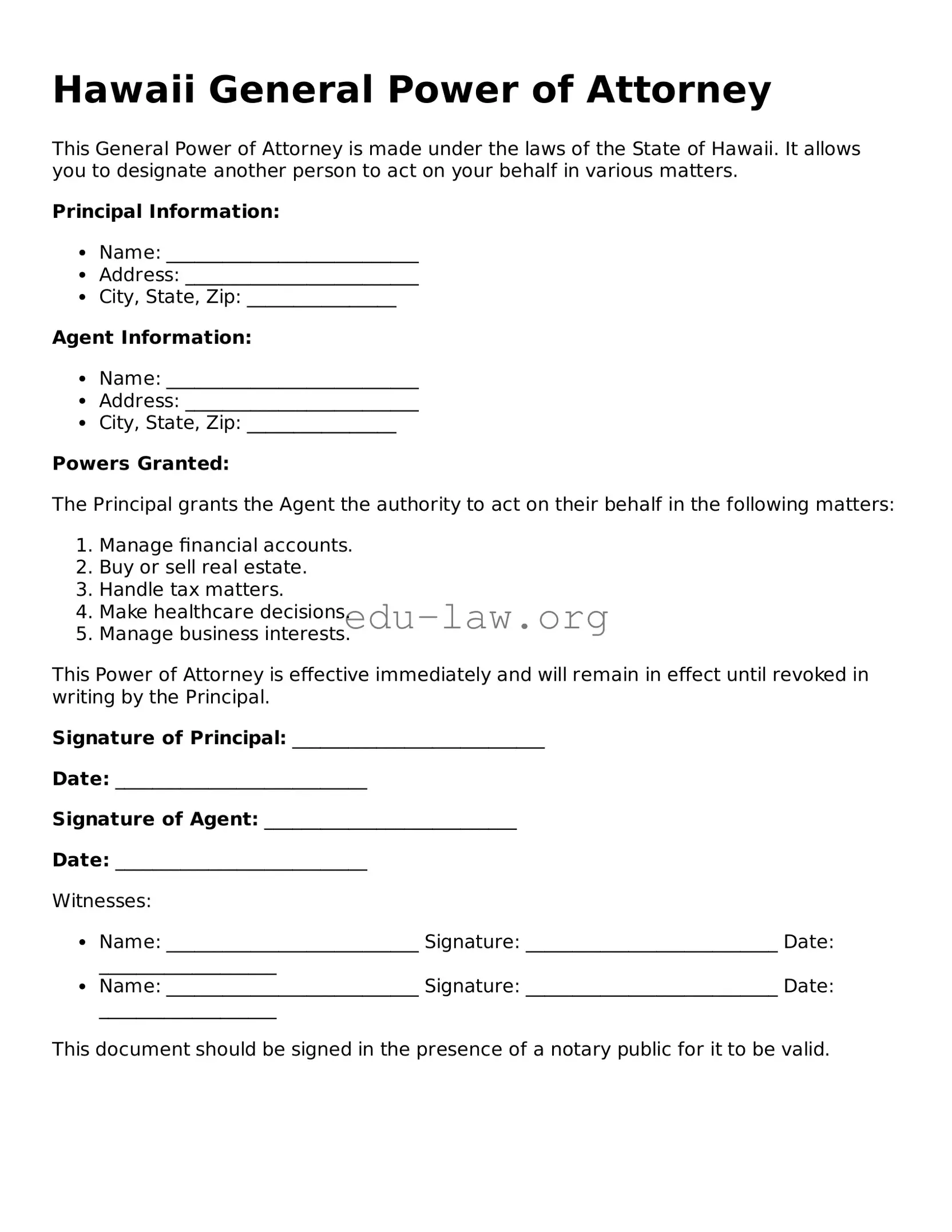
When it comes to managing your affairs in Hawaii, having a General Power of Attorney (GPOA) can be a crucial tool. This legal document allows you to designate someone you trust to act on your behalf in a variety of situations, ensuring that your personal, financial, and legal matters are handled according to your wishes, even when you are unable to do so yourself. The GPOA covers a wide range of responsibilities, including managing bank accounts, signing documents, and making decisions related to your healthcare. It's essential to choose an agent who understands your values and can make decisions that align with your preferences. In Hawaii, the GPOA must meet specific requirements to be valid, such as being signed in the presence of a notary public. Understanding these aspects is vital to ensure that your power of attorney is effective and enforceable, providing peace of mind that your affairs will be managed appropriately when needed.
Hawaii General Power of Attorney
This General Power of Attorney is made under the laws of the State of Hawaii. It allows you to designate another person to act on your behalf in various matters.
Principal Information:
Agent Information:
Powers Granted:
The Principal grants the Agent the authority to act on their behalf in the following matters:
This Power of Attorney is effective immediately and will remain in effect until revoked in writing by the Principal.
Signature of Principal: ___________________________
Date: ___________________________
Signature of Agent: ___________________________
Date: ___________________________
Witnesses:
This document should be signed in the presence of a notary public for it to be valid.
| Fact Name | Description |
|---|---|
| Definition | A Hawaii General Power of Attorney form allows an individual (the principal) to grant another person (the agent) the authority to act on their behalf in financial and legal matters. |
| Governing Law | This form is governed by the Hawaii Revised Statutes, specifically Chapter 551E, which outlines the rules and regulations surrounding powers of attorney in the state. |
| Durability | The general power of attorney can be made durable, meaning it remains effective even if the principal becomes incapacitated, unless explicitly stated otherwise. |
| Revocation | The principal can revoke the power of attorney at any time, as long as they are mentally competent to do so. This revocation must be documented in writing. |
| Notarization | In Hawaii, the General Power of Attorney form must be notarized to be legally binding, ensuring that the principal's signature is authentic and voluntary. |
Filling out the Hawaii General Power of Attorney form is straightforward. Once you have completed the form, you will need to ensure that it is signed and notarized. This will make the document legally binding, allowing your designated agent to act on your behalf.
What is a General Power of Attorney in Hawaii?
A General Power of Attorney is a legal document that allows one person, known as the "principal," to appoint another person, referred to as the "agent" or "attorney-in-fact," to act on their behalf. This authority can cover a wide range of financial and legal matters, including managing bank accounts, signing contracts, and making healthcare decisions. In Hawaii, this form is particularly useful for individuals who may be unable to manage their affairs due to absence, illness, or disability.
How do I create a General Power of Attorney in Hawaii?
To create a General Power of Attorney in Hawaii, you must complete a specific form that outlines the powers you wish to grant to your agent. It is essential to clearly define the scope of authority and any limitations. Once the form is filled out, it must be signed by you in the presence of a notary public. This notarization adds an extra layer of authenticity and ensures that the document will be recognized by financial institutions and other entities.
Can I revoke a General Power of Attorney in Hawaii?
Yes, you can revoke a General Power of Attorney at any time, as long as you are mentally competent. To do this, you should create a written revocation document, clearly stating that you are revoking the previous power of attorney. It is advisable to notify your agent and any institutions that may have received the original document. This helps prevent any confusion or misuse of authority.
What happens if I become incapacitated and do not have a General Power of Attorney?
If you become incapacitated and do not have a General Power of Attorney in place, your loved ones may face challenges in managing your affairs. They may need to go through a court process to obtain guardianship or conservatorship, which can be time-consuming and costly. Establishing a General Power of Attorney ahead of time can help ensure that someone you trust can make decisions on your behalf without legal complications.
Are there any limitations to the powers granted in a General Power of Attorney?
Yes, there can be limitations to the powers granted in a General Power of Attorney. You can specify certain actions that your agent is not authorized to take, such as making changes to your will or trust. Additionally, some powers may not be recognized by certain institutions, so it’s important to clarify the extent of authority in the document. Always consider discussing your intentions with a legal professional to ensure that your wishes are accurately reflected.
Not specifying the scope of authority clearly. It is essential to outline what powers the agent will have. Vague language can lead to confusion and potential misuse of authority.
Failing to sign the document in the presence of a notary. A General Power of Attorney in Hawaii requires notarization to be legally valid. Without this step, the document may not hold up in court.
Not including the date of execution. Omitting the date can create issues regarding the validity of the document and the timing of the powers granted.
Choosing an untrustworthy agent. Selecting someone who lacks integrity or competence can lead to serious financial and personal consequences.
Neglecting to review the document regularly. Life circumstances change, and it is important to update the Power of Attorney to reflect current wishes and needs.
Overlooking the need for successor agents. If the primary agent is unable or unwilling to act, having a backup can prevent complications.
Not discussing the decision with the agent beforehand. Open communication ensures that the chosen agent understands their responsibilities and is willing to take on the role.
Ignoring state-specific requirements. Each state, including Hawaii, has unique laws governing Power of Attorney documents. Failing to adhere to these can invalidate the form.
A General Power of Attorney (POA) is an important legal document that allows one person to act on behalf of another in a variety of matters. In Hawaii, individuals often utilize additional forms and documents to ensure their financial and medical affairs are managed effectively. Below are some commonly used documents that accompany the General Power of Attorney.
Understanding these documents can help individuals make informed decisions about their legal and medical affairs. Each serves a specific purpose and can complement the General Power of Attorney to provide comprehensive management of personal and financial matters.
The Hawaii General Power of Attorney form shares similarities with the Durable Power of Attorney. Both documents allow one person to appoint another to manage their financial and legal affairs. The key difference lies in durability; the Durable Power of Attorney remains effective even if the principal becomes incapacitated, while the General Power of Attorney may not. This distinction is crucial for individuals who want their designated agent to have authority in case of unforeseen health issues.
Another document comparable to the Hawaii General Power of Attorney is the Medical Power of Attorney. While the General Power of Attorney primarily deals with financial matters, the Medical Power of Attorney grants authority to make healthcare decisions on behalf of the principal. Both documents require careful consideration of who is appointed as the agent, as this person will have significant control over important decisions.
The Limited Power of Attorney is also similar, as it allows one individual to act on behalf of another. However, this document is restricted to specific tasks or situations, unlike the General Power of Attorney, which typically provides broader authority. This makes the Limited Power of Attorney suitable for situations where the principal only needs help with particular matters, such as selling a property or managing a specific investment.
The Springing Power of Attorney is another related document. This type of power of attorney becomes effective only under certain conditions, usually when the principal becomes incapacitated. Like the General Power of Attorney, it allows an agent to manage affairs, but its activation is contingent upon specific circumstances. This can provide peace of mind for individuals concerned about losing control over their decisions.
A Trust Agreement is also similar in that it allows one person to designate another to manage assets. However, a Trust Agreement is typically more complex and involves transferring ownership of assets into a trust. In contrast, the General Power of Attorney does not transfer ownership but rather grants authority to act on behalf of the principal. Both documents aim to ensure that someone trusted is in control of important decisions.
The Healthcare Proxy is akin to the Medical Power of Attorney, as both documents designate someone to make healthcare decisions. However, a Healthcare Proxy is often more straightforward and specifically focuses on medical decisions, while the Medical Power of Attorney can encompass a broader range of healthcare-related powers. This can include decisions about treatments, medications, and end-of-life care.
Lastly, the Financial Power of Attorney closely resembles the Hawaii General Power of Attorney. Both documents empower an agent to handle financial matters, such as managing bank accounts and paying bills. The main distinction is that the Financial Power of Attorney may be tailored to financial matters only, while the General Power of Attorney typically covers a wider range of legal and financial affairs. This can provide flexibility depending on the principal's needs.
When filling out the Hawaii General Power of Attorney form, it’s important to follow specific guidelines to ensure the document is valid and meets your needs. Here are some key do's and don'ts:
Understanding the Hawaii General Power of Attorney (POA) form is crucial for effective estate planning. However, several misconceptions can lead to confusion. Here are ten common misconceptions:
Being informed about these misconceptions can help you make better decisions regarding your legal documents and ensure your wishes are honored.
Filling out and using the Hawaii General Power of Attorney form can be a straightforward process if you keep the following key points in mind: