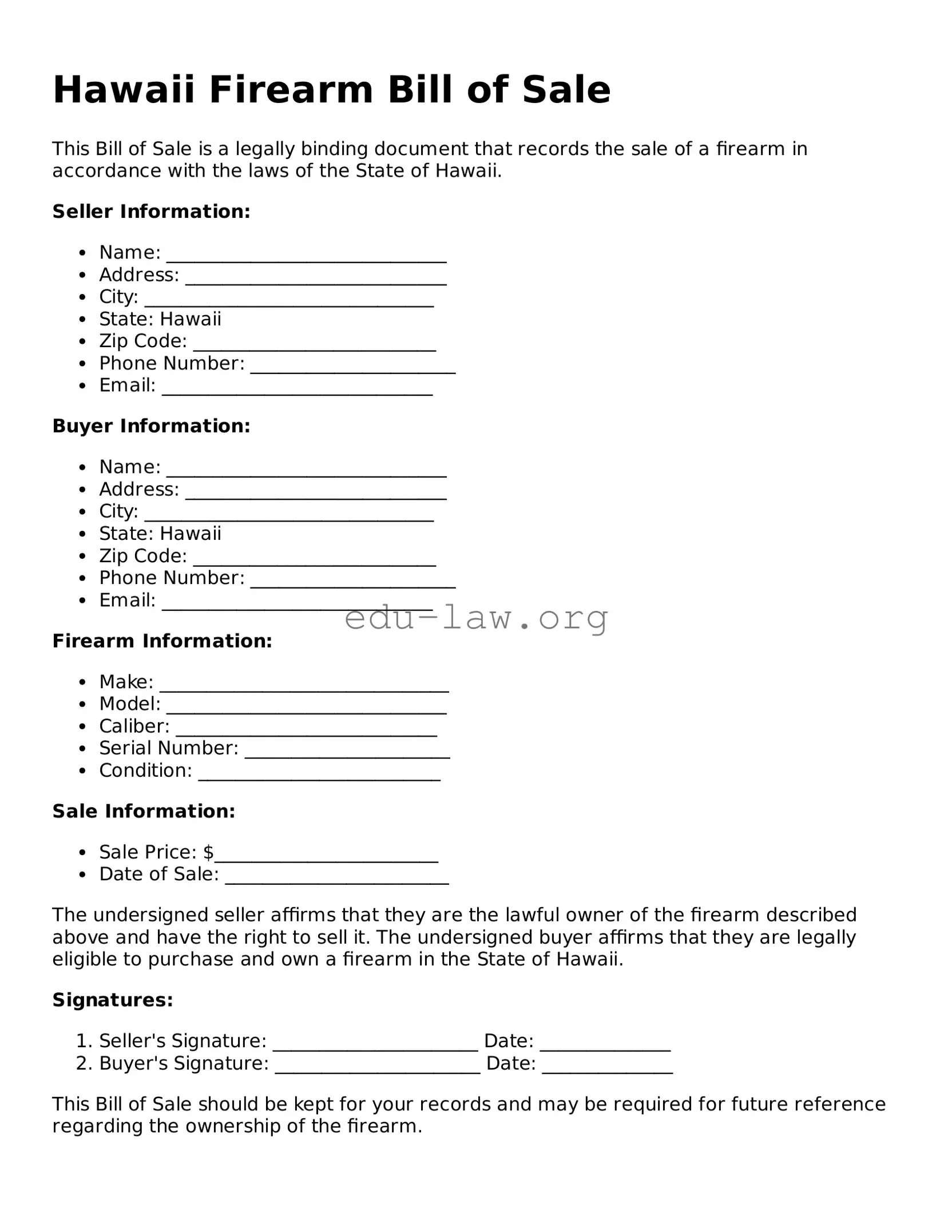
In Hawaii, the Firearm Bill of Sale form serves as a crucial document for anyone involved in the sale or transfer of firearms. This form is designed to provide a clear record of the transaction, ensuring that both the seller and buyer are protected under state laws. It typically includes essential information such as the names and addresses of both parties, details about the firearm being sold—including its make, model, and serial number—and the date of the transaction. Additionally, the form often requires both parties to acknowledge that they are complying with all relevant laws and regulations regarding firearm ownership and transfers. By using this form, individuals can facilitate a smooth and legal exchange, while also maintaining transparency and accountability in the process. Properly completing and retaining a Firearm Bill of Sale can help prevent misunderstandings and provide legal protection should any issues arise in the future.
Hawaii Firearm Bill of Sale
This Bill of Sale is a legally binding document that records the sale of a firearm in accordance with the laws of the State of Hawaii.
Seller Information:
Buyer Information:
Firearm Information:
Sale Information:
The undersigned seller affirms that they are the lawful owner of the firearm described above and have the right to sell it. The undersigned buyer affirms that they are legally eligible to purchase and own a firearm in the State of Hawaii.
Signatures:
This Bill of Sale should be kept for your records and may be required for future reference regarding the ownership of the firearm.
| Fact Name | Description |
|---|---|
| Purpose | The Hawaii Firearm Bill of Sale form is used to document the sale or transfer of firearms between individuals. |
| Governing Law | The transfer of firearms in Hawaii is governed by Hawaii Revised Statutes §134-2. |
| Identification | Both the buyer and seller must provide valid identification to complete the form. |
| Firearm Description | The form requires a detailed description of the firearm, including make, model, and serial number. |
| Signatures | Both parties must sign the form to validate the sale or transfer. |
| Record Keeping | It is recommended that both the buyer and seller keep a copy of the completed Bill of Sale for their records. |
| Legal Age | Both the buyer and seller must be at least 21 years old to legally complete the transaction. |
| Background Check | A background check may be required by law before the transfer of the firearm is completed. |
| Notarization | The form does not require notarization but can be notarized for added legal protection. |
| State-Specific | This Bill of Sale form is specific to the state of Hawaii and may not be valid in other states. |
After obtaining the Hawaii Firearm Bill of Sale form, the next step involves accurately filling it out with the necessary details. Ensure all information is correct before finalizing the document, as this will serve as a record of the transaction.
What is a Hawaii Firearm Bill of Sale form?
The Hawaii Firearm Bill of Sale form is a legal document used to record the sale or transfer of a firearm between two parties in Hawaii. This form serves as proof of the transaction and includes essential details such as the names and addresses of both the seller and buyer, a description of the firearm, and the date of the sale. It is crucial for ensuring compliance with state laws regarding firearm transfers.
Is a Bill of Sale required for all firearm transactions in Hawaii?
Yes, a Bill of Sale is required for all private firearm transactions in Hawaii. This requirement helps to maintain a clear record of ownership and ensures that the transfer is conducted legally. Both the seller and buyer should keep a copy of the completed form for their records, as it may be necessary for future legal or ownership verification.
What information should be included in the Bill of Sale?
The Bill of Sale must include specific information to be valid. Key details include the full names and addresses of both the seller and buyer, the make, model, and serial number of the firearm, the sale price, and the date of the transaction. Additionally, both parties should sign the document to confirm their agreement and acknowledgment of the sale.
Can I use a generic Bill of Sale form for firearm transactions?
While a generic Bill of Sale form may cover basic transaction details, it is advisable to use a specific Hawaii Firearm Bill of Sale form. This ensures compliance with state regulations and includes all necessary information pertinent to firearm sales. Using a dedicated form reduces the risk of missing critical details that could lead to legal complications in the future.
Incomplete Information: One of the most common mistakes is failing to fill out all required fields. Ensure that both the buyer's and seller's names, addresses, and contact information are provided. Missing any of this information can lead to complications later.
Incorrect Firearm Details: It's essential to accurately describe the firearm being sold. This includes the make, model, caliber, and serial number. Inaccuracies can create legal issues and confusion about the transaction.
Not Including Signatures: Both parties must sign the form for it to be valid. Omitting signatures can invalidate the sale. Make sure to double-check that both the buyer and seller have signed before finalizing the transaction.
Failure to Date the Document: Forgetting to include the date of the transaction is another common oversight. The date is important for record-keeping and legal purposes, so always remember to write it down.
Not Keeping Copies: After completing the form, it’s wise to make copies for both the buyer and seller. This ensures that both parties have a record of the transaction, which can be helpful in case of future disputes or questions.
When engaging in the transfer of a firearm in Hawaii, it is essential to ensure that all necessary documentation is in order. The Firearm Bill of Sale form serves as a critical record of the transaction. However, several other forms and documents may be required or beneficial in conjunction with this bill of sale. Below is a list of commonly used forms that can facilitate a smooth transfer process.
In summary, understanding the various forms and documents associated with firearm transactions in Hawaii can help streamline the process and ensure compliance with state laws. Being prepared with the right paperwork is a crucial step in responsible firearm ownership and transfer.
The Hawaii Firearm Bill of Sale form shares similarities with a standard vehicle bill of sale. Both documents serve as proof of a transaction between a buyer and a seller. They typically include essential details such as the names and addresses of both parties, a description of the item being sold, and the sale price. Just as a vehicle bill of sale can be used to register a car with the Department of Motor Vehicles, the firearm bill of sale can be important for legal ownership verification and may be necessary for registration purposes in Hawaii.
Another document akin to the Hawaii Firearm Bill of Sale is a personal property bill of sale. This type of document is used for the sale of various personal items, such as furniture or electronics. Similar to the firearm bill of sale, it outlines the transaction details, including the item description, sale price, and the identities of the buyer and seller. Both documents help protect the interests of both parties and provide a record of the transaction, which can be useful in case of disputes.
The firearm bill of sale also resembles a lease agreement in some respects. While a lease agreement typically pertains to the rental of property, it still requires detailed information about the parties involved, the item (or property) being leased, and the terms of the agreement. Like the firearm bill of sale, a lease agreement establishes a legal relationship and outlines the responsibilities of each party, ensuring clarity and reducing the potential for misunderstandings.
A gift letter can be compared to the Hawaii Firearm Bill of Sale in that both documents formalize the transfer of ownership. A gift letter is often used when someone gives a significant item, such as a car or a piece of art, to another person without a monetary exchange. While the firearm bill of sale involves a sale, both documents serve to clarify the intent behind the transfer and provide a record that can be referenced in the future.
The warranty deed is another document that shares similarities with the firearm bill of sale. A warranty deed is used to transfer ownership of real estate and guarantees that the seller holds clear title to the property. Both documents include the names of the parties involved, a description of the item being transferred, and signatures to validate the transaction. Each serves to protect the rights of the new owner and provides a legal record of the transfer.
In addition, the power of attorney can be likened to the firearm bill of sale. A power of attorney grants one person the authority to act on behalf of another in legal matters, including the sale of property. Both documents require clear identification of the parties involved and the specifics of the transaction. While the firearm bill of sale focuses on the transfer of ownership, the power of attorney can facilitate such transactions by allowing designated individuals to manage the sale process.
The invoice is another document that has similarities with the Hawaii Firearm Bill of Sale. An invoice details a transaction, including the goods or services provided, the price, and payment terms. Like the firearm bill of sale, it serves as a record of the transaction and includes identifying information for both the buyer and seller. Both documents are essential for keeping accurate records and can be used for accounting purposes.
Lastly, the purchase agreement is similar to the firearm bill of sale in that it outlines the terms of a sale. A purchase agreement is often used in real estate or large transactions, detailing the responsibilities of both parties, the sale price, and any contingencies. While the firearm bill of sale is more straightforward, both documents aim to ensure that all parties understand the terms of the transaction and provide a framework for legal ownership transfer.
When filling out the Hawaii Firearm Bill of Sale form, it's important to follow specific guidelines. Here are ten things to keep in mind:
Many people have misunderstandings about the Hawaii Firearm Bill of Sale form. Here are four common misconceptions:
Understanding these misconceptions can help ensure that firearm transactions in Hawaii are conducted properly and legally.
When dealing with the Hawaii Firearm Bill of Sale form, it's essential to understand its significance and the proper way to fill it out. Here are some key takeaways to keep in mind:
By following these guidelines, you can ensure a smooth and compliant transaction when using the Hawaii Firearm Bill of Sale form.