In Hawaii, the Durable Power of Attorney (DPOA) form serves as a crucial legal document that empowers individuals to designate a trusted person, known as an agent, to make decisions on their behalf when they are unable to do so. This form is particularly significant because it remains effective even if the principal becomes incapacitated. The DPOA can cover a wide range of decisions, including financial matters, healthcare choices, and property management. By clearly outlining the scope of authority granted to the agent, the form helps ensure that the principal's wishes are honored during times of vulnerability. Additionally, it is essential for individuals to understand the importance of selecting a reliable agent, as this person will have significant control over critical aspects of their life. Completing the DPOA form requires careful consideration and should be done in accordance with Hawaii state laws to ensure its validity and effectiveness. Proper execution of the document can provide peace of mind, knowing that one's affairs will be managed according to their preferences in the event of unforeseen circumstances.
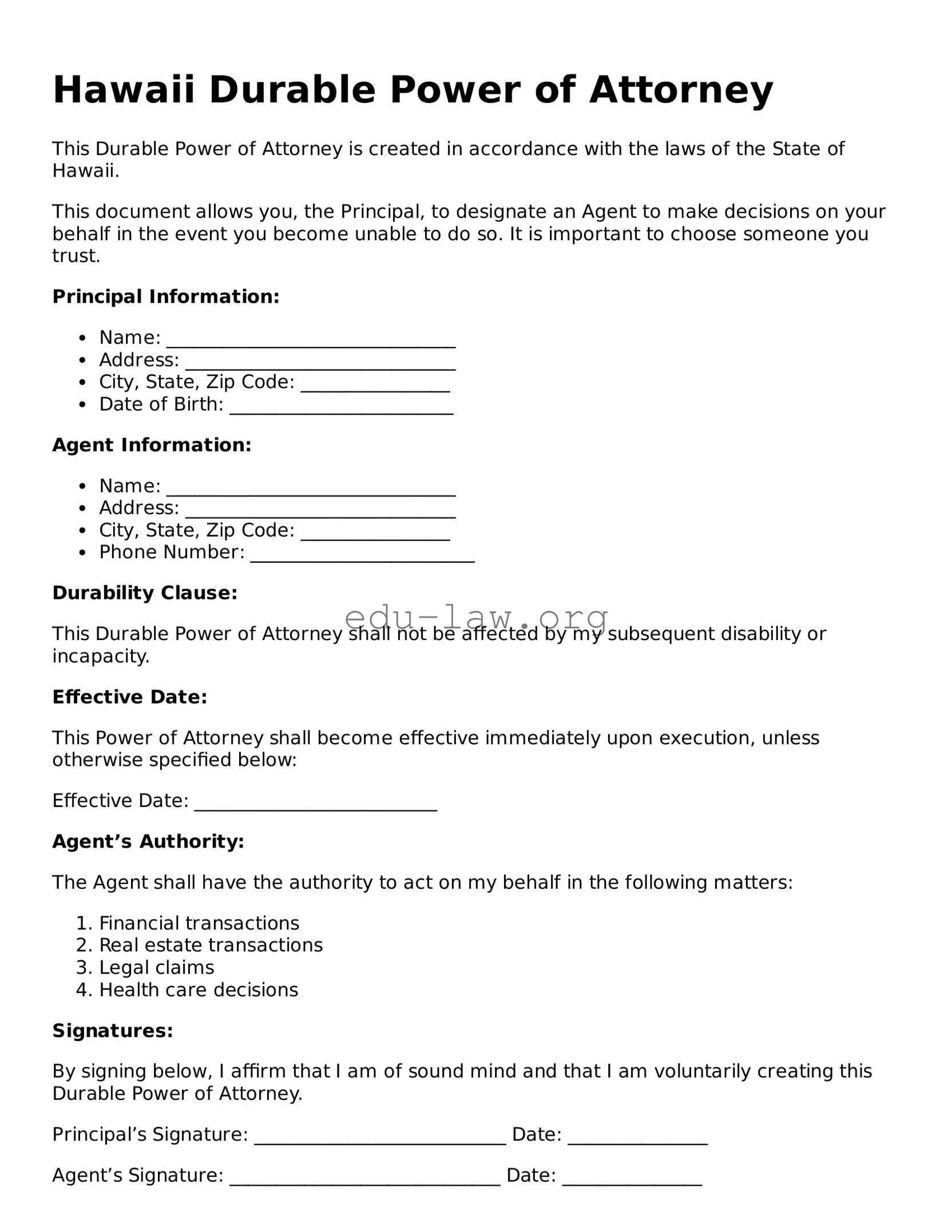
Hawaii Durable Power of Attorney
This Durable Power of Attorney is created in accordance with the laws of the State of Hawaii.
This document allows you, the Principal, to designate an Agent to make decisions on your behalf in the event you become unable to do so. It is important to choose someone you trust.
Principal Information:
Agent Information:
Durability Clause:
This Durable Power of Attorney shall not be affected by my subsequent disability or incapacity.
Effective Date:
This Power of Attorney shall become effective immediately upon execution, unless otherwise specified below:
Effective Date: __________________________
Agent’s Authority:
The Agent shall have the authority to act on my behalf in the following matters:
Signatures:
By signing below, I affirm that I am of sound mind and that I am voluntarily creating this Durable Power of Attorney.
Principal’s Signature: ___________________________ Date: _______________
Agent’s Signature: _____________________________ Date: _______________
Witnesses:
Witness 1: _______________________________ Signature: _______________________ Date: _______________
Witness 2: _______________________________ Signature: _______________________ Date: _______________
This document must be notarized to be legally binding.
| Fact Name | Description |
|---|---|
| Purpose | The Hawaii Durable Power of Attorney form allows an individual to designate someone else to make financial and legal decisions on their behalf, even if they become incapacitated. |
| Governing Law | This form is governed by the Hawaii Revised Statutes, specifically Chapter 551E, which outlines the provisions for durable powers of attorney. |
| Durability | The term "durable" means that the authority granted remains effective even if the principal becomes mentally incapacitated. |
| Agent Responsibilities | The appointed agent must act in the best interest of the principal and manage their affairs according to the principal's wishes. |
| Signing Requirements | The form must be signed by the principal in the presence of a notary public or two witnesses to be considered valid. |
| Revocation | The principal can revoke the durable power of attorney at any time, as long as they are mentally competent to do so. |
Filling out the Hawaii Durable Power of Attorney form is an important step in designating someone to manage your financial and legal affairs if you become unable to do so yourself. This process requires careful attention to detail to ensure that your wishes are accurately reflected.
After completing these steps, ensure that you keep the original document in a safe place while also making it accessible to your agent. Open communication with your agent about your wishes will help facilitate the process when the time comes.
What is a Durable Power of Attorney in Hawaii?
A Durable Power of Attorney (DPOA) in Hawaii is a legal document that allows an individual, known as the principal, to appoint another person, called the agent, to make decisions on their behalf. This authority remains effective even if the principal becomes incapacitated. It is crucial for ensuring that someone you trust can manage your financial and legal matters when you are unable to do so yourself.
What decisions can an agent make under a Durable Power of Attorney?
The agent can make a wide range of decisions, including managing bank accounts, handling investments, paying bills, and making real estate transactions. The specific powers granted can be customized in the document, allowing the principal to specify which areas the agent can manage. It is important for the principal to clearly outline the scope of authority to avoid any confusion later on.
How do I create a Durable Power of Attorney in Hawaii?
To create a Durable Power of Attorney in Hawaii, the principal must complete a DPOA form, which can be obtained from various legal resources or online platforms. The form must be signed by the principal and witnessed by two individuals or notarized. It is advisable to consult with a legal professional to ensure that the document meets all legal requirements and accurately reflects the principal's wishes.
Can I revoke a Durable Power of Attorney in Hawaii?
Yes, a principal can revoke a Durable Power of Attorney at any time as long as they are mentally competent. This can be done by creating a written revocation document and notifying the agent and any relevant institutions. It is important to ensure that all parties are aware of the revocation to prevent any misunderstandings.
What happens if I do not have a Durable Power of Attorney?
If a person becomes incapacitated without a Durable Power of Attorney in place, their family may need to go through a court process to appoint a guardian or conservator. This can be time-consuming and costly, and it may not result in the appointment of someone the individual would have chosen. Having a DPOA in place can prevent this situation and provide peace of mind.
Is a Durable Power of Attorney valid in other states?
A Durable Power of Attorney created in Hawaii is generally recognized in other states, but each state has its own laws regarding DPOAs. It is advisable to check the specific requirements of the state where the DPOA will be used. If you are planning to move or spend significant time in another state, consider consulting with a legal professional in that state to ensure compliance.
Can I appoint multiple agents in my Durable Power of Attorney?
Yes, a principal can appoint multiple agents in their Durable Power of Attorney. However, it is important to specify whether the agents will act jointly or independently. Joint agents must make decisions together, while independent agents can act separately. Clear instructions in the DPOA can help avoid conflicts and ensure smooth decision-making.
How does a Durable Power of Attorney differ from a regular Power of Attorney?
The main difference between a Durable Power of Attorney and a regular Power of Attorney is the durability aspect. A regular Power of Attorney becomes invalid if the principal becomes incapacitated, while a Durable Power of Attorney remains effective in such circumstances. This feature makes the DPOA a crucial tool for long-term planning.
What should I consider when choosing an agent for my Durable Power of Attorney?
When selecting an agent for your Durable Power of Attorney, consider their trustworthiness, financial acumen, and willingness to take on the responsibility. It is essential to choose someone who understands your values and wishes. Open communication about your expectations and preferences can help ensure that your agent acts in your best interest.
Not Choosing the Right Agent: Many people fail to carefully consider who they want to appoint as their agent. This person will have significant authority to make decisions on your behalf, so it’s crucial to select someone trustworthy and capable.
Leaving Sections Blank: It's common for individuals to overlook certain sections of the form. Leaving any part of the document incomplete can lead to confusion or legal challenges later on.
Failing to Specify Powers: Some people do not clearly outline the powers they wish to grant their agent. Without specific instructions, the agent may not have the authority to act in certain situations, which can create complications.
Not Signing or Dating the Document: A common mistake is neglecting to sign or date the form. Without your signature and the date, the document may not be considered valid, rendering it useless when needed.
Ignoring Witness and Notary Requirements: Hawaii requires that the Durable Power of Attorney be witnessed and notarized. Skipping this step can invalidate the document, so it’s essential to follow these legal requirements.
Not Reviewing the Document Regularly: Life circumstances change, and so do your needs. Failing to review and update your Durable Power of Attorney can lead to outdated information or decisions that no longer reflect your wishes.
When preparing a Hawaii Durable Power of Attorney, it's essential to consider other related documents that can complement this important legal tool. Each of these documents serves a unique purpose and can provide additional clarity and protection for your wishes. Below is a list of commonly used forms that often accompany a Durable Power of Attorney.
By understanding these related documents, individuals can create a comprehensive plan that addresses both health care and financial decisions. Taking the time to prepare these forms ensures that your wishes are respected and that your loved ones are equipped to make informed choices on your behalf.
The Hawaii Durable Power of Attorney form is similar to a General Power of Attorney. Both documents allow one person to appoint another to act on their behalf in various matters. However, the key difference lies in durability. While a General Power of Attorney may become invalid if the principal becomes incapacitated, a Durable Power of Attorney remains effective even in such situations. This ensures that the appointed agent can continue to manage the principal's affairs without interruption.
Another document comparable to the Durable Power of Attorney is the Healthcare Power of Attorney. This form specifically designates an individual to make medical decisions for someone who is unable to do so themselves. Like the Durable Power of Attorney, it grants authority to act on behalf of another person. The focus, however, is on healthcare decisions rather than financial or legal matters. Both documents empower agents to act in the best interests of the principal, but their scopes differ significantly.
The Living Will is also similar to the Durable Power of Attorney, though it serves a different purpose. A Living Will outlines an individual's wishes regarding medical treatment in situations where they cannot communicate their preferences. While the Durable Power of Attorney allows someone to make decisions on behalf of the principal, the Living Will provides guidance on what those decisions should be. Both documents are essential for ensuring that a person’s desires are respected during critical times.
Lastly, the Revocable Trust shares similarities with the Durable Power of Attorney in that both can help manage assets and provide for the principal’s wishes. A Revocable Trust allows individuals to place their assets into a trust, which can be managed by a trustee during their lifetime and distributed according to their wishes after death. While the Durable Power of Attorney grants authority to an agent to manage affairs, a Revocable Trust provides a structured way to handle assets, ensuring that the principal’s intentions are followed both during their life and after their passing.
When filling out the Hawaii Durable Power of Attorney form, it is important to approach the process with care and attention to detail. Here are four key do's and don'ts to keep in mind:
By following these guidelines, you can ensure that your Durable Power of Attorney form is completed correctly and serves your intentions effectively.
Understanding the Hawaii Durable Power of Attorney form is essential for anyone considering this important legal document. However, several misconceptions can lead to confusion. Here are ten common misconceptions explained:
This is not true. While many people associate this document with aging, anyone can benefit from a Durable Power of Attorney, especially if they want to ensure their affairs are managed in case of illness or incapacity.
Actually, a Durable Power of Attorney can be set up to take effect immediately or at a future date, depending on the principal’s wishes.
This is a misconception. The principal can specify which powers are granted, such as financial decisions or health care choices, and can limit the scope as desired.
In reality, a Durable Power of Attorney can be revoked at any time by the principal, as long as they are mentally competent to do so.
While it is advisable to consult a lawyer, individuals can create their own Durable Power of Attorney using templates, provided they meet state requirements.
This is incorrect. A Durable Power of Attorney remains effective even if the principal becomes incapacitated, while a regular Power of Attorney does not.
This is a common misunderstanding. Health care decisions must be specifically included in the Durable Power of Attorney or addressed in a separate health care directive.
This is false. Each state, including Hawaii, has its own laws and requirements governing Durable Power of Attorney documents.
This is not accurate. The principal can change their agent at any time, as long as they are mentally competent to do so.
This misconception overlooks that it can also cover health care decisions, property management, and other personal matters, depending on how it is drafted.
Being aware of these misconceptions can help individuals make informed decisions about their legal and financial planning in Hawaii.
When filling out and using the Hawaii Durable Power of Attorney form, several important considerations can guide individuals through the process. Here are key takeaways to keep in mind:
By following these guidelines, individuals can ensure that their Durable Power of Attorney serves its intended purpose effectively.