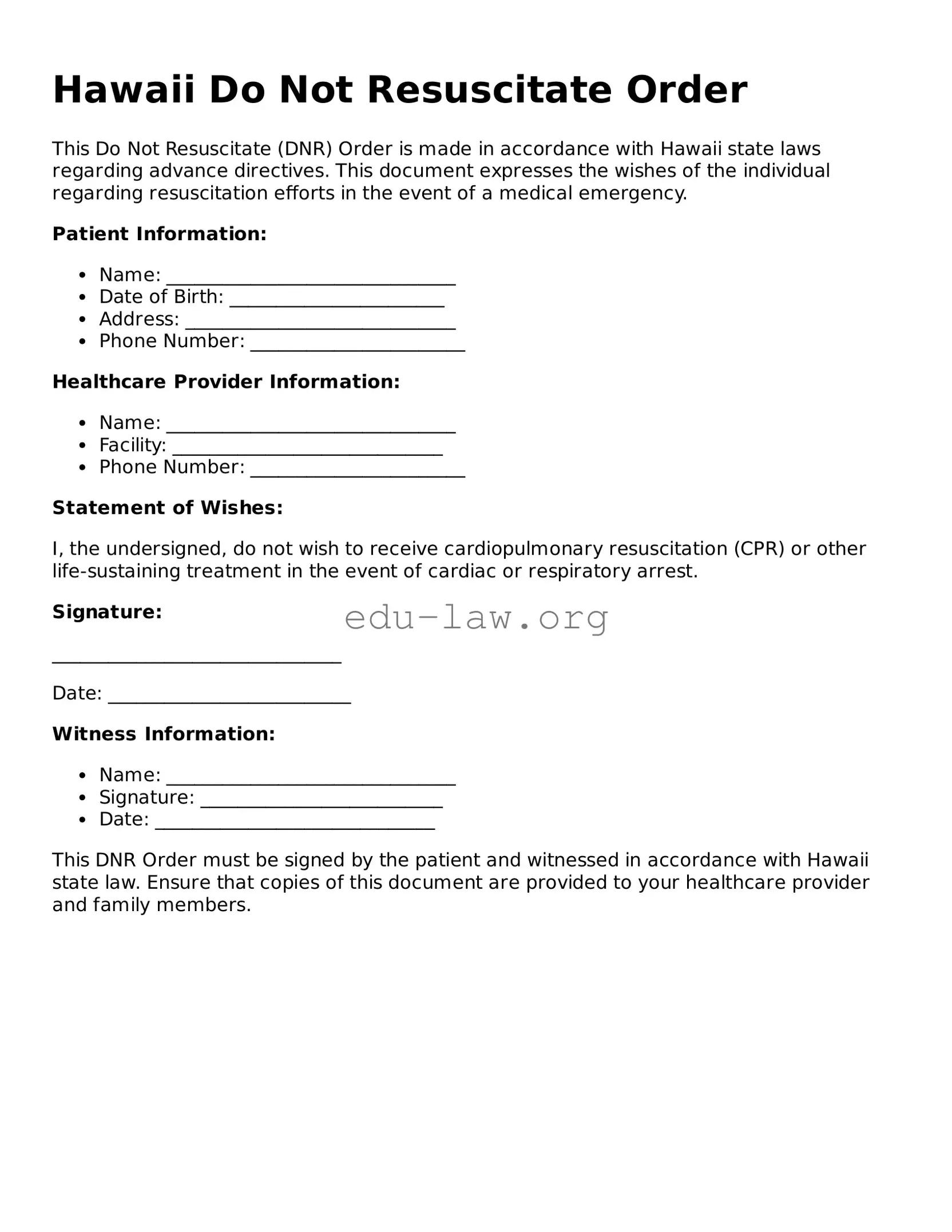
In Hawaii, the Do Not Resuscitate (DNR) Order form plays a crucial role in end-of-life decision-making, allowing individuals to express their wishes regarding resuscitation efforts in the event of a medical emergency. This form is designed for patients who wish to forgo cardiopulmonary resuscitation (CPR) and other life-saving measures if their heart stops beating or if they stop breathing. It is important to note that the DNR Order is a legally binding document, which must be signed by both the patient and a physician to be valid. The form includes essential information such as the patient's name, date of birth, and the signature of the attending physician, ensuring that healthcare providers are aware of the patient's preferences. Additionally, it emphasizes the importance of discussing these wishes with family members and healthcare providers, fostering clear communication about the patient's desires. Understanding the DNR Order form can help individuals make informed choices about their healthcare and ensure their wishes are respected during critical moments.
Hawaii Do Not Resuscitate Order
This Do Not Resuscitate (DNR) Order is made in accordance with Hawaii state laws regarding advance directives. This document expresses the wishes of the individual regarding resuscitation efforts in the event of a medical emergency.
Patient Information:
Healthcare Provider Information:
Statement of Wishes:
I, the undersigned, do not wish to receive cardiopulmonary resuscitation (CPR) or other life-sustaining treatment in the event of cardiac or respiratory arrest.
Signature:
_______________________________
Date: __________________________
Witness Information:
This DNR Order must be signed by the patient and witnessed in accordance with Hawaii state law. Ensure that copies of this document are provided to your healthcare provider and family members.
| Fact Name | Description |
|---|---|
| Purpose | The Hawaii Do Not Resuscitate Order (DNR) form allows individuals to express their wishes regarding resuscitation efforts in case of cardiac or respiratory arrest. |
| Eligibility | This form is intended for adults who have a serious illness or are nearing the end of life and wish to avoid aggressive resuscitation measures. |
| Governing Law | The DNR order in Hawaii is governed by Hawaii Revised Statutes §327-1 to §327-4, which outline the legal framework for advance directives. |
| Signature Requirement | The form must be signed by the individual or their legal representative, as well as by a physician to be valid. |
| Revocation | Individuals can revoke their DNR order at any time, and this can be done verbally or in writing. |
| Distribution | Once completed, copies of the DNR order should be provided to healthcare providers, family members, and kept in a readily accessible location. |
Filling out the Hawaii Do Not Resuscitate Order form is an important step in ensuring that your healthcare preferences are honored. This document allows you to communicate your wishes regarding resuscitation in the event of a medical emergency. Once completed, it is advisable to share copies with your healthcare provider and loved ones to ensure everyone is informed of your decisions.
What is a Do Not Resuscitate (DNR) Order in Hawaii?
A Do Not Resuscitate Order is a legal document that allows individuals to refuse certain life-saving medical interventions, specifically cardiopulmonary resuscitation (CPR), in the event of cardiac arrest or respiratory failure. In Hawaii, this order is designed to ensure that medical personnel respect the wishes of patients regarding their end-of-life care. It is important to note that a DNR does not mean that all medical treatment will be withheld; it simply indicates a preference against resuscitation efforts in critical situations.
Who can request a DNR Order in Hawaii?
In Hawaii, a DNR Order can be requested by a patient who is at least 18 years old and has the capacity to make informed decisions about their healthcare. If the patient is unable to make such decisions, a legal representative, such as a healthcare proxy or family member, may be able to initiate the process. It is essential that the request reflects the patient’s wishes and values regarding end-of-life care.
How do I obtain a DNR Order form in Hawaii?
The DNR Order form can be obtained through various healthcare providers, including hospitals, physicians, and hospice organizations. Additionally, the form is available online through the Hawaii Department of Health’s website. It is advisable to consult with a healthcare professional when filling out the form to ensure that all necessary information is accurately provided and that the patient’s wishes are clearly articulated.
What information is required on the DNR Order form?
The DNR Order form typically requires the patient’s name, date of birth, and a clear statement of their wishes regarding resuscitation. It must also include the signatures of the patient (or their legal representative) and the attending physician. The physician’s signature is crucial, as it validates the order and confirms that the patient has been informed about the implications of the DNR decision.
Is a DNR Order valid in all healthcare settings in Hawaii?
Yes, a properly completed DNR Order is generally recognized across various healthcare settings in Hawaii, including hospitals, nursing homes, and emergency medical services. However, it is advisable for patients to communicate their wishes to family members and healthcare providers to avoid any confusion. Carrying a copy of the DNR Order at all times can also help ensure that medical personnel are aware of the patient’s preferences in emergencies.
Can a DNR Order be revoked or changed?
Absolutely. A DNR Order can be revoked or modified at any time by the patient, as long as they are capable of making decisions. This can be done verbally or in writing. If the patient decides to revoke the order, it is important to inform all relevant healthcare providers and ensure that any copies of the DNR Order are destroyed or marked as revoked. Open communication with family members and medical staff is vital to ensure that everyone is aware of the current wishes regarding resuscitation.
Failing to understand the purpose of the Do Not Resuscitate (DNR) Order. Many individuals do not grasp that this document specifically indicates a person's wish to forgo resuscitation in the event of cardiac arrest or respiratory failure.
Not discussing the DNR Order with family or healthcare providers. Open communication is essential. Without discussions, loved ones may not be aware of a person’s wishes, leading to confusion and potential conflict.
Not signing the form. A DNR Order is only valid if it is signed by the patient or their legal representative. Omitting this crucial step renders the document ineffective.
Neglecting to date the form. A DNR Order should include the date it was signed to ensure it reflects the most current wishes of the individual.
Using outdated forms. Regulations can change, and it is vital to use the most current version of the DNR Order form to ensure compliance with state laws.
Failing to provide copies to relevant parties. Once the form is completed, copies should be distributed to healthcare providers, family members, and kept in accessible locations.
Not reviewing the DNR Order regularly. Life circumstances and medical conditions change. Regular reviews ensure that the DNR Order still reflects the individual's wishes.
Overlooking the need for witnesses or notarization. Depending on state requirements, some DNR Orders may need to be witnessed or notarized to be valid.
Misunderstanding the implications of a DNR Order. Some individuals mistakenly believe that a DNR means no medical care will be provided, which is not the case. Comfort care and other treatments can still be administered.
Ignoring state-specific requirements. Each state, including Hawaii, may have unique regulations regarding DNR Orders. Failing to adhere to these can invalidate the document.
When considering a Hawaii Do Not Resuscitate Order (DNR), there are several other important documents that can help clarify your healthcare wishes. These documents work together to ensure that your preferences are respected in medical situations. Here are some commonly used forms:
These documents can provide clarity and peace of mind for both you and your loved ones. It’s important to discuss your preferences with family members and healthcare providers to ensure everyone understands your wishes.
The Advance Healthcare Directive is a legal document that allows individuals to outline their preferences for medical treatment in case they become unable to communicate their wishes. Like the Hawaii Do Not Resuscitate Order (DNR), this directive empowers patients to make decisions about their care, including the choice to refuse life-sustaining treatments. Both documents emphasize the importance of patient autonomy and ensure that healthcare providers respect the individual's wishes regarding end-of-life care.
The Physician Orders for Life-Sustaining Treatment (POLST) form is another document similar to the Hawaii DNR. It provides specific medical orders regarding a patient’s preferences for life-sustaining treatments. While the DNR specifically addresses resuscitation efforts, the POLST encompasses a broader range of medical interventions, including artificial nutrition and hydration. Both documents are designed to communicate the patient’s wishes clearly to healthcare providers, ensuring that those preferences are honored in emergency situations.
The Medical Power of Attorney (MPOA) is a legal document that designates a person to make healthcare decisions on behalf of another individual if they are unable to do so. Similar to the Hawaii DNR, the MPOA can include instructions regarding resuscitation and other medical interventions. This document ensures that a trusted individual can advocate for the patient’s wishes, providing clarity in critical situations where the patient's preferences may not be immediately known.
Do Not Intubate (DNI) orders are closely related to DNR orders but focus specifically on the decision to avoid intubation and mechanical ventilation. While a DNR order prohibits resuscitation efforts, a DNI order explicitly states that a patient should not be placed on a ventilator. Both documents reflect a patient’s desire to avoid invasive procedures, highlighting the importance of respecting individual choices regarding life support measures.
The Comfort Care Order is a directive that emphasizes providing comfort and palliative care rather than curative treatments. Similar to the Hawaii DNR, this order prioritizes the quality of life for patients facing terminal conditions. Both documents aim to minimize suffering and ensure that patients receive compassionate care that aligns with their end-of-life preferences.
The Do Not Hospitalize (DNH) order is a directive that instructs healthcare providers not to admit a patient to a hospital under certain circumstances. Like the Hawaii DNR, the DNH order is designed to honor the patient’s wishes regarding their care and treatment. Both documents reflect a commitment to patient-centered care, ensuring that individuals receive treatment in a manner consistent with their preferences, especially in end-of-life scenarios.
Healthcare Provider Orders for Life-Sustaining Treatment (HCPOLST) is a variant of the POLST form that may be used in some states. It serves a similar purpose to the Hawaii DNR by providing clear medical orders based on the patient’s wishes. Both documents facilitate communication between patients, families, and healthcare providers, ensuring that the patient’s preferences regarding life-sustaining treatments are documented and respected.
The End-of-Life Care Plan is a comprehensive document that outlines a patient's preferences for all aspects of their care as they approach the end of life. This plan can include directives similar to those found in the Hawaii DNR, such as preferences for resuscitation and other life-sustaining treatments. Both the End-of-Life Care Plan and the DNR emphasize the importance of individualized care and respect for the patient’s wishes during a critical time.
When filling out the Hawaii Do Not Resuscitate (DNR) Order form, it's essential to approach the process with care and consideration. Here’s a helpful list of things you should and shouldn’t do:
Here are nine common misconceptions about the Hawaii Do Not Resuscitate (DNR) Order form:
This is incorrect. A DNR specifically addresses resuscitation efforts, not all medical treatment. Patients can still receive other forms of care and comfort measures.
A DNR can be appropriate for anyone who wishes to avoid resuscitation, regardless of their health status. It’s a personal choice based on individual values.
A DNR order is valid in any setting, including at home or in long-term care facilities, as long as it is properly documented and recognized by medical personnel.
This is false. Individuals can revoke or modify their DNR orders at any time, as long as they communicate their wishes clearly to their healthcare providers.
DNR orders can vary by state and facility. It’s essential to understand the specific requirements and implications of the DNR form in Hawaii.
A DNR does not hasten death. It simply means that if a person’s heart stops or they stop breathing, resuscitation efforts will not be initiated.
Once a DNR is in place, it reflects the wishes of the individual. Family members cannot override it unless they have legal authority, such as a healthcare proxy.
Many people view a DNR as a way to maintain dignity and control over their end-of-life decisions. It is a personal choice that reflects individual values and beliefs.
When considering a Do Not Resuscitate (DNR) Order in Hawaii, it's important to understand the key points to ensure your wishes are respected. Here are some essential takeaways:
Being informed about the DNR process can help you make decisions that align with your values and preferences. Take the time to understand your options and communicate them clearly.