In the process of navigating a divorce in Hawaii, the Divorce Settlement Agreement form plays a crucial role in formalizing the terms of the separation between spouses. This document outlines the agreements reached regarding key issues such as the division of marital property, child custody arrangements, and spousal support. It serves as a comprehensive record of the decisions made by both parties, ensuring clarity and mutual understanding. The form also addresses financial responsibilities, including child support obligations, which are vital for the well-being of any children involved. By detailing these aspects, the Divorce Settlement Agreement helps to minimize future disputes and provides a framework for both individuals to move forward. Completing this form accurately is essential, as it will be submitted to the court for approval, thereby making the agreements legally binding.
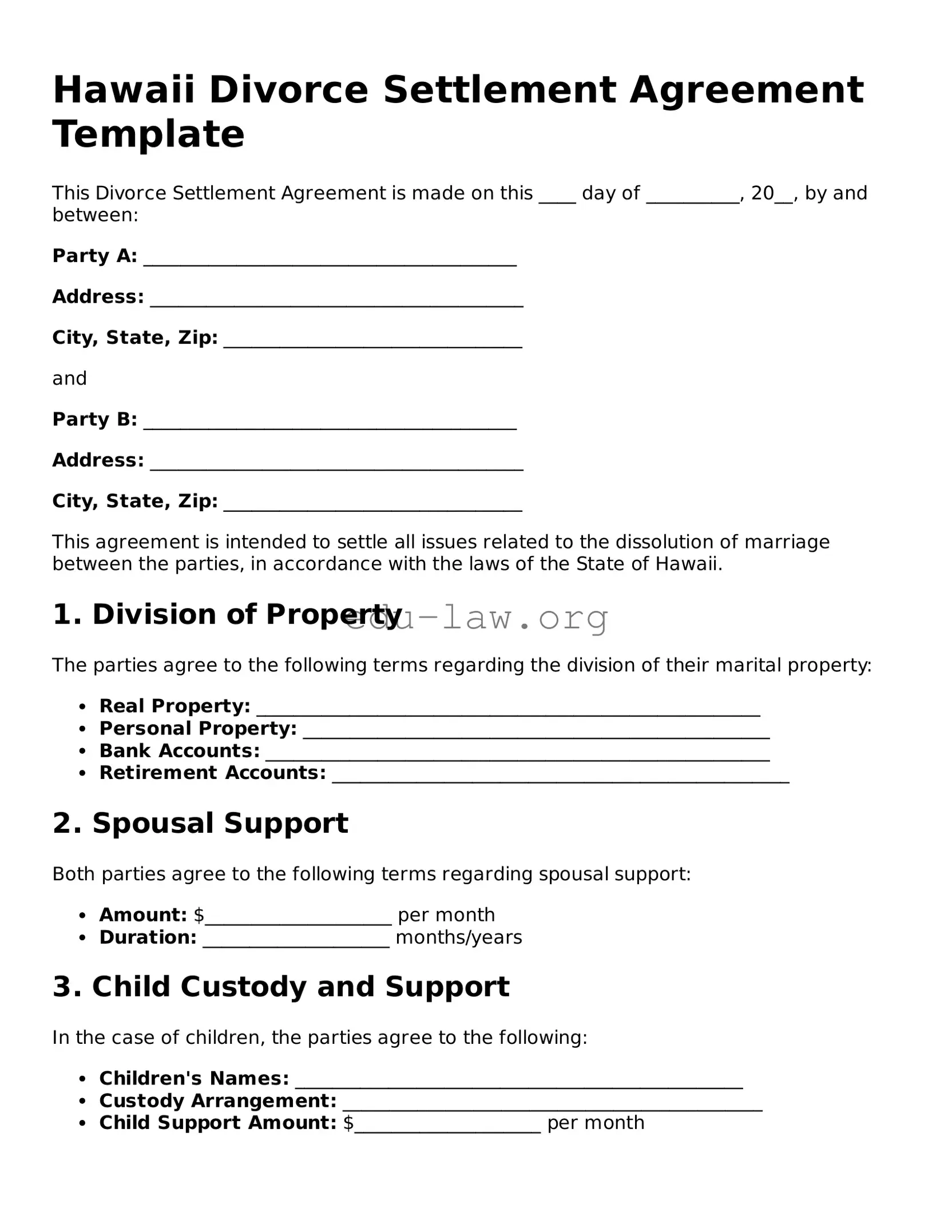
Hawaii Divorce Settlement Agreement Template
This Divorce Settlement Agreement is made on this ____ day of __________, 20__, by and between:
Party A: ________________________________________
Address: ________________________________________
City, State, Zip: ________________________________
and
Party B: ________________________________________
Address: ________________________________________
City, State, Zip: ________________________________
This agreement is intended to settle all issues related to the dissolution of marriage between the parties, in accordance with the laws of the State of Hawaii.
1. Division of Property
The parties agree to the following terms regarding the division of their marital property:
2. Spousal Support
Both parties agree to the following terms regarding spousal support:
3. Child Custody and Support
In the case of children, the parties agree to the following:
4. Health Insurance
The parties agree on the following terms regarding health insurance:
5. Miscellaneous
Additional agreements between the parties include:
This Divorce Settlement Agreement is intended to be a complete and final resolution of all issues arising from the marriage. Both parties acknowledge that they have read and understood this agreement, and they enter into it voluntarily.
IN WITNESS WHEREOF, the parties hereto have executed this Divorce Settlement Agreement as of the day and year first above written.
Party A Signature: _______________________________
Date: _______________________________
Party B Signature: _______________________________
Date: _______________________________
| Fact Name | Description |
|---|---|
| Governing Law | The Hawaii Divorce Settlement Agreement is governed by Hawaii Revised Statutes, specifically Chapter 580, which outlines the laws regarding divorce and family law in the state. |
| Purpose | This form is used to outline the terms of a divorce settlement, including the division of property, child custody arrangements, and spousal support obligations. |
| Mutual Agreement | Both parties must agree to the terms outlined in the settlement agreement for it to be valid and enforceable in court. |
| Filing Requirement | After both parties sign the agreement, it must be filed with the family court as part of the divorce proceedings. |
| Modification | Once the agreement is finalized and approved by the court, it can only be modified under certain circumstances, typically requiring a showing of changed circumstances. |
| Legal Representation | While it is not mandatory, having legal representation is highly recommended to ensure that both parties fully understand their rights and obligations under the agreement. |
After obtaining the Hawaii Divorce Settlement Agreement form, you are ready to begin the process of filling it out. Completing this form accurately is essential for a smooth divorce process. Follow these steps to ensure you provide all necessary information.
Once you have filled out the form, you will need to submit it to the court as part of your divorce proceedings. Be prepared for any follow-up actions that may arise during the legal process.
What is a Hawaii Divorce Settlement Agreement?
A Hawaii Divorce Settlement Agreement is a legal document that outlines the terms agreed upon by both parties during a divorce. This agreement typically addresses issues such as property division, child custody, child support, and spousal support. It serves to formalize the decisions made by both spouses, ensuring that each party understands their rights and responsibilities following the divorce.
How do I complete the Hawaii Divorce Settlement Agreement form?
To complete the form, both parties should discuss and agree on the terms of the divorce. It is important to include all relevant details regarding asset division, debts, and any arrangements for children. Once both parties have reached an agreement, they can fill out the form, ensuring that all sections are completed accurately. After filling out the form, both parties must sign it in front of a notary public to make it legally binding.
Is a lawyer required to complete the Divorce Settlement Agreement?
While it is not legally required to have a lawyer to complete a Divorce Settlement Agreement in Hawaii, it is highly recommended. A lawyer can provide guidance on legal rights and obligations, ensuring that the agreement is fair and compliant with state laws. If both parties feel comfortable negotiating the terms, they may choose to proceed without legal representation.
What happens if one party does not comply with the agreement?
If one party fails to comply with the terms of the Divorce Settlement Agreement, the other party may seek enforcement through the court. The court can take various actions, including ordering compliance or modifying the agreement if necessary. It is crucial to keep a copy of the signed agreement for reference in case any issues arise in the future.
Can the Divorce Settlement Agreement be modified after it is signed?
Yes, a Divorce Settlement Agreement can be modified after it is signed, but both parties must agree to the changes. If circumstances change significantly, such as a change in income or living situation, one party may request a modification. The request must be made through the court, and the proposed changes will be evaluated based on the best interests of any children involved and the fairness of the new terms.
Incomplete Information: One of the most common mistakes is failing to provide all necessary information. Each section of the form must be filled out completely. Missing details can lead to delays or even rejection of the agreement.
Incorrect Financial Disclosure: When listing assets and liabilities, accuracy is crucial. Some individuals underestimate or overestimate the value of their property. This can create significant issues later on, especially if one party feels cheated.
Neglecting to Address Child Custody: For those with children, it’s vital to include a clear plan for custody and visitation. Failing to specify these arrangements can lead to confusion and disputes down the road.
Ignoring Tax Implications: Many overlook the tax consequences of asset division. Understanding how property division affects taxes can save both parties from unexpected financial burdens.
Not Considering Future Changes: Life is unpredictable. Failing to include provisions for potential changes, such as relocation or changes in income, can complicate matters later. It’s wise to think ahead.
Skipping Legal Review: Even if the form seems straightforward, having a legal professional review the agreement is essential. A fresh set of eyes can catch mistakes or suggest improvements that may not be obvious to the parties involved.
When navigating the process of divorce in Hawaii, several important documents accompany the Divorce Settlement Agreement. Each of these forms plays a crucial role in ensuring that both parties understand their rights and responsibilities, and they help facilitate a smoother legal process. Below is a list of commonly used forms and documents that may be required alongside the Divorce Settlement Agreement.
Understanding these documents can significantly ease the divorce process. Each form serves a specific purpose, contributing to a clearer and more organized resolution for both parties involved. Familiarity with these documents can help ensure that individuals are prepared and informed as they navigate their divorce journey.
The Marital Settlement Agreement is a document that outlines the terms of a divorce, similar to the Hawaii Divorce Settlement Agreement. Both documents serve to clarify the rights and responsibilities of each party regarding property division, spousal support, and child custody. While the Hawaii version is tailored to state-specific laws, the Marital Settlement Agreement generally follows a similar structure, detailing agreements made between spouses and requiring both parties' signatures to ensure enforceability.
The Child Custody Agreement is another document that shares similarities with the Hawaii Divorce Settlement Agreement. This agreement focuses specifically on the arrangements for children involved in a divorce. Like the Hawaii form, it addresses custody arrangements, visitation schedules, and child support obligations. Both documents aim to prioritize the welfare of the children while providing a clear framework for parental responsibilities.
The Property Settlement Agreement is closely related to the Hawaii Divorce Settlement Agreement, as it specifically deals with the division of marital assets and debts. Both documents outline how property will be divided between spouses, ensuring that each party understands their rights to various assets. The Property Settlement Agreement can be incorporated into the divorce settlement, providing a comprehensive overview of financial arrangements.
The Separation Agreement is another document that bears resemblance to the Hawaii Divorce Settlement Agreement. This document is often used when spouses choose to live apart but want to establish terms for support, property division, and child custody before finalizing a divorce. Both agreements serve to protect the interests of each party and can be converted into a divorce settlement if the couple decides to proceed with divorce proceedings.
The Parenting Plan is similar to the Hawaii Divorce Settlement Agreement in that it outlines the parenting arrangements for minor children after a divorce. This document details how parents will share responsibilities, including decision-making authority and visitation schedules. Both documents emphasize the importance of maintaining a stable environment for children, ensuring that their needs are met during and after the divorce process.
Finally, the Spousal Support Agreement parallels the Hawaii Divorce Settlement Agreement by addressing financial support obligations between spouses post-divorce. This document specifies the amount and duration of support payments, similar to how the Hawaii agreement may outline spousal support terms. Both documents aim to provide clarity and security for the financially dependent spouse, ensuring that their needs are met during the transition to single life.
When filling out the Hawaii Divorce Settlement Agreement form, it’s important to approach the process carefully. Here are ten things to keep in mind:
Following these guidelines can help ensure that your form is filled out correctly and that the process goes smoothly.
Understanding the Hawaii Divorce Settlement Agreement form is crucial for anyone going through a divorce. However, several misconceptions can lead to confusion. Here are six common misunderstandings:
Being aware of these misconceptions can help ensure a smoother divorce process. Understanding the purpose and implications of the Divorce Settlement Agreement is essential for making informed decisions.
When filling out and using the Hawaii Divorce Settlement Agreement form, consider the following key takeaways: