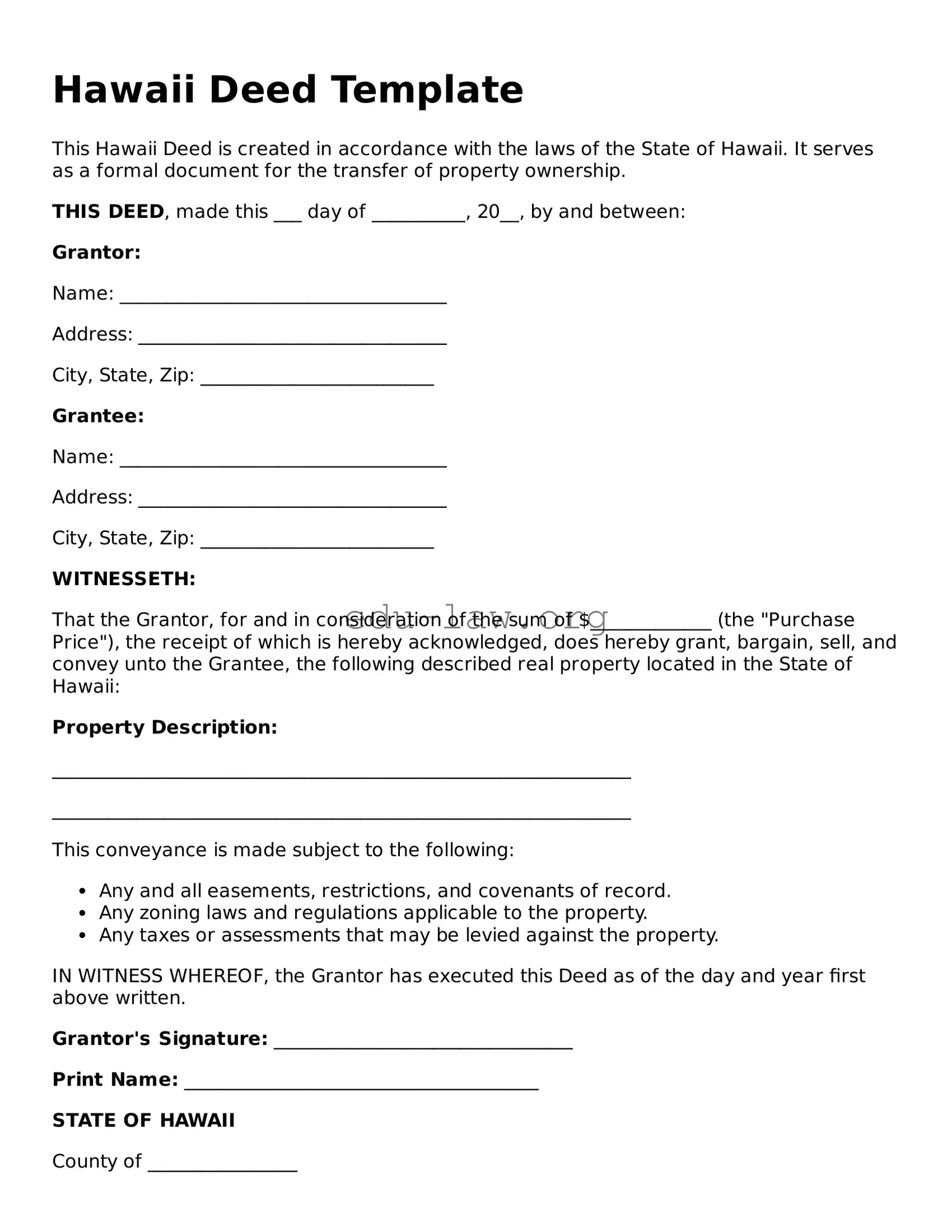
The Hawaii Deed form is an essential legal document used in real estate transactions within the state, facilitating the transfer of property ownership from one party to another. This form serves several crucial functions, including the identification of the grantor (the seller) and the grantee (the buyer), as well as a clear description of the property being conveyed. It is important to note that the Hawaii Deed must be executed in accordance with state laws to ensure its validity. Additionally, the document typically requires notarization, which adds a layer of authenticity to the transaction. Various types of deeds exist in Hawaii, such as warranty deeds and quitclaim deeds, each serving different purposes and offering varying levels of protection for the parties involved. Understanding the nuances of these different deed types can significantly impact the rights and responsibilities of both the grantor and grantee. Furthermore, the form often includes provisions regarding the property’s title, ensuring that the buyer receives a clear and marketable title upon transfer. As such, familiarity with the Hawaii Deed form is vital for anyone engaged in property transactions in the Aloha State, whether they are seasoned investors or first-time homebuyers.
Hawaii Deed Template
This Hawaii Deed is created in accordance with the laws of the State of Hawaii. It serves as a formal document for the transfer of property ownership.
THIS DEED, made this ___ day of __________, 20__, by and between:
Grantor:
Name: ___________________________________
Address: _________________________________
City, State, Zip: _________________________
Grantee:
Name: ___________________________________
Address: _________________________________
City, State, Zip: _________________________
WITNESSETH:
That the Grantor, for and in consideration of the sum of $_____________ (the "Purchase Price"), the receipt of which is hereby acknowledged, does hereby grant, bargain, sell, and convey unto the Grantee, the following described real property located in the State of Hawaii:
Property Description:
______________________________________________________________
______________________________________________________________
This conveyance is made subject to the following:
IN WITNESS WHEREOF, the Grantor has executed this Deed as of the day and year first above written.
Grantor's Signature: ________________________________
Print Name: ______________________________________
STATE OF HAWAII
County of ________________
On this ___ day of __________, 20__, before me, a Notary Public, personally appeared ____________________________, known to me to be the person whose name is subscribed to the within instrument, and acknowledged that he/she executed the same.
WITNESS my hand and official seal.
Notary Public Signature: ____________________________
My Commission Expires: ____________________________
| Fact Name | Details |
|---|---|
| Governing Law | The Hawaii Deed form is governed by the Hawaii Revised Statutes, specifically Chapter 501. |
| Types of Deeds | Hawaii recognizes several types of deeds, including warranty deeds, quitclaim deeds, and special warranty deeds. |
| Requirements for Validity | To be valid, a deed must be in writing, signed by the grantor, and must include a legal description of the property. |
| Recording | Deeds must be recorded with the Bureau of Conveyances in Hawaii to provide public notice of ownership. |
| Transfer Tax | Hawaii imposes a conveyance tax on the transfer of real property, which must be paid at the time of recording the deed. |
After gathering the necessary information and ensuring you have the correct form, you will need to complete the Hawaii Deed form carefully. Once filled out, this form will need to be submitted to the appropriate county office for recording.
What is a Hawaii Deed form?
A Hawaii Deed form is a legal document used to transfer ownership of real property in the state of Hawaii. It serves as proof of the transfer and includes important details such as the names of the parties involved, a description of the property, and any relevant terms of the transfer. This document must be properly executed and recorded to be legally effective.
What types of deeds are available in Hawaii?
In Hawaii, there are several types of deeds, including Warranty Deeds, Quitclaim Deeds, and Special Warranty Deeds. A Warranty Deed guarantees that the seller holds clear title to the property and has the right to sell it. A Quitclaim Deed transfers whatever interest the seller has in the property without any guarantees. Special Warranty Deeds provide limited warranties, covering only the period during which the seller owned the property.
How do I fill out a Hawaii Deed form?
Filling out a Hawaii Deed form requires specific information. You will need to include the names and addresses of the grantor (seller) and grantee (buyer), a legal description of the property, and the consideration (price) paid for the property. Ensure that all information is accurate and complete to avoid any issues during the transfer process.
Do I need a notary public for a Hawaii Deed?
Yes, a Hawaii Deed must be signed in the presence of a notary public. The notary verifies the identities of the parties involved and witnesses the signing of the document. After notarization, the deed must be recorded with the Bureau of Conveyances in Hawaii to be legally effective.
What is the process for recording a Hawaii Deed?
To record a Hawaii Deed, you must submit the completed and notarized document to the Bureau of Conveyances. This can typically be done in person or by mail. There may be a recording fee, which varies based on the type of deed and the number of pages. Once recorded, the deed becomes part of the public record, ensuring that the transfer of ownership is officially documented.
Are there any taxes associated with transferring property in Hawaii?
Yes, when transferring property in Hawaii, you may be subject to conveyance taxes. These taxes are based on the sale price of the property. The seller is typically responsible for paying this tax, but it can be negotiated between the parties. It is essential to check with the local tax office for current rates and any exemptions that may apply.
Can I use a Hawaii Deed form for property held in a trust?
Yes, a Hawaii Deed form can be used to transfer property held in a trust. However, the deed must clearly identify the trust and the trustee acting on behalf of the trust. It is advisable to consult with a legal professional to ensure that the transfer complies with trust provisions and state laws.
Incorrect Names: One common mistake is failing to use the full legal names of all parties involved. This includes middle names or initials that may be necessary for clarity.
Missing Signatures: All required signatures must be present. Leaving out even one signature can render the deed invalid.
Improper Notarization: The deed must be notarized correctly. If the notary's signature or seal is missing, the document may not be accepted.
Incorrect Property Description: A detailed and accurate description of the property is essential. Omitting details or using vague language can lead to disputes.
Failure to Record: After completing the deed, it must be recorded with the appropriate county office. Neglecting this step can create legal complications down the line.
Inaccurate Tax Information: Including incorrect information related to property taxes can cause issues. It's important to verify all tax details before submission.
Not Understanding the Type of Deed: Different types of deeds serve different purposes. Using the wrong type can affect the rights and responsibilities of the parties involved.
Ignoring Local Regulations: Each county may have specific requirements for deeds. Failing to comply with local rules can lead to rejection of the deed.
Not Seeking Legal Advice: Skipping the step of consulting with a legal expert can result in costly mistakes. It's always wise to get professional guidance when dealing with property transfers.
When dealing with property transactions in Hawaii, the Deed form is a crucial document. However, it is often accompanied by other forms and documents that help ensure a smooth transfer of ownership and compliance with local regulations. Here are five key documents commonly used alongside the Hawaii Deed form:
Understanding these documents can significantly ease the process of buying or selling property in Hawaii. Each plays a vital role in ensuring that the transaction is legally sound and that both parties are protected throughout the process.
The warranty deed is one of the most similar documents to the Hawaii deed form. Like the Hawaii deed, a warranty deed transfers ownership of real estate from one party to another. It provides a guarantee that the seller holds clear title to the property and has the right to sell it. This assurance protects the buyer from any future claims against the property, making it a secure option for transferring ownership.
A quitclaim deed is another document that bears similarities to the Hawaii deed form. While both are used to transfer property, a quitclaim deed does not provide any guarantees about the title. It simply conveys whatever interest the seller has in the property, if any. This type of deed is often used between family members or in situations where the seller cannot guarantee a clear title.
A grant deed is another document that shares similarities with the Hawaii deed form. Like the Hawaii deed, a grant deed transfers ownership of real property. However, it typically includes assurances that the property has not been sold to anyone else and that there are no undisclosed encumbrances. This adds a layer of protection for the buyer, similar to what a warranty deed provides.
The bargain and sale deed is also akin to the Hawaii deed. This type of deed transfers property ownership but does not provide any guarantees regarding the title. It implies that the seller has the right to sell the property but does not assure the buyer of a clear title. This can be a riskier option for buyers, as they may inherit any title issues that existed before the sale.
A fiduciary deed is another document that resembles the Hawaii deed form. This deed is used when a fiduciary, such as an executor or trustee, transfers property on behalf of another person. It serves to convey property while also providing some assurances about the title, similar to a warranty deed. This ensures that the transfer is legally binding and protects the interests of all parties involved.
The trust deed, while slightly different in purpose, is also related to the Hawaii deed form. A trust deed involves a borrower, a lender, and a trustee, and it secures a loan with real property. Although it serves a different function, it still involves the transfer of property rights and can affect ownership, much like a Hawaii deed does when transferring property ownership.
A leasehold deed is another document that can be compared to the Hawaii deed. This deed is used to transfer rights to a property for a specified period, typically in the context of a lease. While it does not convey full ownership like a Hawaii deed, it establishes rights and obligations between the landlord and tenant, which is a critical aspect of property law.
Finally, a deed of trust is similar to the Hawaii deed in that it involves real property and the transfer of interests. This document is used to secure a loan with real estate as collateral. While it functions primarily as a security instrument rather than a traditional transfer of ownership, it still plays a crucial role in property transactions, much like a Hawaii deed does in establishing ownership rights.
When filling out the Hawaii Deed form, attention to detail is essential. Here are ten important dos and don'ts to guide you through the process.
Understanding the Hawaii Deed form is essential for anyone involved in property transactions in the state. However, several misconceptions can lead to confusion. Here’s a list of ten common misunderstandings about the Hawaii Deed form:
Being aware of these misconceptions can help individuals navigate property transactions in Hawaii more effectively. Always consult with a legal professional for personalized guidance.
When filling out and using the Hawaii Deed form, there are several important considerations to keep in mind. Below are key takeaways that can help ensure the process is completed correctly.