When engaging in the buying or selling of personal property in Hawaii, a Bill of Sale form plays a crucial role in documenting the transaction. This simple yet effective document serves as proof of the exchange, detailing essential information such as the names and addresses of both the buyer and seller, a description of the item being sold, and the sale price. Additionally, the form may include the date of the transaction and any warranties or guarantees provided by the seller. By clearly outlining these details, the Bill of Sale helps protect both parties in the event of a dispute. Whether you are selling a vehicle, a piece of furniture, or any other item, having a properly completed Bill of Sale can provide peace of mind and ensure a smooth transfer of ownership. Understanding its components and importance can empower individuals to navigate their transactions with confidence.
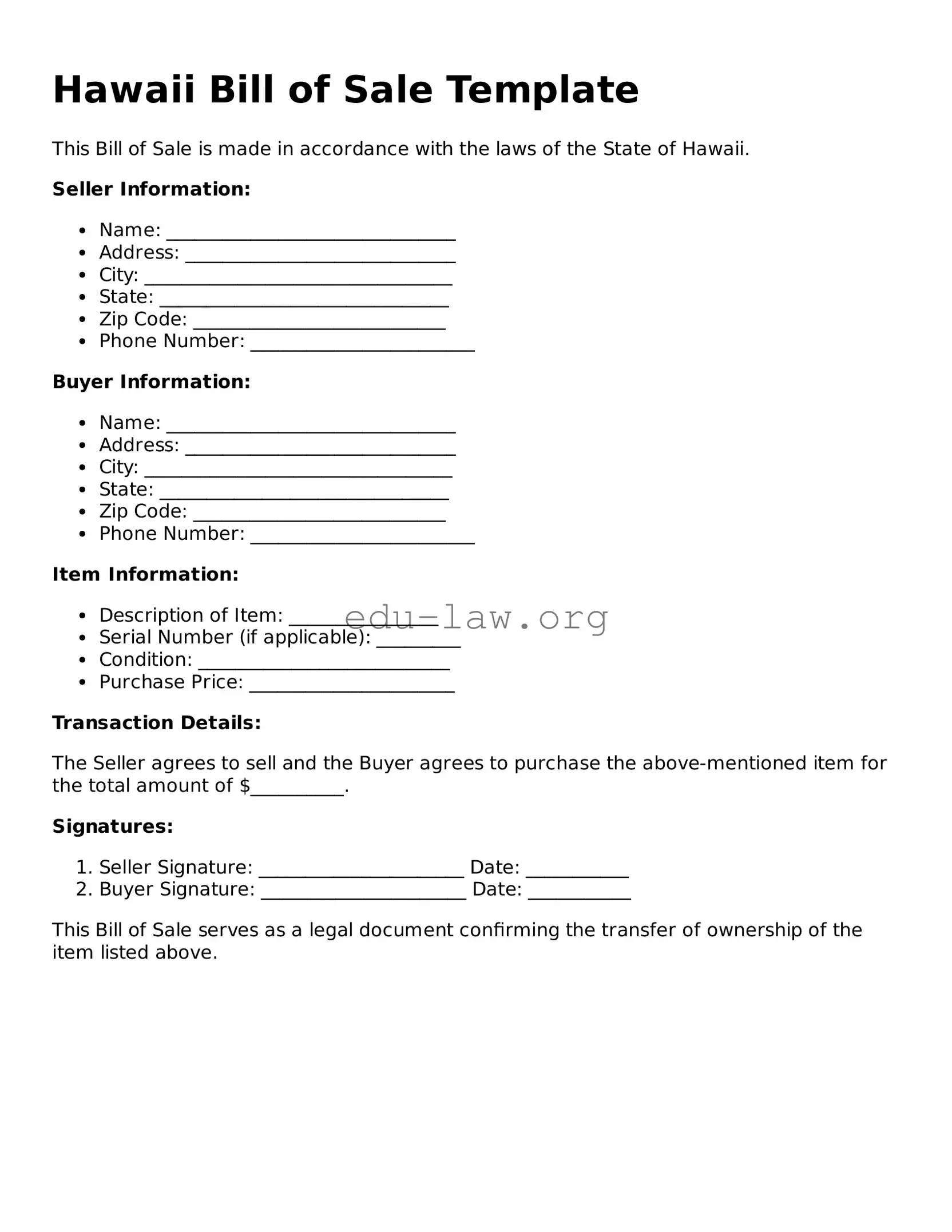
Hawaii Bill of Sale Template
This Bill of Sale is made in accordance with the laws of the State of Hawaii.
Seller Information:
Buyer Information:
Item Information:
Transaction Details:
The Seller agrees to sell and the Buyer agrees to purchase the above-mentioned item for the total amount of $__________.
Signatures:
This Bill of Sale serves as a legal document confirming the transfer of ownership of the item listed above.
| Fact Name | Details |
|---|---|
| Purpose | The Hawaii Bill of Sale form serves as a legal document to transfer ownership of personal property from one party to another. |
| Governing Law | The form is governed by Hawaii Revised Statutes, specifically under Title 1, Chapter 490 (Uniform Commercial Code). |
| Types of Property | This form can be used for various types of personal property, including vehicles, boats, and equipment. |
| Notarization | While notarization is not required, it is highly recommended to enhance the document's credibility. |
| Buyer and Seller Information | The form requires the full names and addresses of both the buyer and the seller to ensure clear identification. |
| Consideration | The document must specify the consideration, or payment, exchanged for the property being sold. |
| Condition of Property | Buyers should be aware that the seller may include a statement regarding the condition of the property, such as "as-is." |
| Signature Requirement | Both parties must sign the Bill of Sale to validate the transfer of ownership. |
| Record Keeping | It is advisable for both parties to keep a copy of the Bill of Sale for their records, in case of future disputes. |
Once you have the Hawaii Bill of Sale form ready, it’s essential to complete it accurately to ensure a smooth transaction. Follow the steps below to fill out the form correctly.
After completing the form, make copies for both parties. This ensures everyone has a record of the transaction. Keep the original in a safe place for your records.
What is a Hawaii Bill of Sale form?
A Hawaii Bill of Sale form is a legal document used to transfer ownership of personal property from one person to another. This form serves as proof of the transaction and includes details about the buyer, seller, and the item being sold. It can apply to various types of property, such as vehicles, boats, or personal items.
Do I need a Bill of Sale for all transactions in Hawaii?
While a Bill of Sale is not always legally required for every transaction, it is highly recommended. For items like vehicles or boats, a Bill of Sale is necessary to register the change of ownership with the state. Even for smaller transactions, having a Bill of Sale can help avoid disputes in the future.
What information should be included in a Hawaii Bill of Sale?
A complete Hawaii Bill of Sale should include the names and addresses of both the buyer and seller, a description of the item being sold, the sale price, and the date of the transaction. It's also wise to include any warranties or conditions related to the sale, as this can clarify expectations for both parties.
Is a Bill of Sale legally binding in Hawaii?
Yes, a Bill of Sale is legally binding in Hawaii as long as it contains all the necessary information and is signed by both the buyer and seller. This document serves as evidence of the transaction and can be used in court if any disputes arise regarding the sale.
Do I need to have the Bill of Sale notarized?
In Hawaii, notarization is not typically required for a Bill of Sale. However, having the document notarized can add an extra layer of security and authenticity. It may be particularly beneficial if you plan to use the Bill of Sale for vehicle registration or other official purposes.
Where can I obtain a Hawaii Bill of Sale form?
You can find a Hawaii Bill of Sale form online through various legal websites, or you can create one using templates available in word processing software. Additionally, some local offices or legal consultants may provide these forms. Make sure to use a reliable source to ensure the form meets all legal requirements.
Incomplete Information: One common mistake is failing to provide all required details. Buyers and sellers must ensure that names, addresses, and contact information are fully filled out. Missing any of these can lead to confusion or disputes later on.
Incorrect Vehicle Identification Number (VIN): When selling a vehicle, the VIN must be accurate. A simple typo can render the document invalid. Double-check the VIN against the title or registration to avoid this error.
Not Signing the Document: Both parties must sign the Bill of Sale for it to be legally binding. Sometimes, one party may forget to sign or assume the other has done so. Ensure that both signatures are present before finalizing the sale.
Neglecting to Date the Form: Failing to include the date of the transaction can create complications. A Bill of Sale should clearly indicate when the sale took place, which helps establish ownership transfer and can be crucial for record-keeping.
Not Keeping a Copy: After completing the Bill of Sale, it is essential for both parties to retain a copy. Some individuals may overlook this step, which can lead to issues if disputes arise in the future. Always ensure you have a record of the transaction.
When engaging in a transaction involving the sale of personal property in Hawaii, the Bill of Sale form is just one piece of the puzzle. Several other documents can complement this form, ensuring that the sale is clear, legal, and well-documented. Here’s a list of some commonly used forms and documents that may accompany the Hawaii Bill of Sale.
Each of these documents plays a vital role in the sales process, providing clarity and protection for both buyers and sellers. By ensuring that you have all the necessary paperwork in order, you can facilitate a smoother transaction and avoid potential legal issues down the road.
The Hawaii Bill of Sale is similar to a Vehicle Bill of Sale, which is specifically used for the transfer of ownership of a motor vehicle. This document includes essential details such as the vehicle identification number (VIN), make, model, and year of the vehicle. Both documents serve as proof of the transaction and protect the interests of both the buyer and seller. The Vehicle Bill of Sale may also include information about any warranties or conditions attached to the sale, similar to how a general Bill of Sale outlines the terms of the transfer.
Another document akin to the Hawaii Bill of Sale is the Personal Property Bill of Sale. This form is used for the sale of tangible personal property, such as furniture, electronics, or other items. Like the Hawaii Bill of Sale, it outlines the parties involved, the item being sold, and the purchase price. Both documents provide a record of the transaction, ensuring that the seller can prove ownership and the buyer can confirm their purchase. The Personal Property Bill of Sale is particularly useful when selling items of significant value, as it can help avoid disputes later on.
The Equipment Bill of Sale is also similar, focusing specifically on the transfer of ownership of equipment, such as machinery or tools. This document details the equipment's specifications, condition, and any included warranties. Just like the Hawaii Bill of Sale, it serves to protect both parties by documenting the sale and providing proof of ownership. The Equipment Bill of Sale may also include clauses regarding liability and maintenance, ensuring that both buyer and seller understand their responsibilities after the sale.
Lastly, the Boat Bill of Sale shares similarities with the Hawaii Bill of Sale, as it is used to transfer ownership of a boat or watercraft. This document typically includes details such as the boat's hull identification number (HIN), make, model, and year. Both documents function as legal proof of the transaction, providing necessary information to register the boat with the state. The Boat Bill of Sale may also address any liens on the vessel, ensuring that the buyer receives clear title, much like the protections offered in a general Bill of Sale.
When filling out the Hawaii Bill of Sale form, it is essential to follow specific guidelines to ensure accuracy and compliance. Below is a list of things you should and shouldn't do:
Understanding the Hawaii Bill of Sale form is important for anyone involved in buying or selling personal property in the state. However, several misconceptions can lead to confusion. Here are ten common misunderstandings:
Many people think the Bill of Sale is only necessary for vehicles. In reality, it can be used for various types of personal property, including boats, trailers, and even household items.
Some believe that a Bill of Sale must be notarized to be valid. While notarization can add an extra layer of authenticity, it is not a legal requirement in Hawaii.
A Bill of Sale and a receipt serve different purposes. The Bill of Sale transfers ownership, while a receipt merely proves that a transaction occurred.
People often think that only private sales require a Bill of Sale. However, it can also be useful for transactions involving businesses or dealers.
Some assume that they can leave out important details. In fact, including specific information such as the buyer's and seller's names, the item description, and the sale price is crucial for the document's validity.
Many believe that a Bill of Sale is merely a formality. In truth, it is a legally binding document that can be used in court to prove ownership and the terms of the sale.
While it is possible to create a handwritten Bill of Sale, using a standardized form is recommended for clarity and to ensure all necessary information is included.
Some people think a Bill of Sale is only necessary when money changes hands. It can also be used for trades or exchanges of property.
Many believe that once a Bill of Sale is signed, it cannot be altered. However, parties can agree to amend the document if both parties consent.
Some think that a Bill of Sale is unnecessary for gifting property. However, documenting the transfer can help avoid disputes in the future.
When dealing with the Hawaii Bill of Sale form, there are several important points to keep in mind. This document serves as a legal record of the transfer of ownership for personal property. Below are key takeaways to ensure you complete and use this form effectively.
By keeping these points in mind, you can ensure that your use of the Hawaii Bill of Sale form is effective and legally sound.