When applying to graduate school, one of the most critical components of your application is the recommendation letter. This document serves as a powerful endorsement of your skills, character, and potential for success in advanced studies. A well-crafted recommendation letter can set you apart from other candidates, showcasing your strengths and unique qualities. The Graduate School Recommendation Letter form typically includes sections for the recommender to provide their contact information, relationship to the applicant, and an assessment of the applicant's abilities. It may also prompt the recommender to address specific skills, experiences, and attributes that make the applicant a strong fit for the program. These letters not only reflect the applicant's academic capabilities but also their personal qualities, such as teamwork, leadership, and resilience. Understanding the significance of this form can help both applicants and recommenders navigate the process with confidence, ensuring that the final letter resonates with admissions committees and highlights the applicant's readiness for the challenges of graduate education.
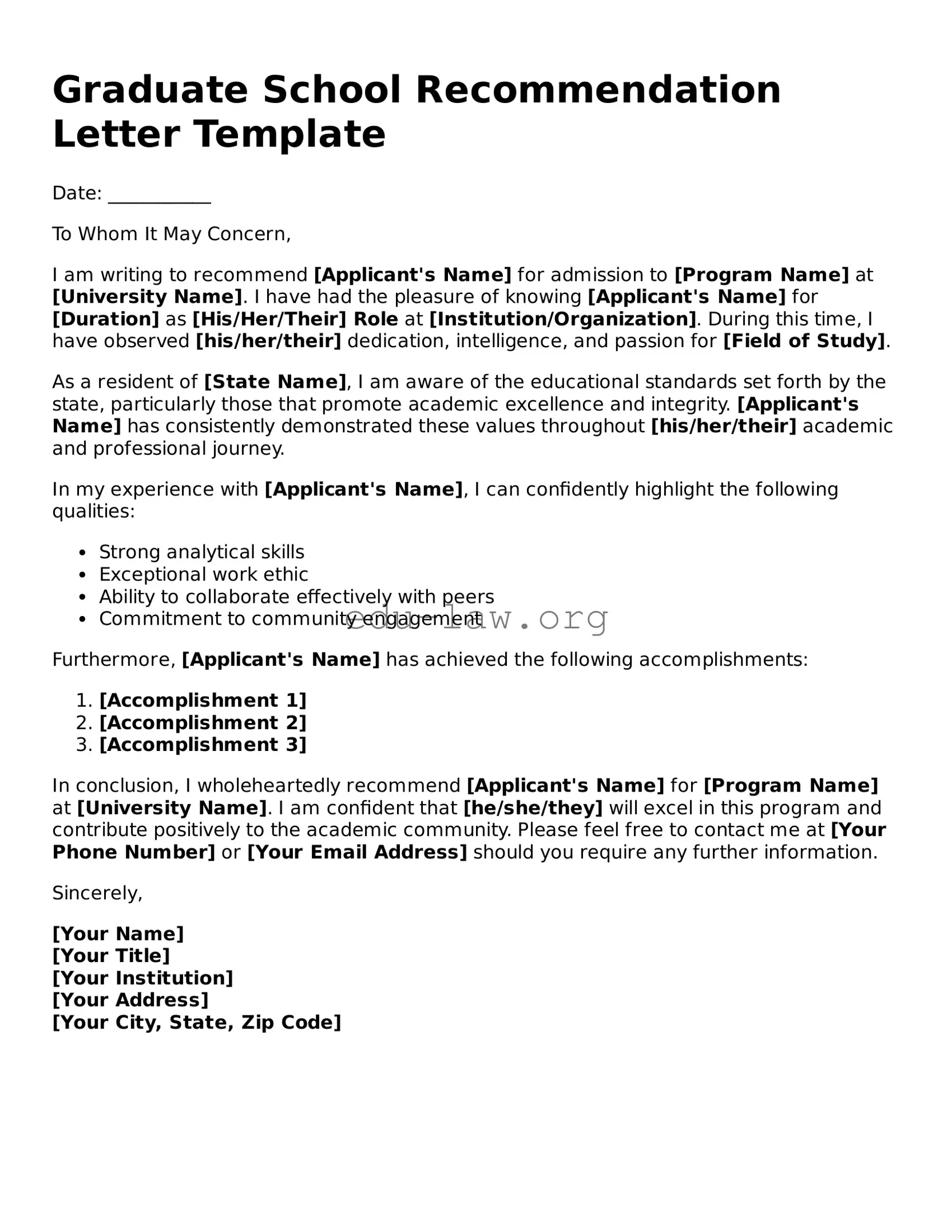
Graduate School Recommendation Letter Template
Date: ___________
To Whom It May Concern,
I am writing to recommend [Applicant's Name] for admission to [Program Name] at [University Name]. I have had the pleasure of knowing [Applicant's Name] for [Duration] as [His/Her/Their] Role at [Institution/Organization]. During this time, I have observed [his/her/their] dedication, intelligence, and passion for [Field of Study].
As a resident of [State Name], I am aware of the educational standards set forth by the state, particularly those that promote academic excellence and integrity. [Applicant's Name] has consistently demonstrated these values throughout [his/her/their] academic and professional journey.
In my experience with [Applicant's Name], I can confidently highlight the following qualities:
Furthermore, [Applicant's Name] has achieved the following accomplishments:
In conclusion, I wholeheartedly recommend [Applicant's Name] for [Program Name] at [University Name]. I am confident that [he/she/they] will excel in this program and contribute positively to the academic community. Please feel free to contact me at [Your Phone Number] or [Your Email Address] should you require any further information.
Sincerely,
[Your Name]
[Your Title]
[Your Institution]
[Your Address]
[Your City, State, Zip Code]
| Fact Name | Description |
|---|---|
| Purpose | The Graduate School Recommendation Letter form is used to gather insights about a candidate's qualifications and character from a recommender. |
| Format | The form typically includes sections for the recommender's information, relationship to the candidate, and a narrative assessment of the candidate's abilities. |
| Confidentiality | Many institutions allow candidates to waive their right to view the recommendation, encouraging honest feedback from recommenders. |
| Submission Method | Recommendations can often be submitted electronically or via traditional mail, depending on the institution's requirements. |
| State-Specific Variations | Some states may have specific guidelines regarding the confidentiality and handling of recommendation letters, especially in educational settings. |
| Governing Laws | In states like California, the Family Educational Rights and Privacy Act (FERPA) governs the privacy of student education records, including recommendations. |
| Recommender Eligibility | Typically, recommenders should be individuals who can provide a professional or academic perspective on the candidate, such as professors or employers. |
| Length and Detail | Recommendations are generally more effective when they provide specific examples of the candidate's skills and accomplishments rather than vague praise. |
| Deadline Awareness | It is crucial for candidates to inform their recommenders of submission deadlines to ensure timely delivery of the recommendation. |
| Follow-Up Etiquette | After a recommendation is submitted, candidates should thank their recommenders, acknowledging their support and effort in the application process. |
After you have gathered all necessary information and selected your recommender, it’s time to fill out the Graduate School Recommendation Letter form. This form is essential for providing the admissions committee with insight into your qualifications and character. Follow these steps to ensure a smooth completion process.
Once the form is complete, share it with your recommender, along with any additional instructions they might need for submitting the letter. Good luck!
What is a Graduate School Recommendation Letter?
A Graduate School Recommendation Letter is a document written by someone who can speak to your qualifications for graduate study. This letter typically highlights your academic abilities, work ethic, and personal qualities that make you a suitable candidate for the program you are applying to. It is an essential part of your application, providing insights that your grades and test scores cannot convey alone.
Who should I ask to write my recommendation letter?
It is best to ask someone who knows you well and can provide specific examples of your strengths. Ideal candidates include professors, employers, or supervisors who can speak to your skills and experiences relevant to your desired field of study. Choose someone who can provide a positive and detailed perspective on your qualifications.
How many recommendation letters do I need?
Most graduate programs require two to three recommendation letters. Check the specific requirements of each program you are applying to, as they may vary. Be sure to give your recommenders enough time to write thoughtful letters by informing them well in advance of your application deadlines.
What information should I provide to my recommender?
When asking for a recommendation, provide your recommender with relevant information about the program, your academic achievements, work experiences, and any specific points you would like them to address. A copy of your resume and a personal statement can also be helpful. This information will assist them in writing a more personalized and impactful letter.
How should my recommender submit the letter?
Most graduate programs have an online application system where recommenders can submit their letters directly. Your recommender will typically receive an email with instructions and a link to upload their letter. If a paper letter is required, ensure they know how to send it and any deadlines they must meet.
Can I read my recommendation letter?
Generally, you cannot read your recommendation letter unless your recommender allows it. Many applicants choose to waive their right to view the letter, as this can encourage recommenders to be more candid. However, if you feel it is necessary, discuss this with your recommender before they write the letter.
What should I do if my recommender misses the deadline?
If your recommender misses the deadline, reach out to them politely to remind them. Sometimes, a gentle nudge can help. If they are unable to submit the letter on time, consider asking another person for a recommendation. Always have a backup plan to ensure your application remains complete and submitted on time.
Neglecting to Personalize the Recommendation: A common mistake is providing a generic recommendation that lacks specific examples of the candidate's strengths and achievements. Tailoring the letter to highlight the individual's unique qualities and experiences can make a significant difference.
Failing to Address the Right Attributes: Sometimes, recommenders overlook the key attributes that graduate programs seek. Focusing on skills such as critical thinking, teamwork, and leadership can better align the recommendation with the program's expectations.
Missing Deadlines: Timeliness is crucial in the recommendation process. Some individuals may forget to submit their letters by the specified deadline, which can negatively impact the candidate's application. Keeping track of due dates is essential.
Ignoring Formatting Guidelines: Graduate programs often provide specific instructions regarding the format and length of recommendation letters. Not adhering to these guidelines can lead to a recommendation being dismissed or viewed as unprofessional.
When applying to graduate school, a variety of forms and documents are often required to support your application. Each of these documents serves a specific purpose, helping the admissions committee understand your qualifications, experiences, and potential for success in their program. Below is a list of common documents that accompany the Graduate School Recommendation Letter form.
Each of these documents plays a crucial role in presenting your application in the best light possible. Carefully preparing and submitting these materials can significantly enhance your chances of being accepted into your desired graduate program. Remember, attention to detail and clarity in your submissions can make a difference in how your application is perceived.
The Graduate School Recommendation Letter form is similar to the Job Reference Letter. Both documents serve as endorsements for an individual, highlighting their skills, experiences, and character. A job reference letter typically comes from a former employer or colleague, while the recommendation letter for graduate school usually comes from a professor or academic advisor. In both cases, the writer aims to provide insight into the individual’s abilities and potential, helping the recipient make informed decisions.
Another document similar to the Graduate School Recommendation Letter is the College Application Recommendation. This document is often required for undergraduate admissions and is written by teachers or counselors. Like the graduate recommendation, it focuses on the applicant’s academic performance and personal qualities. Both letters play a crucial role in showcasing the applicant's strengths and fit for the program or institution they are applying to.
The Professional Recommendation Letter also shares similarities with the Graduate School Recommendation Letter. This type of letter is typically written for someone seeking a job or promotion. It emphasizes the individual’s professional skills and achievements. Both documents aim to persuade the reader of the candidate's qualifications and readiness for the next step, whether it be in academia or the workforce.
Another comparable document is the Letter of Recommendation for Scholarships. This letter supports a student’s application for financial aid, emphasizing their academic achievements and personal qualities. Just like the graduate recommendation, it aims to convince the selection committee of the applicant's merit and potential, making a case for why they deserve the scholarship.
The Letter of Support for Grants is another document that parallels the Graduate School Recommendation Letter. This letter is often written by colleagues or supervisors to support an individual’s application for funding. It highlights the applicant’s qualifications and the significance of their proposed project. Both letters aim to provide a strong endorsement, helping the applicant stand out in a competitive selection process.
The Character Reference Letter is also similar. Often used in various situations, such as legal matters or job applications, this letter focuses on the individual’s personal traits and integrity. While the graduate recommendation emphasizes academic and professional qualifications, both documents seek to provide a well-rounded view of the individual’s character and capabilities.
The Personal Reference Letter shares some characteristics with the Graduate School Recommendation Letter as well. This document is often written by friends or acquaintances and focuses on the individual's personal qualities and experiences. Although it may not delve deeply into academic or professional achievements, it still serves to provide a positive endorsement, much like a graduate recommendation.
Lastly, the Letter of Intent can be seen as related to the Graduate School Recommendation Letter. This document outlines an applicant’s goals and reasons for pursuing a specific program. While it is not a recommendation letter per se, it complements the recommendation by providing context about the applicant’s aspirations. Both documents work together to present a comprehensive view of the candidate’s fit and readiness for the program.
When filling out a Graduate School Recommendation Letter form, it's essential to approach the task thoughtfully. Here’s a list of things you should and shouldn’t do to ensure a strong and effective recommendation.
By following these guidelines, you can craft a recommendation letter that truly reflects the candidate's potential and strengths. Good luck!
Understanding the Graduate School Recommendation Letter form is crucial for applicants and recommenders alike. However, several misconceptions can lead to confusion. Here are six common misconceptions:
While it is beneficial for recommenders to have a strong understanding of the applicant's abilities, it is not a strict requirement. A recommender can provide valuable insights even if they do not know the applicant personally, as long as they can speak to the applicant's potential and qualifications.
Quality matters more than quantity. A concise, focused letter that highlights key strengths and experiences can be more impactful than a lengthy one filled with unnecessary details.
While professionalism is important, a personal touch can make a recommendation stand out. Using a conversational tone can convey authenticity and genuine support for the applicant.
Different programs may have varying requirements. Recommenders should tailor their letters to fit the specific guidelines provided by the graduate school while still addressing the applicant's strengths.
While it’s essential to focus on strengths, mentioning a few weaknesses can provide a balanced view. However, these should be framed constructively, showing how the applicant has worked to overcome challenges.
Timeliness is crucial. Recommenders should submit their letters well before the deadline to ensure they are included in the application review process. Late submissions can negatively impact the applicant's chances.
By addressing these misconceptions, both applicants and recommenders can navigate the recommendation process more effectively.
When filling out and using the Graduate School Recommendation Letter form, consider the following key takeaways:
These steps can enhance the effectiveness of your recommendation letters and support your graduate school application.