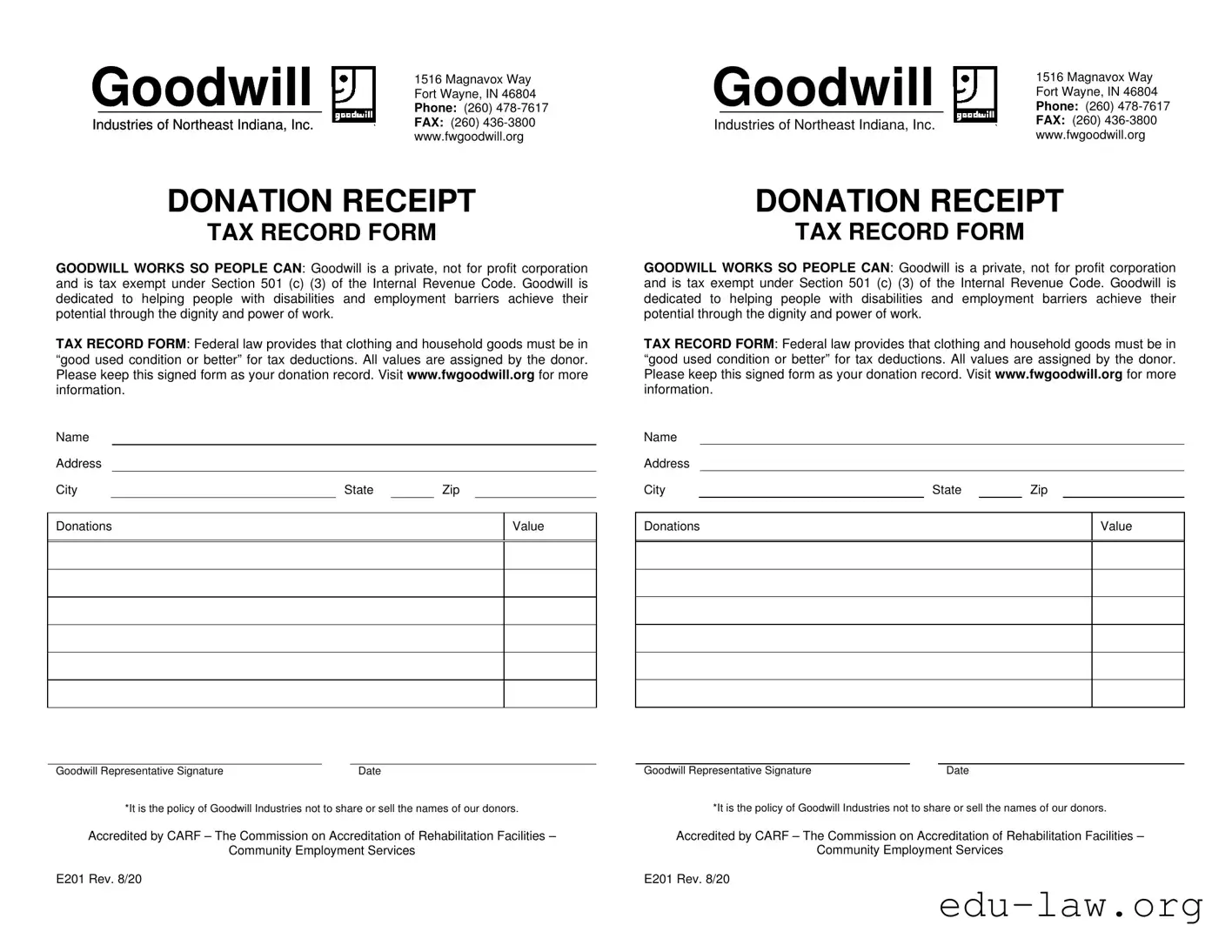
When you donate items to Goodwill, you not only contribute to a worthy cause but also gain the opportunity to claim a tax deduction. Central to this process is the Goodwill donation receipt form, which serves as a crucial document for both donors and the organization. This form typically includes essential details such as the date of the donation, a description of the items donated, and the estimated value of those items. While you might not need to provide an itemized list for every donation, having a general overview can be beneficial. Additionally, the receipt often includes Goodwill's contact information and a statement regarding the tax-deductible nature of your donation. Understanding how to properly fill out and retain this receipt is vital for maximizing your tax benefits and ensuring that your charitable contributions are recognized. By keeping this form organized and accessible, you can navigate the tax implications of your generosity with ease.

Goodwill |
|
Phone: (260) |
|
|
1516 Magnavox Way |
|
|
Fort Wayne, IN 46804 |
Industries of Northeast Indiana, Inc. |
|
FAX: (260) |
|
||
|
|
www.fwgoodwill.org |
DONATION RECEIPT
TAX RECORD FORM
GOODWILL WORKS SO PEOPLE CAN: Goodwill is a private, not for profit corporation and is tax exempt under Section 501 (c) (3) of the Internal Revenue Code. Goodwill is dedicated to helping people with disabilities and employment barriers achieve their potential through the dignity and power of work.
TAX RECORD FORM: Federal law provides that clothing and household goods must be in “good used condition or better” for tax deductions. All values are assigned by the donor. Please keep this signed form as your donation record. Visit www.fwgoodwill.org for more information.
Name
Address
City |
|
State |
|
Zip |
|
|||
|
|
|
|
|
|
|
|
|
Donations |
|
|
|
|
|
Value |
||
|
|
|
|
|
|
|
|
|
|
|
|
|
|
|
|
|
|
|
|
|
|
|
|
|
|
|
|
|
|
|
|
|
|
|
|
|
|
|
|
|
|
|
|
|
|
|
|
|
|
|
|
|
|
|
|
|
|
|
|
|
|
|
|
|
|
|
|
|
|
|
|
Goodwill Representative Signature |
Date |
*It is the policy of Goodwill Industries not to share or sell the names of our donors.
Accredited by CARF – The Commission on Accreditation of Rehabilitation Facilities –
Community Employment Services
E201 Rev. 8/20
Goodwill |
Phone: (260) |
|
|
1516 Magnavox Way |
|
|
Fort Wayne, IN 46804 |
|
Industries of Northeast Indiana, Inc. |
FAX: (260) |
|
www.fwgoodwill.org |
||
|
DONATION RECEIPT
TAX RECORD FORM
GOODWILL WORKS SO PEOPLE CAN: Goodwill is a private, not for profit corporation and is tax exempt under Section 501 (c) (3) of the Internal Revenue Code. Goodwill is dedicated to helping people with disabilities and employment barriers achieve their potential through the dignity and power of work.
TAX RECORD FORM: Federal law provides that clothing and household goods must be in “good used condition or better” for tax deductions. All values are assigned by the donor. Please keep this signed form as your donation record. Visit www.fwgoodwill.org for more information.
Name
Address
City |
|
State |
|
Zip |
|
|||
|
|
|
|
|
|
|
|
|
Donations |
|
|
|
|
|
Value |
||
|
|
|
|
|
|
|
|
|
|
|
|
|
|
|
|
|
|
|
|
|
|
|
|
|
|
|
|
|
|
|
|
|
|
|
|
|
|
|
|
|
|
|
|
|
|
|
|
|
|
|
|
|
|
|
|
|
|
|
|
|
|
|
|
|
|
|
|
|
|
|
|
Goodwill Representative Signature |
Date |
*It is the policy of Goodwill Industries not to share or sell the names of our donors.
Accredited by CARF – The Commission on Accreditation of Rehabilitation Facilities –
Community Employment Services
E201 Rev. 8/20
| Fact Name | Description |
|---|---|
| Purpose | The Goodwill donation receipt form is used to acknowledge donations made to Goodwill Industries. |
| Tax Deduction | Donors can use the receipt to claim tax deductions for their charitable contributions. |
| Itemized List | The form allows donors to provide an itemized list of donated goods, which is important for tax purposes. |
| State-Specific Requirements | Some states may have specific requirements for donation receipts, including the need for a signature or a specific format. |
| Governing Laws | In California, for example, the governing law is the California Revenue and Taxation Code Section 170. |
| Retention Period | Donors should keep the receipt for at least three years, as the IRS may request it during an audit. |
After gathering your items for donation, you’ll need to fill out the Goodwill donation receipt form. This form serves as a record of your donation and can be useful for tax purposes. Follow the steps below to complete the form accurately.
Once you have completed the form, keep a copy for your records. This will be helpful if you need to reference it later for tax deductions or personal records.
What is a Goodwill donation receipt form?
A Goodwill donation receipt form is a document you receive when you donate items to Goodwill. This form serves as proof of your donation for tax purposes. It typically includes details about the items donated, their estimated value, and the date of the donation.
How can I obtain a Goodwill donation receipt?
You can obtain a Goodwill donation receipt at the time of your donation. After you drop off your items, a staff member will provide you with the receipt. If you forget to ask for it, you can return to the location and request a copy.
What items can I donate to Goodwill?
Goodwill accepts a wide range of items, including clothing, household goods, electronics, and furniture. However, some items may not be accepted due to safety or legal reasons. It’s best to check with your local Goodwill for a complete list of acceptable donations.
Do I need to value my donated items?
Yes, you are responsible for estimating the value of your donated items. Goodwill provides guidelines to help you determine fair market value. Keep in mind that the IRS requires you to provide a reasonable estimate for tax deductions.
Can I use the Goodwill donation receipt for tax deductions?
Yes, you can use the Goodwill donation receipt to claim a tax deduction on your income tax return. Ensure you keep the receipt with your tax records as proof of your charitable contribution.
What if I lose my Goodwill donation receipt?
If you lose your receipt, you can contact the Goodwill location where you made the donation. They may be able to provide a duplicate receipt if you have details about your donation, such as the date and items donated.
Is there a limit to how much I can deduct for my donations?
There is no specific limit on how much you can deduct for donations to Goodwill, but your total charitable contributions cannot exceed 60% of your adjusted gross income. Be sure to consult a tax professional for personalized advice.
Can I donate to Goodwill without getting a receipt?
While you can donate without requesting a receipt, it’s highly recommended to get one. The receipt provides proof of your donation, which is important for tax purposes and helps you keep track of your charitable contributions.
Not providing a complete address: Many donors forget to fill in their full address. This information is essential for tax purposes and for Goodwill to properly acknowledge your donation.
Failing to list all donated items: Some people only write down a few items instead of listing everything they donated. It’s important to be thorough, as this can affect your tax deduction.
Estimating values inaccurately: Donors sometimes guess the value of their items without considering their actual worth. Accurate valuations help ensure that your tax deductions are valid.
Not signing the receipt: Some individuals forget to sign the receipt. A signature is necessary for the receipt to be considered valid for tax purposes.
Neglecting to keep a copy: Failing to keep a copy of the receipt for your records can lead to issues later, especially if you need to prove your donation during tax season.
Using outdated forms: Some donors may use an old version of the receipt form. Always ensure you have the most current form to avoid any complications.
Overlooking the date: Forgetting to write the date of the donation can create confusion later. Always include the date to ensure clarity and accuracy.
When making donations to Goodwill or similar organizations, it’s important to keep track of various documents. These documents not only help in maintaining records but also assist in claiming tax deductions. Below is a list of forms and documents that are often used alongside the Goodwill donation receipt form.
By keeping these documents organized and accessible, donors can simplify the process of claiming deductions and ensure compliance with tax regulations. It’s always a good idea to maintain clear records of charitable contributions for personal and financial peace of mind.
The Goodwill donation receipt form is similar to the charitable contribution receipt. Both documents serve as proof of a donation made to a nonprofit organization. They typically include details such as the donor's name, the date of the donation, and a description of the items donated. Just like the Goodwill receipt, the charitable contribution receipt is essential for tax purposes, allowing donors to claim deductions on their income tax returns.
Another document that resembles the Goodwill donation receipt is the IRS Form 8283. This form is specifically used for reporting noncash charitable contributions. When the value of donated items exceeds a certain threshold, Form 8283 must be filled out and submitted along with the tax return. It requires detailed information about the donated items, similar to what is included on the Goodwill receipt, ensuring that donors have adequate documentation for their tax claims.
The donation acknowledgment letter is also comparable to the Goodwill donation receipt. Nonprofits often send these letters to donors as a formal recognition of their contributions. Like the Goodwill receipt, these letters typically include the donor's name, the date of the donation, and a description of the items given. This document not only serves as a record for tax purposes but also expresses gratitude, reinforcing the relationship between the donor and the organization.
Additionally, the donor's tax records can be seen as similar to the Goodwill donation receipt. Donors are encouraged to keep their donation records organized for tax filing. These records may include receipts, acknowledgment letters, and other documentation that verifies charitable contributions. Just as the Goodwill receipt provides proof of donation, these tax records help ensure that donors can substantiate their claims during tax season.
Finally, a bill of sale for donated items can be likened to the Goodwill donation receipt. Although a bill of sale is often used in sales transactions, it can also serve as proof of a donation when items are given to a nonprofit. This document may include details about the items, their estimated value, and the parties involved. While not as common for charitable donations, it fulfills a similar role in documenting the transfer of ownership and value of the donated items.
When filling out the Goodwill donation receipt form, attention to detail is crucial. Here are some essential dos and don'ts to ensure the process goes smoothly.
By following these guidelines, you can ensure that your donation process is efficient and beneficial for both you and Goodwill.
When it comes to donating items to Goodwill, many people have questions about the donation receipt form. Here are five common misconceptions that might help clarify its purpose and usage:
While the receipt can be used for tax deductions, it also serves as a record of your charitable contribution. It helps you keep track of your donations and can be useful for personal record-keeping.
Goodwill does not require you to list every single item. Instead, you can provide a general description of the items donated, such as "clothing" or "household goods," along with an estimated value.
The donor is responsible for determining the value of the items. Goodwill provides guidelines, but ultimately, it's up to you to assess the fair market value of your donations.
While it's ideal to keep the receipt, you may still be able to claim a deduction if you can provide other evidence of your donation, such as bank statements or photographs of the items donated.
The receipt does not expire. You can use it for tax purposes in the year you made the donation, regardless of when you received the receipt.
Understanding these misconceptions can help you make the most of your charitable contributions and ensure you have the necessary documentation for your records.
When making donations to Goodwill, it’s essential to understand how to properly fill out and use the donation receipt form. Here are some key takeaways to keep in mind:
Using the Goodwill donation receipt form correctly can streamline the process of claiming your deductions and ensure that you are compliant with tax regulations.