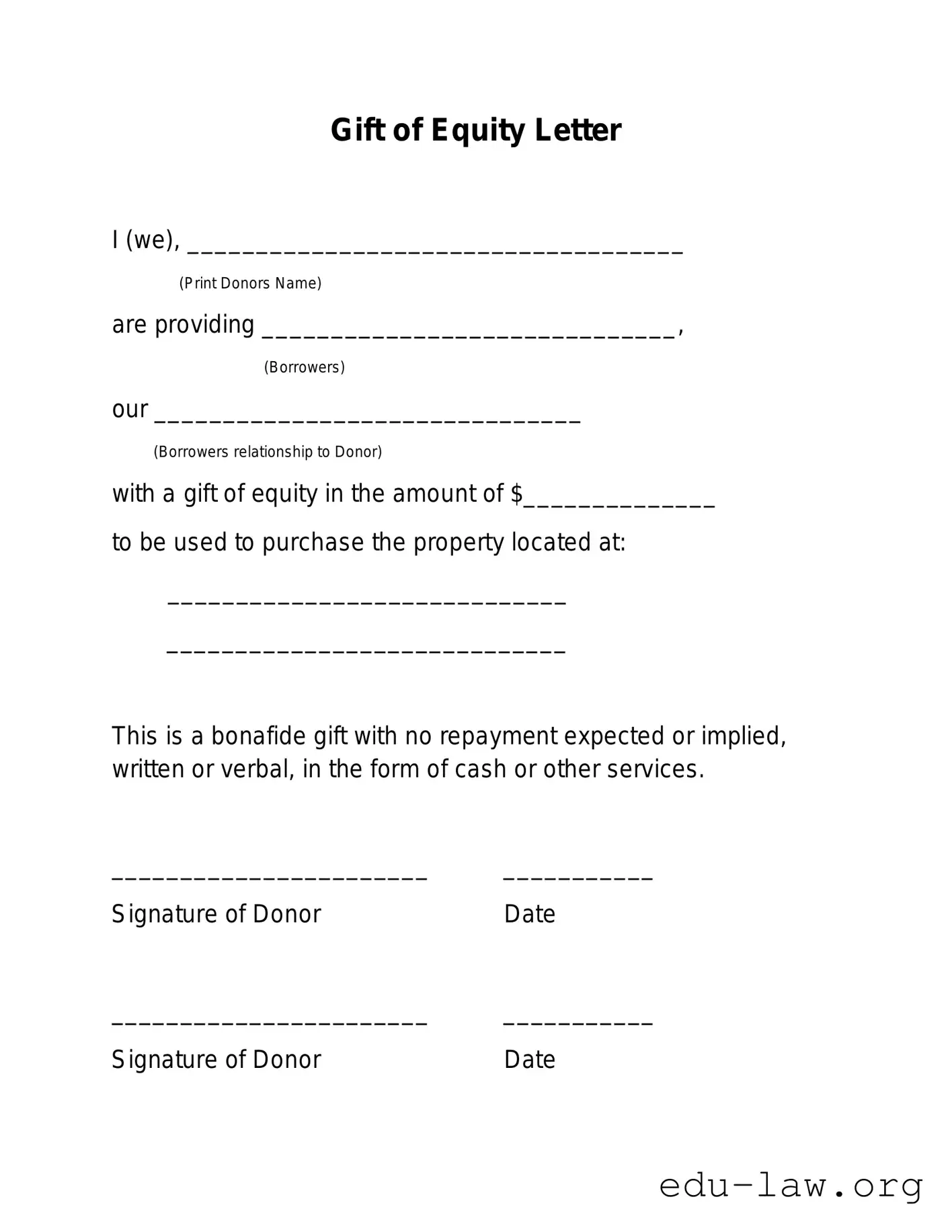
The Gift of Equity Letter is an important document in real estate transactions, particularly when family members or close friends assist one another in purchasing a home. This form serves as a formal declaration that a donor is providing a gift of equity to a borrower, who is typically a relative or someone with a close personal relationship. The letter specifies the amount of equity being gifted, which can significantly reduce the financial burden on the borrower. Importantly, it clarifies that this gift is genuine and does not require repayment, whether in cash or through services. The form requires the signatures of the donors, affirming their intention and commitment to this generous act. By documenting the gift in writing, both parties can avoid misunderstandings in the future and ensure a smooth transaction process. It is a simple yet powerful tool that can help facilitate homeownership for those who might otherwise struggle to secure financing.
Gift of Equity Letter
I (we), ____________________________________
(Print Donors Name)
are providing ______________________________,
(Borrowers)
our _______________________________
(Borrowers relationship to Donor)
with a gift of equity in the amount of $______________
to be used to purchase the property located at:
_____________________________
_____________________________
This is a bonafide gift with no repayment expected or implied, written or verbal, in the form of cash or other services.
_______________________ |
___________ |
Signature of Donor |
Date |
_______________________ |
___________ |
Signature of Donor |
Date |
| Fact Name | Description |
|---|---|
| Purpose | The Gift of Equity Letter serves as a formal declaration from a donor to a borrower, indicating that a gift of equity is being provided for the purchase of a property. |
| Donor Information | The form requires the donor's name to be printed clearly to identify the individual providing the gift. |
| Borrower Details | It includes spaces for the borrower's name and their relationship to the donor, which helps clarify the connection between the parties involved. |
| Amount of Gift | The form specifies the amount of the gift of equity, which is crucial for both parties and any financial institutions involved in the property transaction. |
| No Repayment Clause | The letter explicitly states that the gift is a bona fide gift, meaning no repayment is expected or implied, ensuring clarity in the transaction. |
| Signature Requirement | Both donors must sign and date the form, providing legal acknowledgment of the gift and its terms. |
| State-Specific Forms | Different states may have specific laws governing the use of gift of equity letters, such as California Civil Code § 1624. It is essential to check local regulations. |
Filling out the Gift of Equity Letter form is a straightforward process that requires careful attention to detail. Once completed, this document will formally acknowledge the gift of equity being provided to the borrower, ensuring that all parties are on the same page regarding the terms of the gift.
What is a Gift of Equity Letter?
A Gift of Equity Letter is a formal document that outlines a financial gift made by a property owner to a buyer, allowing the buyer to use the equity in the property as part of their down payment. This letter serves as proof that the donor is giving the equity as a gift, rather than a loan, which can be beneficial for the buyer's mortgage application.
Who can be a donor in a Gift of Equity transaction?
The donor is typically a family member or close friend of the buyer. Common relationships include parents, siblings, or other relatives. The key aspect is that the donor must have an ownership stake in the property being sold.
What information is required in the Gift of Equity Letter?
The letter should include the donor's name, the borrower's name, the relationship between the donor and the borrower, the amount of the gift, and the property address. It must clearly state that the gift is bona fide, meaning there is no expectation of repayment.
Is there a specific format for the Gift of Equity Letter?
While there is no strict format, the letter should be clear and concise. It should include all necessary information as outlined above. The donor's signature and date are also essential to validate the document.
Do I need to notarize the Gift of Equity Letter?
Notarization is not typically required, but it can add an extra layer of authenticity. Some lenders may request a notarized letter to ensure that the gift is legitimate and that the donor understands the implications of the gift.
How does a Gift of Equity affect the buyer's mortgage?
A Gift of Equity can help the buyer meet down payment requirements, potentially allowing them to avoid private mortgage insurance (PMI). It can also improve the buyer's loan-to-value ratio, which may lead to better loan terms and interest rates.
Are there tax implications for the donor?
Yes, there may be tax implications for the donor. The IRS allows individuals to gift up to a certain amount each year without incurring gift taxes. It’s advisable for the donor to consult a tax professional to understand any potential tax liabilities associated with the gift.
Can a Gift of Equity Letter be used for any type of property?
Generally, a Gift of Equity Letter can be used for residential properties, including single-family homes, condos, and multi-family units. However, the lender may have specific requirements or restrictions, so it’s important to check with them before proceeding.
What happens if the buyer does not use the gift for its intended purpose?
If the buyer does not use the gift for its intended purpose, it could lead to complications with the mortgage. Lenders may require documentation to confirm that the funds were used appropriately. Failure to comply could result in penalties or loan denial.
When filling out the Gift of Equity Letter form, it is important to avoid common mistakes that can lead to confusion or issues later on. Here are four mistakes to be aware of:
Incomplete Information: Failing to fill in all required fields can cause delays. Ensure that the names of both the donor and the borrower are clearly printed. Additionally, specify the relationship between the donor and the borrower.
Incorrect Amount: Entering the wrong amount for the gift of equity can create complications. Double-check the dollar amount to ensure it accurately reflects the intended gift.
Missing Signatures: Both donors must sign the letter. Omitting a signature can invalidate the document. Make sure that all signatures are included and dated.
Ambiguous Language: Using vague or unclear language can lead to misunderstandings. The letter should clearly state that the gift is a bonafide gift with no repayment expected, whether in cash or services.
By avoiding these mistakes, the process can go much smoother for everyone involved. Attention to detail is key in ensuring that the Gift of Equity Letter serves its purpose effectively.
When preparing a Gift of Equity Letter, several other forms and documents may also be needed to ensure a smooth transaction. These documents help clarify the gift's nature, establish relationships, and provide necessary information for lenders or legal purposes. Below are some commonly used forms that accompany the Gift of Equity Letter.
Having these documents prepared and organized can facilitate the process of transferring equity and securing financing. Each form plays a vital role in ensuring clarity and compliance throughout the transaction.
The Gift of Equity Letter shares similarities with a Gift Letter. A Gift Letter is a document used in real estate transactions where one party gifts money to another for the purpose of purchasing a home. Like the Gift of Equity Letter, it confirms that the funds are a gift and not a loan. This document typically includes the donor’s name, the recipient’s name, the amount of the gift, and a statement indicating that repayment is not expected. Both documents serve to assure lenders that the funds are not part of a loan, which can affect the buyer's ability to secure financing.
Another similar document is the Affidavit of Gift. This affidavit is a sworn statement that verifies the transfer of funds as a gift. It often includes details about the donor and recipient, the amount gifted, and a declaration that the money does not need to be repaid. Like the Gift of Equity Letter, the Affidavit of Gift is used to provide transparency in financial transactions, especially when large sums are involved. Lenders may require this document to ensure that the buyer's financial situation is accurately represented.
The Third document is the Down Payment Gift Letter. This letter specifically outlines a gift intended to cover a down payment on a home. It is similar to the Gift of Equity Letter in that it states the donor’s intention to gift funds without expecting repayment. The Down Payment Gift Letter typically includes the relationship between the donor and the recipient, the amount of the gift, and a clear statement that the funds are a gift. Both letters help reassure lenders that the buyer has adequate funds for the purchase without incurring additional debt.
Lastly, the Contribution Agreement is another related document. This agreement outlines the terms under which one party contributes money or assets to another party. While it can involve various types of contributions, when used in real estate, it often serves a similar purpose as the Gift of Equity Letter. It specifies the amount being contributed, the relationship between the parties, and confirms that the contribution is a gift. Both documents aim to clarify the nature of the financial transaction, ensuring that all parties understand the terms and conditions involved.
When filling out the Gift of Equity Letter form, it is important to approach the task with care and attention to detail. Here are some essential dos and don'ts to keep in mind:
By following these guidelines, you can help ensure that the Gift of Equity Letter is filled out correctly and effectively. This not only protects the interests of all parties involved but also fosters a clear understanding of the arrangement.
When it comes to the Gift of Equity Letter, there are several misconceptions that can lead to confusion. Understanding the facts can help clarify its purpose and use. Here are seven common misconceptions:
Understanding these misconceptions can help clarify the role and importance of a Gift of Equity Letter in real estate transactions. It’s always wise to approach such matters with a clear understanding of the facts.
Here are key takeaways about filling out and using the Gift Of Equity Letter form: