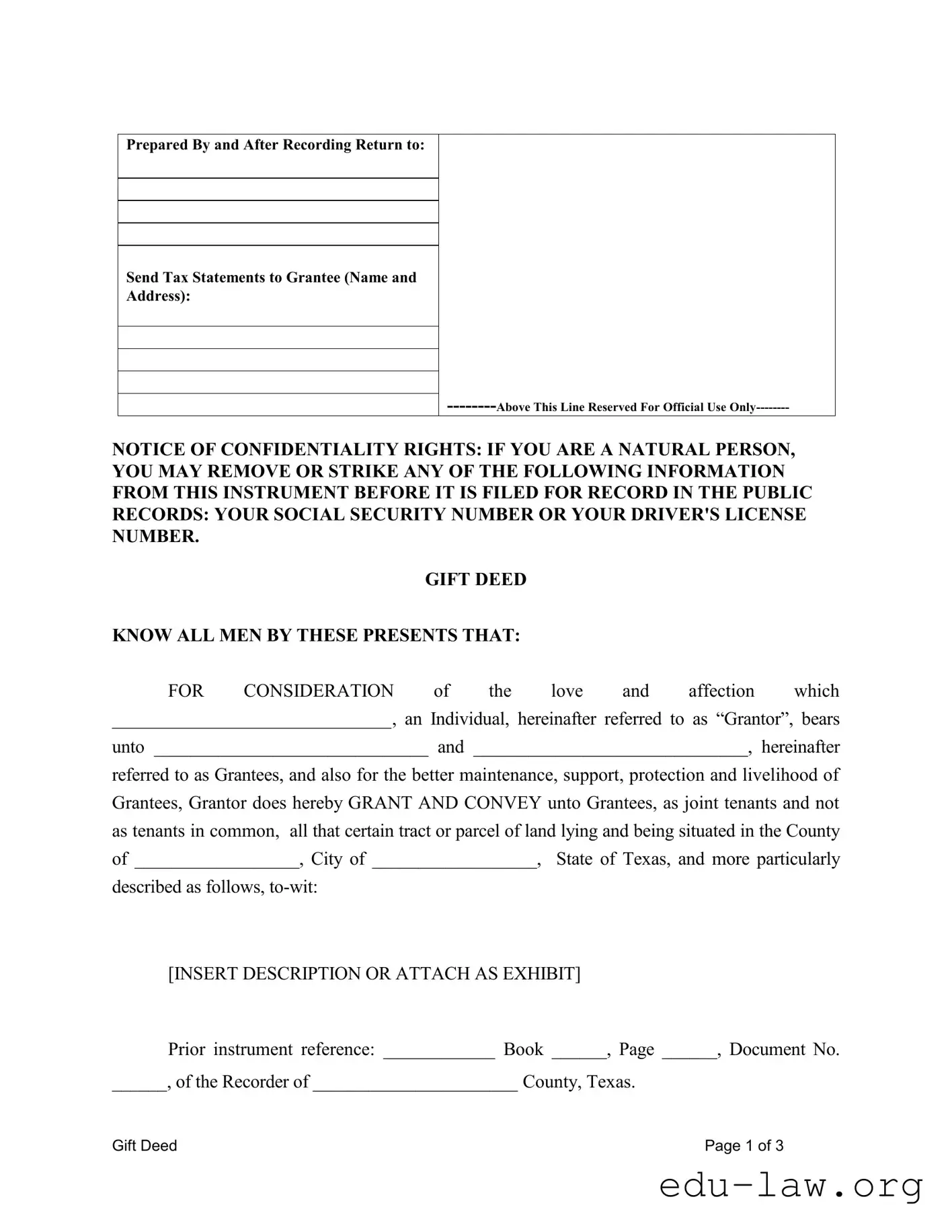
The Gift Deed Texas form serves as a vital legal document for transferring property from one individual, known as the Grantor, to another or multiple individuals, referred to as Grantees, without any monetary exchange. This form emphasizes the importance of love and affection as the basis for the transfer, highlighting its personal nature. It includes essential sections that require the names and addresses of both the Grantor and Grantees, ensuring clarity in the transaction. Notably, the form allows for the property to be held as joint tenants, which carries specific implications for inheritance and survivorship. The deed also addresses potential legal protections for the Grantees, binding the Grantor and their successors to warrant the property against any lawful claims. Additionally, it outlines any existing restrictions or covenants that may affect the property, ensuring that the Grantees are fully informed. Privacy is a key consideration, as the form includes a notice regarding confidentiality rights, allowing individuals to remove sensitive personal information before filing. Overall, the Gift Deed Texas form is a comprehensive instrument that facilitates property transfers while safeguarding the interests of all parties involved.

Prepared By and After Recording Return to:
Send Tax Statements to Grantee (Name and
Address):
NOTICE OF CONFIDENTIALITY RIGHTS: IF YOU ARE A NATURAL PERSON, YOU MAY REMOVE OR STRIKE ANY OF THE FOLLOWING INFORMATION FROM THIS INSTRUMENT BEFORE IT IS FILED FOR RECORD IN THE PUBLIC RECORDS: YOUR SOCIAL SECURITY NUMBER OR YOUR DRIVER'S LICENSE NUMBER.
GIFT DEED
KNOW ALL MEN BY THESE PRESENTS THAT:
FOR CONSIDERATION of the love and affection which
______________________________, an Individual, hereinafter referred to as “Grantor”, bears
unto ______________________________ and ______________________________, hereinafter
referred to as Grantees, and also for the better maintenance, support, protection and livelihood of Grantees, Grantor does hereby GRANT AND CONVEY unto Grantees, as joint tenants and not as tenants in common, all that certain tract or parcel of land lying and being situated in the County of __________________, City of __________________, State of Texas, and more particularly
described as follows,
[INSERT DESCRIPTION OR ATTACH AS EXHIBIT]
Prior instrument reference: ____________ Book ______, Page ______, Document No.
______, of the Recorder of ______________________ County, Texas.
Gift Deed |
Page 1 of 3 |

TO HAVE AND TO HOLD the above described premises together with all and singular the rights and appurtenances thereto in anywise belonging unto the above named Grantees, their successors and assigns forever; and Grantor herein hereby binds itself, its successors, assigns, and administrators to WARRANT AND FOREVER DEFEND all and singular the said premises unto the above named Grantee, their successors and assigns, against every person whomsoever lawfully claiming or to claim the same or any part thereof.
Grantees, TO HAVE AND TO HOLD as joint tenants, with right of survivorship and not as tenants in common, their heirs, personal representatives, executors and assigns forever: it being the intention of the parties to this conveyance, that (unless the joint tenancy hereby created is severed or terminated during the joint lives of the grantees herein) in the event one Grantee herein survives the other, the entire interest in fee simple shall pass to the surviving Grantee, and if one does not survive the other, then the heirs and assigns of the Grantees herein shall take as tenants in common.
This conveyance is made and accepted subject to the following matters, to the extent same are in effect at this time: Any and all restrictions, covenants, conditions and easements, if any, relating to the hereinabove described property, but only to the extent they are still in effect, shown of record in the hereinabove mentioned County and State; and to all zoning laws, regulations and ordinances of municipal and/or other governmental authorities, if any, but only to the extent that they are still in effect, relating to the hereinabove described property.
The property herein conveyed is not a part of the homestead of Grantor, or is part of the homestead of Grantor and the conveyance is joined by both Husband and Wife.
WITNESS Grantor’s hand this the ______ day of __________________, 20______.
Grantor
Type or Print Name
Gift Deed |
Page 2 of 3 |

STATE OF TEXAS
COUNTY OF __________________
This instrument was acknowledged before me on __________________ (date) by
____________________________________ (name of representative) as
____________________________________ (title of representative) of
________________________________________________ (name of entity or person
represented).
Notary Public
My commission expires:
Type or Print Name
Mailing Address of Grantee:
Name
Address
Gift Deed |
Page 3 of 3 |
| Fact Name | Details |
|---|---|
| Definition | A Gift Deed in Texas is a legal document used to transfer property ownership without monetary compensation, typically based on love and affection. |
| Governing Law | The Gift Deed is governed by the Texas Property Code, specifically Section 5.021, which outlines the requirements for valid property transfers. |
| Confidentiality Rights | Individuals can remove personal information, such as Social Security numbers or driver's license numbers, from the deed before recording it to protect their privacy. |
| Joint Tenancy | The deed typically establishes joint tenancy with right of survivorship, meaning that if one grantee passes away, the surviving grantee automatically inherits the property. |
| Restrictions | The transfer may be subject to existing restrictions, covenants, and zoning laws that affect the property, which must be acknowledged in the deed. |
| Homestead Status | The deed must specify whether the property is part of the Grantor's homestead, which can affect legal rights and obligations related to the property. |
Filling out the Gift Deed Texas form is a straightforward process. After completing the form, it will need to be signed and possibly notarized before being filed with the appropriate county office. Here are the steps to fill out the form:
What is a Gift Deed in Texas?
A Gift Deed in Texas is a legal document used to transfer property from one person (the Grantor) to another (the Grantee) without any exchange of money. This type of deed is often used to give property to family members or loved ones as a gift. It establishes the Grantee's ownership and outlines the terms of the gift.
Who can be a Grantor and Grantee?
In Texas, any individual who legally owns property can act as a Grantor. The Grantee can be anyone, including family members, friends, or even organizations. However, it’s important that the Grantee is capable of accepting the gift, which usually means they must be of legal age and mentally competent.
Do I need to pay taxes on a Gift Deed?
While the transfer of property through a Gift Deed is not subject to sales tax, it may have tax implications for both the Grantor and Grantee. The Grantor may need to file a gift tax return if the value of the gift exceeds the annual exclusion limit set by the IRS. It's wise to consult a tax professional for guidance on your specific situation.
What information is required on a Gift Deed?
A Gift Deed must include the names of the Grantor and Grantee, a description of the property being transferred, and the date of the transfer. Additionally, it should state that the property is being given as a gift. It's also essential to include a legal description of the property, which can usually be found in previous deeds or property records.
Is it necessary to have a notary for a Gift Deed?
Yes, a Gift Deed must be notarized to be legally valid in Texas. The notary public will verify the identities of the Grantor and any witnesses, ensuring that the deed is executed properly. This step helps prevent fraud and protects all parties involved.
Can a Gift Deed be revoked?
Once a Gift Deed is executed and recorded, it generally cannot be revoked. The transfer of ownership is complete. However, if the Grantor retains certain rights or conditions, there might be grounds for revocation. It's best to consult with a legal professional if you believe revocation may be necessary.
What happens if one Grantee dies?
If the Grantees are designated as joint tenants with the right of survivorship, the surviving Grantee automatically inherits the deceased Grantee's share of the property. This means that the entire interest in the property passes to the surviving Grantee without going through probate.
Are there any restrictions on the property being gifted?
Yes, the property being gifted may be subject to existing restrictions, covenants, or easements. These are conditions that could affect how the property can be used or developed. It's important to review these matters before finalizing a Gift Deed to avoid any future complications.
How do I record a Gift Deed in Texas?
To record a Gift Deed, you need to file it with the county clerk in the county where the property is located. There may be a small fee for recording the deed. Once recorded, the deed becomes part of the public record, making the transfer official and protecting the Grantee's ownership rights.
Can I include conditions in a Gift Deed?
Yes, you can include specific conditions in a Gift Deed, such as requiring the Grantee to use the property for a particular purpose. However, these conditions must be clear and legally enforceable. It's advisable to consult with a legal expert to ensure that any conditions you wish to impose are valid and properly documented.
Failing to provide complete and accurate Grantee information. Ensure that all names and addresses are correctly filled out to avoid future disputes.
Not including a clear property description. A vague or incomplete description can lead to confusion about what is being transferred.
Omitting the consideration clause. While the deed is a gift, stating the consideration is still necessary for legal clarity.
Neglecting to indicate whether the property is part of the homestead. This distinction affects the rights of the Grantor and Grantees.
Not having the deed witnessed or notarized. This step is crucial for the deed to be legally binding.
Failing to mention any restrictions or easements on the property. This information is essential for the Grantees to understand their rights.
Forgetting to check for zoning laws that may affect the property. Compliance with local regulations is critical.
Leaving out the date of the transaction. A missing date can create ambiguity about when the transfer occurred.
Not reviewing the form for errors before submission. Simple mistakes can lead to significant legal complications.
When completing a Gift Deed in Texas, several additional documents may be necessary to ensure a smooth transfer of property. Each of these forms serves a specific purpose in the process. Here’s a list of commonly used documents alongside the Gift Deed:
Utilizing these documents along with the Gift Deed can help ensure a clear and legally sound transfer of property. It’s always advisable to consult with a legal professional to confirm that all necessary paperwork is in order.
The Gift Deed in Texas shares similarities with a Warranty Deed. A Warranty Deed provides a guarantee from the seller (grantor) to the buyer (grantee) that the property is free from any claims or liens, ensuring the buyer receives clear title. In both documents, the grantor conveys property rights to the grantee. However, while a Warranty Deed typically involves a sale and may require payment, a Gift Deed is used when the property is given without any exchange of money, emphasizing the intent of generosity rather than a commercial transaction.
Another document comparable to the Gift Deed is the Quitclaim Deed. A Quitclaim Deed transfers whatever interest the grantor has in the property to the grantee, without any warranties. This means that if the grantor has no legal claim to the property, the grantee receives nothing. Like the Gift Deed, it is often used in non-commercial transactions, such as transferring property between family members. Both documents can be used to pass ownership, but the Quitclaim Deed lacks the assurances that accompany a Gift Deed.
The Special Warranty Deed also bears resemblance to the Gift Deed. In a Special Warranty Deed, the grantor guarantees that they have not encumbered the property during their ownership. This means the grantor is only responsible for claims that arose while they owned the property. While both documents convey property, the Special Warranty Deed provides limited protection to the grantee, unlike the unconditional nature of a Gift Deed, which is rooted in the act of giving.
A Deed of Trust is another related document. It is used to secure a loan with real property as collateral. In this case, the property is transferred to a trustee, who holds it until the loan is paid off. While a Gift Deed involves a transfer of ownership without any financial obligation, a Deed of Trust creates a financial relationship that requires repayment. Both documents involve property transfer but serve very different purposes.
The Real Estate Transfer Declaration is also similar in that it documents the transfer of property ownership. This form is typically filed with the local tax authority to assess the property’s value for taxation purposes. While the Gift Deed focuses on the act of giving property, the Real Estate Transfer Declaration is more administrative, ensuring that the property’s new ownership is recorded for tax assessments. Both are essential in the property transfer process but cater to different legal and financial aspects.
Lastly, the Lease Agreement can be viewed as related in the context of property rights. A Lease Agreement grants a tenant the right to use a property owned by another party for a specified period, usually in exchange for rent. While a Gift Deed transfers ownership permanently, a Lease Agreement allows for temporary use without transferring ownership. Both documents outline rights and responsibilities concerning property, but their fundamental intentions differ significantly.
When filling out the Gift Deed Texas form, it is crucial to follow specific guidelines to ensure accuracy and compliance. Here’s a list of what you should and shouldn’t do:
Completing the Gift Deed correctly can prevent future legal issues. Review the form carefully before submission.
Understanding the Gift Deed Texas form can be challenging, and there are several misconceptions that can lead to confusion. Here are seven common misunderstandings:
Many people believe that a gift deed involves a financial transaction like a sale. In reality, a gift deed transfers property without any exchange of money. The motivation is often love and affection rather than financial gain.
Some may think that verbal agreements are sufficient for transferring property. However, a gift deed must be documented in writing and properly recorded to be legally effective. This protects both the giver and the recipient.
It is a common belief that all properties can be freely gifted. However, certain properties may have restrictions, such as being part of a homestead or subject to liens. It’s essential to check these factors before proceeding.
Some individuals think that they can still control the property after gifting it. Once a gift deed is executed, the grantor relinquishes ownership and control over the property, transferring it fully to the grantee.
While many people use gift deeds to transfer property to family members, they can also be used for friends or charitable organizations. The key is the intent behind the transfer, which is to give without expecting anything in return.
Some believe that gifting property is completely tax-free. However, there may be tax implications, such as gift taxes or changes in property taxes. Consulting a tax professional is advisable to understand potential liabilities.
Many people think that once a gift deed is executed, it cannot be undone. While it is true that a gift deed is a permanent transfer, there are circumstances under which it may be challenged or revoked, especially if there was undue influence or lack of capacity.
Filling out and using the Gift Deed Texas form requires careful attention to detail. Here are key takeaways to consider:
By following these guidelines, individuals can effectively complete and utilize the Gift Deed Texas form, ensuring a smooth transfer of property ownership.