In Georgia, settling the affairs of a loved one who has passed away can be a daunting task, especially when it comes to managing their estate. For smaller estates, however, the process can be simplified through the use of the Small Estate Affidavit form. This legal document allows heirs to claim the deceased’s assets without going through the lengthy and often costly probate process. Typically, this form is applicable when the total value of the estate is below a certain threshold, making it an efficient option for families dealing with modest estates. By completing the Small Estate Affidavit, heirs can assert their right to inherit property, bank accounts, and other assets directly, streamlining the transfer of ownership. It’s important to note that specific requirements and conditions must be met for the affidavit to be valid, including the necessity for the deceased to have passed away at least 30 days prior. Understanding how to properly fill out and file this form can save time and reduce stress during an already difficult period.
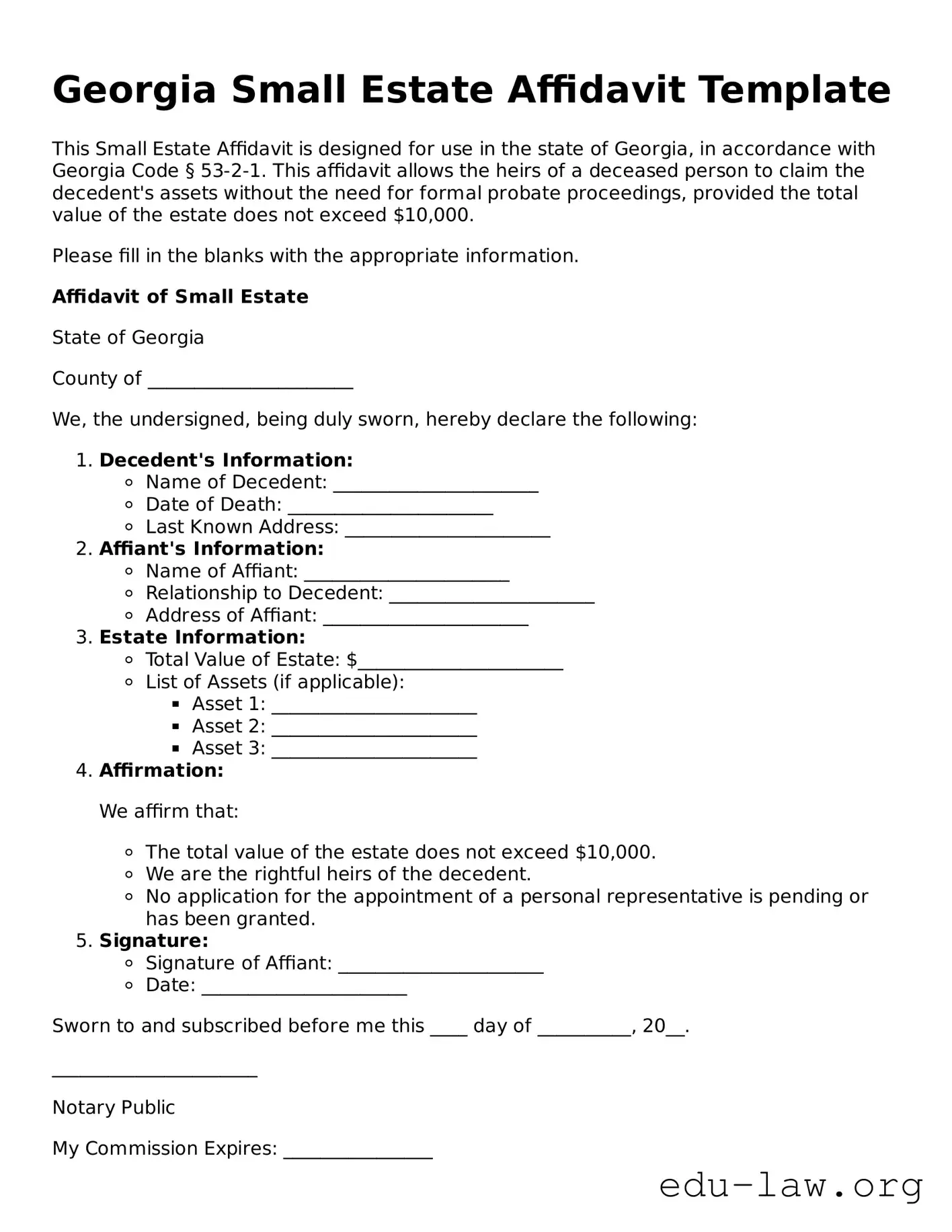
Georgia Small Estate Affidavit Template
This Small Estate Affidavit is designed for use in the state of Georgia, in accordance with Georgia Code § 53-2-1. This affidavit allows the heirs of a deceased person to claim the decedent's assets without the need for formal probate proceedings, provided the total value of the estate does not exceed $10,000.
Please fill in the blanks with the appropriate information.
Affidavit of Small Estate
State of Georgia
County of ______________________
We, the undersigned, being duly sworn, hereby declare the following:
We affirm that:
Sworn to and subscribed before me this ____ day of __________, 20__.
______________________
Notary Public
My Commission Expires: ________________
| Fact Name | Description |
|---|---|
| Purpose | The Georgia Small Estate Affidavit allows heirs to claim assets without going through a lengthy probate process. |
| Eligibility | This form is applicable when the total value of the estate is $10,000 or less, excluding certain exempt assets. |
| Governing Law | The use of the Small Estate Affidavit in Georgia is governed by O.C.G.A. § 53-2-40. |
| Required Information | Heirs must provide details such as the deceased's name, date of death, and a list of assets. |
| Signature Requirement | The affidavit must be signed by the heirs and notarized to be considered valid. |
| Filing Process | Once completed, the affidavit can be presented to financial institutions and other entities holding the deceased's assets. |
Completing the Georgia Small Estate Affidavit form is an important step in managing the estate of a deceased person. Once the form is filled out correctly, it will allow you to claim the deceased's assets without going through the probate process. Follow the steps below to ensure accurate completion of the form.
What is a Georgia Small Estate Affidavit?
The Georgia Small Estate Affidavit is a legal document that allows individuals to settle the estate of a deceased person without going through the lengthy and often costly process of probate. This form can be used when the total value of the estate is below a certain threshold, which, as of the latest updates, is $10,000 for personal property and $25,000 for real property. The affidavit simplifies the transfer of assets to heirs or beneficiaries, making it a practical option for smaller estates.
Who is eligible to use the Small Estate Affidavit in Georgia?
To qualify for the Small Estate Affidavit, the individual must be an heir or beneficiary of the deceased person. Additionally, the estate must meet the value limits mentioned earlier. It is important to note that if the deceased had a will, the affidavit can still be used, but it must align with the provisions of the will. If the estate exceeds the specified value limits, the probate process will be necessary to properly administer the estate.
How do I complete and file the Small Estate Affidavit?
Completing the Small Estate Affidavit involves gathering necessary information about the deceased's assets, debts, and heirs. The form must be filled out accurately, providing details such as the decedent's name, date of death, and the value of the estate. Once completed, the affidavit should be signed in front of a notary public. After notarization, the document can be filed with the appropriate court or presented to financial institutions or other entities holding the deceased's assets. It's wise to keep copies for personal records.
What happens after filing the Small Estate Affidavit?
After the Small Estate Affidavit is filed, the heirs or beneficiaries can claim the assets listed in the affidavit. This process typically involves presenting the affidavit to banks, insurance companies, or other institutions that hold the deceased's assets. The institutions may require additional documentation, such as a death certificate, before releasing the assets. Once the assets are transferred, the estate can be settled without the complexities of formal probate, allowing for a more straightforward resolution for those involved.
Incomplete Information: One common mistake is failing to provide all necessary details. Every section of the form must be filled out completely. Omitting even a small piece of information can lead to delays or rejection.
Incorrect Signatures: Signatures are crucial on the Small Estate Affidavit. People often forget to sign the document or may not have the required witnesses sign it. Ensure that all signatures are present and properly dated.
Not Meeting Eligibility Requirements: The Small Estate Affidavit is only applicable under certain conditions. Individuals sometimes mistakenly believe they qualify when they do not. Familiarize yourself with the eligibility criteria before proceeding.
Failure to Include Asset Details: Listing all assets of the deceased is essential. Some individuals neglect to mention certain assets, which can complicate the process. A thorough inventory should be provided.
Incorrectly Identifying Heirs: The form requires accurate identification of heirs. Errors in names, relationships, or contact information can cause issues. Double-check all entries to ensure they are correct.
Not Notarizing the Document: A notarized affidavit is often required. Many people forget this step, which can invalidate the document. Make sure to have the affidavit notarized before submission.
Ignoring Local Requirements: Different counties may have specific requirements or additional forms. Failing to check local regulations can lead to complications. Always verify the requirements for the county where the affidavit will be filed.
When dealing with the distribution of a deceased person's assets in Georgia, the Small Estate Affidavit is a useful tool. However, several other forms and documents may be necessary to ensure a smooth process. Here are some commonly used documents that accompany the Small Estate Affidavit:
Gathering these documents can streamline the estate settlement process and help ensure compliance with Georgia's legal requirements. Proper preparation will facilitate a smoother transition for all parties involved.
The Georgia Small Estate Affidavit is similar to the Affidavit of Heirship. This document is used to establish the heirs of a deceased person, particularly when there is no will. By providing information about the deceased and the heirs, the Affidavit of Heirship helps facilitate the transfer of property without going through probate. It serves as a declaration by individuals who know the family history, which can be crucial in resolving ownership issues in a timely manner.
Another document that bears resemblance to the Small Estate Affidavit is the Will. A will outlines how a person wishes their property to be distributed after their death. While the Small Estate Affidavit is used when the estate is below a certain value, a will can apply to estates of any size. Both documents aim to clarify the deceased's intentions and help ensure that their wishes are honored, but a will typically requires probate, while the affidavit allows for a more streamlined process.
The Affidavit of Collection of Personal Property is also similar. This document allows individuals to collect personal property of a deceased person without going through the probate process. Like the Small Estate Affidavit, it simplifies the transfer of assets, but it is specifically focused on personal property rather than real estate or other types of assets. This makes it particularly useful for families dealing with smaller estates.
The Small Estate Affidavit shares characteristics with the Transfer on Death Deed (TOD). A TOD allows property owners to designate beneficiaries who will receive the property upon their death, bypassing probate. Both documents facilitate the transfer of assets outside of probate, but the TOD specifically addresses real estate and is executed during the property owner's lifetime, while the Small Estate Affidavit is used after death.
The Affidavit of Domestic Partnership is another related document. This affidavit is often used to assert the existence of a domestic partnership for purposes such as inheritance rights. While it does not directly transfer property, it can impact how assets are distributed, similar to the Small Estate Affidavit, which allows for the distribution of a small estate without formal probate proceedings.
The Small Estate Affidavit can also be compared to the Petition for Letters of Administration. This petition is filed in probate court to appoint an administrator for an estate when there is no will. While both documents deal with the administration of an estate, the Small Estate Affidavit is a quicker, less formal option for smaller estates, allowing heirs to access assets without waiting for court approval.
Another document similar to the Small Estate Affidavit is the Affidavit of Survivorship. This affidavit is used when a joint owner of property passes away, allowing the surviving owner to claim full ownership. Both documents serve to clarify ownership and simplify the transfer of assets, but the Affidavit of Survivorship specifically addresses joint ownership situations.
Finally, the Durable Power of Attorney can be considered similar in that it allows individuals to designate someone to manage their affairs, including property, while they are still alive. While the Small Estate Affidavit deals with the distribution of assets after death, both documents emphasize the importance of clearly defined authority and intentions regarding property management. The key difference lies in the timing of their use and the circumstances they address.
When filling out the Georgia Small Estate Affidavit form, attention to detail is crucial. Here are some important do's and don'ts to consider:
The Georgia Small Estate Affidavit is a useful legal tool that simplifies the process of settling small estates. However, several misconceptions surround its use and requirements. Here are ten common misunderstandings:
Only estates under $10,000 qualify. Many believe that the limit for a small estate is strictly $10,000. In Georgia, the limit is actually $15,000 for individuals who die on or after January 1, 2022. This amount can change, so it's essential to verify the current limit.
All debts must be paid before using the affidavit. Some people think that all debts must be settled before they can use the Small Estate Affidavit. While it's important to address debts, the affidavit allows for the transfer of assets without settling all debts immediately.
The affidavit can only be used for probate assets. There is a misconception that the Small Estate Affidavit applies only to assets that go through probate. However, it can also be used for certain non-probate assets, depending on the circumstances.
Only heirs can use the Small Estate Affidavit. While heirs often use the affidavit, anyone with a legal claim to the estate, including creditors, may also be able to utilize it under specific conditions.
A lawyer is required to complete the affidavit. Many assume that legal representation is necessary to fill out the Small Estate Affidavit. In reality, individuals can complete the form on their own, provided they understand the requirements.
The affidavit is the same as a will. Some people confuse the Small Estate Affidavit with a will. They serve different purposes; a will outlines how an estate should be distributed after death, while the affidavit is a tool for transferring assets without formal probate.
All assets must be listed in the affidavit. It is not required to list every single asset in the Small Estate Affidavit. Only the assets that the affiant wishes to transfer need to be included.
The process is the same for all counties in Georgia. Some individuals think that the procedure for using the Small Estate Affidavit is uniform across the state. In fact, local rules and practices may vary, so checking with the local probate court is advisable.
Once filed, the affidavit cannot be changed. There is a belief that once the Small Estate Affidavit is submitted, it cannot be modified. However, if there are changes or new information, the affidavit can often be amended.
The Small Estate Affidavit can be used for any estate. Lastly, some people mistakenly think that the Small Estate Affidavit is applicable to all estates, regardless of size or complexity. It is specifically designed for smaller estates, so larger or more complicated estates will require a different approach.
Understanding these misconceptions can help individuals navigate the process of settling a small estate in Georgia more effectively. Always consider consulting with a legal professional for guidance tailored to specific situations.
The Georgia Small Estate Affidavit is a useful tool for individuals seeking to settle the estate of a deceased person without going through formal probate. Here are key takeaways to consider when filling out and using this form: