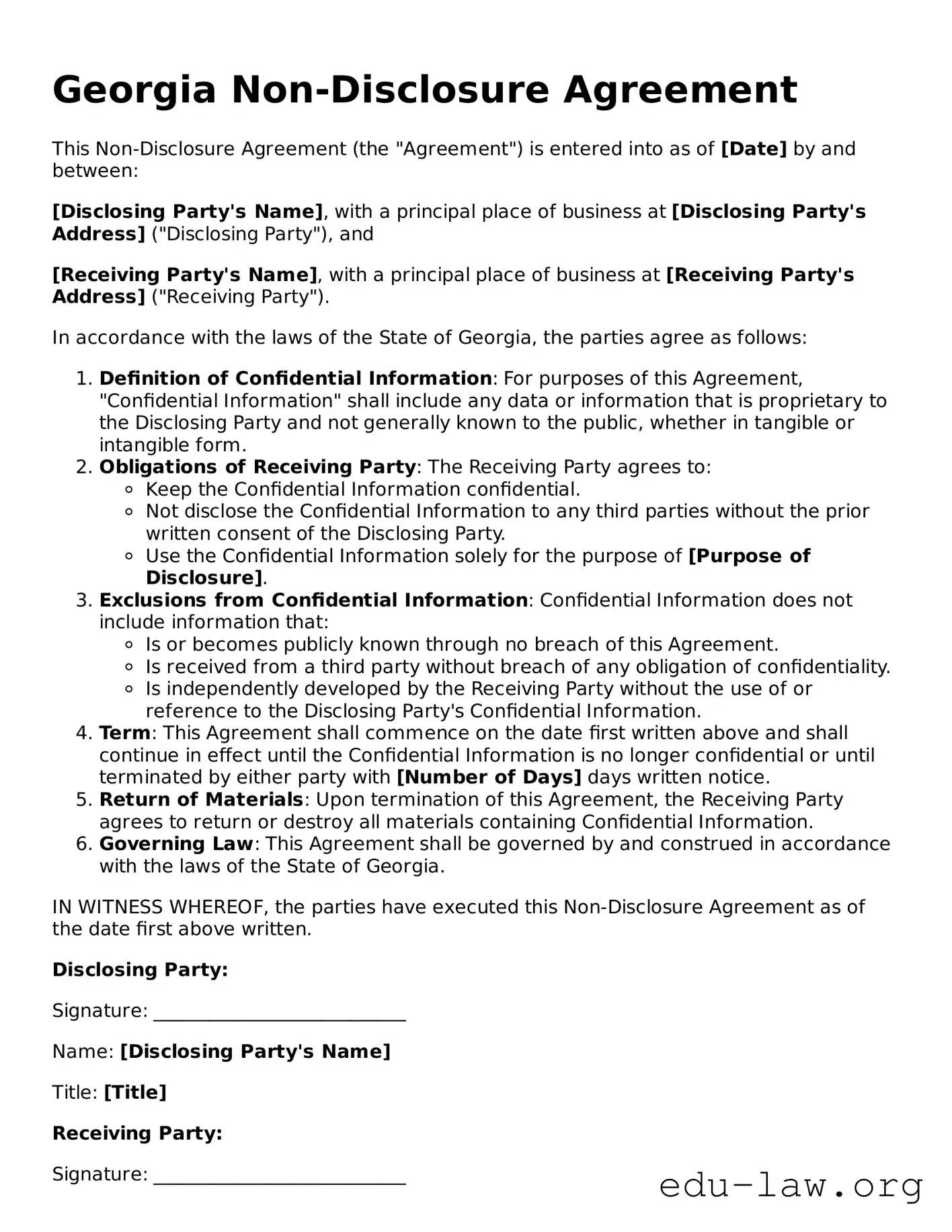
In the realm of business and professional relationships, confidentiality plays a crucial role in protecting sensitive information. The Georgia Non-disclosure Agreement (NDA) form serves as a vital tool for individuals and organizations seeking to safeguard their proprietary data. This legally binding document outlines the obligations of parties involved regarding the handling and sharing of confidential information. Key components of the NDA include definitions of what constitutes confidential information, the duration of the confidentiality obligation, and the permitted uses of the disclosed information. Additionally, it addresses the consequences of unauthorized disclosure, ensuring that parties understand the seriousness of breaching the agreement. By establishing clear guidelines, the Georgia NDA helps foster trust and collaboration while minimizing the risk of information leaks that could harm competitive advantage or proprietary interests.
Georgia Non-Disclosure Agreement
This Non-Disclosure Agreement (the "Agreement") is entered into as of [Date] by and between:
[Disclosing Party's Name], with a principal place of business at [Disclosing Party's Address] ("Disclosing Party"), and
[Receiving Party's Name], with a principal place of business at [Receiving Party's Address] ("Receiving Party").
In accordance with the laws of the State of Georgia, the parties agree as follows:
IN WITNESS WHEREOF, the parties have executed this Non-Disclosure Agreement as of the date first above written.
Disclosing Party:
Signature: ___________________________
Name: [Disclosing Party's Name]
Title: [Title]
Receiving Party:
Signature: ___________________________
Name: [Receiving Party's Name]
Title: [Title]
| Fact Name | Description |
|---|---|
| Purpose | The Georgia Non-disclosure Agreement (NDA) is designed to protect confidential information shared between parties. |
| Governing Law | The NDA is governed by the laws of the State of Georgia. |
| Parties Involved | The agreement typically involves a disclosing party and a receiving party. |
| Duration | The duration of confidentiality obligations can vary and should be specified in the agreement. |
| Enforceability | Non-disclosure agreements in Georgia are generally enforceable if they are reasonable in scope and duration. |
After obtaining the Georgia Non-disclosure Agreement form, it is essential to complete it accurately to ensure that all parties understand their obligations. This process involves providing specific information about the parties involved and the nature of the confidential information being protected. Follow these steps to fill out the form correctly.
What is a Non-disclosure Agreement (NDA) in Georgia?
A Non-disclosure Agreement, commonly known as an NDA, is a legal contract designed to protect sensitive information shared between parties. In Georgia, this agreement ensures that confidential information remains private and is not disclosed to unauthorized individuals or entities. NDAs are often used in business transactions, employment relationships, and partnerships to safeguard trade secrets and proprietary information.
Who should use a Non-disclosure Agreement?
Any individual or business that plans to share confidential information should consider using an NDA. This includes entrepreneurs discussing business ideas with potential investors, companies sharing proprietary technology with partners, or employers disclosing sensitive information to employees. By implementing an NDA, parties can establish clear expectations regarding confidentiality and protect their interests.
What should be included in a Georgia Non-disclosure Agreement?
A comprehensive NDA should outline several key elements. First, it must clearly define what constitutes confidential information. Second, it should specify the obligations of the receiving party regarding the handling of this information. Additionally, the agreement should include the duration of confidentiality, any exclusions (such as information already in the public domain), and the consequences of a breach. It is also advisable to include a dispute resolution clause to address potential conflicts.
How long does a Non-disclosure Agreement last in Georgia?
The duration of an NDA can vary based on the specific terms agreed upon by the parties involved. Generally, NDAs may last for a specified period, such as one to five years, or until the confidential information becomes public knowledge. It is crucial to clearly state the duration in the agreement to avoid any ambiguity and ensure both parties understand their obligations.
What happens if someone breaches a Non-disclosure Agreement?
If a party breaches an NDA, the other party may have legal recourse. This can include seeking damages for any losses incurred due to the breach. In some cases, the injured party may also seek injunctive relief to prevent further disclosure of the confidential information. It is essential to enforce the terms of the NDA promptly to protect one's interests effectively.
Can a Non-disclosure Agreement be modified?
Yes, a Non-disclosure Agreement can be modified if both parties agree to the changes. Modifications should be documented in writing and signed by both parties to ensure enforceability. It is advisable to review the NDA regularly to ensure it remains relevant and adequately protects the interests of all parties involved.
Incomplete Information: Failing to provide all required details, such as names and addresses, can lead to issues down the line.
Incorrect Dates: Entering the wrong dates for the agreement’s duration can create confusion about the terms.
Missing Signatures: Not signing the document or omitting a signature from one of the parties can render the agreement invalid.
Ambiguous Language: Using vague terms or unclear definitions can lead to misunderstandings about what information is protected.
Neglecting to Identify Confidential Information: Failing to specify what constitutes confidential information can weaken the agreement.
Ignoring State-Specific Requirements: Not adhering to Georgia’s specific legal requirements can affect enforceability.
Assuming All Information is Confidential: Including non-confidential information in the agreement can dilute its effectiveness.
Not Considering Duration: Overlooking the time frame for the confidentiality obligations can lead to unnecessary complications.
Failure to Review: Not reviewing the document thoroughly before signing can result in overlooked errors.
Not Seeking Legal Advice: Skipping the step of consulting a legal professional can lead to misunderstandings about rights and obligations.
When engaging in business relationships, especially in Georgia, a Non-disclosure Agreement (NDA) is a crucial tool for protecting sensitive information. However, it often works best in conjunction with other important forms and documents. Here’s a list of commonly used forms that complement the Georgia Non-disclosure Agreement:
Understanding these documents can significantly enhance your ability to protect sensitive information and foster trust in business relationships. Always consider the unique needs of your situation and consult with a professional when drafting or signing these agreements.
A Confidentiality Agreement is similar to a Non-disclosure Agreement (NDA) in that both documents aim to protect sensitive information. A Confidentiality Agreement typically outlines what information must be kept private and the obligations of the parties involved. It serves to prevent the unauthorized sharing of proprietary data, trade secrets, or personal information, making it essential in various business relationships.
A Proprietary Information Agreement (PIA) shares similarities with an NDA, focusing specifically on proprietary information. This type of agreement is often used in situations where one party discloses information that is critical to their business operations. Like an NDA, a PIA establishes the boundaries of confidentiality, ensuring that the receiving party understands the importance of safeguarding the disclosed information.
A Mutual Non-disclosure Agreement is another document closely related to a standard NDA. In this case, both parties agree to protect each other's confidential information. This mutuality fosters trust and encourages open communication, especially in negotiations or partnerships where both sides may share sensitive data. The structure and terms of a mutual NDA are similar to a unilateral NDA but emphasize the shared nature of the confidentiality obligations.
An Employment Agreement often includes a confidentiality clause that resembles an NDA. This clause protects an employer's sensitive information from being disclosed by employees during and after their employment. While the primary purpose of an Employment Agreement is to outline the terms of employment, the confidentiality clause serves as a safeguard for the employer’s intellectual property and trade secrets.
A Service Agreement can also include confidentiality terms that are similar to those in an NDA. When a service provider is given access to sensitive information, the Service Agreement may specify the obligation to keep that information confidential. This ensures that any proprietary data shared during the course of providing services remains protected, similar to the confidentiality obligations outlined in an NDA.
When filling out the Georgia Non-disclosure Agreement form, it's important to follow certain guidelines to ensure accuracy and compliance. Here are some dos and don'ts to keep in mind:
By following these guidelines, you can help ensure that your Non-disclosure Agreement is properly completed and enforceable.
Misconceptions about the Georgia Non-disclosure Agreement (NDA) can lead to misunderstandings about its purpose and effectiveness. Here are six common misconceptions:
Understanding these misconceptions can help individuals and businesses navigate the complexities of NDAs more effectively.
When dealing with sensitive information in Georgia, a Non-disclosure Agreement (NDA) is a vital tool. Here are some key takeaways to consider when filling out and using this form:
Using a well-crafted NDA can help foster trust between parties while protecting valuable information. Understanding the nuances of this agreement is essential for effective use.