In Georgia, the Medical Power of Attorney form serves as a vital tool for individuals seeking to ensure their healthcare preferences are honored when they are unable to communicate those wishes themselves. This legal document allows you to designate a trusted person, often referred to as your agent or proxy, to make medical decisions on your behalf. It covers a range of decisions, from routine medical care to life-sustaining treatments, providing clarity and guidance for healthcare providers during critical moments. By outlining your preferences in advance, you can alleviate the burden on family members and friends, ensuring that your values and wishes are respected. Understanding how to properly execute this form is crucial, as it requires specific signatures and may need to be notarized or witnessed to be legally binding. Additionally, it’s important to know that this document can be revoked or modified at any time, giving you flexibility as your circumstances or preferences change. With this form in place, you can navigate the complexities of medical care with greater peace of mind, knowing that your chosen advocate will act in your best interest when it matters most.
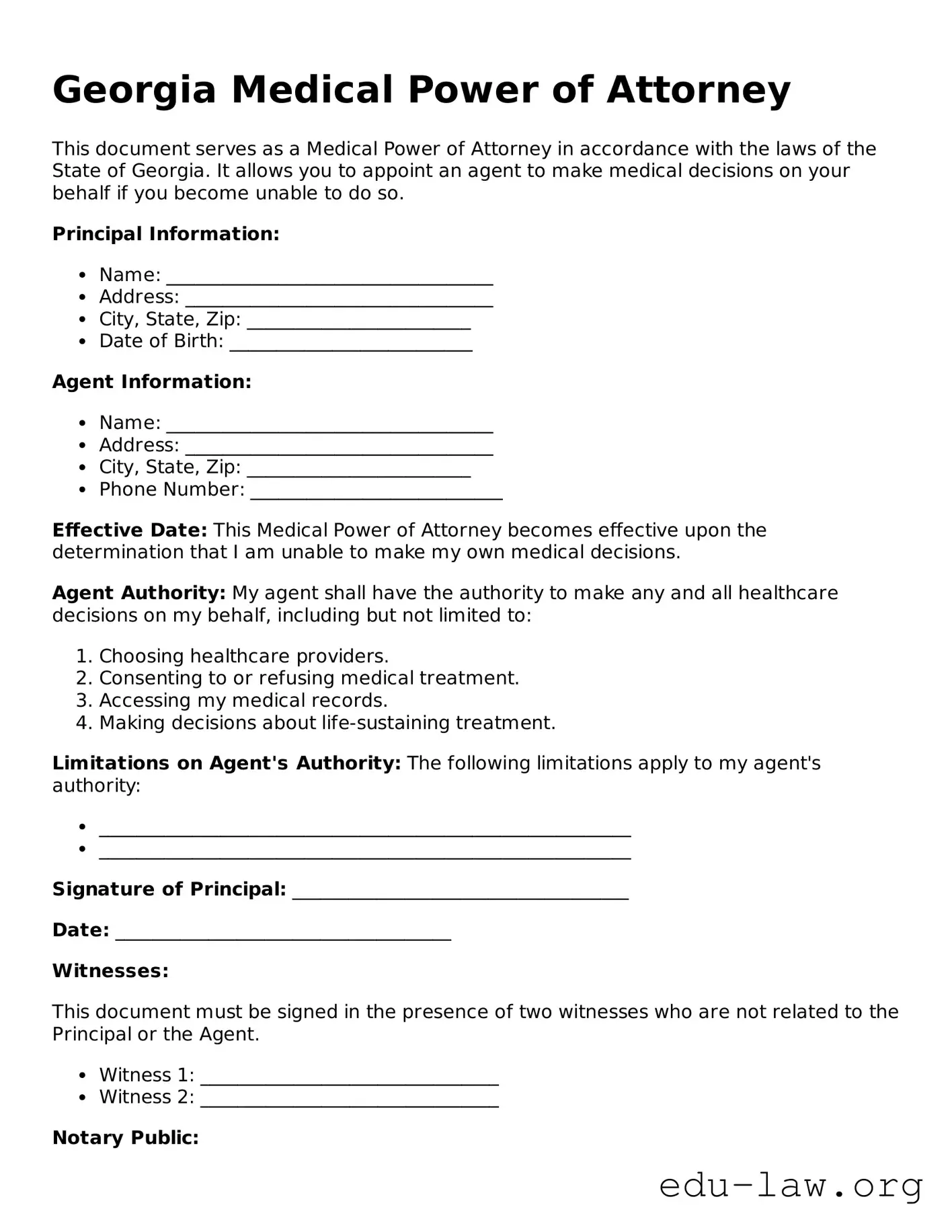
Georgia Medical Power of Attorney
This document serves as a Medical Power of Attorney in accordance with the laws of the State of Georgia. It allows you to appoint an agent to make medical decisions on your behalf if you become unable to do so.
Principal Information:
Agent Information:
Effective Date: This Medical Power of Attorney becomes effective upon the determination that I am unable to make my own medical decisions.
Agent Authority: My agent shall have the authority to make any and all healthcare decisions on my behalf, including but not limited to:
Limitations on Agent's Authority: The following limitations apply to my agent's authority:
Signature of Principal: ____________________________________
Date: ____________________________________
Witnesses:
This document must be signed in the presence of two witnesses who are not related to the Principal or the Agent.
Notary Public:
State of Georgia, County of ________________
Subscribed and sworn to before me on this _____ day of __________, 20__.
Notary Public: ________________________________
My commission expires: ______________________
| Fact Name | Description |
|---|---|
| Purpose | The Georgia Medical Power of Attorney form allows an individual to designate someone to make medical decisions on their behalf if they become unable to do so. |
| Governing Law | This form is governed by the Georgia Code, specifically O.C.G.A. § 31-36, which outlines the regulations surrounding medical powers of attorney in the state. |
| Eligibility | Any adult resident of Georgia can create a Medical Power of Attorney, as long as they are of sound mind when signing the document. |
| Agent Requirements | The person appointed as the agent must be at least 18 years old and cannot be the individual’s healthcare provider or an employee of the healthcare provider. |
| Revocation | The principal can revoke the Medical Power of Attorney at any time, as long as they are mentally competent, and should do so in writing to ensure clarity. |
Filling out the Georgia Medical Power of Attorney form is an important step in ensuring that your healthcare decisions are made according to your wishes if you become unable to communicate them yourself. Once you have the form completed, you will need to sign it and have it witnessed or notarized to make it legally binding.
What is a Georgia Medical Power of Attorney?
A Georgia Medical Power of Attorney is a legal document that allows an individual, known as the principal, to appoint someone else, called an agent, to make healthcare decisions on their behalf if they become unable to do so. This ensures that the principal's medical preferences are respected even when they cannot communicate them directly.
Who can be appointed as an agent?
In Georgia, any competent adult can be appointed as an agent. This includes family members, friends, or trusted individuals. It is important to choose someone who understands your healthcare wishes and is willing to advocate for them in medical situations.
Is the Georgia Medical Power of Attorney form required to be notarized?
No, the Georgia Medical Power of Attorney form does not need to be notarized. However, it must be signed by the principal in the presence of two witnesses who are not related to the principal or the agent and who will not benefit from the principal's estate.
Can I revoke my Medical Power of Attorney?
Yes, you can revoke your Medical Power of Attorney at any time, as long as you are mentally competent. To do this, you should inform your agent and any healthcare providers of your decision. It is advisable to create a written revocation to avoid any confusion.
What happens if I do not have a Medical Power of Attorney?
If you do not have a Medical Power of Attorney and become incapacitated, healthcare providers may need to seek a court-appointed guardian to make decisions on your behalf. This process can be time-consuming and may not reflect your personal wishes regarding medical care.
Can I include specific medical instructions in the form?
Yes, you can include specific medical instructions in your Medical Power of Attorney. It is beneficial to clearly outline your preferences regarding treatments, life support, and other healthcare decisions to guide your agent in making choices that align with your values.
How do I ensure my Medical Power of Attorney is valid?
To ensure your Medical Power of Attorney is valid, make sure it is properly signed by you and witnessed according to Georgia law. Keep the document in a safe place and provide copies to your agent and any healthcare providers involved in your care.
Can I change my agent after I have appointed one?
Yes, you can change your agent at any time while you are still competent. To do this, you should complete a new Medical Power of Attorney form that designates the new agent and revoke the previous document to avoid any conflicts.
What should I do if my agent is unavailable when decisions need to be made?
If your agent is unavailable, the Medical Power of Attorney does not automatically designate an alternative agent. It is advisable to name a backup agent in your document to ensure that someone can make decisions on your behalf when needed.
Where should I keep my Medical Power of Attorney document?
Keep your Medical Power of Attorney document in a secure yet accessible location. Inform your agent and close family members about its location. Additionally, consider providing copies to your healthcare providers to ensure they have access to your wishes when necessary.
Not Naming an Alternate Agent: Many individuals fail to name an alternate agent. If the primary agent cannot act, this oversight can lead to complications.
Leaving Sections Blank: Some people leave sections of the form blank, which can create confusion or lead to misinterpretation of their wishes.
Using Ambiguous Language: Vague terms can lead to misunderstandings. Clear and specific language is essential to convey medical preferences.
Not Signing the Document: A common mistake is forgetting to sign the form. Without a signature, the document is not valid.
Failing to Date the Form: Not dating the form can create issues regarding the timing of the agent's authority. Always include the date of signing.
Ignoring Witness Requirements: In Georgia, the form must be signed in the presence of two witnesses or notarized. Failing to meet these requirements invalidates the document.
Choosing an Inappropriate Agent: Selecting someone who may not respect your wishes or who is not capable of making tough decisions can lead to conflicts.
Not Reviewing the Document Regularly: Life changes, and so do preferences. Failing to review and update the document can result in outdated directives.
Overlooking State-Specific Laws: Each state has its own laws regarding medical powers of attorney. Ignoring Georgia’s specific requirements can lead to issues.
Not Discussing Wishes with the Agent: Failing to communicate your healthcare preferences with your chosen agent can create confusion and stress during critical times.
When considering a Georgia Medical Power of Attorney, it's important to understand that it often works alongside several other documents. These forms can help clarify your wishes regarding medical treatment and ensure that your healthcare preferences are respected. Below is a list of common documents that are frequently used in conjunction with the Medical Power of Attorney form.
Understanding these documents can provide peace of mind. They work together to ensure your healthcare and financial wishes are honored, even when you may not be able to communicate them yourself. It's advisable to discuss these forms with your loved ones and healthcare providers to ensure everyone is on the same page.
The Georgia Medical Power of Attorney form is similar to the Advance Healthcare Directive. Both documents allow individuals to outline their healthcare preferences and appoint someone to make medical decisions on their behalf if they become unable to communicate. The Advance Healthcare Directive goes a step further by combining the powers of a Medical Power of Attorney with a living will, which specifies the types of medical treatment a person wishes to receive or avoid in certain situations. This comprehensive approach ensures that an individual’s healthcare wishes are honored even when they cannot voice them directly.
Another document that shares similarities is the Durable Power of Attorney for Healthcare. Like the Medical Power of Attorney, this document designates a person to make healthcare decisions for someone who is incapacitated. However, the Durable Power of Attorney can also encompass financial decisions, allowing the appointed individual to manage both medical and financial matters. This dual capacity can be beneficial for individuals looking for a single trusted person to handle various aspects of their lives if they are unable to do so themselves.
The Living Will is also comparable to the Georgia Medical Power of Attorney. While the Medical Power of Attorney focuses on appointing a decision-maker, the Living Will explicitly states a person's wishes regarding end-of-life care and specific medical treatments. It serves as a guide for healthcare providers and family members about what types of life-sustaining measures an individual does or does not want, making it an essential document for those wanting to ensure their preferences are respected in critical situations.
The Health Care Proxy is another document that functions similarly to the Medical Power of Attorney. This form designates a trusted individual to make healthcare decisions for someone who is unable to do so. While it may not include detailed instructions about specific medical treatments, it empowers the proxy to make choices based on the individual’s known values and preferences. This flexibility can be crucial in rapidly changing medical situations where quick decisions are necessary.
Lastly, the Do Not Resuscitate (DNR) order can be seen as related to the Medical Power of Attorney. While it does not appoint a decision-maker, it expresses a person’s wishes regarding resuscitation efforts in the event of cardiac arrest. This document is particularly important for individuals who wish to avoid aggressive medical interventions at the end of life. It complements the Medical Power of Attorney by providing specific instructions that can guide the appointed agent in making decisions consistent with the individual’s desires.
When filling out the Georgia Medical Power of Attorney form, it is essential to follow certain guidelines to ensure your document is valid and effective. Here’s a list of things you should and shouldn’t do:
Understanding the Georgia Medical Power of Attorney (MPOA) form is essential for making informed decisions about healthcare. However, several misconceptions can lead to confusion. Here are ten common misconceptions about the Georgia MPOA form:
Clarifying these misconceptions can help individuals make better decisions regarding their healthcare and ensure that their wishes are respected when they cannot speak for themselves.
When filling out and using the Georgia Medical Power of Attorney form, it is essential to keep several important points in mind. This document allows you to appoint someone to make healthcare decisions on your behalf if you become unable to do so. Here are key takeaways to consider:
Being informed about these aspects can help ensure that your medical preferences are respected when it matters most.