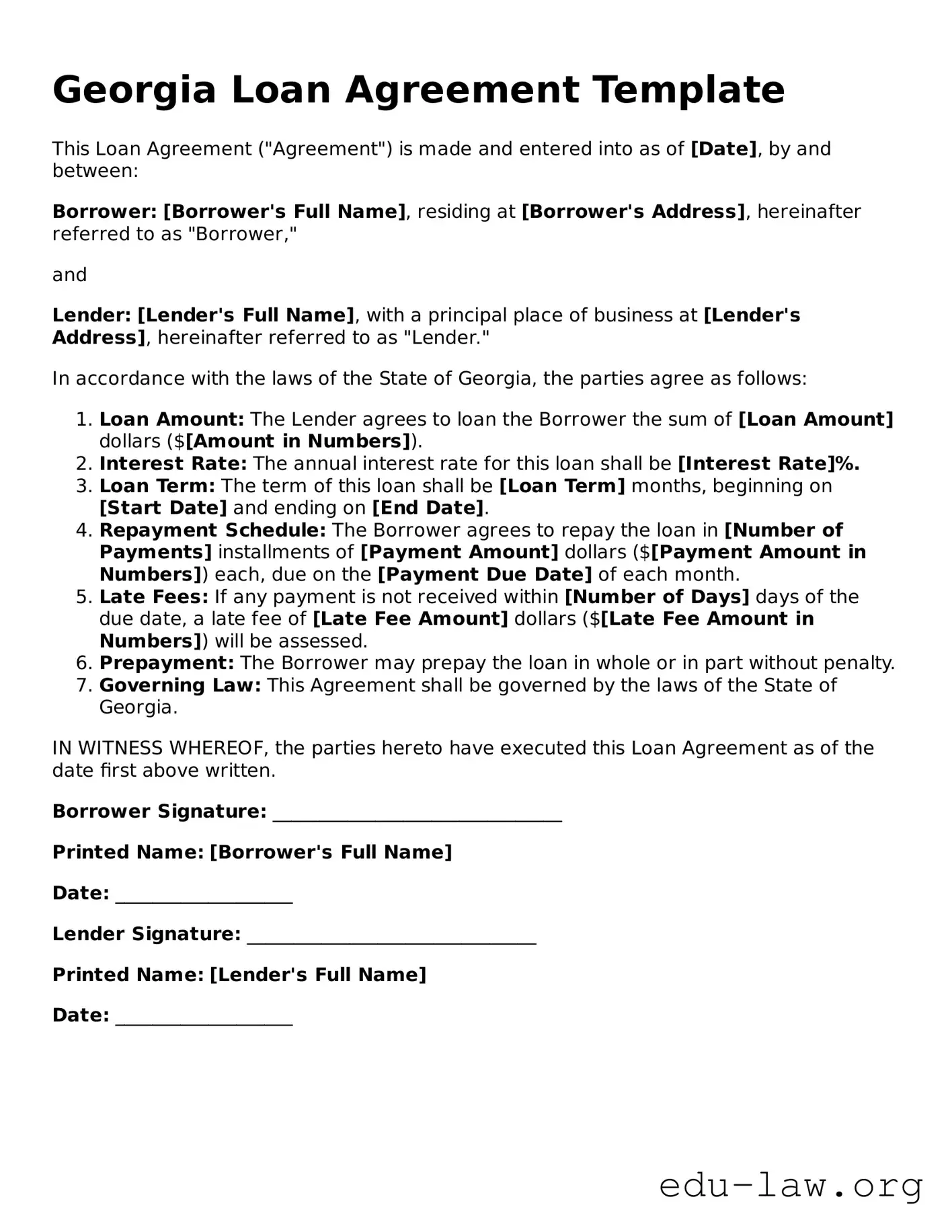
When navigating the financial landscape, understanding the Georgia Loan Agreement form is essential for both borrowers and lenders. This document serves as a legally binding contract that outlines the terms and conditions of a loan, ensuring that all parties are on the same page. Key components of the form include the loan amount, interest rate, repayment schedule, and any collateral involved. Additionally, it details the rights and responsibilities of each party, which helps prevent misunderstandings down the line. The agreement also addresses potential default scenarios, outlining the steps that may be taken if payments are missed. By clearly defining these aspects, the Georgia Loan Agreement form not only protects the lender's investment but also provides borrowers with a clear understanding of their obligations. This comprehensive approach fosters transparency and trust, making it a vital tool in the borrowing process.
Georgia Loan Agreement Template
This Loan Agreement ("Agreement") is made and entered into as of [Date], by and between:
Borrower: [Borrower's Full Name], residing at [Borrower's Address], hereinafter referred to as "Borrower,"
and
Lender: [Lender's Full Name], with a principal place of business at [Lender's Address], hereinafter referred to as "Lender."
In accordance with the laws of the State of Georgia, the parties agree as follows:
IN WITNESS WHEREOF, the parties hereto have executed this Loan Agreement as of the date first above written.
Borrower Signature: _______________________________
Printed Name: [Borrower's Full Name]
Date: ___________________
Lender Signature: _______________________________
Printed Name: [Lender's Full Name]
Date: ___________________
| Fact Name | Description |
|---|---|
| Governing Law | The Georgia Loan Agreement is governed by the laws of the State of Georgia. |
| Parties Involved | The agreement typically involves a lender and a borrower, both of whom must be clearly identified. |
| Loan Amount | The specific amount of money being loaned must be stated in the agreement. |
| Interest Rate | The agreement must specify the interest rate applicable to the loan, whether fixed or variable. |
| Repayment Terms | Details regarding how and when the borrower will repay the loan should be clearly outlined. |
| Default Conditions | The agreement should describe the conditions under which a borrower would be considered in default. |
| Collateral | If applicable, any collateral securing the loan must be identified in the agreement. |
| Signatures | Both parties must sign the agreement for it to be legally binding. |
| Amendments | The process for making any amendments to the agreement should be stated clearly. |
Filling out the Georgia Loan Agreement form requires careful attention to detail. After completing the form, it will be essential to review the information provided for accuracy before submitting it. This ensures that all parties involved understand their rights and obligations under the agreement.
What is a Georgia Loan Agreement form?
A Georgia Loan Agreement form is a legal document that outlines the terms and conditions under which a borrower agrees to repay a loan to a lender. This form typically includes details such as the loan amount, interest rate, repayment schedule, and any collateral involved. It serves to protect both parties by clearly defining their rights and obligations.
Who should use a Georgia Loan Agreement?
This form is suitable for individuals or businesses in Georgia who are lending or borrowing money. Whether it's a personal loan between friends, a business loan, or any other financial transaction, having a written agreement helps ensure that all parties understand their responsibilities and reduces the risk of disputes.
What key elements should be included in the Loan Agreement?
Essential elements of a Georgia Loan Agreement include the names and contact information of the borrower and lender, the principal amount of the loan, the interest rate, the repayment schedule, any late fees, and provisions for default. Additionally, it may specify any collateral securing the loan and the governing law, which in this case would be Georgia law.
Is it necessary to have the Loan Agreement notarized?
While notarization is not strictly required for a Georgia Loan Agreement to be valid, it is highly recommended. Notarizing the document adds an extra layer of authenticity and can help prevent disputes over the validity of the agreement in the future.
What happens if the borrower defaults on the loan?
If the borrower defaults, the lender has the right to take specific actions as outlined in the agreement. This may include charging late fees, accelerating the loan (demanding full repayment), or taking legal action to recover the owed amount. The exact consequences should be clearly stated in the agreement to avoid confusion.
Can the Loan Agreement be modified after it is signed?
Yes, the Loan Agreement can be modified after it is signed, but both parties must agree to the changes. It is advisable to document any modifications in writing and have both parties sign the amended agreement to maintain clarity and legal standing.
Are there any state-specific laws I should be aware of?
Yes, Georgia has specific laws governing loan agreements, including limits on interest rates and requirements for disclosures. It's important to ensure that the Loan Agreement complies with these regulations to avoid potential legal issues. Consulting with a legal professional is recommended for complex agreements.
Where can I obtain a Georgia Loan Agreement form?
A Georgia Loan Agreement form can be obtained from various sources, including legal websites, office supply stores, or through a legal professional. It is essential to use a form that complies with Georgia laws to ensure its enforceability.
Incorrect Personal Information: Many individuals fail to provide accurate personal details, such as their full name, address, or Social Security number. Double-checking this information is crucial to avoid delays.
Missing Signatures: Some people forget to sign the document or miss the required signatures of co-borrowers. Each signature is essential for the agreement to be valid.
Improper Loan Amount: Entering an incorrect loan amount can lead to confusion and complications. Ensure the amount matches what was agreed upon.
Failure to Read Terms: Skimming through the terms and conditions is a common mistake. Understanding the repayment terms and interest rates is vital for making informed decisions.
Inaccurate Dates: People often miswrite the date of the agreement or the loan term start and end dates. This can create issues in the future.
Neglecting to Include Contact Information: Not providing a phone number or email can hinder communication between the lender and borrower. Clear communication is key.
Not Reviewing for Errors: Failing to proofread the document can lead to overlooked mistakes. A thorough review can save time and prevent misunderstandings.
Ignoring State-Specific Requirements: Each state may have unique requirements for loan agreements. Familiarizing oneself with Georgia's specific laws is essential for compliance.
When entering into a loan agreement in Georgia, several other documents may be required to ensure clarity and legal compliance. Each of these forms serves a specific purpose, helping both the lender and borrower understand their rights and responsibilities. Below is a list of commonly used forms associated with a Georgia Loan Agreement.
Understanding these documents can help borrowers navigate the loan process with greater confidence. Each form plays a crucial role in protecting both parties and ensuring a smooth transaction. Always consider consulting a legal professional if you have questions about any specific document or its implications.
The Promissory Note is a document that outlines a borrower's promise to repay a loan under specified terms. Like the Georgia Loan Agreement, it includes details such as the loan amount, interest rate, and repayment schedule. However, the Promissory Note is primarily focused on the borrower's commitment, while the Loan Agreement encompasses broader terms and conditions, including the rights and obligations of both parties involved in the transaction.
A Mortgage Agreement is another document that shares similarities with the Georgia Loan Agreement. This document specifically pertains to real estate transactions and secures the loan with the property itself. Both agreements detail the terms of the loan, but the Mortgage Agreement includes provisions related to the property, such as foreclosure rights, which are not typically found in a standard Loan Agreement.
The Security Agreement is also comparable to the Georgia Loan Agreement. This document is used when personal property secures a loan. It outlines the collateral and the lender's rights in case of default. While the Loan Agreement focuses on the loan terms, the Security Agreement emphasizes the collateral and the conditions under which the lender can claim it.
A Lease Agreement can bear similarities to a Loan Agreement, particularly in the context of financing equipment or vehicles. Both documents establish terms for the use of property, including payment schedules and responsibilities. However, a Lease Agreement typically does not transfer ownership, whereas a Loan Agreement generally leads to ownership after the loan is repaid.
The Installment Sale Agreement is another document that aligns with the Georgia Loan Agreement. This agreement allows a buyer to pay for an item over time while taking possession immediately. Similar to a Loan Agreement, it specifies payment terms and conditions. However, the key difference lies in the transfer of ownership, which occurs gradually as payments are made, unlike a traditional loan where ownership is established upfront.
A Line of Credit Agreement resembles the Georgia Loan Agreement in that it provides access to funds up to a specified limit. Borrowers can draw from the line of credit as needed, similar to how they can utilize a loan. Both documents outline repayment terms, but a Line of Credit Agreement often includes flexible borrowing options and variable interest rates, which can differ from a standard loan structure.
The Personal Loan Agreement is similar to the Georgia Loan Agreement in that it governs loans made between individuals or entities. This document specifies the loan amount, interest rate, and repayment terms. However, Personal Loan Agreements may lack some of the formalities and legal protections typically included in a more structured Loan Agreement.
A Business Loan Agreement shares characteristics with the Georgia Loan Agreement, particularly in the context of commercial financing. Both documents detail the terms of the loan, including interest rates and repayment schedules. However, Business Loan Agreements often include additional clauses related to business operations, financial reporting, and covenants that are not typically present in personal loan agreements.
Finally, a Debt Settlement Agreement is somewhat similar to the Georgia Loan Agreement as it involves the resolution of outstanding debts. This document outlines the terms under which a borrower agrees to pay a reduced amount to settle their debt. While both agreements involve financial obligations, a Debt Settlement Agreement is focused on resolving existing debts rather than establishing new loan terms.
When filling out the Georgia Loan Agreement form, attention to detail is crucial. Here are some important guidelines to follow:
Following these guidelines can help streamline your experience and increase the likelihood of a successful loan application. It is important to approach this task with care and diligence.
Here are seven common misconceptions about the Georgia Loan Agreement form:
Many people believe that a loan agreement is just a formality. In reality, once both parties sign, it becomes a legally enforceable contract.
This is false. Individuals and private lenders can also create and enforce loan agreements.
Loan agreements can vary significantly based on the terms, interest rates, and repayment schedules. Each agreement should be tailored to the specific situation.
While verbal agreements may seem convenient, they are often difficult to enforce. Written agreements provide clear evidence of the terms.
Even small loans benefit from a written agreement. It helps prevent misunderstandings and disputes.
This is not true. Loan agreements are also used in business transactions and real estate deals.
While the original agreement is binding, both parties can negotiate changes. Any modifications should be documented in writing.
When filling out and using the Georgia Loan Agreement form, there are several important points to keep in mind. Understanding these can help ensure that the process goes smoothly and that both parties are protected.
By keeping these key takeaways in mind, you can create a more effective and legally sound loan agreement in Georgia.