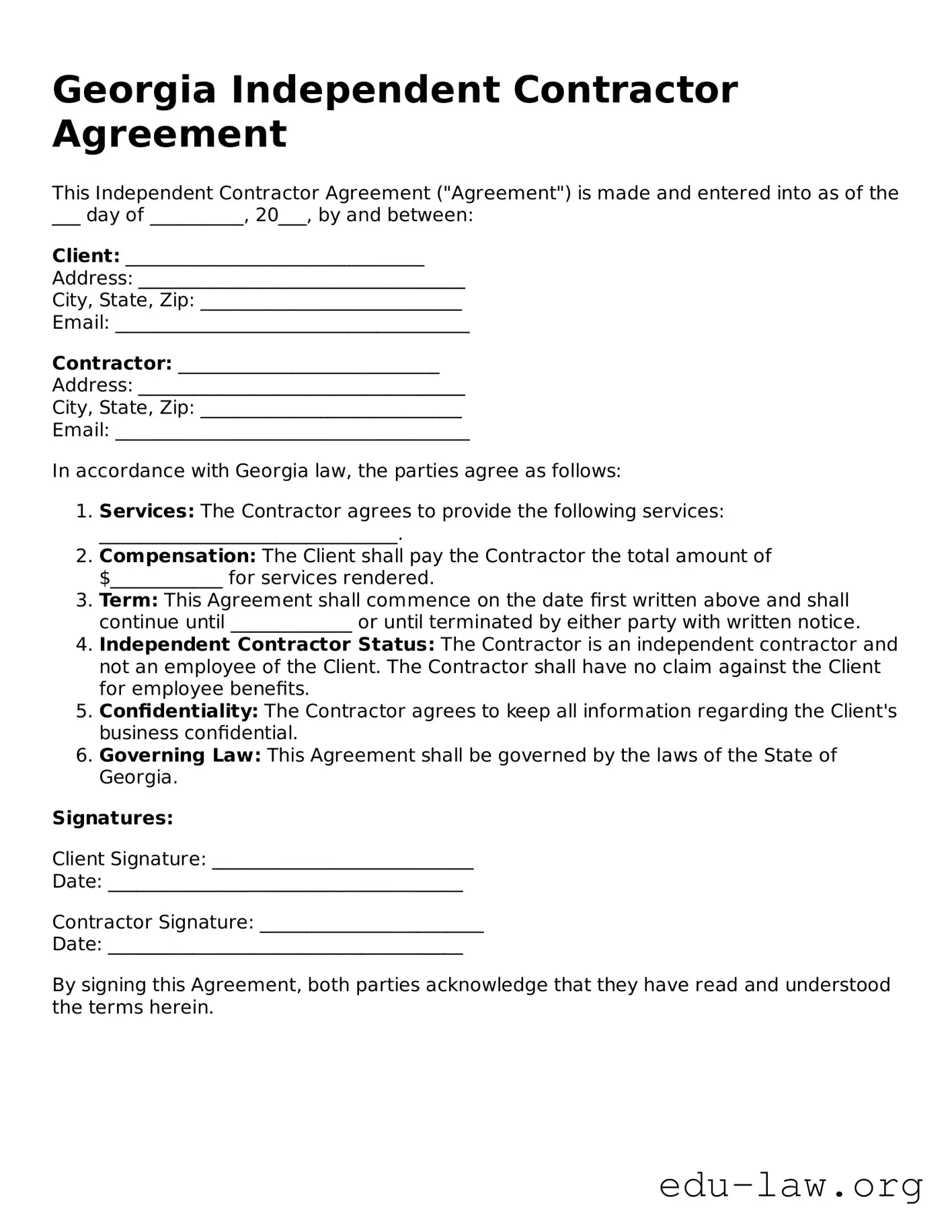
The Georgia Independent Contractor Agreement form serves as a crucial document for individuals and businesses engaging in independent contracting relationships. This form outlines the terms and conditions under which services will be provided, ensuring clarity and mutual understanding between the contractor and the hiring party. Key aspects of the agreement include the scope of work, payment terms, and duration of the contract. Additionally, it addresses the responsibilities of both parties, confidentiality provisions, and the process for resolving disputes. By clearly defining these elements, the agreement helps to minimize misunderstandings and protect the rights of all involved. It is essential for both contractors and businesses to understand the implications of this document, as it plays a significant role in establishing a professional working relationship while adhering to Georgia's legal standards.
Georgia Independent Contractor Agreement
This Independent Contractor Agreement ("Agreement") is made and entered into as of the ___ day of __________, 20___, by and between:
Client: ________________________________
Address: ___________________________________
City, State, Zip: ____________________________
Email: ______________________________________
Contractor: ____________________________
Address: ___________________________________
City, State, Zip: ____________________________
Email: ______________________________________
In accordance with Georgia law, the parties agree as follows:
Signatures:
Client Signature: ____________________________
Date: ______________________________________
Contractor Signature: ________________________
Date: ______________________________________
By signing this Agreement, both parties acknowledge that they have read and understood the terms herein.
| Fact Name | Description |
|---|---|
| Definition | The Georgia Independent Contractor Agreement outlines the terms between a business and an independent contractor. |
| Governing Law | The agreement is governed by the laws of the State of Georgia. |
| Purpose | This form clarifies the relationship, responsibilities, and rights of both parties involved. |
| Payment Terms | The agreement specifies how and when the contractor will be compensated for their services. |
| Confidentiality | Often, the agreement includes clauses to protect sensitive information shared during the contract. |
| Termination Clause | The agreement typically outlines conditions under which either party can terminate the contract. |
| Liability | Independent contractors usually assume responsibility for their own liabilities and insurance. |
| Dispute Resolution | The agreement may include provisions for resolving disputes, such as mediation or arbitration. |
Filling out the Georgia Independent Contractor Agreement form requires careful attention to detail. This form is essential for establishing a clear understanding between the contractor and the client. Follow the steps below to ensure accurate completion of the form.
Once the form is completed and signed, both parties should retain a copy. This ensures that there is a clear record of the agreement and its terms. If any questions arise later, refer back to this document for clarity.
What is a Georgia Independent Contractor Agreement?
A Georgia Independent Contractor Agreement is a legal document that outlines the relationship between a business and an independent contractor. This agreement specifies the terms and conditions under which the contractor will provide services to the business. It helps to clarify expectations, responsibilities, and compensation, ensuring both parties are on the same page.
Why is it important to have an Independent Contractor Agreement?
Having an Independent Contractor Agreement is crucial for several reasons. First, it protects both the business and the contractor by clearly defining the scope of work, payment terms, and deadlines. This clarity can help prevent misunderstandings and disputes down the line. Additionally, it establishes the contractor's status as an independent entity, which can have implications for tax and liability purposes.
What key elements should be included in the agreement?
Several key elements should be included in a Georgia Independent Contractor Agreement. These typically include the names of the parties involved, a detailed description of the services to be provided, payment terms (such as rates and payment schedules), deadlines, and confidentiality clauses. Additionally, it may address termination conditions and dispute resolution procedures. Including these elements helps ensure that both parties understand their rights and obligations.
Can an Independent Contractor Agreement be modified after it is signed?
Yes, an Independent Contractor Agreement can be modified after it is signed, but both parties must agree to any changes. It is advisable to document any modifications in writing and have both parties sign the amended agreement. This helps maintain clarity and ensures that all parties are aware of the updated terms.
What happens if there is a dispute over the agreement?
If a dispute arises regarding the Independent Contractor Agreement, the first step is often to refer to the agreement itself. Many agreements include a clause that outlines how disputes should be resolved, whether through mediation, arbitration, or litigation. It’s important for both parties to follow these outlined procedures to resolve the issue effectively and fairly.
Is it necessary to have a lawyer review the agreement?
While it is not legally required to have a lawyer review an Independent Contractor Agreement, it is highly recommended. A legal professional can help ensure that the agreement complies with Georgia laws and adequately protects your interests. Their expertise can also provide peace of mind, knowing that the agreement is sound and enforceable.
Not providing accurate personal information. Ensure that names, addresses, and contact details are correct.
Failing to clearly define the scope of work. Be specific about the tasks and responsibilities expected from the contractor.
Overlooking payment terms. Clearly outline how much will be paid, when payments are due, and the method of payment.
Ignoring tax obligations. Understand the tax implications for both the contractor and the hiring party.
Not specifying the duration of the agreement. Indicate whether the contract is for a specific project or an ongoing arrangement.
Leaving out termination clauses. Include conditions under which either party can terminate the agreement.
Neglecting confidentiality agreements. If sensitive information is involved, ensure that confidentiality is addressed.
Failing to include dispute resolution methods. Specify how disputes will be handled to avoid future complications.
Not having both parties sign the agreement. Ensure that both the contractor and the hiring party sign and date the document.
Using vague language. Be clear and precise in all descriptions to avoid misunderstandings.
When entering into an Independent Contractor Agreement in Georgia, several other documents may be necessary to ensure clarity and protect the interests of both parties. These documents help outline expectations, responsibilities, and legal obligations. Here are some commonly used forms that often accompany the Independent Contractor Agreement:
Utilizing these forms and documents in conjunction with the Georgia Independent Contractor Agreement can help create a solid foundation for the working relationship. Clear communication and documentation are key to avoiding disputes and ensuring a successful partnership.
The Independent Contractor Agreement form is similar to the Employment Agreement, which outlines the terms of employment between an employer and an employee. Both documents specify the duties and responsibilities of the parties involved. However, while an Employment Agreement establishes an employer-employee relationship with associated benefits and obligations, the Independent Contractor Agreement clarifies that the contractor operates independently and is not entitled to the same benefits as an employee.
Another document comparable to the Independent Contractor Agreement is the Non-Disclosure Agreement (NDA). An NDA protects confidential information shared between parties. Both agreements can include clauses that address confidentiality, ensuring that sensitive information remains secure. However, the primary focus of an NDA is on protecting proprietary information, while the Independent Contractor Agreement centers on the terms of the working relationship.
The Service Agreement is also similar in nature. This document outlines the terms under which services are provided, including payment and deliverables. Both the Service Agreement and the Independent Contractor Agreement can define the scope of work and expectations. However, the Service Agreement may be broader, covering various types of service relationships, while the Independent Contractor Agreement specifically addresses the contractor's role.
A Consulting Agreement shares similarities with the Independent Contractor Agreement, particularly in how both documents define the relationship between the consultant and the client. Each agreement specifies the services to be rendered and the compensation for those services. The key difference lies in the nature of the work; a Consulting Agreement typically involves expert advice or specialized knowledge, whereas the Independent Contractor Agreement may cover a wider range of tasks.
The Partnership Agreement is another relevant document. While it governs the relationship between business partners, it can also include terms related to independent contractors hired by the partnership. Both agreements emphasize the roles and responsibilities of the parties involved. However, a Partnership Agreement focuses on the collaboration and profit-sharing among partners, unlike the Independent Contractor Agreement, which centers on a contractual relationship with a third party.
The Franchise Agreement is similar in that it governs the relationship between a franchisor and a franchisee. Both documents include terms regarding the rights and obligations of each party. However, a Franchise Agreement is more comprehensive, detailing the operational procedures and branding requirements for the franchisee, while the Independent Contractor Agreement focuses on the specific services provided by the contractor.
The License Agreement also bears resemblance to the Independent Contractor Agreement, particularly in how both documents outline the terms of use for certain rights or services. Each agreement can stipulate payment terms and the duration of the agreement. However, a License Agreement typically involves the granting of rights to use intellectual property, while the Independent Contractor Agreement focuses on the performance of specific services.
The Lease Agreement can be compared to the Independent Contractor Agreement in that both involve the rental of property or services. Each document specifies the terms of use and responsibilities of the parties involved. However, a Lease Agreement is primarily concerned with the rental of physical space or equipment, whereas the Independent Contractor Agreement is focused on the provision of services by the contractor.
Lastly, the Memorandum of Understanding (MOU) is similar to the Independent Contractor Agreement in that it outlines the intentions and agreements between parties. Both documents can establish the framework for a working relationship. However, an MOU is generally less formal and may not be legally binding, while the Independent Contractor Agreement is a formal contract with enforceable terms.
When filling out the Georgia Independent Contractor Agreement form, it’s essential to be mindful of certain practices. Here’s a helpful list of what to do and what to avoid:
Following these guidelines can help ensure a smoother process when completing the Georgia Independent Contractor Agreement form.
Understanding the Georgia Independent Contractor Agreement form can be tricky. Here are some common misconceptions that many people have about this important document:
By clearing up these misconceptions, individuals and businesses can better navigate their relationships with independent contractors in Georgia.
When using the Georgia Independent Contractor Agreement form, it’s essential to understand its components and implications. Here are key takeaways to consider:
By paying attention to these key elements, both parties can establish a clear and effective working relationship through the Georgia Independent Contractor Agreement.