The Georgia General Power of Attorney form is a crucial legal document that allows one person, known as the principal, to designate another individual, referred to as the agent, to act on their behalf in a wide range of financial and legal matters. This form grants the agent the authority to make decisions regarding property, manage financial accounts, and handle various transactions, ensuring that the principal's interests are represented even when they are unable to act for themselves. It is important to note that the powers granted can be broad or limited, depending on the principal's preferences. Additionally, the form must be signed and notarized to be legally binding, providing a layer of protection for both parties involved. Understanding the implications of this document is essential, as it can significantly impact personal and financial affairs. Whether planning for future incapacity or simply needing assistance with everyday tasks, the Georgia General Power of Attorney form serves as a vital tool in managing one's affairs effectively and responsibly.
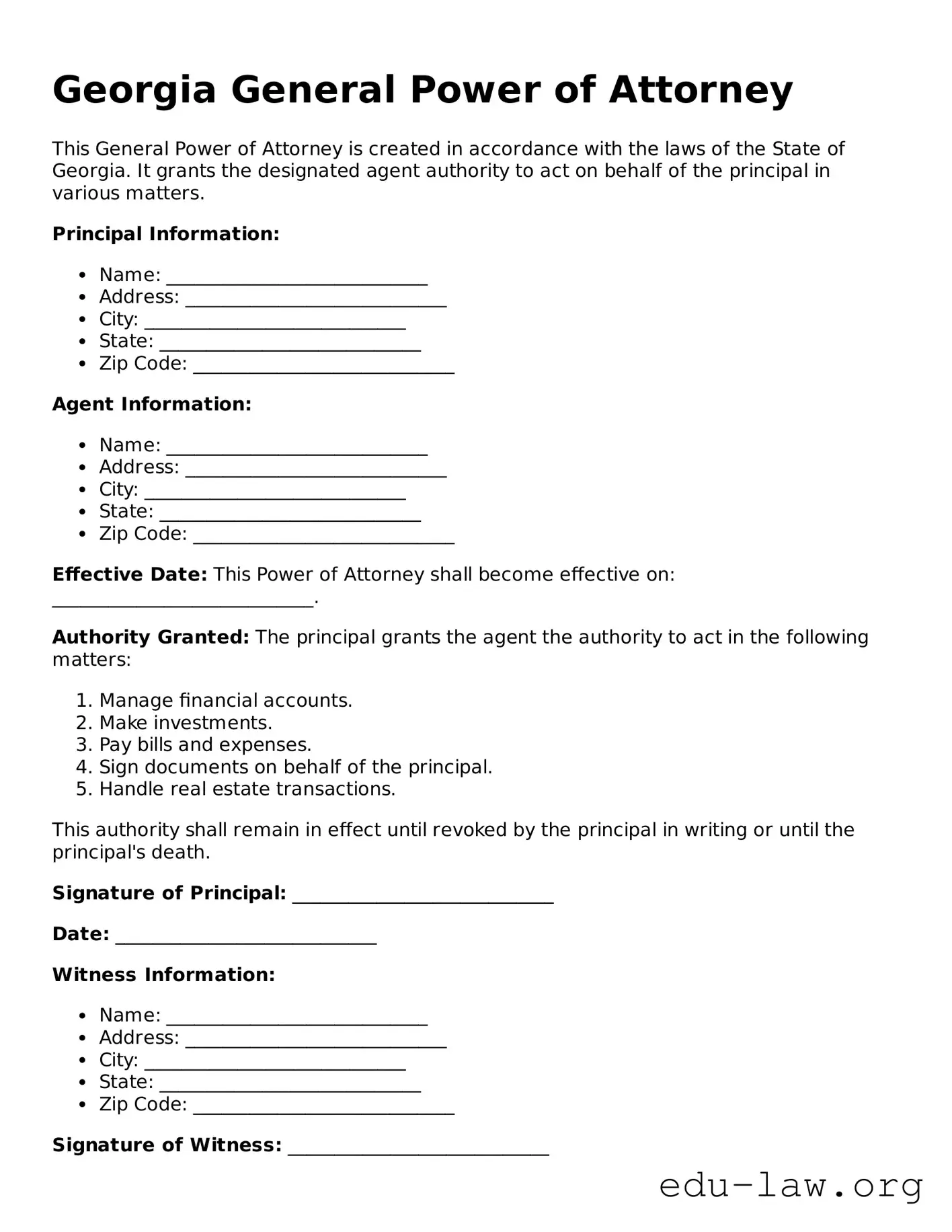
Georgia General Power of Attorney
This General Power of Attorney is created in accordance with the laws of the State of Georgia. It grants the designated agent authority to act on behalf of the principal in various matters.
Principal Information:
Agent Information:
Effective Date: This Power of Attorney shall become effective on: ____________________________.
Authority Granted: The principal grants the agent the authority to act in the following matters:
This authority shall remain in effect until revoked by the principal in writing or until the principal's death.
Signature of Principal: ____________________________
Date: ____________________________
Witness Information:
Signature of Witness: ____________________________
Date: ____________________________
| Fact Name | Description |
|---|---|
| Definition | The Georgia General Power of Attorney form allows an individual to grant another person the authority to act on their behalf in financial and legal matters. |
| Governing Law | This form is governed by the Georgia Uniform Power of Attorney Act, codified in O.C.G.A. § 10-6B-1 et seq. |
| Durability | The General Power of Attorney can be made durable, meaning it remains effective even if the principal becomes incapacitated. |
| Revocation | The principal can revoke the General Power of Attorney at any time, as long as they are mentally competent to do so. |
Filling out the Georgia General Power of Attorney form is a crucial step in ensuring that your financial and legal affairs are managed according to your wishes. After completing the form, it is essential to have it signed and notarized to ensure its validity. Here are the steps to fill out the form properly.
What is a General Power of Attorney in Georgia?
A General Power of Attorney (GPOA) in Georgia is a legal document that allows one person, known as the principal, to appoint another person, known as the agent or attorney-in-fact, to make decisions on their behalf. This authority can cover a wide range of matters, including financial transactions, property management, and legal affairs. The GPOA remains effective until it is revoked by the principal or until the principal becomes incapacitated, unless it is specifically designed to be durable.
Who can be appointed as an agent under a General Power of Attorney?
In Georgia, any competent adult can be appointed as an agent under a General Power of Attorney. This includes family members, friends, or professionals, such as attorneys or financial advisors. It is crucial to choose someone you trust, as this person will have significant control over your financial and legal matters.
Does a General Power of Attorney need to be notarized in Georgia?
Yes, in Georgia, a General Power of Attorney must be signed in the presence of a notary public to be considered valid. Additionally, it is recommended to have at least one witness present during the signing. This helps ensure that the document is legally binding and can be accepted by third parties.
Can a General Power of Attorney be revoked?
Absolutely. The principal has the right to revoke a General Power of Attorney at any time, as long as they are mentally competent. Revocation can be done by creating a new document that explicitly states the previous GPOA is no longer valid or by providing written notice to the agent. It is advisable to inform any institutions or individuals who may have relied on the original document to avoid confusion.
What happens if the principal becomes incapacitated?
If the principal becomes incapacitated, a General Power of Attorney that is not durable will become ineffective. However, if the GPOA is designated as durable, it will remain in effect even if the principal is unable to make decisions for themselves. This distinction is vital when drafting the document, as it determines the agent's authority during periods of incapacity.
Can a General Power of Attorney be used for healthcare decisions?
A General Power of Attorney typically does not cover healthcare decisions. For that purpose, a separate document known as an Advance Healthcare Directive or Medical Power of Attorney is necessary. This document specifically grants authority to an agent to make medical decisions on behalf of the principal if they become unable to do so themselves.
Is a General Power of Attorney valid in other states?
A General Power of Attorney executed in Georgia may be recognized in other states, but this can depend on the specific laws of those states. It is advisable to check the local laws or consult with a legal professional if you plan to use your GPOA outside of Georgia. Some states may have different requirements for validity, so being informed is essential.
Not Specifying Powers Clearly: One common mistake is failing to clearly outline the specific powers granted to the agent. The form allows for various powers, such as managing financial affairs or making healthcare decisions. Without clear specifications, the agent may not have the authority to act in certain situations.
Neglecting to Date the Document: Another frequent error is omitting the date on which the power of attorney is executed. Dating the document is crucial, as it establishes when the authority begins. Without a date, there could be confusion regarding the validity of the document.
Inadequate Witness or Notary Requirements: Many individuals overlook the requirement for signatures from witnesses or a notary public. In Georgia, a power of attorney must be signed in the presence of a notary and may also require one or two witnesses, depending on the powers granted. Failing to meet these requirements can invalidate the document.
Not Revoking Previous Powers of Attorney: When creating a new power of attorney, individuals sometimes forget to revoke any prior powers of attorney. If previous documents remain in effect, they could create conflicts regarding authority. It is essential to formally revoke any earlier documents to ensure clarity and prevent confusion.
The Georgia General Power of Attorney form allows an individual, known as the principal, to designate another person, called the agent, to act on their behalf in various matters. When utilizing this form, several other documents may also be relevant to ensure comprehensive management of the principal's affairs. Below is a list of commonly used forms and documents that complement the General Power of Attorney in Georgia.
Utilizing these documents alongside the Georgia General Power of Attorney can help ensure that all aspects of an individual's affairs are managed according to their wishes. Each form serves a specific purpose and collectively provides a robust framework for decision-making and asset management.
The Georgia General Power of Attorney form is similar to the Durable Power of Attorney. Both documents allow individuals to designate someone to manage their affairs. However, the Durable Power of Attorney remains effective even if the principal becomes incapacitated, while the General Power of Attorney ceases to be valid under such circumstances. This distinction is crucial for individuals seeking to ensure their affairs are handled in the event of incapacity.
The Limited Power of Attorney is another document that shares similarities with the General Power of Attorney. Like the General Power of Attorney, it allows a principal to appoint an agent to act on their behalf. However, the Limited Power of Attorney restricts the agent's authority to specific tasks or time periods. This makes it a suitable option for individuals who only need assistance with particular transactions or decisions.
The Medical Power of Attorney is also comparable to the General Power of Attorney. Both documents empower an agent to make decisions on behalf of the principal. However, the Medical Power of Attorney specifically focuses on healthcare decisions. It allows the agent to make medical choices if the principal is unable to communicate their wishes, ensuring that healthcare preferences are honored.
The Springing Power of Attorney shares some features with the General Power of Attorney. It allows a principal to appoint an agent but becomes effective only under certain conditions, typically when the principal becomes incapacitated. This type of document provides a safety net, as it does not grant authority until specific criteria are met, unlike the General Power of Attorney, which is effective immediately upon signing.
The Financial Power of Attorney is another document similar to the General Power of Attorney. Both grant an agent the authority to manage financial matters on behalf of the principal. However, the Financial Power of Attorney is specifically tailored to financial transactions, while the General Power of Attorney can encompass a broader range of responsibilities, including legal and personal affairs.
The Revocation of Power of Attorney is related to the General Power of Attorney in that it can be used to terminate a previously granted authority. If the principal wishes to revoke the General Power of Attorney, they can do so through this document. This ensures that the principal maintains control over who has the power to act on their behalf.
The Living Will is another document that complements the General Power of Attorney, particularly the Medical Power of Attorney. While the General Power of Attorney allows an agent to make decisions, the Living Will outlines the principal's wishes regarding end-of-life care. It serves as a guide for the agent, ensuring that the principal's preferences are respected in critical situations.
The Trust Agreement is also similar in that it allows individuals to designate a trustee to manage their assets. While the General Power of Attorney grants authority to act on behalf of the principal, a Trust Agreement establishes a legal entity to hold and manage property for the benefit of the beneficiaries. Both documents are tools for asset management but operate in different legal frameworks.
Lastly, the Guardianship documents share a connection with the General Power of Attorney. Both involve appointing someone to make decisions on behalf of another person. However, Guardianship is typically established through a court process and is often used for minors or individuals deemed incapacitated. In contrast, a General Power of Attorney is created voluntarily by the principal without court involvement, providing more flexibility in choosing an agent.
When filling out the Georgia General Power of Attorney form, it's important to approach the process with care. Here are some key do's and don'ts to keep in mind:
Following these guidelines will help ensure that your General Power of Attorney form is completed correctly and effectively. It's a crucial document, so attention to detail is essential.
Understanding the Georgia General Power of Attorney (GPOA) form is crucial for anyone considering its use. However, several misconceptions can lead to confusion. Here are eight common misunderstandings about the GPOA in Georgia:
Many believe that a General Power of Attorney only covers financial decisions. In reality, it can also grant authority over medical decisions, property management, and other personal affairs, depending on how it is drafted.
This is a critical misconception. A General Power of Attorney ceases to be valid upon the death of the person who created it, known as the principal. After death, the authority transfers to the executor of the estate.
Some people think that once a GPOA is signed, it cannot be changed. In fact, the principal can revoke or amend the document at any time, as long as they are mentally competent.
This is not accurate. A Durable Power of Attorney remains effective even if the principal becomes incapacitated, while a General Power of Attorney may not. Understanding the difference is essential for long-term planning.
While it is advisable to consult a lawyer, individuals can create a GPOA themselves using templates. However, ensuring that it meets all legal requirements is crucial to avoid future complications.
This is misleading. The authority granted in a GPOA is limited to what the principal specifies. The agent must act in the best interest of the principal and within the scope of the powers granted.
While seniors often consider a GPOA, anyone can benefit from having one. Life is unpredictable, and having a plan in place can provide peace of mind at any age.
This is false. A General Power of Attorney can be updated or replaced as circumstances change. Regular reviews ensure that it reflects the principal's current wishes and needs.
Being aware of these misconceptions can help individuals make informed decisions about their legal planning. It is always wise to seek advice from a qualified professional when dealing with legal documents.
Filling out and utilizing the Georgia General Power of Attorney form requires careful attention to detail and an understanding of its implications. Here are some key takeaways to keep in mind:
Understanding these aspects can help ensure that the General Power of Attorney serves its intended purpose effectively and securely.