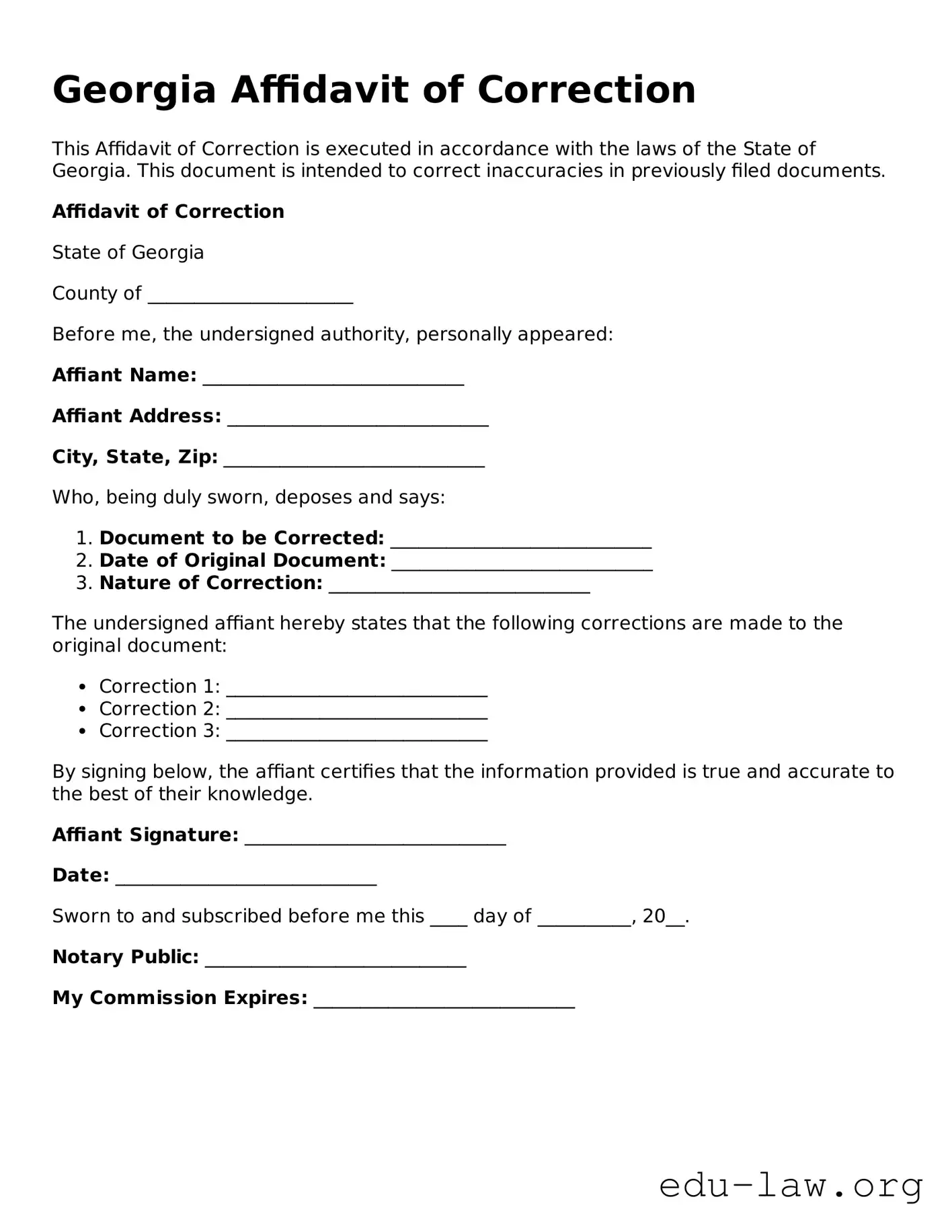
The Georgia Affidavit of Correction form serves as a crucial legal tool for individuals seeking to rectify errors in official documents. This form is typically used to amend inaccuracies found in public records, such as deeds, mortgages, or other legal instruments. By submitting this affidavit, a person can clarify or correct information that may have been misrecorded or misrepresented. The process involves providing specific details about the original document, including its date and the nature of the error. Additionally, the affidavit requires the signatures of the individuals involved, affirming their agreement to the corrections. It is essential to follow the proper procedures when completing and filing this form to ensure that the corrections are legally recognized. Understanding the implications of the affidavit and its role in maintaining accurate public records is vital for anyone looking to navigate the complexities of legal documentation in Georgia.
Georgia Affidavit of Correction
This Affidavit of Correction is executed in accordance with the laws of the State of Georgia. This document is intended to correct inaccuracies in previously filed documents.
Affidavit of Correction
State of Georgia
County of ______________________
Before me, the undersigned authority, personally appeared:
Affiant Name: ____________________________
Affiant Address: ____________________________
City, State, Zip: ____________________________
Who, being duly sworn, deposes and says:
The undersigned affiant hereby states that the following corrections are made to the original document:
By signing below, the affiant certifies that the information provided is true and accurate to the best of their knowledge.
Affiant Signature: ____________________________
Date: ____________________________
Sworn to and subscribed before me this ____ day of __________, 20__.
Notary Public: ____________________________
My Commission Expires: ____________________________
| Fact Name | Description |
|---|---|
| Purpose | The Georgia Affidavit of Correction is used to correct errors in public records. |
| Governing Law | O.C.G.A. § 15-6-67 governs the use of affidavits for correcting errors in Georgia. |
| Eligibility | Any individual or entity can file an affidavit to correct a mistake in their records. |
| Common Errors | Common errors include misspellings, incorrect dates, and wrong property descriptions. |
| Filing Process | The affidavit must be signed in front of a notary public before submission. |
| Where to File | File the affidavit with the appropriate county clerk's office or relevant agency. |
| Impact | Correcting the record ensures accurate information for legal and financial matters. |
| Cost | Filing fees may vary by county; check with local authorities for specific amounts. |
After obtaining the Georgia Affidavit of Correction form, the next step involves carefully filling it out with accurate information. This form is essential for correcting any errors in previously filed documents. It is important to ensure that all details are correct to avoid any delays in processing.
What is the Georgia Affidavit of Correction form?
The Georgia Affidavit of Correction form is a legal document used to correct errors in public records, such as deeds, mortgages, or other official documents. This form allows individuals to clarify or amend information that may have been inaccurately recorded. Common reasons for using this form include typographical errors, misspellings of names, or incorrect property descriptions. By filing this affidavit, individuals can ensure that the public record accurately reflects the intended information.
Who can file an Affidavit of Correction in Georgia?
Any individual or entity that has a vested interest in the document can file an Affidavit of Correction. This typically includes property owners, lenders, or other parties involved in the transaction. It is important that the person filing the affidavit has the authority to make corrections on behalf of the parties involved. For example, if a property owner discovers a mistake in their deed, they can file the affidavit to correct it. However, it is advisable to consult with a legal professional to ensure proper procedure is followed.
How do I complete and submit the Affidavit of Correction form?
To complete the Affidavit of Correction form, start by obtaining the correct template from a reliable source, such as the Georgia Secretary of State's website or your local county office. Fill in the required information, including the details of the original document and the specific corrections needed. After completing the form, it must be signed in the presence of a notary public. Once notarized, submit the affidavit to the appropriate county office where the original document was recorded. Be sure to keep a copy for your records.
Are there any fees associated with filing an Affidavit of Correction?
Yes, there are typically fees associated with filing an Affidavit of Correction in Georgia. These fees can vary by county, so it is essential to check with the local recording office for the exact amount. In addition to the filing fee, there may be costs for notarization and any additional copies you may need. Be prepared to pay these fees at the time of submission to ensure that your affidavit is processed without delay.
Failing to include all required information. Each section of the form must be completed accurately. Missing details can lead to delays or rejections.
Using incorrect or outdated information. Ensure that all names, addresses, and other details are current and match official records.
Not signing the affidavit. A signature is necessary for the form to be valid. Without it, the document cannot be processed.
Not having the affidavit notarized. In Georgia, the form typically requires notarization. Failing to do this can invalidate the document.
Incorrectly identifying the type of correction needed. Clearly state what needs to be corrected to avoid confusion.
Neglecting to provide supporting documents. If additional proof is needed, include copies of relevant documents to support the correction.
Submitting the form to the wrong office. Ensure that the affidavit is sent to the correct county office or agency to avoid delays.
The Georgia Affidavit of Correction is a useful document for amending errors in public records. When filing this affidavit, several other forms and documents may be required to ensure the process is completed accurately. Below is a list of some commonly used forms that accompany the Affidavit of Correction.
Each of these documents plays a crucial role in ensuring that the Affidavit of Correction is processed smoothly. By gathering the necessary forms and information, individuals can facilitate a more efficient correction process, ultimately leading to accurate public records.
The Georgia Affidavit of Correction form shares similarities with the Affidavit of Identity. Both documents serve to clarify or correct information that may have been misrepresented or inaccurately recorded. The Affidavit of Identity is often used to confirm a person's identity in situations where there may be confusion or discrepancies in legal records. Like the Affidavit of Correction, it requires a sworn statement, providing a legal basis for the corrections made. This ensures that the information presented is accurate and can be relied upon by third parties.
Another document akin to the Georgia Affidavit of Correction is the Affidavit of Heirship. This form is typically used in probate cases to establish the rightful heirs of a deceased person's estate when no formal will exists. Similar to the Affidavit of Correction, it involves a sworn declaration that aims to clarify the legal status of individuals involved. Both documents serve to rectify or clarify legal standing, ensuring that the correct parties are recognized in legal matters.
The Affidavit of Support also bears resemblance to the Georgia Affidavit of Correction. This document is often utilized in immigration cases to affirm that a sponsor can financially support an immigrant. While its primary purpose is different, both affidavits require the sponsor or declarant to provide accurate information under oath. They serve as legal assurances that the information provided is truthful and can be relied upon by government agencies.
The Affidavit of Truth is another document that aligns with the purpose of the Georgia Affidavit of Correction. This form is used to assert the veracity of facts in various legal contexts. Like the Affidavit of Correction, it requires the signer to affirm the accuracy of the statements made. Both documents aim to correct or clarify information, enhancing the reliability of legal documents and proceedings.
Finally, the Declaration of Domicile is similar in function to the Georgia Affidavit of Correction. This document is used to establish an individual’s legal residence, often for tax or voting purposes. Both documents require a sworn statement, providing clarity on an individual’s status. They help to rectify any misunderstandings regarding a person's legal standing, ensuring that all parties involved have accurate and updated information.
Filling out the Georgia Affidavit of Correction form can be a straightforward process if you know what to do and what to avoid. Here’s a helpful list to guide you through it.
By following these guidelines, you can confidently complete the Georgia Affidavit of Correction form, making the process smoother and more efficient.
When dealing with the Georgia Affidavit of Correction form, several misconceptions can arise. Understanding these misconceptions can help individuals navigate the process more effectively. Here are five common misunderstandings:
By clarifying these misconceptions, individuals can approach the Georgia Affidavit of Correction with greater confidence and understanding.
The Georgia Affidavit of Correction form is an important legal document used to correct errors in public records. Understanding how to fill it out and use it effectively can save time and prevent future complications. Here are key takeaways regarding the form:
By following these guidelines, individuals can navigate the process of correcting public records in Georgia more effectively.