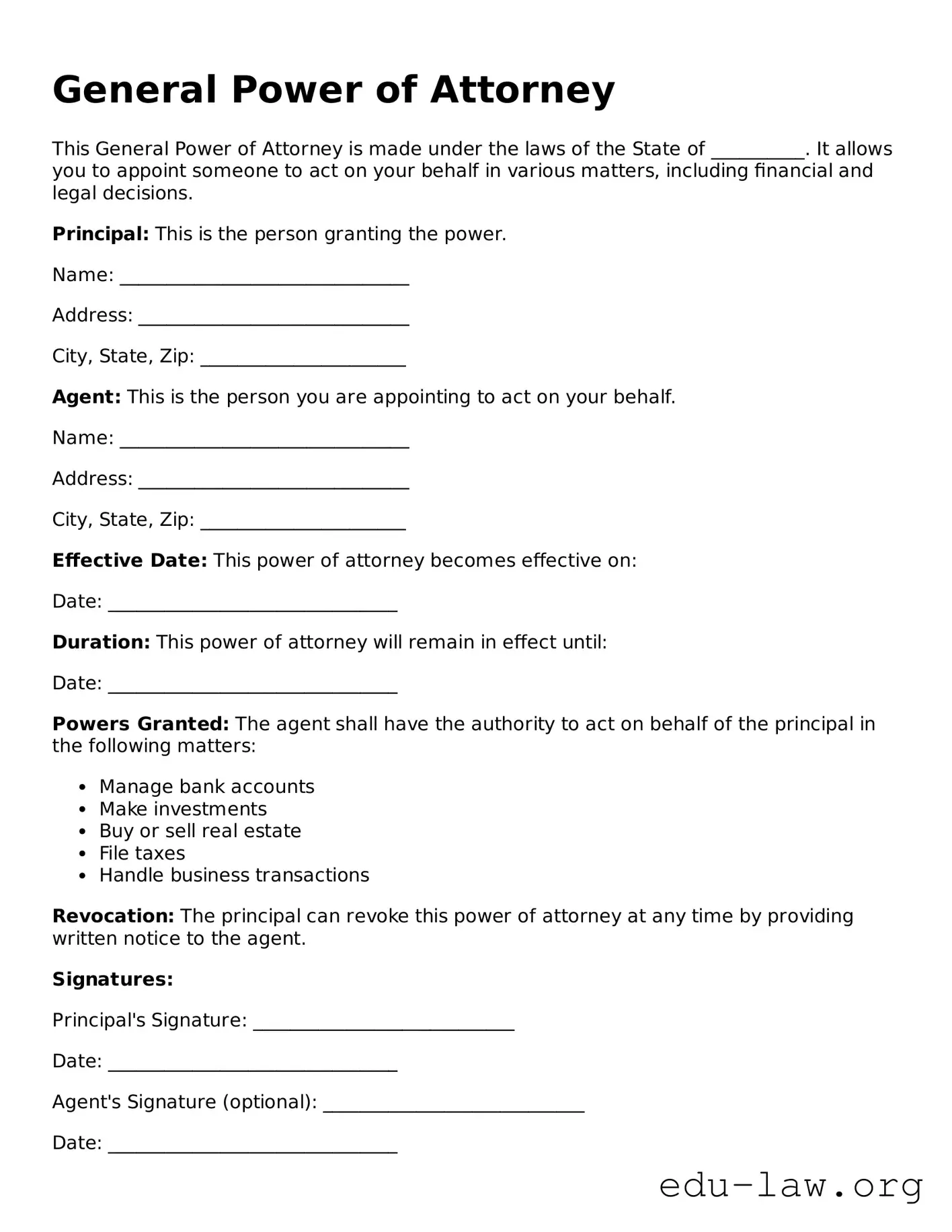
A General Power of Attorney is a crucial legal document that grants an individual, known as the agent or attorney-in-fact, the authority to act on behalf of another person, referred to as the principal. This form is often utilized in various situations, such as managing financial affairs, making healthcare decisions, or handling real estate transactions when the principal is unable to do so themselves. It is important to note that the powers granted can be broad or limited, depending on the specific needs of the principal. The General Power of Attorney can take effect immediately or can be set to activate upon a certain event, such as the principal becoming incapacitated. Additionally, this document can be revoked at any time, as long as the principal is mentally competent. Understanding the implications of granting such authority is essential, as the agent will have significant control over the principal's affairs. This article will explore the key components of the General Power of Attorney form, the responsibilities of the agent, and the potential benefits and risks associated with its use.
General Power of Attorney
This General Power of Attorney is made under the laws of the State of __________. It allows you to appoint someone to act on your behalf in various matters, including financial and legal decisions.
Principal: This is the person granting the power.
Name: _______________________________
Address: _____________________________
City, State, Zip: ______________________
Agent: This is the person you are appointing to act on your behalf.
Name: _______________________________
Address: _____________________________
City, State, Zip: ______________________
Effective Date: This power of attorney becomes effective on:
Date: _______________________________
Duration: This power of attorney will remain in effect until:
Date: _______________________________
Powers Granted: The agent shall have the authority to act on behalf of the principal in the following matters:
Revocation: The principal can revoke this power of attorney at any time by providing written notice to the agent.
Signatures:
Principal's Signature: ____________________________
Date: _______________________________
Agent's Signature (optional): ____________________________
Date: _______________________________
Witnesses: This document should be signed in the presence of two witnesses.
Witness 1 Signature: ____________________________
Date: _______________________________
Witness 2 Signature: ____________________________
Date: _______________________________
Notarization: If required by state law, this document should be notarized.
Notary Public Signature: ____________________________
Date: _______________________________
| Fact Name | Description |
|---|---|
| Definition | A General Power of Attorney (GPOA) is a legal document that grants an agent broad authority to act on behalf of the principal in various matters, including financial and legal decisions. |
| Scope of Authority | The agent can perform a wide range of actions, such as managing bank accounts, signing checks, and making real estate transactions, unless specifically limited in the document. |
| Durability | A GPOA can be durable or non-durable. A durable GPOA remains effective even if the principal becomes incapacitated, while a non-durable GPOA ceases to be valid under such circumstances. |
| State-Specific Forms | Each state has its own requirements and forms for a General Power of Attorney. For example, California's GPOA is governed by the California Probate Code. |
| Revocation | The principal can revoke a General Power of Attorney at any time, provided they are mentally competent. This revocation must be communicated to the agent and any relevant institutions. |
| Agent's Duties | The agent has a fiduciary duty to act in the best interests of the principal, which includes avoiding conflicts of interest and providing accurate accounting of transactions. |
| Legal Requirements | Most states require the GPOA to be signed by the principal and witnessed or notarized to ensure its validity. Specific requirements may vary by state. |
Filling out the General Power of Attorney form is an important task that requires attention to detail. Once completed, this document will allow you to designate someone to act on your behalf in various matters. Follow these steps carefully to ensure accuracy and completeness.
What is a General Power of Attorney?
A General Power of Attorney is a legal document that allows one person, known as the agent or attorney-in-fact, to act on behalf of another person, referred to as the principal. This authority can cover a wide range of financial and legal matters, including managing bank accounts, signing contracts, and handling real estate transactions.
Why would someone need a General Power of Attorney?
Individuals often create a General Power of Attorney to ensure that someone they trust can manage their affairs if they become unable to do so due to illness, disability, or absence. This document provides peace of mind, knowing that financial and legal matters can be handled smoothly without court intervention.
What powers does an agent have under a General Power of Attorney?
The agent can perform various tasks, including paying bills, filing taxes, managing investments, and making decisions regarding property. However, the specific powers granted can be tailored in the document. It's essential to clearly outline the authority given to avoid misunderstandings.
Can a General Power of Attorney be revoked?
Yes, a principal can revoke a General Power of Attorney at any time, as long as they are mentally competent. Revocation must be done in writing and should be communicated to the agent and any institutions or individuals relying on the document.
Does a General Power of Attorney remain valid if the principal becomes incapacitated?
A General Power of Attorney typically ends if the principal becomes incapacitated. However, if the document includes specific language stating that it is durable, it will remain in effect even if the principal loses capacity. This is an important distinction to consider when creating the document.
How is a General Power of Attorney executed?
To execute a General Power of Attorney, the principal must sign the document in the presence of a notary public or witnesses, depending on state laws. It's crucial to follow the legal requirements in your state to ensure the document is valid and enforceable.
Can a General Power of Attorney be used for medical decisions?
No, a General Power of Attorney typically does not grant authority for medical decisions. For healthcare matters, a separate document called a Medical Power of Attorney or Healthcare Proxy is needed. This document specifically designates someone to make medical decisions on behalf of the principal if they are unable to do so.
Not specifying the powers granted. It's crucial to clearly outline what authority is being given to the agent. Vague language can lead to misunderstandings.
Failing to date the document. A date is important for establishing when the power of attorney becomes effective.
Not signing in the presence of a notary. Many states require notarization for the document to be valid. Without it, the form may not be recognized.
Choosing the wrong agent. Selecting someone who is not trustworthy or capable can lead to misuse of authority.
Overlooking state-specific requirements. Each state has its own laws regarding power of attorney. Not adhering to these can invalidate the document.
Neglecting to inform the agent. It's important to discuss the role and responsibilities with the chosen agent beforehand.
Not considering a backup agent. Life is unpredictable, and having an alternative can ensure that your wishes are honored.
Using outdated forms. Laws change, and using an old version may lead to complications. Always check for the most current form.
Failing to review the document periodically. Situations change, and it's wise to revisit the power of attorney to ensure it still reflects your wishes.
A General Power of Attorney (POA) form allows one person to act on behalf of another in legal and financial matters. When creating a POA, it’s often beneficial to consider additional documents that can complement or enhance the authority granted. Below is a list of forms and documents commonly used alongside a General Power of Attorney.
Considering these additional documents can provide a comprehensive approach to managing personal and financial affairs. Each serves a specific purpose, ensuring that your preferences are respected and that your affairs are handled smoothly.
A General Power of Attorney (GPOA) is often compared to a Durable Power of Attorney (DPOA). Both documents allow an individual, known as the principal, to designate another person, called the agent, to make decisions on their behalf. The key difference lies in the durability aspect. A DPOA remains effective even if the principal becomes incapacitated, while a GPOA ceases to be valid under such circumstances. This distinction makes the DPOA particularly useful for long-term planning, especially for those concerned about potential health issues in the future.
Another document similar to a GPOA is the Limited Power of Attorney (LPOA). Like the GPOA, the LPOA allows a principal to appoint an agent to act on their behalf. However, the authority granted in an LPOA is restricted to specific tasks or time periods. For example, a person might use an LPOA to allow someone to handle a real estate transaction while they are out of town. This targeted approach can provide greater control over what decisions the agent can make, ensuring that the principal's wishes are more closely followed.
A Medical Power of Attorney (MPOA) also shares similarities with a GPOA but focuses specifically on healthcare decisions. In this document, the principal designates an agent to make medical choices when they are unable to do so themselves. While a GPOA can cover a wide range of financial and legal matters, the MPOA is tailored to healthcare situations. This specificity is crucial, as medical decisions often require immediate action and a clear understanding of the principal’s values and preferences.
Lastly, a Living Will can be seen as a companion to the GPOA, although it serves a different purpose. A Living Will outlines an individual’s wishes regarding medical treatment in the event of terminal illness or incapacitation. While a GPOA empowers an agent to make decisions, a Living Will communicates the principal’s preferences directly. Together, these documents ensure that an individual’s medical and financial wishes are respected, even when they are unable to voice them themselves.
When filling out a General Power of Attorney form, it's important to follow certain guidelines to ensure the document is valid and effective. Here’s a list of things you should and shouldn’t do:
When considering a General Power of Attorney (GPOA), it’s important to understand the common misconceptions surrounding this legal document. Misunderstandings can lead to confusion and potential issues down the line. Here are six misconceptions that often arise:
This is not true. A General Power of Attorney grants authority that can become invalid if the principal (the person who grants the power) becomes incapacitated. In contrast, a Durable Power of Attorney remains effective even if the principal can no longer make decisions for themselves.
This is a misconception. The principal can revoke a General Power of Attorney at any time, as long as they are mentally competent. Revocation should be documented in writing and communicated to the agent and any relevant parties.
While agents are expected to act in good faith, the scope of their authority can vary based on the specific terms outlined in the GPOA. It’s crucial to choose a trustworthy agent and clearly define their powers.
This is misleading. The powers granted can be limited to specific tasks, such as managing finances or making medical decisions. If broader powers are desired, they must be explicitly stated in the document.
This is incorrect. Laws governing GPOAs can vary significantly from state to state. It is essential to understand the specific requirements and regulations in your state to ensure the document is valid.
This is not the case. The principal retains control over their affairs as long as they are competent. The agent acts on behalf of the principal but does not replace their authority unless specified otherwise.
Understanding these misconceptions can help individuals make informed decisions about using a General Power of Attorney. It’s always wise to consult with a legal professional to ensure that your needs and intentions are clearly understood and documented.
When it comes to filling out and using the General Power of Attorney (GPOA) form, there are several important points to keep in mind. Here are some key takeaways to help you navigate this process effectively:
By keeping these takeaways in mind, you can confidently fill out and utilize a General Power of Attorney form that meets your needs.