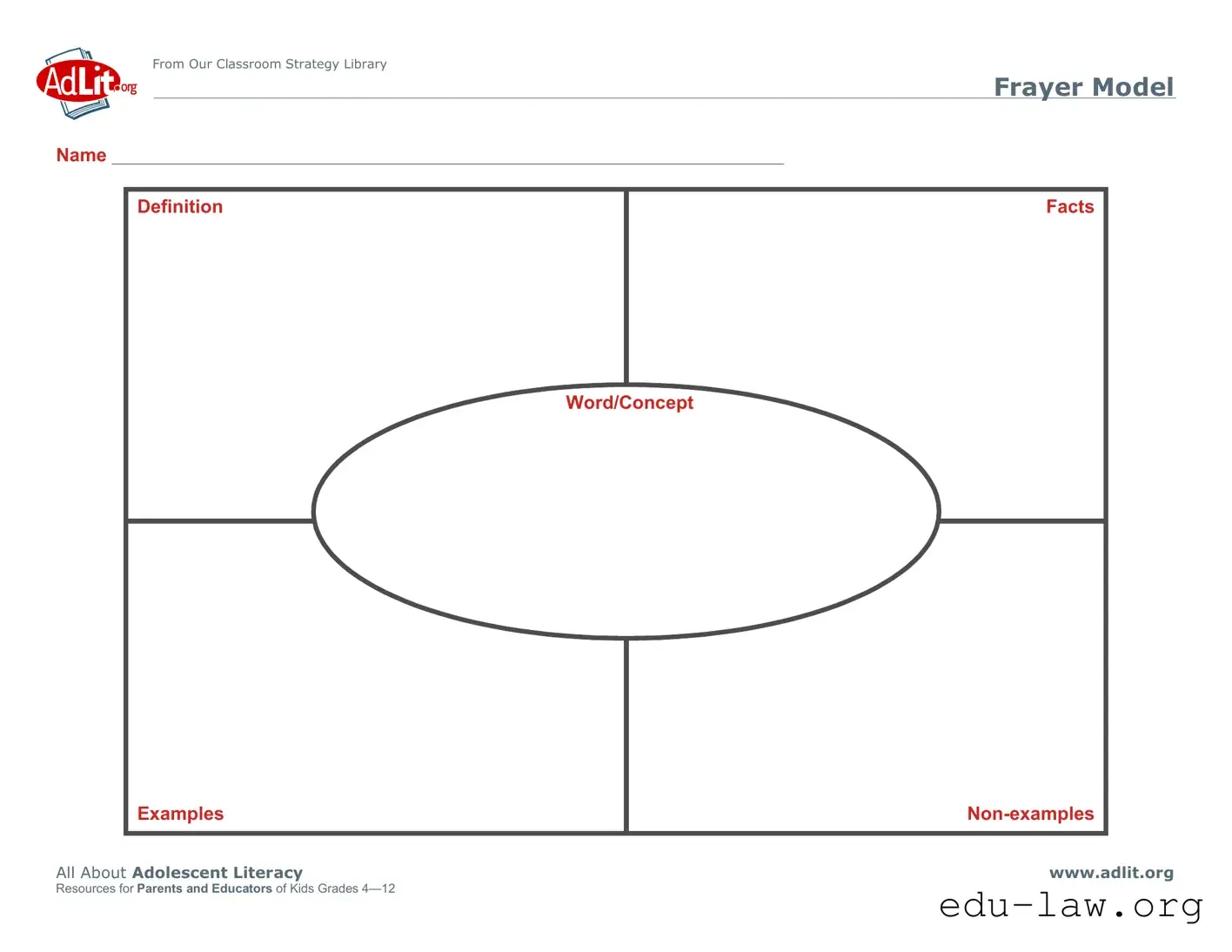
The Frayer Model Editable form serves as a versatile educational tool designed to enhance comprehension and vocabulary development among students. This form is structured to facilitate deeper understanding of a specific word or concept by breaking it down into four distinct sections: the definition, facts, examples, and non-examples. By encouraging students to articulate what they know about a term, the Frayer Model promotes critical thinking and active engagement with the material. This approach is particularly beneficial for adolescents, as it caters to learners in grades 4 through 12, allowing them to explore language and ideas in a structured yet flexible manner. Additionally, the form provides resources aimed at supporting both parents and educators, ensuring that they can effectively assist students in their literacy journey. Overall, the Frayer Model Editable form is an invaluable resource for fostering a rich learning environment that encourages exploration and mastery of language.
From Our Classroom Strategy Library
Name
Definition
Frayer Model
Facts
Word/Concept
Examples
All About Adolescent Literacy
RESOURCES FOR Parents and Educators OF KIDS GRADES
www.adlit.org
| Fact Name | Description |
|---|---|
| Name | The Frayer Model is a graphic organizer designed to help students understand concepts and vocabulary. |
| Definition | It consists of four sections: definition, characteristics, examples, and non-examples. |
| Word/Concept | Students can use the model to explore a specific word or concept in depth. |
| Examples | Examples are provided to illustrate the concept and enhance understanding. |
| Non-examples | Non-examples help clarify what the concept is not, preventing misconceptions. |
| Target Audience | This tool is geared towards adolescents, specifically those in grades 4-12. |
| Resources | It serves as a valuable resource for parents and educators looking to support literacy development. |
Filling out the Frayer Model Editable form is a straightforward process that allows you to organize information about a specific word or concept effectively. By following the steps outlined below, you can ensure that you capture all relevant details in a clear and structured manner.
What is the Frayer Model Editable form?
The Frayer Model Editable form is a versatile educational tool designed to help students understand and define concepts. It encourages critical thinking by requiring students to identify the definition, characteristics, examples, and non-examples of a word or concept. This model is particularly useful for enhancing vocabulary and comprehension skills.
Who can use the Frayer Model Editable form?
This form is suitable for students in grades 4 through 12. It can be utilized by both educators and parents to support adolescent literacy. The adaptable nature of the form allows it to be employed in various subjects and learning environments.
How does the Frayer Model support learning?
The Frayer Model promotes deeper understanding by requiring students to engage with the material actively. By categorizing information into definitions, facts, examples, and non-examples, students develop a more comprehensive grasp of the concept being studied. This method encourages critical thinking and helps students make connections between ideas.
Can the Frayer Model Editable form be customized?
Yes, the Frayer Model Editable form is designed to be flexible and customizable. Educators can modify the form to suit specific learning objectives or individual student needs. This adaptability makes it a valuable resource for diverse classrooms.
What resources are available for parents and educators?
The Frayer Model Editable form is part of a broader resource library aimed at supporting parents and educators of children in grades 4 through 12. This library includes various strategies and tools designed to enhance literacy and learning outcomes.
How can I implement the Frayer Model in my classroom?
To implement the Frayer Model, introduce it to your students by explaining its components: definition, facts, examples, and non-examples. Encourage students to choose a word or concept relevant to their studies. Guide them in filling out the form, promoting discussion and collaboration as they share their insights.
Is the Frayer Model suitable for all subjects?
Yes, the Frayer Model can be effectively used across various subjects, including language arts, science, and social studies. Its structure allows students to explore vocabulary and concepts in any discipline, making it a versatile educational tool.
How does the Frayer Model benefit vocabulary development?
By requiring students to explore definitions, examples, and non-examples, the Frayer Model enhances vocabulary development. This comprehensive approach helps students not only memorize words but also understand their meanings and contexts, leading to improved language skills.
Can the Frayer Model be used for group activities?
Absolutely. The Frayer Model is an excellent tool for group activities. Students can work collaboratively to fill out the form, share their findings, and discuss their understanding of the concept. This collaborative approach fosters communication skills and encourages peer learning.
Neglecting to Define the Word or Concept Clearly: One common mistake is failing to provide a clear and concise definition of the word or concept being analyzed. This can lead to confusion and misinterpretation of the material.
Overlooking Relevant Examples: When filling out the examples section, individuals often forget to include relevant and relatable examples. Without these, the understanding of the concept can remain abstract and less meaningful.
Failing to Include Non-examples: Many users skip the non-examples section altogether. This omission is significant because understanding what a concept is not can clarify its meaning and application.
Inadequate Research on Facts: Some individuals do not take the time to gather accurate facts about the word or concept. Inaccurate or vague facts can diminish the overall quality of the Frayer Model and hinder effective learning.
Not Engaging with the Content: Lastly, a lack of engagement with the content can lead to superficial answers. It is essential to reflect on the word or concept deeply to create a more impactful and informative Frayer Model.
The Frayer Model Editable form is a versatile tool used in educational settings to help students deepen their understanding of concepts. It encourages critical thinking by allowing learners to explore definitions, examples, and non-examples of a word or concept. Alongside this form, several other documents can enhance the learning experience. Here is a list of some commonly used forms and documents that complement the Frayer Model.
These documents work together with the Frayer Model Editable form to create a comprehensive learning environment. By utilizing these resources, educators can foster a more engaging and effective educational experience for their students.
The Frayer Model Editable form is similar to the Concept Map, which visually organizes information about a specific topic. Both tools help individuals break down complex concepts into manageable parts. While the Frayer Model includes sections for definitions, facts, examples, and non-examples, a Concept Map uses nodes and connecting lines to illustrate relationships between ideas. This visual representation aids in comprehension and retention, making it easier for students to grasp new material.
Another document that shares similarities with the Frayer Model is the Graphic Organizer. Like the Frayer Model, Graphic Organizers help structure information in a clear and concise manner. They can take various forms, such as Venn diagrams or flowcharts, to facilitate understanding. Both tools encourage critical thinking and allow users to categorize information effectively, enhancing learning outcomes for students.
The Mind Map also resembles the Frayer Model in its purpose of organizing thoughts and ideas. Mind Maps focus on a central concept, branching out into related topics and subtopics. This method encourages creativity and helps individuals see connections between different pieces of information. While the Frayer Model is more structured with defined sections, both tools promote active engagement with the material.
Similar to the Frayer Model is the KWL Chart, which stands for "Know, Want to Know, and Learned." This chart assists students in reflecting on their prior knowledge and setting learning goals. Like the Frayer Model, the KWL Chart is divided into sections that guide students through the learning process. Both tools foster a deeper understanding of the subject matter by encouraging students to actively participate in their education.
The Venn Diagram also shares common ground with the Frayer Model. Both tools allow users to compare and contrast different concepts. The Frayer Model focuses on defining a single concept, while the Venn Diagram highlights similarities and differences between two or more ideas. This comparative approach aids in critical analysis and enhances comprehension by allowing students to see relationships between concepts.
The T-Chart is another document similar to the Frayer Model. It provides a simple way to organize information by listing two opposing ideas or concepts side by side. While the Frayer Model delves into definitions and examples, the T-Chart focuses on pros and cons or advantages and disadvantages. Both tools encourage clear thinking and help students articulate their understanding of various topics.
The Outline format is akin to the Frayer Model in that it organizes information hierarchically. Both documents break down information into main ideas and supporting details. While the Frayer Model emphasizes definitions and examples, an Outline provides a broader structure for essays or presentations. This organization helps students see the big picture while also focusing on specific elements of their work.
The Summary Chart is similar to the Frayer Model in its goal of condensing information into digestible parts. Both tools help students distill key points from larger texts or concepts. The Frayer Model focuses on definitions and examples, while the Summary Chart summarizes main ideas and supporting details. This process of simplification aids in comprehension and retention of information.
Lastly, the Cornell Notes system shares similarities with the Frayer Model. Both methods encourage active engagement with the material. The Cornell Notes format divides the page into sections for notes, cues, and summaries, while the Frayer Model organizes information into defined categories. Both tools support effective study habits and help students review and retain important information.
When filling out the Frayer Model Editable form, there are important actions to take and avoid. Here’s a list of dos and don'ts:
The Frayer Model Editable form is a useful educational tool, but several misconceptions surround its use. Here’s a breakdown of nine common misunderstandings.
Many believe the Frayer Model is limited to vocabulary. In reality, it can be applied to any concept or idea, making it versatile for various subjects.
Some think that educators need special training to implement the Frayer Model. However, its straightforward design allows anyone to use it effectively with minimal preparation.
There’s a misconception that the Frayer Model is only for older students. In fact, it can be adapted for younger learners, making complex ideas more accessible.
While it functions as a graphic organizer, the Frayer Model also promotes deeper understanding through its focus on definitions, examples, and non-examples.
Some educators think the Frayer Model is rigid and unchangeable. The editable form allows for customization to fit specific teaching needs and styles.
Many assume the model is only beneficial in language arts. It’s effective across disciplines, including science, social studies, and math.
There’s a belief that using the Frayer Model takes too much time. With practice, it can be integrated into lessons efficiently, enhancing learning without lengthy delays.
Some people think the Frayer Model is just a rote memorization tool. In fact, it encourages students to analyze and synthesize information, fostering critical thinking skills.
Lastly, many believe the Frayer Model is solely for individual assignments. It can also be used in group settings, promoting collaboration and discussion among students.
Understanding these misconceptions can help educators utilize the Frayer Model more effectively, enhancing learning experiences for their students.
The Frayer Model is an effective tool for enhancing vocabulary and comprehension. It encourages deeper understanding of concepts through a structured approach. Here are some key takeaways regarding the use of the Frayer Model Editable form:
Utilizing the Frayer Model effectively can enhance vocabulary acquisition and comprehension skills among students. By engaging with the model, learners can develop a more nuanced understanding of concepts, which is essential for academic success.