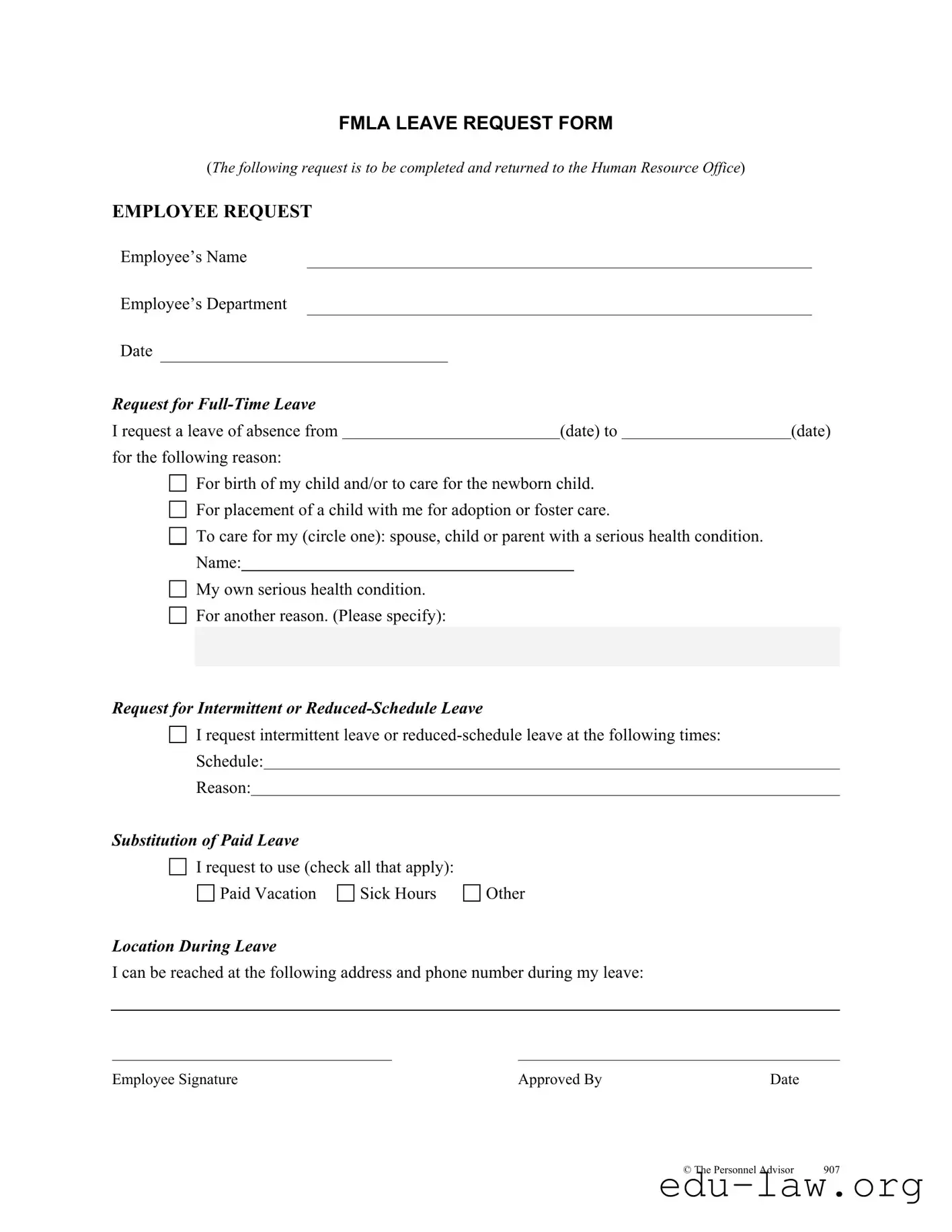
The Family and Medical Leave Act (FMLA) Leave Request Form is a crucial document for employees seeking time off for specific family or medical reasons. This form serves as a formal request to the Human Resource Office and requires the employee's name, department, and the dates for which leave is requested. Employees can request full-time leave for various reasons, including the birth of a child, adoption, or caring for a family member with a serious health condition. Additionally, the form allows for requests for intermittent or reduced-schedule leave, which can be essential for those needing flexibility due to ongoing medical issues. Employees also have the option to indicate any paid leave they wish to substitute during their absence, such as vacation or sick hours. Finally, the form asks for contact information, ensuring that the employee can be reached during their leave. Proper completion of this form is vital for both employees and employers to ensure compliance with the law and to facilitate a smooth leave process.
FMLA LEAVE REQUEST FORM
(The following request is to be completed and returned to the Human Resource Office)
EMPLOYEE REQUEST
Employee’s Name
Employee’s Department
Date
Request for |
|
|
I request a leave of absence from |
(date) to |
(date) |
for the following reason:
For birth of my child and/or to care for the newborn child.
For placement of a child with me for adoption or foster care.
To care for my (circle one): spouse, child or parent with a serious health condition. Name:
My own serious health condition.
For another reason. (Please specify):
Request for Intermittent or
I request intermittent leave or
Schedule:
Reason:
Substitution of Paid Leave
I request to use (check all that apply):
Paid Vacation |
Sick Hours |
Location During Leave |
|
Other
I can be reached at the following address and phone number during my leave:
Employee Signature |
Approved By |
Date |
© The Personnel Advisor |
907 |
| Fact Name | Description |
|---|---|
| Purpose of FMLA | The FMLA allows employees to take unpaid leave for specific family and medical reasons without fear of losing their job. |
| Eligibility | To qualify, an employee must have worked for their employer for at least 12 months and have logged 1,250 hours in the past year. |
| Leave Duration | Eligible employees can take up to 12 weeks of leave in a 12-month period for qualifying reasons. |
| Reasons for Leave | Leave can be taken for the birth of a child, to care for a newborn, for adoption, or to care for a family member with a serious health condition. |
| Intermittent Leave | Employees may request intermittent leave, allowing them to take leave in separate blocks of time rather than all at once. |
| Paid Leave Substitution | Employees can choose to use paid vacation or sick leave during their FMLA leave, if available. |
| State-Specific Forms | Some states have their own family leave laws, such as California’s CFRA, which may provide additional rights beyond the FMLA. |
After completing the FMLA Leave form, submit it to the Human Resource Office. They will review your request and follow up with you regarding the next steps.
What is the FMLA Leave Form used for?
The FMLA Leave Form is used by employees to formally request leave under the Family and Medical Leave Act (FMLA). This leave can be for various reasons, including the birth of a child, adoption, or to care for a family member with a serious health condition.
Who is eligible to use the FMLA Leave Form?
To be eligible for FMLA leave, an employee must have worked for their employer for at least 12 months and have completed at least 1,250 hours of service during the previous 12 months. Additionally, the employer must have at least 50 employees within a 75-mile radius.
What types of leave can be requested using the FMLA Leave Form?
Employees can request full-time leave, intermittent leave, or reduced-schedule leave. Full-time leave is for a continuous period, while intermittent leave allows for breaks in the leave period. Reduced-schedule leave involves working fewer hours than usual during a specified timeframe.
What reasons can I provide for my leave request?
Reasons for requesting leave include the birth of a child, placement of a child for adoption or foster care, caring for a spouse, child, or parent with a serious health condition, or addressing your own serious health condition. You may also specify another reason if applicable.
How do I indicate my preferred schedule for intermittent or reduced-schedule leave?
In the form, you will need to provide details about your requested schedule, including specific dates and times. Clearly outline when you will need the leave and for what reason to ensure your employer understands your needs.
Can I use paid leave during my FMLA leave?
Yes, you can request to use paid leave during your FMLA leave. The form allows you to check the types of paid leave you wish to utilize, such as vacation or sick hours. This can help maintain your income during your time away from work.
How will my employer contact me during my leave?
The form requires you to provide your contact information, including an address and phone number. This ensures that your employer can reach you if necessary while you are on leave.
What happens after I submit the FMLA Leave Form?
Once you submit the form to the Human Resource Office, your request will be reviewed. Your employer will then determine if your leave qualifies under FMLA and will notify you of their decision, typically in writing.
Is there a specific timeframe for submitting the FMLA Leave Form?
It is advisable to submit the form as soon as you are aware of your need for leave. Ideally, you should provide at least 30 days' notice when the leave is foreseeable. If the leave is unexpected, notify your employer as soon as possible.
What should I do if my leave request is denied?
If your leave request is denied, you have the right to ask for clarification on the reasons for the denial. You may also want to review your employer's policies and consult with HR or legal counsel to understand your options for appeal or further action.
Failing to provide the employee’s name clearly at the top of the form can lead to confusion.
Not specifying the exact dates for the requested leave may result in delays in processing the request.
Omitting the reason for leave can cause complications. Ensure that the reason is clearly stated.
Neglecting to circle the correct relationship when requesting leave to care for a family member can lead to misunderstandings.
Not indicating whether the leave is for full-time or intermittent can result in an incomplete request.
Failing to check all applicable boxes when requesting the substitution of paid leave can lead to issues with pay during the leave.
Leaving the contact information section blank can hinder communication during the leave period.
Not signing the form before submission may result in the request being considered invalid.
Submitting the form without ensuring it is up-to-date with the latest policies can cause processing delays.
Not allowing enough time for the request to be processed before the intended leave can lead to complications.
When applying for leave under the Family and Medical Leave Act (FMLA), it is important to understand that several other forms and documents may be required to support your request. These documents help clarify the reasons for your leave and ensure compliance with legal requirements. Below is a list of common forms that accompany the FMLA Leave form.
Completing the FMLA process can be complex, but understanding these additional forms can help streamline your request. Always ensure that you provide accurate information and timely submissions to facilitate a smooth leave experience.
The Family and Medical Leave Act (FMLA) Leave Request Form is similar to the Short-Term Disability Claim Form. Both documents serve as a means for employees to formally request time off due to health-related issues. The Short-Term Disability Claim Form typically requires medical documentation to support the claim, whereas the FMLA form focuses on the reasons for leave, such as caring for a newborn or dealing with a serious health condition. Employees must provide specific details about their situation, ensuring that the employer understands the necessity of the leave.
Another document akin to the FMLA Leave Request Form is the Paid Family Leave Application. This form is designed for employees seeking paid time off to care for family members or bond with a new child. Like the FMLA form, it requires the employee to specify the reason for the leave. However, the Paid Family Leave Application often includes information about the duration of the leave and any financial compensation the employee may receive during this period, making it a crucial resource for those who need financial support while on leave.
The Medical Leave of Absence Form is also similar to the FMLA Leave Request Form. This document is used when an employee needs to take leave due to their own medical condition. Both forms require a clear explanation of the reason for the leave, but the Medical Leave of Absence Form often necessitates additional medical documentation. This ensures that the employer has a comprehensive understanding of the employee's health situation and the expected duration of the leave.
Additionally, the Employee Leave of Absence Request Form shares similarities with the FMLA form. This document allows employees to request time off for various reasons, including personal, medical, or family matters. Both forms require employees to provide specific dates and reasons for their leave. However, the Employee Leave of Absence Request Form may not be limited to the specific criteria outlined in the FMLA, allowing for broader categories of leave.
The Workers' Compensation Claim Form is another document that resembles the FMLA Leave Request Form. Both forms address situations where an employee must take time off due to health issues. The Workers' Compensation Claim Form focuses on injuries or illnesses that occur in the workplace, while the FMLA form encompasses a wider range of family and medical reasons. Both documents require detailed information to support the leave request and may involve medical evidence to substantiate the claim.
The Bereavement Leave Request Form is also comparable to the FMLA Leave Request Form. Employees use this document to request time off due to the death of a loved one. Similar to the FMLA form, it requires the employee to provide specific details about the leave, including the relationship to the deceased and the duration of the requested time off. Both forms aim to support employees during difficult personal times, ensuring they have the necessary time to grieve and manage their affairs.
The Maternity Leave Request Form is another document that aligns with the FMLA Leave Request Form. It is specifically designed for employees who are expecting a child and need to take time off for childbirth and recovery. Both forms allow employees to specify the dates of their leave and the reasons for it. However, the Maternity Leave Request Form may include additional provisions related to childbirth recovery, which can differ from the broader family and medical leave covered under the FMLA.
Lastly, the Personal Leave of Absence Form shares characteristics with the FMLA Leave Request Form. Employees utilize this document to request time off for personal reasons that may not fall under the categories specified by the FMLA. Both forms require employees to articulate their reasons for the leave, but the Personal Leave of Absence Form offers more flexibility in terms of acceptable reasons, making it a useful option for employees who need time away from work for non-medical issues.
When filling out the FMLA Leave form, there are important dos and don'ts to keep in mind. Here’s a helpful list to guide you:
There are several misconceptions about the FMLA Leave form that can lead to confusion. Understanding these can help you navigate the process more smoothly.
This is not true. FMLA leave can be taken for various reasons, including caring for a newborn, adopting a child, or taking care of a family member with a serious health condition.
Many people believe that FMLA leave must be taken in one continuous block. However, you can request intermittent leave or a reduced schedule if your situation allows for it.
This is incorrect. You can choose to use paid vacation or sick leave while on FMLA leave. This can help ease the financial burden during your time away from work.
Employers must follow specific guidelines when reviewing FMLA requests. They cannot deny your request without a valid reason related to eligibility or documentation.
Understanding the Family and Medical Leave Act (FMLA) Leave form is crucial for employees seeking time off for specific family or medical reasons. Here are key takeaways to consider: