In Florida, managing the estate of a deceased loved one can often feel overwhelming, especially when it comes to navigating the legal requirements. One useful tool in this process is the Florida Small Estate Affidavit form. This form provides a streamlined way for heirs to claim the assets of an estate without going through the lengthy probate process, making it an attractive option for smaller estates. To qualify, the total value of the estate must fall below a certain threshold, which is adjusted periodically. The form allows designated heirs to assert their rights to the deceased's property, including bank accounts, personal belongings, and other assets. By submitting the Small Estate Affidavit, individuals can facilitate the transfer of assets more quickly and with less expense, bypassing some of the complexities associated with traditional probate. Understanding the requirements and proper use of this form can significantly ease the burden during a challenging time, ensuring that the wishes of the deceased are honored while providing a clear path for heirs to follow.
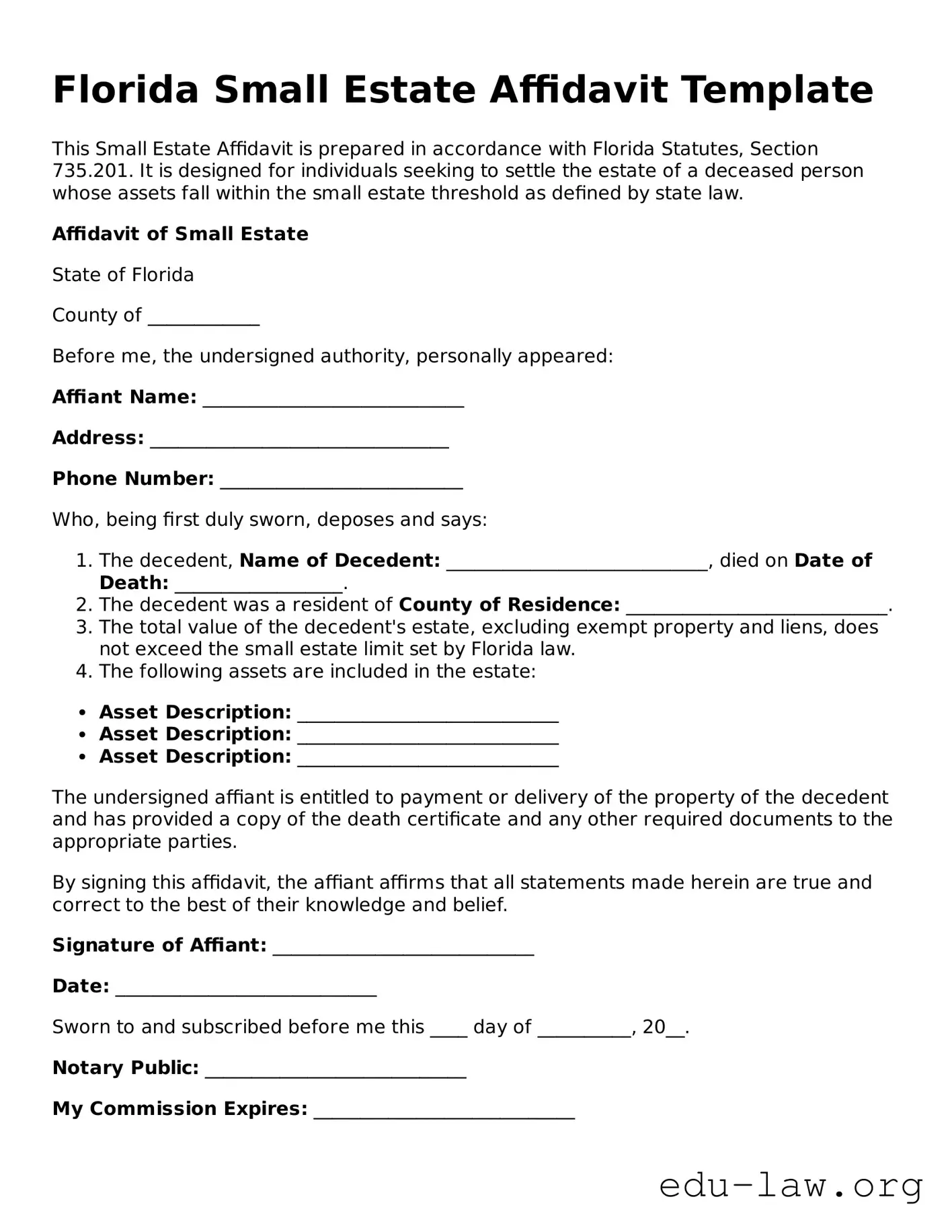
Florida Small Estate Affidavit Template
This Small Estate Affidavit is prepared in accordance with Florida Statutes, Section 735.201. It is designed for individuals seeking to settle the estate of a deceased person whose assets fall within the small estate threshold as defined by state law.
Affidavit of Small Estate
State of Florida
County of ____________
Before me, the undersigned authority, personally appeared:
Affiant Name: ____________________________
Address: ________________________________
Phone Number: __________________________
Who, being first duly sworn, deposes and says:
The undersigned affiant is entitled to payment or delivery of the property of the decedent and has provided a copy of the death certificate and any other required documents to the appropriate parties.
By signing this affidavit, the affiant affirms that all statements made herein are true and correct to the best of their knowledge and belief.
Signature of Affiant: ____________________________
Date: ____________________________
Sworn to and subscribed before me this ____ day of __________, 20__.
Notary Public: ____________________________
My Commission Expires: ____________________________
| Fact Name | Details |
|---|---|
| Definition | The Florida Small Estate Affidavit is a legal document that allows for the transfer of assets from a deceased person's estate without formal probate proceedings. |
| Eligibility | This affidavit can be used if the total value of the estate is $100,000 or less, excluding homestead property. |
| Governing Law | The use of the Small Estate Affidavit is governed by Florida Statutes, specifically Section 735.201. |
| Homestead Property | Homestead property is not included in the $100,000 limit, allowing it to be transferred separately. |
| Required Signatures | The affidavit must be signed by the person claiming the assets and may require the signatures of witnesses. |
| Filing Location | The affidavit should be filed in the county where the deceased person lived at the time of death. |
| Time Limit | There is no specific time limit for filing the Small Estate Affidavit, but it is advisable to do so soon after death. |
| Asset Types | Common assets that can be transferred include bank accounts, personal property, and vehicles. |
| Notarization | The affidavit must be notarized to be considered valid. |
| Court Involvement | Using the Small Estate Affidavit generally avoids the need for court involvement, simplifying the process for heirs. |
Once you have the Florida Small Estate Affidavit form, you’ll need to fill it out accurately to ensure a smooth process. This form is essential for settling the estate of a deceased person when the total value of their assets is below a certain threshold. Follow these steps to complete the form correctly.
After filing the Small Estate Affidavit, you may need to wait for the court to process it. Once approved, you can proceed with distributing the assets as outlined in the affidavit. Keep copies of all documents for your records, as they may be needed later in the process.
What is a Florida Small Estate Affidavit?
A Florida Small Estate Affidavit is a legal document that allows individuals to claim the assets of a deceased person without going through a full probate process. This option is available when the total value of the estate is below a certain threshold, making it a simpler and quicker way to settle an estate.
Who is eligible to use the Small Estate Affidavit?
To use the Small Estate Affidavit, you must be a qualified beneficiary of the deceased person's estate. This typically includes heirs such as spouses, children, or other close relatives. Additionally, the total value of the estate must not exceed $75,000, excluding certain exempt assets like homestead property.
What assets can be claimed using the Small Estate Affidavit?
You can claim various types of assets through the Small Estate Affidavit, including bank accounts, personal property, and vehicles. However, real estate is usually not included unless it qualifies as homestead property. It's important to ensure that the total value of all claimed assets stays within the $75,000 limit.
How do I complete the Small Estate Affidavit?
To complete the Small Estate Affidavit, you will need to fill out the form with accurate information about the deceased person, their assets, and your relationship to them. You'll also need to sign the affidavit in front of a notary public. Make sure to gather any supporting documents, such as death certificates and asset valuations, to strengthen your claim.
Do I need to file the Small Estate Affidavit with the court?
No, you do not need to file the Small Estate Affidavit with the court unless you are claiming real property. Instead, you can present the affidavit directly to the institutions holding the deceased person's assets, such as banks or car dealerships, to access the assets.
How long does the process take?
The process of using a Small Estate Affidavit can vary in length. Generally, it can be completed relatively quickly, often within a few weeks, depending on how promptly the necessary institutions process your request. However, gathering documents and completing the affidavit accurately can take additional time.
What happens if the estate exceeds the $75,000 limit?
If the estate's value exceeds the $75,000 limit, you will need to go through the formal probate process. This process can be more complex and time-consuming, often requiring the assistance of an attorney. It’s advisable to assess the total value of the estate carefully before deciding on the Small Estate Affidavit route.
Can I use the Small Estate Affidavit if there is a will?
Yes, you can use the Small Estate Affidavit even if there is a will. However, the will must not require formal probate proceedings. If the will is straightforward and the estate qualifies under the small estate rules, you can proceed with the affidavit to claim the assets.
Failing to identify all heirs: It's crucial to include every heir who is entitled to a share of the estate. Omitting an heir can lead to complications and disputes later on.
Not providing accurate property valuations: When listing assets, ensure that the values are correct and reflect the fair market value. Incorrect valuations can affect the distribution process.
Ignoring the requirement for notarization: The Florida Small Estate Affidavit must be signed in front of a notary public. Neglecting this step can invalidate the affidavit.
Overlooking debts and liabilities: All known debts of the deceased should be disclosed. Failing to account for these can lead to issues with creditors.
Using outdated forms: Always use the most current version of the Florida Small Estate Affidavit. Using an outdated form can result in rejection or delays.
Not checking for additional requirements: Some counties may have specific requirements or additional documentation needed. It’s important to verify local rules before submission.
Submitting incomplete information: Ensure that all sections of the affidavit are filled out completely. Incomplete submissions can lead to processing delays.
Failing to keep copies: Always make copies of the completed affidavit and any supporting documents for personal records. This practice can help in case of future disputes or questions.
The Florida Small Estate Affidavit is a useful tool for settling the estates of deceased individuals when the estate's value falls below a certain threshold. However, it is often accompanied by other important documents to ensure the process runs smoothly. Here are four common forms and documents that are typically used alongside the Small Estate Affidavit:
Using these documents in conjunction with the Florida Small Estate Affidavit can help simplify the estate settlement process. Each document serves a specific purpose and contributes to a clearer understanding of the deceased's wishes and assets.
The Florida Small Estate Affidavit is similar to a Will in that both documents facilitate the transfer of assets after an individual passes away. A Will outlines the deceased's wishes regarding asset distribution and appoints an executor to carry out those wishes. However, the Small Estate Affidavit is typically used when the estate is below a certain value, allowing for a more streamlined process without the need for probate court involvement. This can expedite the distribution of assets to heirs, making it a practical alternative for smaller estates.
An Affidavit of Heirship also shares similarities with the Small Estate Affidavit. Both documents establish the rightful heirs of a deceased individual. While the Small Estate Affidavit allows heirs to claim assets directly, an Affidavit of Heirship is often used to clarify the lineage and relationship of heirs when there is no Will. This document can help in situations where ownership of property is disputed or unclear, thereby providing a legal basis for heirs to assert their rights.
The Declaration of Trust bears resemblance to the Small Estate Affidavit in that both can be used to manage and distribute assets. A Declaration of Trust outlines how a trustee will manage assets for beneficiaries, while the Small Estate Affidavit allows heirs to claim their inheritance directly. Trusts often require ongoing management and can provide tax benefits, while the Small Estate Affidavit is designed for a more straightforward, one-time transfer of assets.
The Petition for Summary Administration is another document that serves a similar purpose. Both the Petition for Summary Administration and the Small Estate Affidavit allow for the distribution of assets without the need for full probate proceedings. However, the Petition is typically used for estates that exceed the small estate threshold but still qualify for a simplified process due to specific conditions. This document requires court approval, while the Small Estate Affidavit is often executed without court intervention, making it quicker and more accessible.
Lastly, the Probate Inventory form is akin to the Small Estate Affidavit in that it involves the listing of assets. The Probate Inventory is used during the probate process to detail all assets of the deceased. In contrast, the Small Estate Affidavit serves as a declaration that identifies the heirs and allows them to claim assets directly. While both documents provide essential information about the estate, the Small Estate Affidavit focuses on the heirs' rights and claims, streamlining the process for smaller estates.
When filling out the Florida Small Estate Affidavit form, it is important to follow specific guidelines to ensure the process goes smoothly. Here is a list of things you should and shouldn't do:
Following these guidelines will help you navigate the Small Estate Affidavit process with confidence.
Many people have misunderstandings about the Florida Small Estate Affidavit form. These misconceptions can lead to confusion and may affect the handling of a deceased person's estate. Below are six common misconceptions:
Understanding these misconceptions can help individuals navigate the complexities of estate management more effectively. It is always wise to seek guidance when dealing with estate matters.
When dealing with the Florida Small Estate Affidavit form, there are several important points to keep in mind. This form is designed to simplify the process of settling small estates without going through probate. Here are key takeaways to consider: