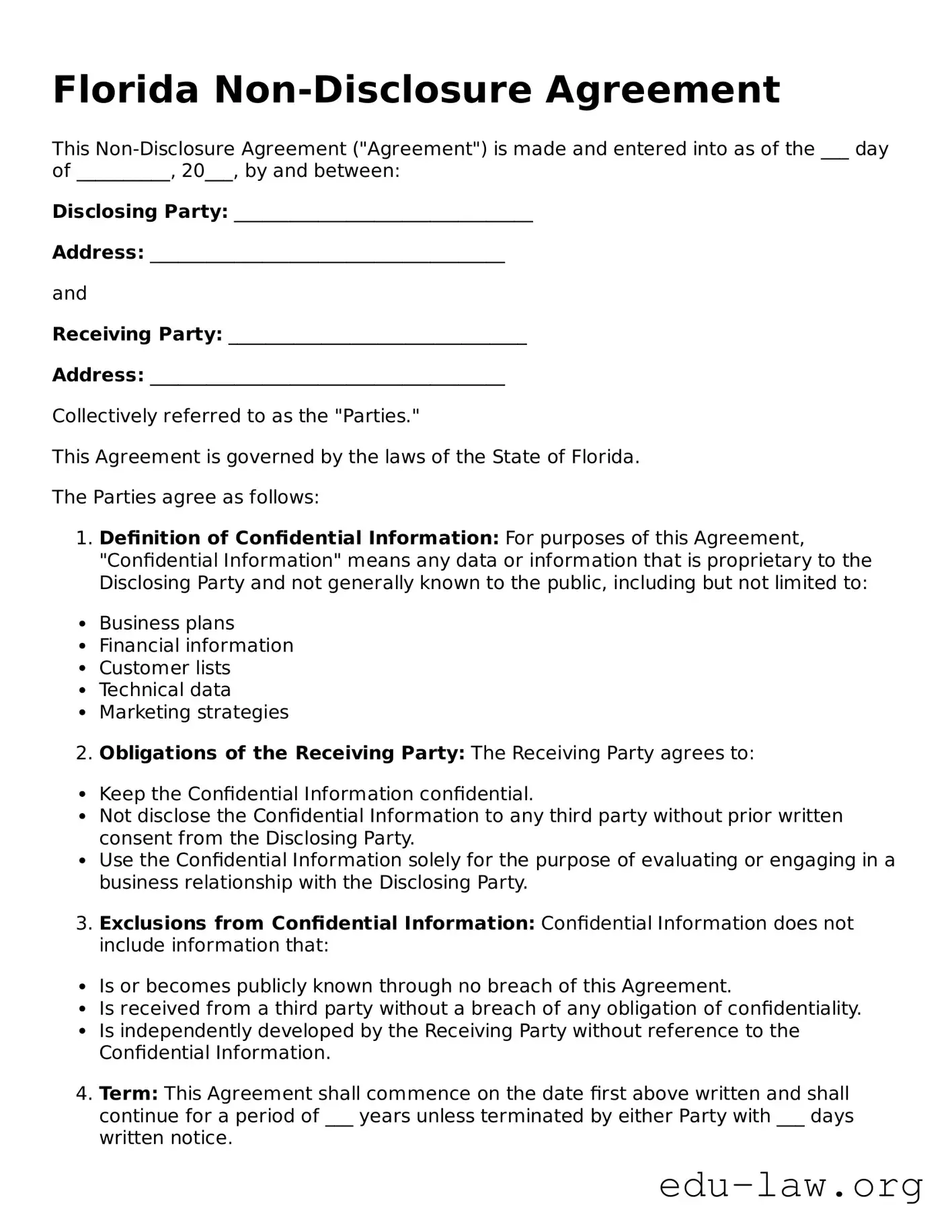
In the realm of business, protecting sensitive information is crucial for maintaining a competitive edge. The Florida Non-disclosure Agreement (NDA) form serves as a vital tool for individuals and organizations looking to safeguard their proprietary information. This legally binding document outlines the terms under which confidential information can be shared between parties, ensuring that such information remains protected from unauthorized disclosure. Key aspects of the NDA include the definition of what constitutes confidential information, the obligations of the parties involved, and the duration of the confidentiality requirement. Additionally, the form may specify any exclusions, such as information that is already public or independently developed. By clearly establishing these parameters, the Florida NDA helps to foster trust and collaboration while minimizing the risk of information leaks that could harm a business's interests.
Florida Non-Disclosure Agreement
This Non-Disclosure Agreement ("Agreement") is made and entered into as of the ___ day of __________, 20___, by and between:
Disclosing Party: ________________________________
Address: ______________________________________
and
Receiving Party: ________________________________
Address: ______________________________________
Collectively referred to as the "Parties."
This Agreement is governed by the laws of the State of Florida.
The Parties agree as follows:
IN WITNESS WHEREOF, the Parties hereto have executed this Non-Disclosure Agreement as of the date first above written.
Disclosing Party Signature: ________________________________
Date: ____________
Receiving Party Signature: ________________________________
Date: ____________
| Fact Name | Details |
|---|---|
| Definition | A Florida Non-disclosure Agreement (NDA) is a legal contract that protects confidential information shared between parties. |
| Governing Law | The NDA is governed by Florida state law, specifically under Florida Statutes Chapter 688. |
| Parties Involved | The agreement typically involves a disclosing party and a receiving party, both of whom agree to keep certain information confidential. |
| Duration of Confidentiality | The NDA should specify how long the confidentiality obligation lasts. This period can vary based on the nature of the information. |
| Permitted Disclosures | Some disclosures may be allowed, such as when required by law or court order. The NDA should outline these exceptions clearly. |
| Consequences of Breach | If a party breaches the NDA, the other party may seek legal remedies, including damages and injunctive relief. |
| Enforceability | Florida courts generally uphold NDAs as long as they are reasonable in scope and duration, and serve a legitimate business purpose. |
After you have obtained the Florida Non-disclosure Agreement form, you are ready to fill it out. This form is essential for protecting confidential information between parties. Follow these steps carefully to ensure all necessary information is accurately provided.
What is a Florida Non-disclosure Agreement (NDA)?
A Florida Non-disclosure Agreement is a legal contract designed to protect confidential information shared between parties. It establishes a confidential relationship and restricts the sharing of sensitive information with third parties. NDAs are commonly used in business settings to safeguard trade secrets, proprietary information, and other sensitive data.
Who typically uses a Non-disclosure Agreement in Florida?
NDAs are used by a variety of individuals and organizations in Florida, including businesses, entrepreneurs, and freelancers. They are particularly common in industries where proprietary information is vital, such as technology, pharmaceuticals, and manufacturing. Both parties involved in a business relationship may use an NDA to ensure that confidential information remains protected.
What should be included in a Florida Non-disclosure Agreement?
An effective NDA should include several key components. First, it should clearly define what constitutes confidential information. Next, it should outline the obligations of both parties regarding the handling of this information. Additionally, the duration of the confidentiality obligation should be specified, along with any exclusions from confidentiality, such as information that becomes public knowledge. Finally, it is important to include provisions for the return or destruction of confidential information upon termination of the agreement.
How long does the confidentiality last under a Florida Non-disclosure Agreement?
The duration of confidentiality in an NDA can vary based on the agreement between the parties. Typically, the confidentiality obligation lasts for a specified period, often ranging from one to five years. However, some agreements may state that the obligation continues indefinitely, especially for trade secrets. It is essential for both parties to agree on the duration and include it clearly in the contract.
What are the consequences of violating a Non-disclosure Agreement in Florida?
Violating an NDA can lead to several consequences. The injured party may seek legal remedies, including monetary damages for any losses incurred due to the breach. In some cases, the court may issue an injunction to prevent further disclosure of confidential information. Additionally, the violating party may face reputational damage and loss of trust in business relationships. Therefore, it is crucial to adhere to the terms outlined in the agreement.
Failing to include all parties involved. It is crucial to list every individual or entity that will be bound by the agreement. Omitting a party can lead to complications later.
Not defining confidential information clearly. A vague description can create confusion and may result in unintentional disclosures.
Leaving out the duration of confidentiality. Specify how long the information must remain confidential. Without this, the agreement lacks clarity.
Neglecting to include the purpose of the disclosure. Clearly stating why the information is being shared helps to limit its use.
Using complex language. The agreement should be easy to understand. Legal jargon can lead to misunderstandings.
Not considering exceptions to confidentiality. It is important to outline any circumstances under which the information may be disclosed legally.
Failing to sign and date the agreement. An unsigned document may not hold up legally, so ensure all parties have signed and dated it.
Not keeping a copy of the signed agreement. Retaining a copy is essential for reference and enforcement purposes.
The Florida Non-disclosure Agreement (NDA) is a crucial document for protecting confidential information between parties. However, several other forms and documents are commonly used in conjunction with an NDA to ensure comprehensive legal protection and clarity in business relationships. Below is a list of these documents, along with a brief description of each.
These documents complement the Florida Non-disclosure Agreement by addressing various aspects of business relationships and protecting sensitive information. Utilizing them appropriately can help safeguard interests and establish clear expectations among parties involved.
A Confidentiality Agreement is quite similar to a Non-disclosure Agreement (NDA). Both documents aim to protect sensitive information shared between parties. In a Confidentiality Agreement, the focus is often on ensuring that the receiving party does not disclose proprietary information to others. This document can be used in various situations, such as during business negotiations or when sharing trade secrets, just like an NDA.
A Mutual Non-disclosure Agreement is another type of document that shares similarities with the Florida NDA. This agreement involves two parties who both share confidential information with each other. Each party agrees not to disclose the other’s sensitive information. This is particularly useful in joint ventures or partnerships where both sides need to protect their respective information.
An Employment Non-disclosure Agreement is specifically tailored for employees. It ensures that employees do not share the company's confidential information with outsiders. This type of NDA is often signed when an employee starts a new job, safeguarding the company’s trade secrets and sensitive data throughout their employment and sometimes even after they leave.
A Non-compete Agreement can also relate to NDAs, though its focus is slightly different. This document prevents an individual from engaging in business activities that compete with their employer for a specified time and within a certain area. While it primarily restricts competition, it often includes confidentiality clauses to protect sensitive information as well.
A Proprietary Information Agreement is another document that serves a similar purpose. It protects proprietary information shared between parties. Like an NDA, it outlines what information is considered proprietary and the obligations of the receiving party to keep that information confidential. This agreement is commonly used in business relationships where sensitive information is exchanged.
A Service Agreement may also include confidentiality provisions similar to those found in NDAs. When businesses hire service providers, they often share sensitive information. A Service Agreement can include clauses that require the service provider to keep this information confidential, thereby protecting the business’s interests.
A Licensing Agreement can share similarities with NDAs when it comes to protecting sensitive information. When one party licenses a product or service from another, they may need access to confidential information. This agreement often includes confidentiality clauses to ensure that proprietary information is not disclosed during the licensing process.
A Partnership Agreement can also incorporate elements of a Non-disclosure Agreement. In partnerships, both parties may share sensitive business information. The Partnership Agreement may include confidentiality clauses to protect this information, ensuring that both parties uphold their obligations to keep shared data private.
Finally, a Collaboration Agreement may resemble an NDA in its approach to protecting shared information. When two or more parties collaborate on a project, they often share sensitive information. This agreement typically includes confidentiality provisions to ensure that all parties involved protect each other’s proprietary information throughout the collaboration.
When filling out the Florida Non-disclosure Agreement form, it is important to follow certain guidelines to ensure accuracy and compliance. Here is a list of things you should and shouldn't do:
Following these guidelines can help prevent misunderstandings and ensure that the Non-disclosure Agreement serves its intended purpose effectively.
Non-disclosure agreements (NDAs) are important legal tools used to protect confidential information. However, several misconceptions exist regarding the Florida Non-disclosure Agreement form. Understanding these misconceptions can help individuals and businesses navigate the complexities of confidentiality agreements more effectively.
By dispelling these misconceptions, individuals and businesses can better understand the role of non-disclosure agreements in protecting their interests.
When filling out and using the Florida Non-disclosure Agreement (NDA) form, several key points should be considered to ensure effectiveness and legal compliance.