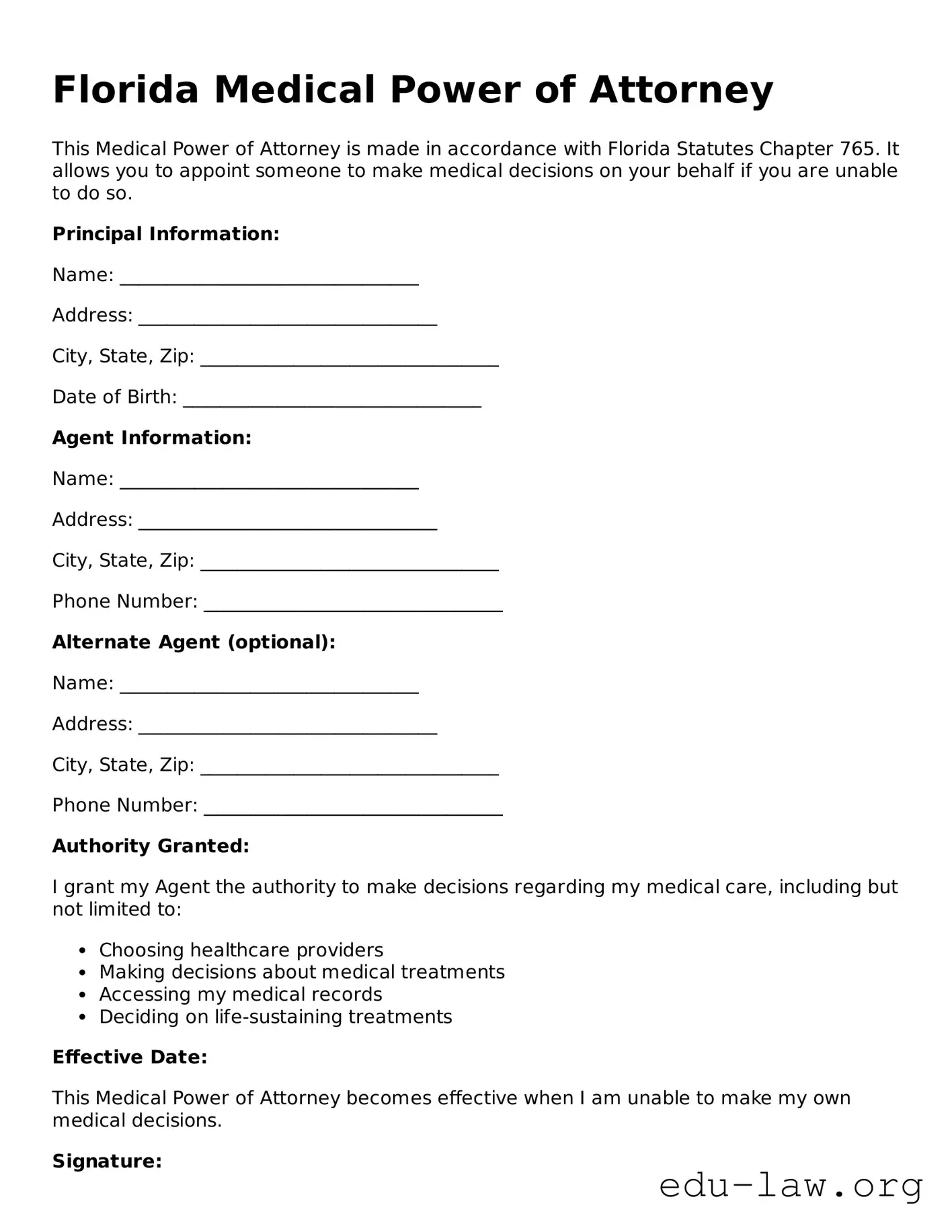
When it comes to making crucial healthcare decisions, having a trusted person by your side can make all the difference. In Florida, a Medical Power of Attorney (MPOA) form allows you to designate someone to make medical decisions on your behalf if you're unable to do so. This essential document outlines your preferences for medical treatment and appoints a healthcare surrogate, ensuring that your wishes are respected even when you can't voice them. The MPOA can cover a range of decisions, from routine medical care to more complex interventions, and can be tailored to reflect your values and beliefs. It's not just about who makes the decisions; it's also about how those decisions align with your personal desires. Understanding the nuances of this form is key to ensuring your healthcare choices are honored, providing peace of mind for you and your loved ones.
Florida Medical Power of Attorney
This Medical Power of Attorney is made in accordance with Florida Statutes Chapter 765. It allows you to appoint someone to make medical decisions on your behalf if you are unable to do so.
Principal Information:
Name: ________________________________
Address: ________________________________
City, State, Zip: ________________________________
Date of Birth: ________________________________
Agent Information:
Name: ________________________________
Address: ________________________________
City, State, Zip: ________________________________
Phone Number: ________________________________
Alternate Agent (optional):
Name: ________________________________
Address: ________________________________
City, State, Zip: ________________________________
Phone Number: ________________________________
Authority Granted:
I grant my Agent the authority to make decisions regarding my medical care, including but not limited to:
Effective Date:
This Medical Power of Attorney becomes effective when I am unable to make my own medical decisions.
Signature:
Principal's Signature: ________________________________
Date: ________________________________
Witnesses:
This document must be signed in the presence of two witnesses who are not related to you or your Agent, and who do not stand to benefit from your estate.
It is advisable to keep a copy of this document with your important papers and provide a copy to your Agent and healthcare providers.
| Fact Name | Details |
|---|---|
| Definition | A Florida Medical Power of Attorney allows an individual to appoint someone to make healthcare decisions on their behalf if they become unable to do so. |
| Governing Law | This form is governed by Florida Statutes, Chapter 765. |
| Principal | The person creating the Medical Power of Attorney is known as the principal. |
| Agent | The individual appointed to make decisions is referred to as the agent or surrogate. |
| Signing Requirements | The form must be signed by the principal in the presence of two witnesses or a notary public. |
| Revocation | The principal can revoke the Medical Power of Attorney at any time as long as they are competent. |
| Durability | This document remains effective even if the principal becomes incapacitated. |
| Healthcare Decisions | The agent can make decisions regarding medical treatment, including end-of-life care. |
| Limitations | Agents cannot make decisions that are contrary to the principal's wishes as expressed in the document. |
Filling out the Florida Medical Power of Attorney form is an important step in ensuring that your healthcare wishes are respected. After completing the form, you will need to sign it in front of a witness and have it notarized to make it legally binding.
Once you have completed these steps, keep the original form in a safe place and provide copies to your agent and healthcare providers. This will ensure that your wishes are known and can be acted upon when needed.
What is a Florida Medical Power of Attorney?
A Florida Medical Power of Attorney is a legal document that allows you to appoint someone else to make medical decisions on your behalf if you become unable to do so. This person, known as your agent or proxy, will have the authority to discuss your medical treatment and make choices regarding your healthcare based on your wishes and best interests.
Who can be appointed as my agent?
You can choose any competent adult as your agent. This could be a family member, friend, or trusted individual. It is crucial that the person you select understands your healthcare preferences and is willing to advocate for your wishes. However, healthcare providers or employees of your healthcare facility cannot serve as your agent unless they are related to you.
Do I need a lawyer to create a Medical Power of Attorney in Florida?
No, you do not need a lawyer to create a Medical Power of Attorney in Florida. The form can be completed on your own. However, consulting with a legal professional can help ensure that your document accurately reflects your wishes and complies with state laws.
Is a Medical Power of Attorney the same as a Living Will?
No, a Medical Power of Attorney and a Living Will are different documents. A Medical Power of Attorney appoints someone to make decisions for you, while a Living Will outlines your wishes regarding medical treatment in specific situations, such as terminal illness or irreversible coma. Both documents can work together to provide comprehensive guidance for your healthcare.
How do I revoke or change my Medical Power of Attorney?
You can revoke or change your Medical Power of Attorney at any time, as long as you are mentally competent. To do this, you must create a new document or a written revocation that clearly states your intention to revoke the previous authority. Inform your agent and any healthcare providers about the change to avoid confusion.
Does my Medical Power of Attorney need to be notarized?
In Florida, a Medical Power of Attorney does not require notarization. However, it must be signed by you and witnessed by two individuals who are not your designated agent. This ensures that your document is valid and recognized by healthcare providers.
When does my Medical Power of Attorney take effect?
Your Medical Power of Attorney typically takes effect when your doctor determines that you are unable to make your own medical decisions. You can also specify in the document if you want it to take effect immediately or under certain conditions. Make sure your agent understands when their authority begins.
Can I use a Medical Power of Attorney created in another state in Florida?
Yes, a Medical Power of Attorney created in another state may be honored in Florida as long as it complies with the laws of that state and meets Florida's requirements. However, to avoid complications, it is advisable to create a new Medical Power of Attorney that adheres to Florida's specific regulations.
Not specifying the agent clearly. It is crucial to name a specific person who will act on your behalf. Vague references can lead to confusion.
Failing to include alternate agents. If the primary agent is unavailable or unable to act, having a backup can ensure that your wishes are still honored.
Overlooking the need for witnesses. In Florida, the form requires signatures from two witnesses. Neglecting this step can invalidate the document.
Not updating the form. Life changes, such as marriage or divorce, can affect your choices. Regularly reviewing and updating the document is essential.
Using outdated forms. Laws and regulations may change. Always ensure you are using the most current version of the Florida Medical Power of Attorney form.
Failing to discuss your wishes with your agent. Open communication about your healthcare preferences is vital for your agent to make informed decisions.
Not signing and dating the form properly. Each signature must be dated to confirm the document's validity. Incomplete signatures can lead to complications.
When considering a Florida Medical Power of Attorney, it’s essential to be aware of other documents that can complement this important legal tool. Each of these forms serves a unique purpose, ensuring that your medical and financial wishes are honored in various circumstances. Below is a list of some commonly used forms and documents that you may find beneficial.
Understanding these documents can significantly enhance your ability to manage your healthcare and financial decisions. By preparing them in advance, you can ensure that your preferences are clear and that your loved ones are equipped to act in your best interest when the time comes.
The Florida Medical Power of Attorney form is similar to a Durable Power of Attorney. Both documents allow individuals to appoint someone to make decisions on their behalf. However, the Durable Power of Attorney can cover a broader range of decisions, including financial matters. While the Medical Power of Attorney specifically focuses on healthcare decisions, the Durable Power of Attorney remains effective even if the principal becomes incapacitated.
Another similar document is the Living Will. While the Medical Power of Attorney designates a person to make healthcare decisions, the Living Will outlines the principal's wishes regarding medical treatment in specific situations, such as end-of-life care. Together, these documents ensure that an individual's healthcare preferences are honored when they cannot communicate them directly.
The Healthcare Proxy is also comparable to the Medical Power of Attorney. This document allows an individual to appoint a healthcare agent to make medical decisions on their behalf. The main distinction lies in the terminology and specific state laws. In some states, the term "healthcare proxy" is used interchangeably with "Medical Power of Attorney," but the underlying purpose remains the same: to ensure that someone trusted makes healthcare choices when the individual is unable to do so.
A Do Not Resuscitate (DNR) order shares similarities with the Medical Power of Attorney in that both pertain to healthcare decisions. However, a DNR specifically instructs medical personnel not to perform CPR if the individual stops breathing or their heart stops. While the Medical Power of Attorney allows for broader healthcare decisions, the DNR is a specific directive regarding resuscitation efforts.
The Advance Healthcare Directive is another document akin to the Medical Power of Attorney. It combines the functions of a Medical Power of Attorney and a Living Will, allowing individuals to appoint a healthcare agent while also expressing their treatment preferences. This comprehensive approach ensures that both the choice of an advocate and the individual's wishes are clearly documented.
The Mental Health Power of Attorney is similar in that it allows a person to designate someone to make decisions regarding mental health treatment. Unlike the general Medical Power of Attorney, which covers all medical decisions, the Mental Health Power of Attorney focuses specifically on mental health issues. This distinction is crucial for individuals who may require specialized care in mental health situations.
In some cases, a Guardianship document can be compared to the Medical Power of Attorney. A Guardianship may be established when an individual is deemed unable to make decisions for themselves, often through a court process. This document grants a guardian the authority to make healthcare and other decisions on behalf of the individual, similar to the Medical Power of Attorney, but it typically involves more formal oversight.
The Authorization for Release of Medical Records is another relevant document. While the Medical Power of Attorney allows someone to make healthcare decisions, the Authorization for Release of Medical Records gives permission for a designated person to access an individual's medical information. This access is essential for the appointed agent to make informed decisions regarding the individual's care.
Finally, the Physician Orders for Life-Sustaining Treatment (POLST) is similar in that it addresses end-of-life care preferences. The POLST form is a medical order that outlines a patient’s wishes regarding life-sustaining treatments. While the Medical Power of Attorney designates a person to make decisions, the POLST provides specific instructions for medical personnel, ensuring that the individual’s preferences are followed in critical situations.
When filling out a Florida Medical Power of Attorney form, it is essential to approach the task with care and attention to detail. Here are some important dos and don’ts to keep in mind:
By following these guidelines, individuals can ensure that their Medical Power of Attorney form reflects their intentions and is legally sound.
Understanding the Florida Medical Power of Attorney form is crucial for ensuring that your healthcare preferences are honored when you cannot speak for yourself. However, several misconceptions often arise regarding this important legal document. Here are eight common misunderstandings:
By dispelling these misconceptions, individuals can better prepare for their healthcare decisions and ensure their wishes are respected when it matters most.
Filling out a Florida Medical Power of Attorney form is an important step in ensuring that your healthcare wishes are respected. Here are some key takeaways to consider:
By following these guidelines, you can ensure that your Medical Power of Attorney is both effective and reflective of your healthcare preferences.