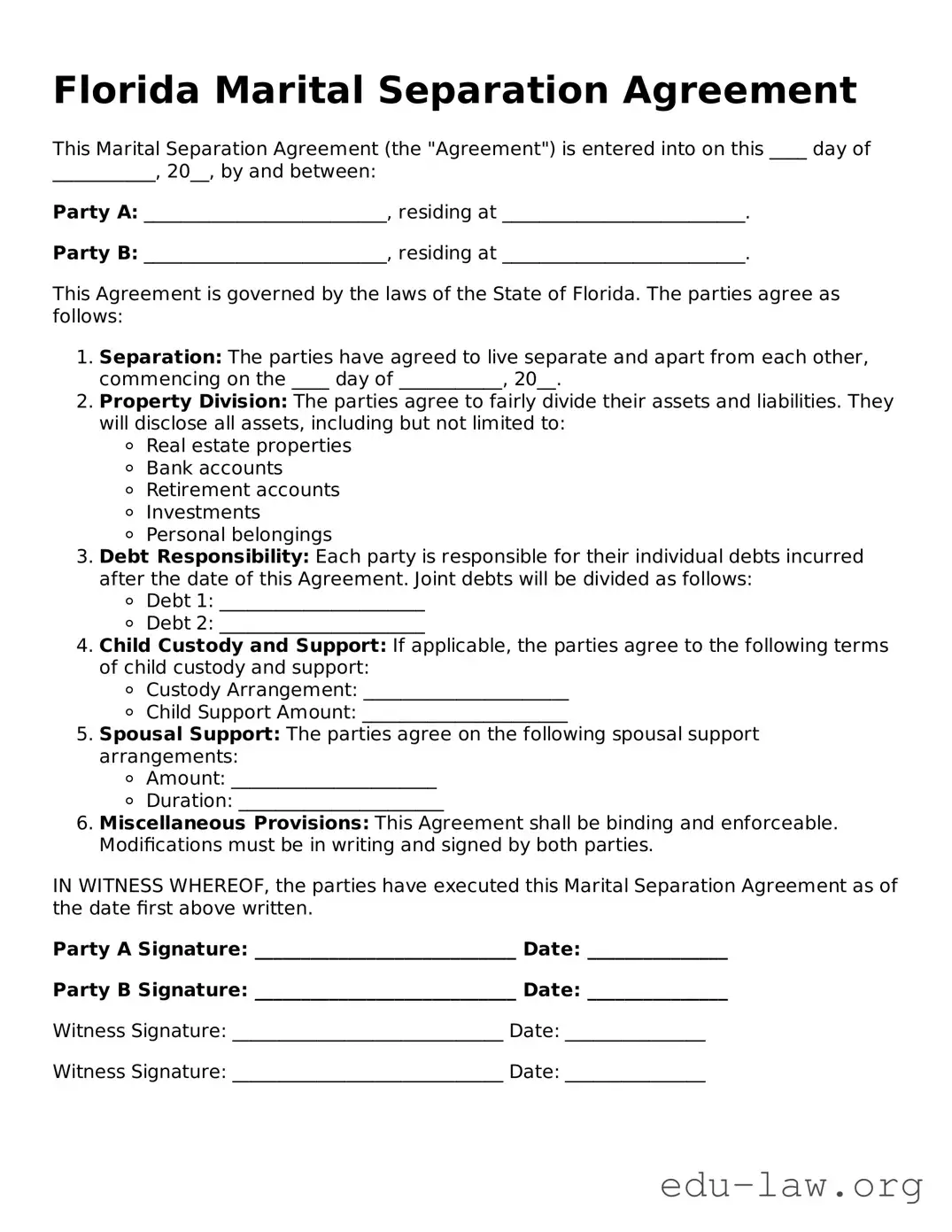
In Florida, when couples decide to separate but want to maintain clarity on important aspects of their lives, a Marital Separation Agreement can be a valuable tool. This document helps outline essential arrangements regarding property division, spousal support, and child custody, providing a framework that both parties can agree upon. It serves as a roadmap for responsibilities and entitlements during a separation period. By detailing these critical aspects, the agreement can help reduce misunderstandings and conflicts, making the separation process smoother for everyone involved. Additionally, having a formal agreement in place may help both partners stay organized and focused on future decisions, all while ensuring the protection of their rights.
Florida Marital Separation Agreement
This Marital Separation Agreement (the "Agreement") is entered into on this ____ day of ___________, 20__, by and between:
Party A: __________________________, residing at __________________________.
Party B: __________________________, residing at __________________________.
This Agreement is governed by the laws of the State of Florida. The parties agree as follows:
IN WITNESS WHEREOF, the parties have executed this Marital Separation Agreement as of the date first above written.
Party A Signature: ____________________________ Date: _______________
Party B Signature: ____________________________ Date: _______________
Witness Signature: _____________________________ Date: _______________
Witness Signature: _____________________________ Date: _______________
| Fact Name | Details |
|---|---|
| Purpose | The Florida Marital Separation Agreement allows couples to outline the terms of their separation, addressing issues such as asset division, support, and child custody. |
| Governing Law | This agreement is governed by the Florida Statutes, specifically Chapter 61, which covers dissolution of marriage and related legal matters. |
| Legal Binding | Once signed by both parties, the agreement can be legally binding if it meets the legal requirements and is made part of a divorce decree. |
| Modification | The terms of the agreement can be modified by mutual consent of both parties, ideally in writing, to ensure enforceability in court. |
After completing the Florida Marital Separation Agreement form, you will need to file it with the appropriate court and possibly attend a court hearing. Follow these steps to ensure the form is filled out correctly.
What is a Florida Marital Separation Agreement?
A Florida Marital Separation Agreement is a legal document that outlines the terms and conditions of a couple's separation. It usually covers various aspects such as division of property, child custody, visitation rights, and spousal support. While the separation agreement is not the same as a divorce, it helps both parties clarify their responsibilities and rights during the separation period.
Do I need a lawyer to create a Marital Separation Agreement in Florida?
While it is not required to hire a lawyer to draft a Florida Marital Separation Agreement, it is highly recommended. Having legal assistance ensures that all aspects of the agreement comply with state laws and that both parties understand their rights. A lawyer can also help negotiate terms that are fair and equitable, reducing the chances of disputes later on.
How is a Marital Separation Agreement enforced in Florida?
A Marital Separation Agreement is enforceable in Florida as long as it is fair, reasonable, and signed voluntarily by both parties. If one party fails to adhere to the terms outlined in the agreement, the other can seek enforcement through the court. While the agreement itself does not constitute a divorce, it can lead to a smoother divorce process by having pre-established terms.
What happens to the Marital Separation Agreement if we reconcile?
If you and your spouse decide to reconcile after creating a Marital Separation Agreement, the agreement may be rendered void. Alternatively, both parties can choose to modify or nullify specific terms of the agreement. It's crucial to document any changes in writing to avoid confusion in the future. Consulting with a lawyer during this process is advisable to ensure that all legalities are observed.
Failing to include personal information accurately. Make sure all names, addresses, and contact details are correct.
Not being clear about the date of separation. This date is important for legal purposes and should be specified accurately.
Omitting assets and liabilities. List all property owned together and debts owed. Not doing this can lead to future disputes.
Making assumptions about property division. Be explicit about who will keep which assets to avoid misunderstandings later.
Neglecting to address child custody and support. This section should be clear to protect both the children's welfare and the parents' rights.
Overlooking signatures. All parties must sign the agreement for it to be valid.
Failing to have a witness or notary present. Some jurisdictions require a witness or notarization for the agreement.
Not reviewing the document periodically. Situations change, and so should your agreement; regular reviews are necessary.
Ignoring tax implications. Certain decisions can affect tax liabilities. Consider consulting a financial advisor.
Misunderstanding the form’s purpose. A Marital Separation Agreement is not a divorce decree. Clarify your goals before filing.
When navigating a marital separation in Florida, several forms and documents can be essential. Understanding these documents can help ensure that all aspects of the separation are addressed and handled smoothly.
These documents work together to establish a structure for a marital separation in Florida. Each plays a specific role in facilitating clear communication and agreements between both parties, ultimately aiding in a smoother transition into post-separation life.
The Florida Marital Separation Agreement shares similarities with a Separation Agreement, which is a general document used in various jurisdictions. This document outlines the terms of separation for a couple who has decided to live apart but are not pursuing divorce yet. Both agreements detail property division, debt responsibilities, and child custody arrangements, ensuring that both parties have a clear understanding of their obligations and rights during the separation period.
A Parenting Plan is another document that is closely related to the Marital Separation Agreement. A Parenting Plan specifically focuses on the arrangements for the care and custody of children following a separation. This legal document includes schedules for visitation, decision-making responsibilities, and child support issues, similar to how a Marital Separation Agreement addresses these concerns in the context of the couple’s overall separation.
The Divorce Settlement Agreement is also akin to the Marital Separation Agreement. After a divorce is initiated, this document finalizes the terms negotiated between spouses regarding asset distribution, alimony, and other essential matters. While the Marital Separation Agreement is for separated couples, the Divorce Settlement Agreement is for couples who have officially ended their marriage but also addresses similar issues of property and financial responsibilities.
The Property Settlement Agreement is another related document. It explicitly details how property and debts are divided between spouses. While the Marital Separation Agreement may contain clauses about property division during separation, a Property Settlement Agreement specifically focuses on finalizing these arrangements, which is often necessary before a divorce can be finalized.
Another relevant document is the Domestic Relations Order (DRO). This document is commonly used to divide retirement benefits and pensions as part of a divorce or separation. While a Marital Separation Agreement covers terms related to various assets, a DRO is particularly focused on ensuring that retirement accounts are appropriately split between the two parties, often requiring specific legal protocols.
The Alimony Agreement can also be compared to the Marital Separation Agreement. It outlines the support one spouse agrees to provide the other following separation or during divorce proceedings. This agreement is often part of the negotiations in a Marital Separation Agreement, but it may also be a standalone document establishing the terms of financial support.
The Cohabitation Agreement shares some principles with the Marital Separation Agreement. Though primarily used by couples who live together without being married, both agreements establish rules about property division, financial responsibilities, and other significant aspects of living arrangements. In both situations, clear expectations help prevent disputes and foster communication.
Finally, the Non-Marital Separation Agreement functions similarly but is tailored for couples who are not legally married. This document outlines how the couple will handle their finances, personal property, and, if applicable, children. Like the Marital Separation Agreement, it is designed to provide clarity and security during a difficult transition.
Many people have misunderstandings about the Florida Marital Separation Agreement form. Here are some common misconceptions:
Filling out and using the Florida Marital Separation Agreement form is a significant step for couples choosing to separate legally. This document outlines the rights and responsibilities of each spouse during separation. Here are ten key takeaways regarding the form:
By understanding these key points, couples can approach the marital separation process more informed and prepared.
Marital Settlement Agreement - Facilitates easier transitions for all family members involved.
Legal Separation in Michigan - Filing a Marital Separation Agreement is often a step taken before divorce proceedings begin.