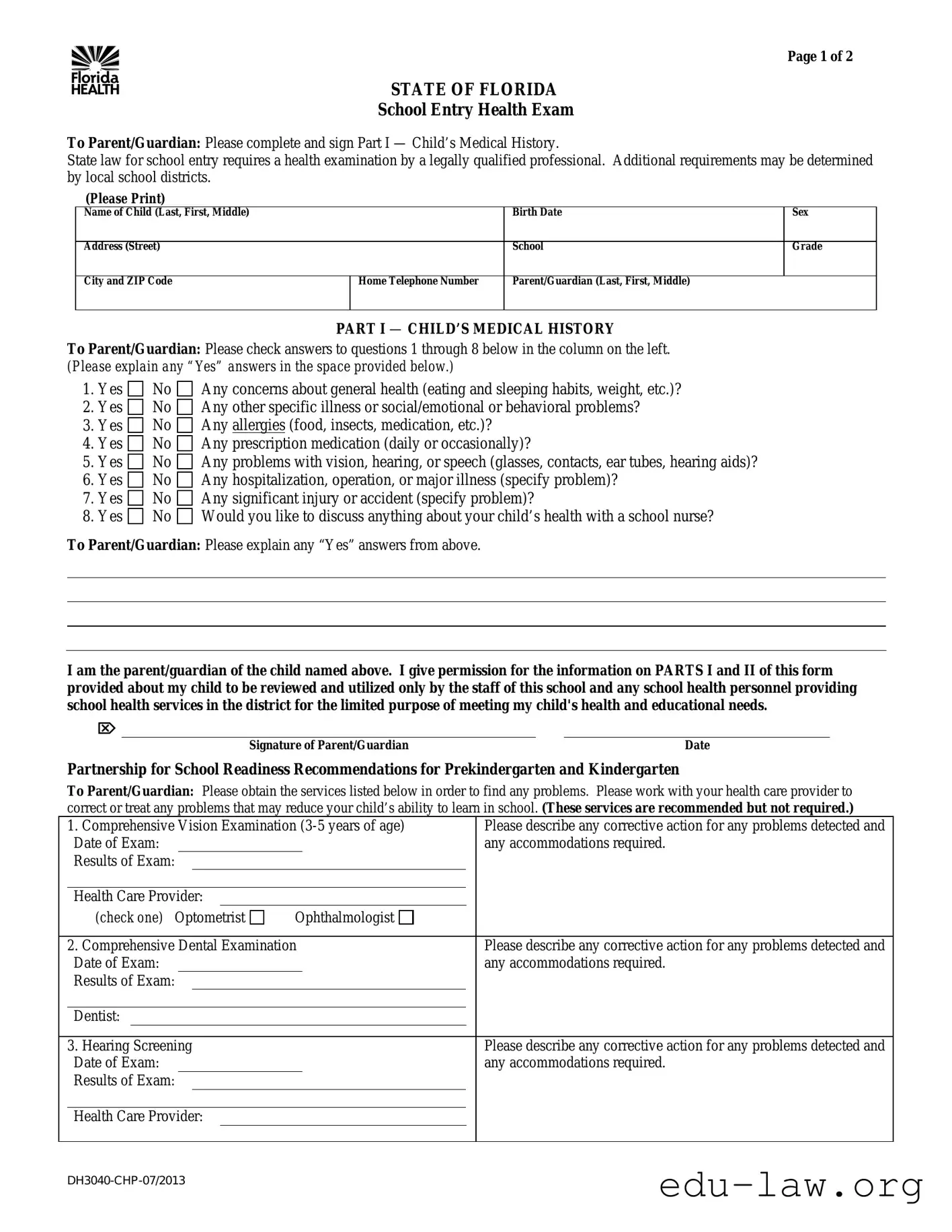
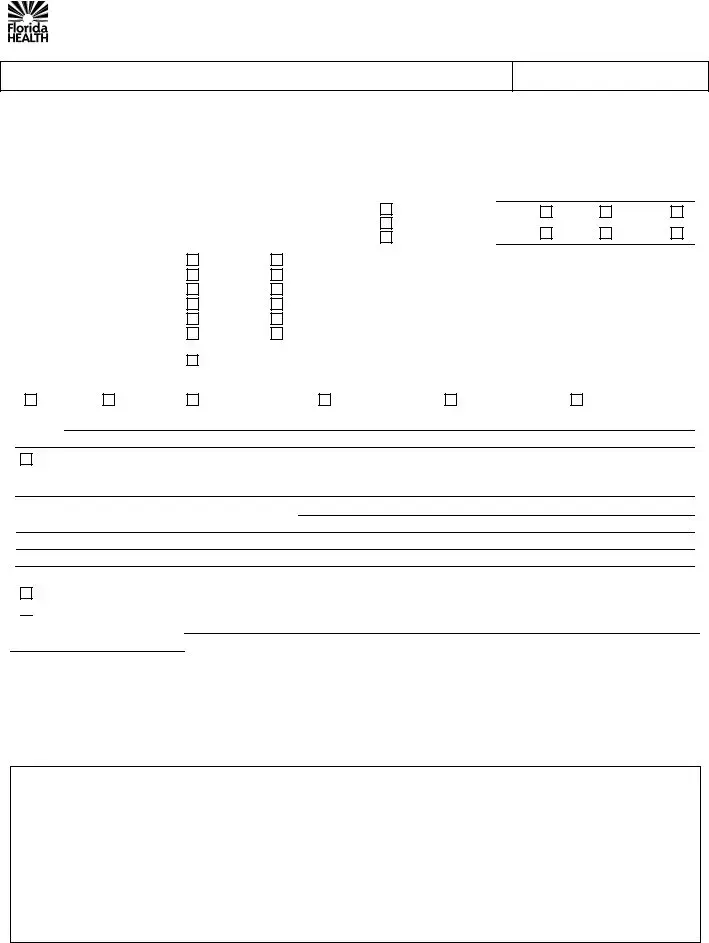
The Florida Health form is a crucial document for parents and guardians as their children prepare to enter school. This form not only captures essential medical history but also ensures compliance with state laws requiring a health examination by a qualified professional. Parents must provide details such as the child's name, birth date, and address, alongside answering specific health-related questions that cover general health, allergies, and any past illnesses or injuries. Additionally, the form includes sections for recommendations regarding vision, dental, and hearing screenings, which are vital for identifying potential issues that could affect a child's learning experience. The health care provider will complete the second part of the form, documenting the results of a thorough medical evaluation, including height, weight, and other health assessments. It is important to note that this information will be used solely for the child's health and educational needs, ensuring a supportive environment as they embark on their academic journey.

Page 1 of 2
STATE OF FLORIDA
School Entry Health Exam
To Parent/Guardian: Please complete and sign Part I — Child’s Medical History.
State law for school entry requires a health examination by a legally qualified professional. Additional requirements may be determined by local school districts.
(Please Print)
Name of Child (Last, First, Middle) |
|
Birth Date |
Sex |
Address (Street) |
|
School |
Grade |
City and ZIP Code |
Home Telephone Number |
Parent/Guardian (Last, First, Middle) |
|
PART I — CHILD’S MEDICAL HISTORY
To Parent/Guardian: Please check answers to questions 1 through 8 below in the column on the left. (Please explain any “Yes” answers in the space provided below.)
1.Yes No Any concerns about general health (eating and sleeping habits, weight, etc.)?
2.Yes No Any other specific illness or social/emotional or behavioral problems?
3.Yes No Any allergies (food, insects, medication, etc.)?
4.Yes No Any prescription medication (daily or occasionally)?
5.Yes No Any problems with vision, hearing, or speech (glasses, contacts, ear tubes, hearing aids)?
6.Yes No Any hospitalization, operation, or major illness (specify problem)?
7.Yes No Any significant injury or accident (specify problem)?
8.Yes No Would you like to discuss anything about your child’s health with a school nurse?
To Parent/Guardian: Please explain any “Yes” answers from above.
I am the parent/guardian of the child named above. I give permission for the information on PARTS I and II of this form provided about my child to be reviewed and utilized only by the staff of this school and any school health personnel providing school health services in the district for the limited purpose of meeting my child's health and educational needs.
⌦
Signature of Parent/Guardian |
|
Date |
Partnership for School Readiness Recommendations for Prekindergarten and Kindergarten
To Parent/Guardian: Please obtain the services listed below in order to find any problems. Please work with your health care provider to correct or treat any problems that may reduce your child’s ability to learn in school. (These services are recommended but not required.)
|
1. Comprehensive Vision Examination |
|
Please describe any corrective action for any problems detected and |
||||||
|
Date of Exam: |
|
|
|
any accommodations required. |
||||
|
Results of Exam: |
|
|
|
|
|
|
|
|
|
|
|
|
|
|
|
|
||
|
Health Care Provider: |
|
|
|
|
|
|||
|
(check one) Optometrist |
Ophthalmologist |
|
|
|||||
|
|
|
|
||||||
|
2. Comprehensive Dental Examination |
|
Please describe any corrective action for any problems detected and |
||||||
|
Date of Exam: |
|
|
|
any accommodations required. |
||||
|
Results of Exam: |
|
|
|
|
|
|
||
|
|
|
|
|
|
|
|||
|
Dentist: |
|
|
|
|
|
|||
|
|
|
|
|
|
||||
|
3. Hearing Screening |
|
|
|
Please describe any corrective action for any problems detected and |
||||
|
Date of Exam: |
|
|
|
any accommodations required. |
||||
|
Results of Exam: |
|
|
|
|
|
|
||
|
|
|
|
|
|
||||
|
Health Care Provider: |
|
|
|
|
||||
|
|
|
|
|
|
|
|
|
|
Name of Child (Last, First, Middle)
School Entry Health Exam Page 2 of 2
Birth Date
PART II — MEDICAL EVALUATION
To be completed and signed by the Health Care Provider ONLY:
The child named above has had a complete history and physical exam on the following date:
|
|
|
|
|
(Exam must be within one year of enrollment) |
|
|
|
|
|
|
|
Month |
|
|
Day |
|
Year |
|
|||||||||||||
Screening Results: |
|
|
|
|
|
|
|
|
|
|
|
|
|
|
|
|
|
|
|
|
|
|
|
|
|
|
|
|
|
|
||
|
Height: |
|
Weight: |
|
BMI%: |
|
|
B/P: |
|
|
|
Hct/Hgb: |
|
|
Lead: |
|
|
|
Urinalysis: |
|
||||||||||||
|
|
|
|
|
|
|
|
|
|
|
|
|
|
|
|
|
|
|
||||||||||||||
|
Vision - Without Glasses |
|
Right 20/_____ |
|
Left 20/_____ |
Passed |
|
Hearing – Right |
|
Passed |
Failed |
|
Referred |
|||||||||||||||||||
|
|
|
|
|
|
|
|
|
|
|
|
Failed |
|
|
|
|
|
|
|
|
|
|
|
|
|
|
|
|
|
|
||
|
Vision - With Glasses |
|
Right 20/_____ |
|
Left 20/_____ |
|
|
Hearing – Left |
|
Passed |
Failed |
|
Referred |
|||||||||||||||||||
|
|
|
|
Referred |
|
|
|
|||||||||||||||||||||||||
|
|
|
|
|
|
|
|
|
|
|
|
|
|
|
|
|
|
|
|
|
|
|
|
|
|
|
|
|
|
|||
|
Gross dental (teeth and gums) |
Normal |
|
|
Abnormal |
|
|
|
|
|
Refer/Tx: |
|
|
|
|
|
|
|
||||||||||||||
|
Head/scalp/skin |
|
|
|
Normal |
|
|
Abnormal |
|
|
|
|
|
|
Refer/Tx: |
|
|
|
|
|
|
|
|
|||||||||
|
Eyes/Ears/Nose/Throat |
|
Normal |
|
|
Abnormal |
|
|
|
|
|
|
Refer/Tx: |
|
|
|
|
|
|
|
|
|||||||||||
|
Chest/Lungs/Heart |
|
Normal |
|
|
Abnormal |
|
|
|
|
|
|
Refer/Tx: |
|
|
|
|
|
|
|
|
|||||||||||
|
Abdomen |
|
|
|
Normal |
|
|
Abnormal |
|
|
|
|
|
|
Refer/Tx: |
|
|
|
|
|
|
|
|
|||||||||
|
Postural assessment |
|
Normal |
|
|
Abnormal |
|
|
|
|
|
|
|
Refer/Tx: |
|
|
|
|
|
|
|
|
|
|||||||||
TB risk assessment done
(Please review Targeted Testing Guidelines listed below.)
This child has the following problems that may impact the educational experience:
Vision |
Hearing |
Speech/Language |
Physical |
Specify:
Social/Behavioral
Cognitive
This child has a health condition that may require emergency action at school, e.g. seizures, allergies. Specify below.
(This form will be stored in the child’s Cumulative Health Folder and may be accessed by both school and health personnel.)
Recommendations (Attach additional sheet if necessary):
(Please Check One)
This child may participate fully in school activities including physical education.
This child may participate in school activities including physical education with the following restriction/adaptation. (Specify reason and restriction)
Signature/Title of Health Care Provider |
Date |
Address (Please print or stamp) |
⌦ |
___/___/___ |
|
Name (Please print or stamp) |
|
|
|
|
|
Tuberculosis Targeted Testing Guidelines for Health Care Providers
Tuberculosis Infection Risk:
Review the following risks and administer a Mantoux TB skin test if child is in one or more categories. The TB test is administered confidentially as part of the health examination. Do not record administration of any TB test or related information on this form.
•Recent immigrant (< 5 years), frequent visitor to TB endemic areas
•Close contact to active TB case
•Frequent contact with adults at
•HIV+ or have other medical conditions that increase the risk to progress from infection to disease, e.g., chronic renal failure, diabetes, hematologic or any other malignancy, weight loss > 10% of ideal body weight, on immunosuppressive medications
Active TB Disease Risk:
•Does the child exhibit signs/symptoms of tuberculosis (e.g. cough for three weeks or longer, weight loss, loss of appetite)?
•If symptoms are present,
| Fact Name | Details |
|---|---|
| Governing Law | The Florida Statutes, specifically Section 1003.22, require a health examination for school entry. |
| Purpose of the Form | This form collects essential health information to ensure children's health needs are met in the school environment. |
| Child’s Medical History | Part I requires parents or guardians to provide details about the child's general health, allergies, and any medical conditions. |
| Health Care Provider's Role | Part II must be completed by a licensed health care provider, confirming the child's health status through a physical exam. |
| Age Requirement | The health examination must occur within one year prior to the child's enrollment in school. |
| Emergency Health Conditions | The form allows for the documentation of any health conditions that may require emergency action during school hours. |
| Screening Recommendations | Parents are encouraged to obtain vision, dental, and hearing screenings, although these are not mandatory. |
| Confidentiality | The information provided will be stored in the child's Cumulative Health Folder and accessed only by school and health personnel. |
| Signature Requirement | The form must be signed by the parent or guardian, as well as the health care provider, to validate the information provided. |
Completing the Florida Health form is essential for ensuring your child's health needs are met upon school entry. Follow the steps carefully to provide accurate information, as this will assist school health personnel in understanding your child's health status and any necessary accommodations.
What is the purpose of the Florida Health form?
The Florida Health form is required for school entry and serves to collect essential medical information about a child. It ensures that the child has undergone a health examination by a qualified professional, which is mandated by state law. This information helps school staff understand the child's health needs and provide appropriate support for their educational experience.
Who needs to fill out the Florida Health form?
The form must be completed by a parent or guardian of the child. It includes sections that require input about the child's medical history, any current health concerns, and permissions regarding the use of this information by school staff and health personnel.
What information is required in Part I of the form?
Part I requires the parent or guardian to answer questions regarding the child's general health, any specific illnesses, allergies, medications, and other health-related issues. The parent or guardian must check “Yes” or “No” for each question and provide explanations for any “Yes” answers. This information is critical for assessing the child's health status and needs.
What is included in Part II of the form?
Part II is to be completed by a healthcare provider and includes a comprehensive medical evaluation of the child. This section documents the child's height, weight, vision, hearing, and any other relevant health assessments. The healthcare provider will also indicate if the child can participate fully in school activities or if there are any restrictions.
What should a parent do if their child has health concerns?
If a parent identifies any health concerns while completing the form, they should discuss these issues with their healthcare provider. The form recommends obtaining services such as vision and dental examinations, which can help identify and address any problems that may affect the child's learning and development.
Are there any additional recommendations for prekindergarten and kindergarten children?
Yes, the form includes recommendations for obtaining a comprehensive vision examination, dental examination, and hearing screening. While these services are not mandatory, they are encouraged to help ensure that any potential health issues are addressed before the child begins school.
What happens to the information provided on the Florida Health form?
The information collected on the form is stored in the child's Cumulative Health Folder. This folder can be accessed by school and health personnel for the purpose of meeting the child's health and educational needs. The confidentiality of the information is maintained, and it is used solely for school health services.
What should a parent do if their child has a health condition that requires emergency action at school?
Parents should specify any health conditions that may require emergency action directly on the form. This includes conditions like allergies or seizures. Providing this information ensures that school staff are prepared to respond appropriately in case of an emergency.
How often does the health examination need to be conducted?
The health examination must be completed within one year of the child's enrollment in school. This ensures that the information is current and accurately reflects the child's health status at the time of school entry.
Inaccurate Information: Providing incorrect details about the child's name, birth date, or address can lead to confusion and delays in processing the form.
Missing Signatures: Failing to sign the form where required may result in the form being considered incomplete and not accepted by the school.
Neglecting Medical History: Omitting important medical history details, such as allergies or past illnesses, can impact the child's health and educational needs.
Ignoring “Yes” Responses: Not providing explanations for any “Yes” answers in the medical history section can leave school health personnel without crucial information.
Overlooking Required Exams: Failing to obtain recommended health examinations, such as vision or dental checks, may hinder the child’s learning experience.
Not Updating Information: Using outdated information, especially regarding the child's health status or medications, can lead to inappropriate care.
Inconsistent Responses: Providing contradictory answers in different sections of the form can raise red flags and lead to further inquiries.
Failure to Communicate: Not indicating any concerns to discuss with the school nurse can prevent timely intervention for the child's health issues.
Ignoring Local Requirements: Not being aware of additional local school district requirements can result in non-compliance with regulations.
When completing the Florida Health form for school entry, several other documents may also be needed to ensure a comprehensive understanding of a child's health status. Below is a list of common forms and documents that are often used alongside the Florida Health form.
Gathering these documents can help create a complete health profile for a child, ensuring that their needs are met effectively in the school environment. Being prepared with all necessary paperwork can facilitate a smoother transition into school and promote a supportive learning atmosphere.
The Florida Health form shares similarities with the Child Health Assessment form commonly used in many states. Both documents aim to gather essential health information about a child before they enter school. The Child Health Assessment form also requires parents or guardians to provide a detailed medical history, including any existing health conditions, allergies, and medications. This ensures that school officials are aware of any health issues that may affect the child's learning and well-being, just as the Florida Health form does.
Another document that resembles the Florida Health form is the School Physical Examination form. This form is often mandated by school districts and requires a health care provider to conduct a thorough physical examination of the child. Similar to the Florida Health form, it includes sections for recording vital signs, vision, hearing, and other health assessments. The goal is to ensure that the child is physically fit for school activities, which aligns with the objectives of the Florida Health form.
The Immunization Record is yet another document that parallels the Florida Health form. This record tracks a child's vaccinations and is crucial for school enrollment. Both documents emphasize the importance of preventive health measures. The Florida Health form may request information about immunizations, ensuring that children are up to date on required vaccinations, similar to what is documented in the Immunization Record.
The Individualized Education Program (IEP) document also shares some common ground with the Florida Health form, particularly for children with special needs. An IEP outlines specific educational goals and the support services a child may require. Just like the Florida Health form, the IEP considers a child’s health conditions and how they may impact their educational experience. This ensures that appropriate accommodations are made, fostering a supportive learning environment.
The Health History Questionnaire is another document that serves a similar purpose. This questionnaire collects comprehensive health information from parents or guardians, focusing on the child's medical background. Like the Florida Health form, it addresses any significant health concerns that could affect a child's performance in school. The information gathered helps school health personnel provide tailored support to each child.
The Consent for Treatment form is also akin to the Florida Health form. While the Florida Health form requires parental permission for information sharing, the Consent for Treatment form allows parents to authorize medical care for their child during school hours. Both documents ensure that parents are actively involved in their child’s health care decisions and that school staff can respond appropriately to any health-related issues.
Lastly, the Emergency Contact Information form is similar in its focus on a child's health and safety. This document collects vital information about whom to contact in case of a medical emergency. Like the Florida Health form, it emphasizes the importance of being prepared for health-related incidents at school. Having accurate and up-to-date emergency contact information helps school personnel act swiftly to ensure a child’s safety and well-being.
Completing the Florida Health form accurately is crucial for your child's school entry. Below is a list of dos and don'ts to ensure the process goes smoothly.
There are several misconceptions about the Florida Health form that can lead to confusion. Here are some of the most common misunderstandings:
When filling out and using the Florida Health form, consider the following key takeaways: