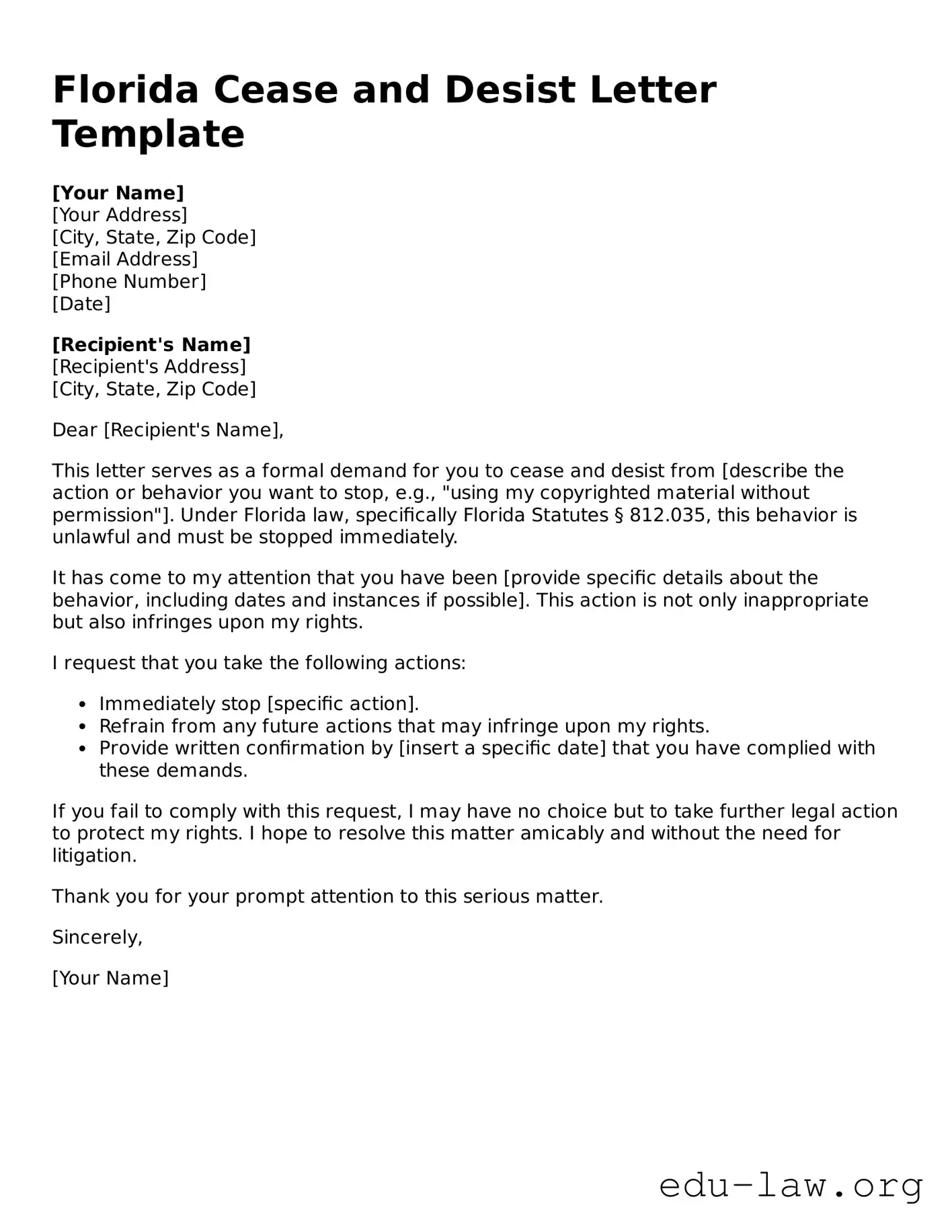
In Florida, a Cease and Desist Letter serves as a crucial tool for individuals and businesses seeking to address unwanted actions or behaviors. This letter is typically used to formally request that the recipient stop a specific activity, such as harassment, copyright infringement, or other unlawful conduct. It outlines the nature of the complaint, provides details about the offending behavior, and sets a deadline for compliance. Importantly, the letter can also highlight potential legal consequences if the recipient fails to comply, making it a powerful means of communication. While it is not a legally binding document, it can serve as a precursor to further legal action if the issue remains unresolved. Understanding how to properly draft and deliver this letter can significantly impact the outcome of the situation, ensuring that the sender's rights are protected while encouraging a prompt resolution.
Florida Cease and Desist Letter Template
[Your Name]
[Your Address]
[City, State, Zip Code]
[Email Address]
[Phone Number]
[Date]
[Recipient's Name]
[Recipient's Address]
[City, State, Zip Code]
Dear [Recipient's Name],
This letter serves as a formal demand for you to cease and desist from [describe the action or behavior you want to stop, e.g., "using my copyrighted material without permission"]. Under Florida law, specifically Florida Statutes § 812.035, this behavior is unlawful and must be stopped immediately.
It has come to my attention that you have been [provide specific details about the behavior, including dates and instances if possible]. This action is not only inappropriate but also infringes upon my rights.
I request that you take the following actions:
If you fail to comply with this request, I may have no choice but to take further legal action to protect my rights. I hope to resolve this matter amicably and without the need for litigation.
Thank you for your prompt attention to this serious matter.
Sincerely,
[Your Name]
| Fact Name | Details |
|---|---|
| Purpose | A Florida Cease and Desist Letter is used to formally request that an individual or organization stop certain actions that are believed to be illegal or harmful. |
| Governing Law | The letter is governed by Florida Statutes, particularly those related to tort law and intellectual property rights. |
| Format | The letter typically includes the sender's information, the recipient's information, a description of the behavior to cease, and a deadline for compliance. |
| Legal Standing | While a cease and desist letter is not a legally binding document, it serves as a formal notice and can be used in court if the issue escalates. |
| Delivery Method | It is advisable to send the letter via certified mail to ensure there is a record of delivery. |
| Response Time | Typically, recipients are given a reasonable amount of time, often 10 to 30 days, to comply with the request. |
| Consequences of Ignoring | If ignored, the sender may pursue further legal action, including filing a lawsuit. |
| Common Uses | Commonly used for copyright infringement, trademark disputes, harassment claims, and breaches of contract. |
| Personal vs. Business | Cease and desist letters can be issued by individuals or businesses against other individuals or businesses. |
| Consultation Recommended | Consulting with a legal professional before sending a cease and desist letter is often recommended to ensure it is properly drafted. |
Once you have the Florida Cease and Desist Letter form in hand, you are ready to proceed with filling it out. Completing this form accurately is essential for ensuring that your request is clear and properly documented. Follow the steps outlined below to fill out the form effectively.
After filling out the form, you can send it to the recipient via certified mail or another reliable method. This ensures that you have proof of delivery, which can be important if further action is needed.
What is a Cease and Desist Letter?
A Cease and Desist Letter is a formal request for an individual or organization to stop a specific action that is believed to be harmful or unlawful. This letter serves as a warning, outlining the behavior that needs to be halted and the potential consequences of failing to comply. It can be used in various situations, such as intellectual property disputes, harassment cases, or contract violations.
When should I use a Cease and Desist Letter in Florida?
You should consider using a Cease and Desist Letter when you believe someone is infringing on your rights or engaging in behavior that negatively impacts you. Common scenarios include unauthorized use of your intellectual property, defamation, or harassment. It is often a good first step before pursuing legal action, as it allows the other party an opportunity to correct their behavior without escalating the situation to court.
How do I write a Cease and Desist Letter?
Writing a Cease and Desist Letter involves clearly stating your grievances and the actions you want the recipient to stop. Start by addressing the letter to the individual or organization responsible for the behavior. Include a detailed description of the actions that are causing harm, the legal basis for your request, and a deadline for compliance. It is important to remain professional and factual throughout the letter.
Is a Cease and Desist Letter legally binding?
A Cease and Desist Letter is not a legally binding document. However, it can serve as an important record of your intent to resolve the issue amicably. If the recipient fails to comply, you may use the letter as evidence of your attempts to address the matter before pursuing further legal action. It is often viewed as a crucial step in demonstrating that you sought to resolve the issue outside of court.
What should I do if I receive a Cease and Desist Letter?
If you receive a Cease and Desist Letter, it is essential to take it seriously. Review the claims made in the letter carefully. Consider seeking legal advice to understand your options and the implications of the letter. Depending on the situation, you may choose to comply, negotiate a resolution, or contest the claims made against you. Acting promptly can help you avoid further legal complications.
Not providing clear details about the issue. It's essential to specify what action you want the recipient to stop.
Failing to include your contact information. Ensure your name, address, and phone number are clearly stated for follow-up.
Using vague language. Be direct and specific about the behaviors or actions that are causing concern.
Neglecting to include a deadline for compliance. State a reasonable time frame for the recipient to cease the actions in question.
Not signing the letter. A signature adds credibility and shows that you are serious about the request.
Ignoring legal requirements. Ensure that the letter complies with Florida laws regarding cease and desist requests.
Failing to keep a copy for your records. Documenting the correspondence is crucial for any future legal action.
Not considering alternative resolutions. Before sending a cease and desist letter, evaluate if direct communication could resolve the issue.
A Florida Cease and Desist Letter is a formal request to stop certain actions or behaviors that are deemed harmful or unlawful. When utilizing this letter, several other documents may also be relevant in supporting the claim or addressing the situation effectively. Below are five forms and documents often used in conjunction with a Cease and Desist Letter.
Understanding these documents can help individuals navigate disputes more effectively. Each serves a unique purpose and can play a crucial role in resolving conflicts or protecting one's rights.
A demand letter is a document that requests a party to fulfill an obligation or cease certain actions. Like a cease and desist letter, it is often used in disputes to assert a claim. The main difference lies in the tone and intent; a demand letter typically seeks a resolution or compliance, while a cease and desist letter specifically demands that the recipient stop an action. Both documents can serve as a precursor to legal action, establishing a record of communication and intent. They are important in showing that the sender attempted to resolve the issue before escalating it to court.
A notice of violation is another document similar to a cease and desist letter. It is often used in regulatory contexts, where a governmental body informs an individual or business that they have violated a law or regulation. This notice outlines the specific violation and may require the recipient to correct the issue within a certain timeframe. Like a cease and desist letter, it serves to inform the recipient of their actions and the potential consequences if they do not comply. Both documents aim to prompt a change in behavior and can be used as evidence if legal action becomes necessary.
An injunction request is a legal document filed with a court, asking for an order to prevent a party from continuing a specific action. While a cease and desist letter is a more informal request, an injunction request is formal and typically requires a hearing. Both documents share the goal of stopping undesirable actions, but an injunction request involves the court system and may lead to legal consequences if not adhered to. The urgency and seriousness of an injunction request often reflect the immediate harm that the requesting party seeks to prevent.
A settlement agreement is a document that outlines the terms under which parties agree to resolve a dispute without going to trial. While it is different from a cease and desist letter in that it usually comes after negotiations, it may contain similar elements regarding the cessation of certain behaviors or actions. Both documents aim to resolve conflicts and prevent further legal action. A cease and desist letter can sometimes lead to a settlement agreement if the parties can come to a mutual understanding about the issues at hand.
When filling out a Florida Cease and Desist Letter form, it is essential to approach the task with care and precision. Here are four important dos and don'ts to keep in mind:
Understanding the Florida Cease and Desist Letter form can be challenging due to several misconceptions. Here are eight common misunderstandings:
This is incorrect. A cease and desist letter is not a court order. It is a formal request to stop certain actions, but it does not have legal authority unless it is enforced by a court.
While technically anyone can draft and send a cease and desist letter, it is advisable to have legal counsel involved. This ensures that the letter is appropriately worded and addresses the specific legal issues at hand.
Sending a cease and desist letter does not guarantee that the recipient will comply. It is merely a request, and the recipient may choose to ignore it.
This is a misconception. Each letter should be tailored to the specific situation and the actions that need to be stopped. Generic letters may not effectively convey the necessary legal context.
Sending the letter is often just the first step. If the recipient does not comply, further legal action may be necessary to resolve the issue.
This is not true. While they are commonly used for copyright issues, cease and desist letters can address a variety of legal disputes, including trademark infringement, harassment, and contract violations.
Receiving such a letter does not imply guilt. It simply indicates that the sender believes you are engaging in actions that are unlawful or harmful. A response or defense may be warranted.
Ignoring a cease and desist letter can lead to further legal action. It is important to take the letter seriously and consider a response, especially if legal action is threatened.
When filling out and using the Florida Cease and Desist Letter form, consider the following key takeaways: