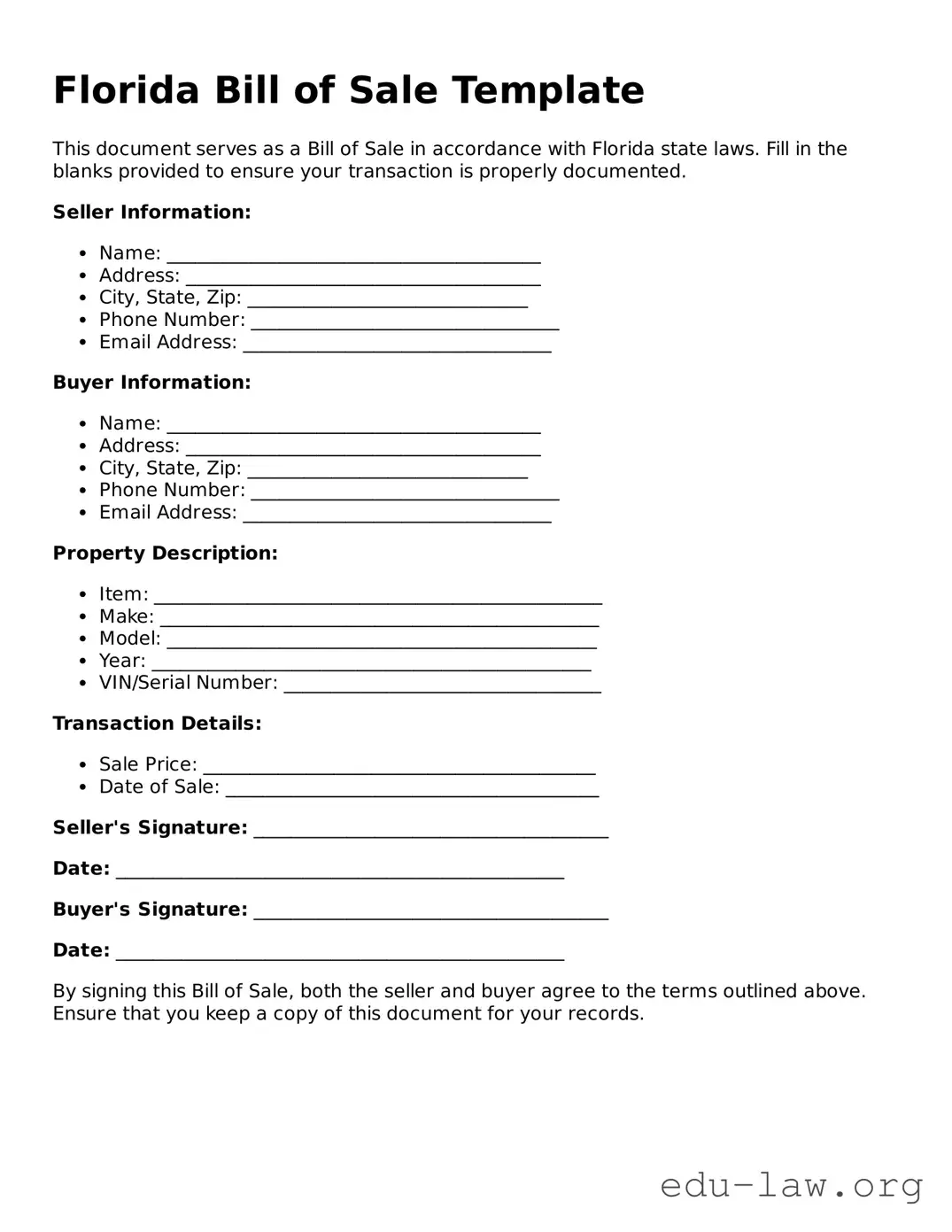
In Florida, the Bill of Sale form serves as a crucial document for individuals engaging in the sale or transfer of personal property. This form not only acts as proof of the transaction but also provides essential information that protects both buyers and sellers. It outlines the details of the item being sold, including its description, condition, and any identifying numbers, such as a Vehicle Identification Number (VIN) for automobiles. Furthermore, the Bill of Sale includes the agreed-upon purchase price, payment method, and the date of the transaction, ensuring clarity for both parties involved. By documenting the names and addresses of the buyer and seller, the form establishes a clear record of the transaction, which can be useful in the event of future disputes or for registration purposes. Additionally, the Bill of Sale can contain warranties and disclaimers that further clarify the responsibilities of each party, thereby helping to set expectations and reduce misunderstandings. Ultimately, this straightforward form plays a significant role in facilitating secure and transparent property transfers in Florida.
Florida Bill of Sale Template
This document serves as a Bill of Sale in accordance with Florida state laws. Fill in the blanks provided to ensure your transaction is properly documented.
Seller Information:
Buyer Information:
Property Description:
Transaction Details:
Seller's Signature: ______________________________________
Date: ________________________________________________
Buyer's Signature: ______________________________________
Date: ________________________________________________
By signing this Bill of Sale, both the seller and buyer agree to the terms outlined above. Ensure that you keep a copy of this document for your records.
| Fact Name | Description |
|---|---|
| Purpose | The Florida Bill of Sale is used to document the transfer of ownership of personal property. |
| Governing Law | The bill of sale is governed by Florida Statutes, particularly Chapter 679, which covers secured transactions. |
| Required Information | Typically includes names and addresses of the buyer and seller, a description of the item, and the sale price. |
| Notarization | Not required in Florida, but it's recommended for additional legal validity. |
| Use Cases | Commonly used for vehicles, boats, and other personal property transfers. |
| Template Availability | Templates for the Florida Bill of Sale can be found online and may vary by specific property type. |
| Record Keeping | Both parties should keep a copy of the bill of sale for their records and future reference. |
When preparing to sell personal property in Florida, it is essential to complete the Bill of Sale accurately. This document serves as a record of the transaction and may be required for registration purposes or to provide proof of ownership transfer.
What is a Florida Bill of Sale?
A Bill of Sale in Florida is a legal document that serves as a receipt for the sale of personal property. It details the transaction between the buyer and seller, covering essential information such as the description of the item, the sale price, and the date of the transaction. This form provides proof of ownership, which can be important for registration and insurance purposes.
Do I need a Bill of Sale for a vehicle in Florida?
Yes, a Bill of Sale is necessary for vehicle transactions in Florida. While it is not mandated by law for private sales, it greatly aids in the registration process at the Department of Highway Safety and Motor Vehicles (DHSMV). It helps document the transfer of ownership from the seller to the buyer, ensuring that all parties have a record of the sale.
What information is required in a Florida Bill of Sale?
A comprehensive Bill of Sale should include the following information: the full names and addresses of both the buyer and seller, a detailed description of the item being sold (including VIN for vehicles), the sale price, the date of the transaction, and any relevant signatures. Additional details, such as warranties or conditions of sale, can also be included for clarity.
Is a notarized Bill of Sale required in Florida?
No, notarization is not required in Florida for a Bill of Sale to be valid. However, having the document notarized can provide additional legal protection and authenticity to the transaction. It helps confirm the identities of the parties involved and witnesses their signatures, which can be beneficial in case of future disputes.
Where can I obtain a Bill of Sale form in Florida?
Florida residents can find Bill of Sale forms readily available online. Many websites offer free or paid templates that comply with state laws. Alternatively, you can draft your own Bill of Sale using the required information, ensuring that it meets all pertinent specifications and details of the transaction.
Can I use a generic Bill of Sale in Florida?
Yes, a generic Bill of Sale can be used in Florida, provided it includes all necessary information specific to the transaction. If you opt for a generic form, ensure that it clearly states all details relevant to the sold item and the parties involved. Customizing a generic form may help prevent any misunderstandings later on.
What happens if I lose my Bill of Sale?
If you lose a Bill of Sale, it can complicate matters if you need to prove ownership of an item. To remedy this, you can often rebuild a record of the transaction by contacting the seller or buyer to obtain a copy. In some cases, a replacement Bill of Sale can be drafted that confirms the original transaction details, assuming both parties agree.
How long should I keep my Bill of Sale?
It is advisable to retain a copy of your Bill of Sale for a minimum of three to five years after the transaction, especially for significant purchases like vehicles or other valuables. Keeping this documentation may prove vital for tax purposes, resale, or if any disputes arise concerning ownership or condition of the sold item.
Can a Bill of Sale affect taxes?
Yes, a Bill of Sale can have implications for taxes, particularly regarding sales tax obligations. In Florida, sales of certain items may require the seller to collect sales tax from the buyer. It's essential to consult local regulations to ensure compliance and understand how the Bill of Sale may impact tax filings.
Do I need a Bill of Sale for a gift?
A Bill of Sale is not typically required for gifts, as there is no exchange of money involved. However, if the item in question is significant in value—such as a vehicle—it may still be prudent to document the transaction with a Bill of Sale. This practice can help clarify ownership transfer and protect both parties in case of future ownership disputes or legal questions.
Not Including Complete Buyer and Seller Information: It is crucial to provide full names, addresses, and contact information for both the buyer and seller. Missing details can lead to confusion and disputes.
Failing to Specify the Item: Clearly describe the item being sold, including its make, model, year, and any identification numbers. Vague descriptions may create ambiguity.
Not Indicating the Purchase Price: The form must state the sale price of the item. Omitting this information can complicate the transfer and verification of ownership.
Skipping the Date of Transaction: Documenting the transaction date is important for both parties. It establishes when the sale occurred and can be critical in case of future disputes.
Not Including Signatures: Both parties must sign the Bill of Sale. Without signatures, the document lacks validity and may not hold up in a legal context.
Neglecting to Add Witness Information: In some cases, including a witness can bolster the validity of the sale. Not having a witness can leave the transaction open to question.
Overlooking State Requirements: Each state may have specific requirements for a Bill of Sale. Failing to adhere to Florida's regulations can render the document ineffective.
Using Incorrect or Improper Language: It's essential to use clear and concise language to avoid misinterpretation. Ambiguous terms can lead to misunderstandings between the parties.
Not Keeping Copies of the Document: After completing the form, it is important for both parties to keep copies for their records. This can assist in future transactions or disputes.
Ignoring Additional Terms and Conditions: If there are any specific terms related to the sale, such as warranties or guarantees, they should be clearly stated to protect both parties’ interests.
When conducting a transaction in Florida, particularly for the sale of goods or vehicles, it is important to have the proper documentation in place. The Florida Bill of Sale form is a key document, but there are additional forms and documents that can complement it, ensuring both parties are protected and that the transaction is formally recognized. Below are four commonly used documents.
Incorporating these documents in your transaction process streamlines the sale and enhances legal protection for both the buyer and seller. Being thorough with documentation fosters clarity and trust, allowing for smoother transactions overall.
The Florida Bill of Sale form shares some similarities with vehicle title transfer documents. Both documents serve the purpose of transferring ownership. A vehicle title transfer reflects the change of ownership from the seller to the buyer, including specifics such as vehicle identification number (VIN), make, model, and odometer readings. Similarly, a Bill of Sale provides essential information about the item being sold, including a description and the purchase price, establishing a legal acknowledgment of the transaction.
Another document similar to the Bill of Sale is the property deed. A property deed acts as legal evidence of ownership when real estate is bought or sold. Like the Bill of Sale, it contains details regarding the buyer and seller and a description of the property. Both documents formally acknowledge the transfer of ownership, although a deed is specifically used for real estate while a Bill of Sale can apply to various types of personal property.
The lease agreement also parallels the Bill of Sale in that it outlines the terms of an agreement involving property, although it does not transfer ownership. This document details the rights and responsibilities of both the lessor and lessee concerning the rental of property, whether residential or commercial. Like a Bill of Sale, a lease agreement is a binding document that protects both parties by clearly delineating the expectations and terms involved in the transaction.
Purchase agreements for personal property also resemble the Bill of Sale. These contracts detail the terms of sale, including the item description, price, and delivery conditions. Similar to a Bill of Sale, a purchase agreement provides a structured framework for the transaction, making it clear to both parties what is expected before, during, and after the sale.
A pawnbroker ticket, although slightly different in purpose, shares the essential elements seen in a Bill of Sale. When an item is pawned, a ticket is issued that signifies a temporary loan secured by the pledged item. This document outlines the pawn amount, description of the item, and terms of repayment, much like a Bill of Sale outlines transaction details. In both cases, the documentation serves as a record of the exchange and the terms involved.
Gift agreements can also be likened to the Bill of Sale. While a Bill of Sale usually involves an exchange of money for goods, a gift agreement formalizes the transfer of ownership without monetary compensation. Both documents declare the intention to transfer property and describe the item, yet a gift agreement often includes information about the donor's consent and intended recipient, establishing it as a legal gift.
Finally, service contracts can bear resemblance to a Bill of Sale in the way they outline a mutual agreement between parties. These documents detail the specific services to be performed, payment terms, and other conditions. Even though a Bill of Sale focuses on tangible items, both documents are designed to ensure clarity and agreement between parties, fostering accountability in their respective transactions.
Warranty deeds also bear similarities to a Bill of Sale by providing proof of ownership for real estate transactions. These documents guarantee that the seller has a legal right to transfer the property and ensures the buyer against potential claims. The Bill of Sale serves a similar function for personal property, officially marking the transition of ownership and protecting the buyer's interests.
Lastly, consignment agreements relate closely to the Bill of Sale through their shared goals of documenting ownership and terms of sale. When items are sold on consignment, a formal agreement outlines how and when items will be sold, as well as payment details. Much like the Bill of Sale, this document provides protection and clarification for both the seller (the consignor) and the buyer (who may be purchasing items at retail). In both cases, clarity serves as a crucial component in ensuring that all parties understand their rights and obligations.
When completing a Florida Bill of Sale form, it's important to follow certain guidelines to ensure the document is valid and effective. Below are some things to do and avoid during this process.
By following these guidelines, the process of filling out the Bill of Sale can be straightforward and effective.
Understanding the Florida Bill of Sale form is essential for anyone engaging in the buying or selling of personal property. However, several misconceptions can create confusion. Below is a list of common misconceptions along with explanations to clarify them.
This is incorrect. While many people associate a Bill of Sale primarily with vehicle sales, it is applicable to any personal property transaction, including boats, trailers, equipment, and even goods like furniture and electronics.
Although verbal agreements can be legally binding, having a written Bill of Sale provides proof of the transaction and details that protect both the buyer and seller. It also helps avoid misunderstandings in the future.
In Florida, notarization of a Bill of Sale is not required for it to be legally binding. However, having it notarized can add an extra layer of security, especially for high-value transactions.
While using a template can be convenient, it is important to ensure that the template meets Florida's legal requirements and accurately reflects the specifics of the transaction being conducted.
This statement is misleading. A Bill of Sale typically indicates whether the sale is "as-is" or with certain warranties. The terms of the sale should clarify the seller's obligations regarding the condition of the property.
In fact, a Bill of Sale is important for both buyers and sellers. It serves as documentation of the transaction for tax reporting and proves ownership for the buyer, while it protects the seller against future claims regarding the sale.
The Florida Bill of Sale form is an essential document when buying or selling personal property in the Sunshine State. Here are some key takeaways to keep in mind when filling it out and using it:
Taking these points into consideration can help ensure a smooth transaction, making the process straightforward and effective for all parties involved.
Bill of Sale for Car - Serves as proof of purchase for the buyer after a transaction.
State of Georgia Bill of Sale - A Bill of Sale ensures that both parties understand the conditions of the sale.
Template Bill of Sale for Car - In real estate transactions, a Bill of Sale may accompany the property title transfer.