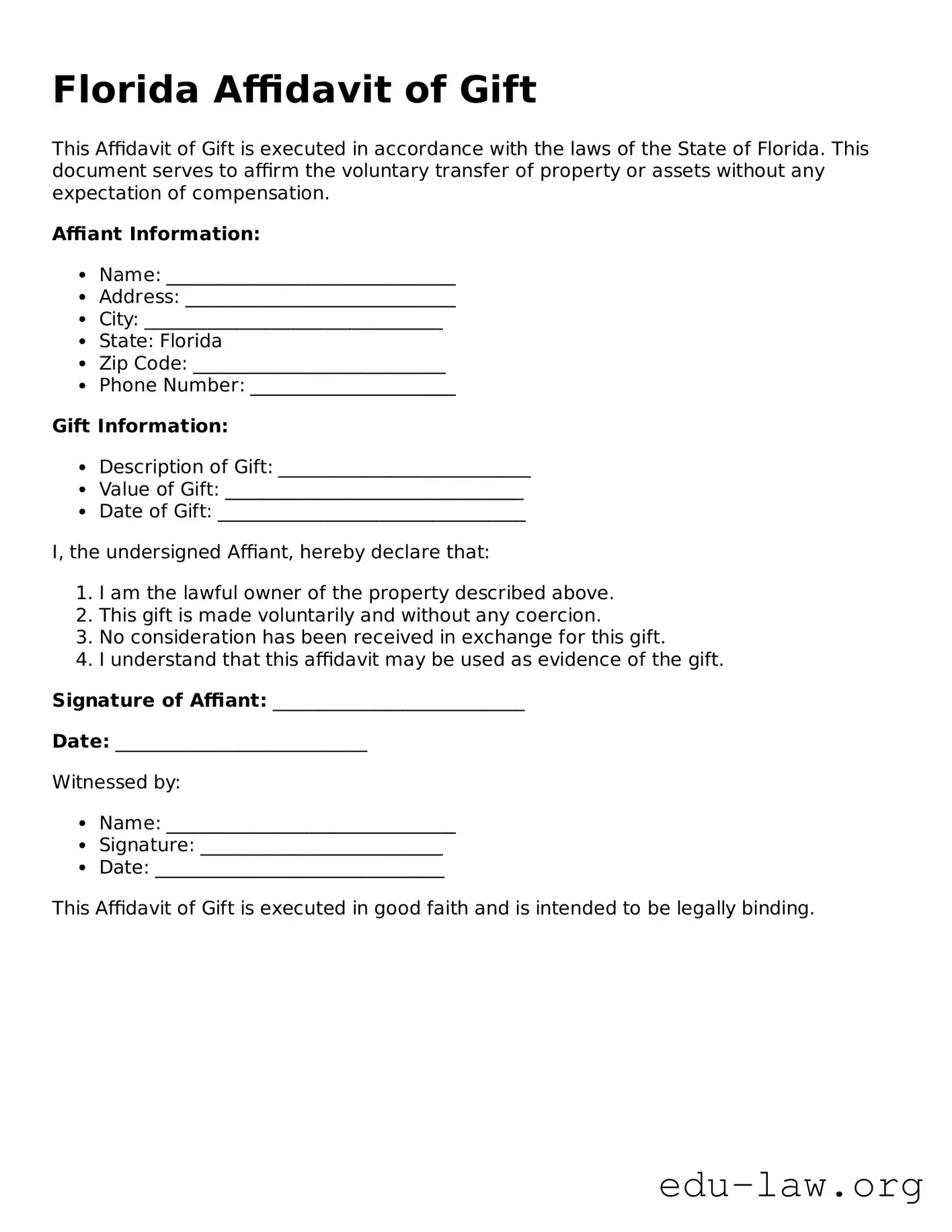
The Florida Affidavit of Gift form serves as a crucial document in the process of transferring ownership of property without the exchange of money. This form is particularly relevant in situations where an individual wishes to gift real estate or personal property to another person, often within the context of family or close relationships. By completing this affidavit, the donor provides a written declaration that they are voluntarily giving the property, thereby eliminating any expectation of compensation. The form typically requires essential details such as the names of both the donor and the recipient, a description of the property being gifted, and the donor's signature to validate the transaction. Additionally, certain legal requirements must be met, including the potential need for notarization, to ensure the transfer is recognized by the state. Understanding the nuances of this form is essential for both donors and recipients to navigate the complexities of property gifting in Florida effectively.
Florida Affidavit of Gift
This Affidavit of Gift is executed in accordance with the laws of the State of Florida. This document serves to affirm the voluntary transfer of property or assets without any expectation of compensation.
Affiant Information:
Gift Information:
I, the undersigned Affiant, hereby declare that:
Signature of Affiant: ___________________________
Date: ___________________________
Witnessed by:
This Affidavit of Gift is executed in good faith and is intended to be legally binding.
| Fact Name | Description |
|---|---|
| Purpose | The Florida Affidavit of Gift form is used to document the transfer of property as a gift from one individual to another. |
| Governing Law | This form is governed by Florida Statutes, specifically Chapter 709, which covers gifts and property transfers. |
| Signature Requirement | The form must be signed by the donor (the person giving the gift) in the presence of a notary public to be considered valid. |
| Notarization | Notarization is essential as it provides legal verification of the identities of the parties involved in the transaction. |
| Tax Implications | Gifts may have tax implications for both the donor and recipient. It's advisable to consult a tax professional regarding potential gift taxes. |
| Property Types | The form can be used for various types of property, including real estate, vehicles, and personal belongings. |
| Record Keeping | It is important to keep a copy of the completed affidavit for personal records and future reference. |
| Usage Limitations | This form is not suitable for all transfers. Legal advice should be sought if the transaction involves complex issues. |
After obtaining the Florida Affidavit of Gift form, you will need to complete it accurately. This form is essential for documenting the transfer of a gift. Follow these steps carefully to ensure all necessary information is provided.
What is the Florida Affidavit of Gift form?
The Florida Affidavit of Gift form is a legal document used to formally declare that a gift has been made. This form is often used in situations where property, such as real estate or vehicles, is transferred from one person to another without any exchange of money. It serves as a record of the gift and can help clarify ownership in the future.
Who needs to use the Affidavit of Gift form?
This form is typically utilized by individuals who are giving or receiving a significant gift. For example, if a parent gifts a car to their child, the Affidavit of Gift can document this transfer. It is particularly useful in avoiding disputes regarding ownership and can be important for tax purposes as well.
How do I fill out the Affidavit of Gift form?
Filling out the Affidavit of Gift form requires specific information. You will need to include the names and addresses of both the giver and the recipient, a description of the gift, and the date of the transfer. Additionally, both parties must sign the form, and it may need to be notarized to ensure its validity.
Is notarization required for the Affidavit of Gift form?
While notarization is not always mandatory, it is highly recommended. Having the form notarized adds an extra layer of authenticity and can help prevent future disputes. If you plan to use the form for legal purposes, such as transferring ownership of a vehicle, notarization may be required by the state.
Can the Affidavit of Gift form be revoked?
Once the Affidavit of Gift is executed and the gift is delivered, it generally cannot be revoked. However, the giver may have the ability to revoke the gift under certain circumstances, such as if the gift was made under duress or fraud. It is essential to understand that once the gift is given and accepted, the recipient typically has full ownership rights.
Are there tax implications associated with gifting?
Yes, there can be tax implications when giving a gift. In the United States, the IRS allows individuals to give a certain amount each year without incurring gift tax. For 2023, this annual exclusion amount is $17,000 per recipient. If the value of the gift exceeds this amount, the giver may need to file a gift tax return. Consulting a tax professional is advisable to navigate these rules effectively.
Where can I obtain the Florida Affidavit of Gift form?
The Florida Affidavit of Gift form can be obtained from various sources, including online legal document services, local government offices, or legal stationery stores. It is essential to ensure that you are using the most current version of the form to comply with state requirements.
Incomplete Information: Many individuals fail to provide all required details. Ensure that names, addresses, and other relevant information are fully completed.
Incorrect Signatures: Signatures must match the names listed on the form. Double-check that the correct individuals have signed where necessary.
Missing Notarization: The affidavit must be notarized. Forgetting this step can lead to delays or rejection of the document.
Improper Date: Ensure the date of signing is accurate. An incorrect date can raise questions about the validity of the gift.
Failure to Include Gift Description: A clear description of the gift is essential. Omitting this can create confusion about what is being transferred.
Not Following State Guidelines: Each state has specific requirements. Make sure to review Florida’s regulations to avoid any issues.
Assuming All Forms Are the Same: Different forms serve different purposes. Using the wrong affidavit can invalidate the gift.
When completing a transaction involving the Florida Affidavit of Gift form, several other documents may also be required to ensure compliance with legal and tax obligations. Below is a list of five common forms and documents that are often used in conjunction with the Affidavit of Gift.
These documents collectively ensure that the gifting process adheres to legal standards and protects both the giver and recipient. Proper documentation is essential for avoiding potential disputes and ensuring compliance with tax regulations.
The Florida Affidavit of Gift form shares similarities with the Affidavit of Support. Both documents are used to affirm the legitimacy of a transfer or gift. The Affidavit of Support is often utilized in immigration contexts, where a sponsor declares their financial ability to support a visa applicant. Like the Affidavit of Gift, it requires the sponsor to provide personal information and details about the financial support being offered, ensuring transparency and accountability in the process.
Another document akin to the Florida Affidavit of Gift is the Bill of Sale. This form serves as a legal record of the transfer of ownership of personal property. While the Affidavit of Gift does not involve a sale, both documents confirm the transfer of an item from one party to another. The Bill of Sale provides details about the item, the parties involved, and the terms of the transaction, similar to how the Affidavit of Gift outlines the specifics of the gift being given.
The Quitclaim Deed is also comparable to the Florida Affidavit of Gift. This legal document transfers ownership of real property without guaranteeing the title's validity. In both cases, the intent to transfer ownership is clear. The Quitclaim Deed is often used among family members or in situations where a gift of property is involved, paralleling the Affidavit of Gift's purpose in confirming the donation of assets.
The Power of Attorney (POA) shares some similarities with the Affidavit of Gift as well. A POA allows one person to act on behalf of another in legal or financial matters. Both documents require a clear declaration of intent and must be executed properly to be legally binding. While the Affidavit of Gift focuses on the transfer of gifts, the POA can facilitate various transactions, including those involving gifts, by allowing another individual to manage the process.
The Donation Receipt is another document that resembles the Florida Affidavit of Gift. This form is typically used by charitable organizations to acknowledge the receipt of a donation. Like the Affidavit of Gift, it confirms the transfer of an asset or money and provides documentation for tax purposes. Both documents serve to validate the gift and provide a record for the donor, ensuring compliance with tax laws and regulations.
The Warranty Deed is similar in function to the Florida Affidavit of Gift, particularly when real estate is involved. This document guarantees that the seller holds clear title to the property and has the right to transfer ownership. Both the Warranty Deed and the Affidavit of Gift establish a legal transfer of ownership. However, the Warranty Deed provides additional assurances regarding the title's validity, whereas the Affidavit of Gift focuses on the intent and acknowledgment of the gift.
The Release of Liability form is another document that can be compared to the Florida Affidavit of Gift. This form protects one party from future claims related to a specific action or event. In the context of gifting, the Affidavit of Gift may include a clause that releases the donor from any future claims regarding the gifted item. Both documents require clear communication of intent and acceptance of terms by the involved parties.
Lastly, the Trust Agreement can be seen as similar to the Florida Affidavit of Gift in that both involve the transfer of assets. A Trust Agreement outlines how assets will be managed and distributed, often including provisions for gifting. While the Affidavit of Gift focuses on a specific transfer, the Trust Agreement provides a broader framework for managing and distributing gifts over time, reflecting the donor's wishes and intentions.
When filling out the Florida Affidavit of Gift form, it is essential to follow certain guidelines to ensure the process goes smoothly. Here are four key dos and don'ts to keep in mind:
The Florida Affidavit of Gift form is often misunderstood. Here are ten common misconceptions about this form and clarifications for each.
Understanding these misconceptions can help clarify the purpose and use of the Florida Affidavit of Gift form.
When it comes to transferring property or assets in Florida, the Affidavit of Gift form plays a crucial role. Understanding how to fill it out and use it effectively can simplify the process significantly. Here are some key takeaways to keep in mind: