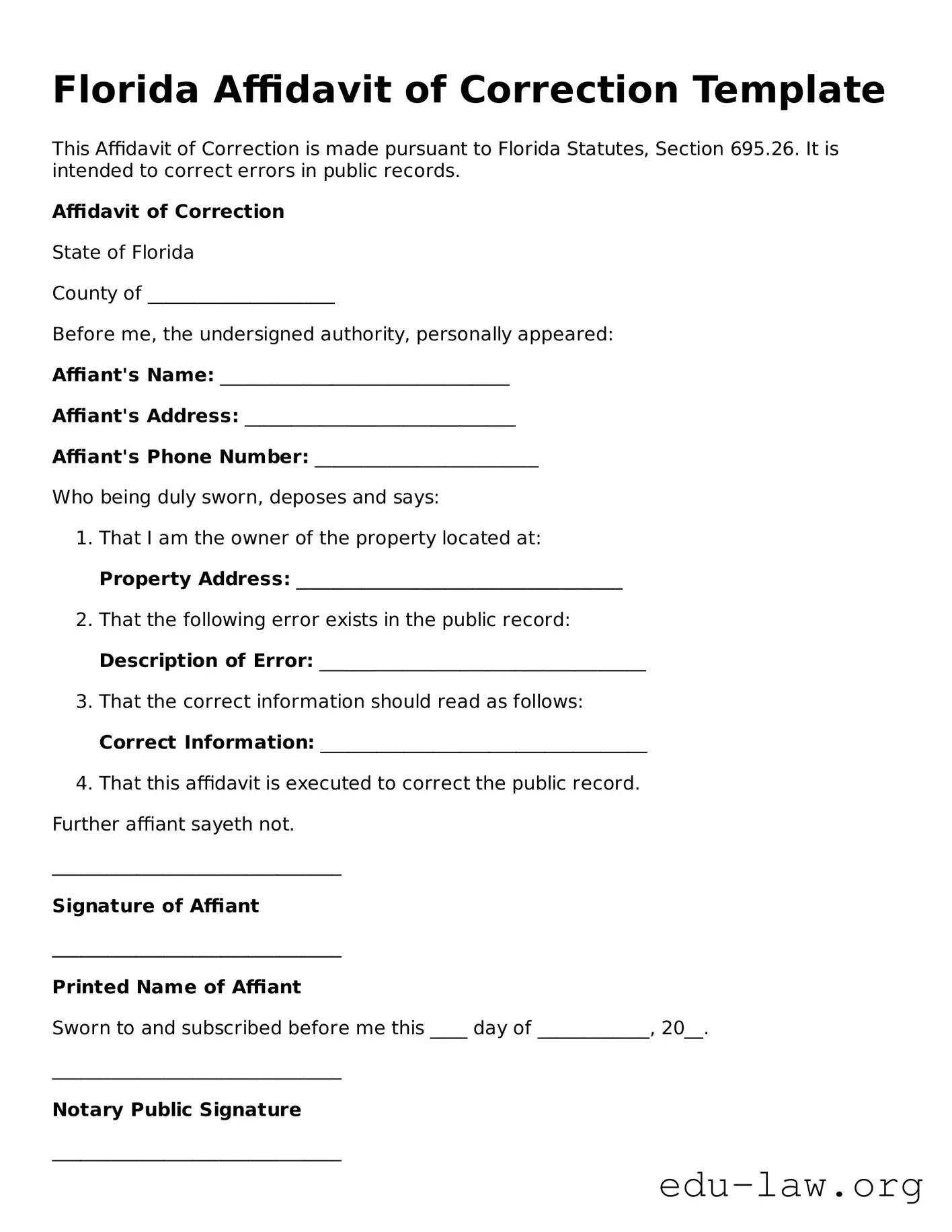
The Florida Affidavit of Correction form serves as a vital tool for individuals seeking to rectify errors in public records, ensuring that information is accurate and up-to-date. This form is particularly useful for correcting mistakes in documents such as deeds, mortgages, and other legal instruments. By filing this affidavit, a person can formally declare the inaccuracies present in the original document and provide the correct information. The process typically involves gathering necessary details, including the original document's reference, the specific errors to be corrected, and the correct data to replace them. Once completed, the affidavit must be signed in the presence of a notary public, adding an essential layer of authenticity. This straightforward yet effective procedure can help prevent future disputes and confusion regarding property ownership and other legal matters, ultimately promoting clarity in public records.
Florida Affidavit of Correction Template
This Affidavit of Correction is made pursuant to Florida Statutes, Section 695.26. It is intended to correct errors in public records.
Affidavit of Correction
State of Florida
County of ____________________
Before me, the undersigned authority, personally appeared:
Affiant's Name: _______________________________
Affiant's Address: _____________________________
Affiant's Phone Number: ________________________
Who being duly sworn, deposes and says:
Property Address: ___________________________________
Description of Error: ___________________________________
Correct Information: ___________________________________
Further affiant sayeth not.
_______________________________
Signature of Affiant
_______________________________
Printed Name of Affiant
Sworn to and subscribed before me this ____ day of ____________, 20__.
_______________________________
Notary Public Signature
_______________________________
Printed Name of Notary Public
My commission expires: _______________
| Fact Name | Description |
|---|---|
| Purpose | The Florida Affidavit of Correction is used to correct errors in public records, such as deeds or mortgages. |
| Governing Law | Florida Statutes, Chapter 695.26 outlines the legal framework for correcting errors in recorded documents. |
| Eligibility | Any individual or entity that discovers an error in a public record may file this affidavit. |
| Filing Process | The affidavit must be signed in the presence of a notary public and then recorded with the appropriate county clerk. |
| Effectiveness | Once filed, the corrections made by the affidavit are retroactive, affecting the original document as if the error never existed. |
Once you have the Florida Affidavit of Correction form in hand, you are ready to proceed with filling it out. This document is essential for making necessary corrections to a previously recorded document. Ensuring accuracy while completing the form is crucial, as any mistakes could lead to further complications.
After completing the form, you will need to file it with the appropriate county office where the original document was recorded. This ensures that the correction is officially recognized and recorded in the public records.
What is a Florida Affidavit of Correction?
The Florida Affidavit of Correction is a legal document used to correct errors in public records. This could include mistakes in property deeds, mortgages, or other official documents. The purpose of the affidavit is to provide a formal declaration that clarifies the original intent of the document, thereby rectifying any inaccuracies that may have been recorded. It ensures that the public record reflects the correct information moving forward.
When should I use an Affidavit of Correction?
You should consider using an Affidavit of Correction if you discover a mistake in a public record that could affect your rights or obligations. Common reasons for filing this affidavit include typographical errors, incorrect names, or wrong legal descriptions of property. Addressing these issues promptly is crucial to avoid potential legal complications in the future.
Who can file an Affidavit of Correction?
What information is required in the Affidavit of Correction?
The affidavit must include specific details to be effective. This generally includes the original document's information, such as the date it was recorded, the names of the parties involved, and a clear description of the error. Additionally, the affidavit should state the correct information that should replace the erroneous data. Providing accurate and complete information is essential to avoid further complications.
How do I file an Affidavit of Correction in Florida?
Filing an Affidavit of Correction in Florida typically involves completing the form and submitting it to the appropriate county clerk's office where the original document was recorded. Some counties may allow electronic filing, while others require in-person submissions. It is advisable to check with your local clerk's office for specific filing procedures and any associated fees.
Are there any fees associated with filing an Affidavit of Correction?
Yes, there are usually fees associated with filing an Affidavit of Correction. These fees can vary by county and may depend on the nature of the correction. It's important to confirm the exact amount with your local county clerk's office. Being prepared for these costs can help streamline the process and avoid delays.
What happens after I file the Affidavit of Correction?
Once you file the Affidavit of Correction, the clerk's office will review it to ensure that it meets all necessary requirements. If everything is in order, the affidavit will be recorded in the public records. This means that the correction will be officially recognized, and the public record will reflect the accurate information. Keep a copy of the filed affidavit for your records, as it serves as proof of the correction.
Incomplete Information: Many individuals fail to provide all required details on the form. This can include missing names, addresses, or specific descriptions of the error being corrected.
Incorrect Notarization: Some people overlook the necessity of having the affidavit notarized. Without a proper notary signature, the document may be deemed invalid.
Filing with the Wrong Office: It's crucial to submit the affidavit to the correct office. Filing it in the wrong location can lead to delays or rejection of the correction.
Failure to Follow Instructions: Each affidavit form comes with specific instructions. Ignoring these can result in errors that require additional time and effort to rectify.
Not Keeping Copies: After submitting the affidavit, individuals often neglect to keep copies for their records. This can create complications if proof of submission is needed later.
The Florida Affidavit of Correction is a useful document for addressing errors in public records. When filing this affidavit, several other forms and documents may also be required or beneficial to ensure the correction is properly processed. Below is a list of common forms and documents that often accompany the Affidavit of Correction in Florida.
These documents can help facilitate a smoother correction process when filing the Florida Affidavit of Correction. Each plays a role in ensuring that the necessary changes are made accurately and legally.
The Florida Affidavit of Correction is similar to a Declaration of Correction. This document is often used to rectify clerical errors in recorded documents. Just like the Affidavit of Correction, a Declaration of Correction serves to clarify or amend specific details in a previously filed document, ensuring that the public record accurately reflects the intent of the parties involved. Both documents require the signature of the individual making the correction and may need to be notarized to validate the changes made.
Another related document is the Correction Deed. This instrument is utilized to correct mistakes in a property deed, such as misspellings of names or incorrect property descriptions. Like the Affidavit of Correction, the Correction Deed is executed by the parties involved and must be recorded with the appropriate county office. The primary goal of both documents is to eliminate confusion and ensure that the legal record is precise and reliable.
The Quitclaim Deed is also akin to the Affidavit of Correction, particularly when it comes to transferring property rights. While a Quitclaim Deed does not correct errors per se, it can be used to clarify ownership or to resolve disputes over property titles. Both documents aim to provide clarity and certainty in legal transactions, although they serve different functions in the process of property ownership and rights.
Similarly, a Warranty Deed may bear resemblance to the Affidavit of Correction, especially when it involves correcting the title of a property. A Warranty Deed guarantees that the grantor holds clear title to the property and has the right to sell it. In instances where errors in the title are identified, a Warranty Deed can be executed to affirm the ownership and rectify any discrepancies, much like how an Affidavit of Correction addresses inaccuracies in other legal documents.
The Certificate of Correction is another document that shares similarities with the Florida Affidavit of Correction. This certificate is used to amend errors in previously filed documents, particularly in corporate filings. It allows businesses to correct mistakes without needing to refile the entire document. Both the Certificate of Correction and the Affidavit of Correction serve the purpose of maintaining accurate records, ensuring that any necessary changes are officially recognized and documented.
A Statement of Correction also parallels the Affidavit of Correction. This document is often used to amend inaccuracies in various types of public records, such as marriage licenses or birth certificates. Similar to the Affidavit of Correction, a Statement of Correction provides a formal method for individuals to clarify or rectify errors, ensuring that official documents reflect the true information as intended by the parties involved.
The Notice of Error is another document that can be likened to the Affidavit of Correction. This notice is typically filed to inform relevant parties of discrepancies in recorded documents, especially in real estate transactions. While it does not correct the error itself, it serves as a precursor to the formal correction process. Both the Notice of Error and the Affidavit of Correction aim to address inaccuracies and foster transparency in legal matters.
Lastly, the Amendment to Document shares similarities with the Affidavit of Correction. This document is used to change specific provisions in an existing agreement or contract. Like the Affidavit of Correction, an Amendment clarifies the intentions of the parties involved and rectifies any misunderstandings or errors in the original document. Both documents are essential tools for ensuring that legal records accurately reflect the agreements made between individuals or entities.
When filling out the Florida Affidavit of Correction form, it’s important to follow certain guidelines to ensure accuracy and compliance. Here are some key do's and don'ts to keep in mind:
By following these guidelines, you can help ensure that your Florida Affidavit of Correction is processed smoothly and efficiently.
When it comes to the Florida Affidavit of Correction form, there are several misconceptions that can lead to confusion. Understanding the truth behind these misconceptions is essential for anyone considering using this form. Here are seven common misunderstandings:
It can be used for any type of correction. Many people believe that the Affidavit of Correction can address any error, but it is specifically designed for clerical mistakes or minor errors in recorded documents, not substantive changes.
It requires a lawyer to complete. While legal assistance can be beneficial, it is not mandatory to have a lawyer fill out this form. Individuals can complete it on their own, provided they understand the requirements.
It is the same as a notary correction. A notary correction and an Affidavit of Correction are not interchangeable. The affidavit serves a specific legal purpose and must be executed according to Florida law.
It can fix any document that has been recorded. This form is limited to specific types of documents, such as deeds or mortgages. It cannot be used for all recorded documents.
It must be filed with the court. Some believe that the affidavit needs to be filed in court, but it is actually filed with the same office where the original document was recorded, such as the county clerk's office.
There is no deadline for filing it. People often think they can file the affidavit at any time. However, there may be time limits based on the nature of the error and the type of document involved.
Once filed, the original document is no longer valid. This is a common misconception. The original document remains valid, and the affidavit simply serves to clarify or correct the specific error.
Understanding these misconceptions can help individuals navigate the process more effectively and ensure that they are using the Florida Affidavit of Correction form correctly.
Filling out the Florida Affidavit of Correction form can be a straightforward process if you understand its purpose and requirements. Here are some key takeaways to consider:
Understanding these key points can help ensure that the correction process goes smoothly and effectively addresses any errors in your public records.