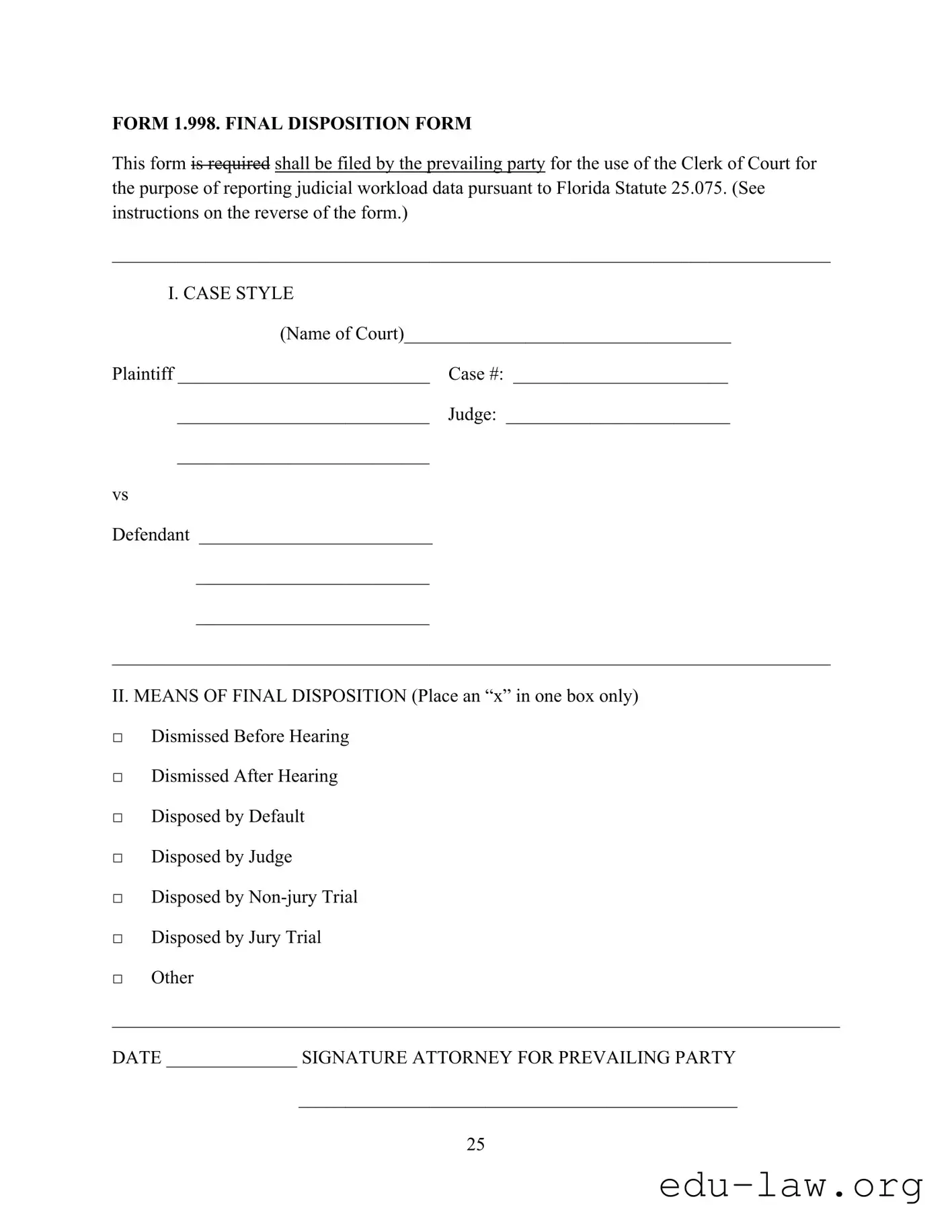
The Final Disposition form is an essential document in the legal landscape, particularly within the state of Florida. This form serves a dual purpose: it not only facilitates the reporting of judicial workload data but also ensures that the court maintains accurate records of case outcomes. When a case concludes, the prevailing party is responsible for filing this form with the Clerk of Court. It captures critical information such as the case style, which includes the names of the court, the judge, and the parties involved. Furthermore, it delineates the means of final disposition, allowing attorneys to indicate how the case was resolved—whether it was dismissed before or after a hearing, disposed of by default, or concluded through a jury or non-jury trial. Each option is clearly defined, ensuring that legal professionals can accurately represent the case's outcome. Finally, the form requires the attorney's signature and the date of filing, solidifying the official record of the case's resolution. Understanding the nuances of the Final Disposition form is crucial for anyone navigating the legal system, as it plays a pivotal role in the administration of justice and the collection of judicial data.
FORM 1.998. FINAL DISPOSITION FORM
This form is required shall be filed by the prevailing party for the use of the Clerk of Court for the purpose of reporting judicial workload data pursuant to Florida Statute 25.075. (See instructions on the reverse of the form.)
_____________________________________________________________________________
I. CASE STYLE
(Name of Court)___________________________________
Plaintiff ___________________________ |
Case #: _______________________ |
___________________________ |
Judge: ________________________ |
___________________________ |
|
vs |
|
Defendant _________________________ |
|
_________________________ |
|
_________________________
_____________________________________________________________________________
II. MEANS OF FINAL DISPOSITION (Place an “x” in one box only)
□Dismissed Before Hearing
□Dismissed After Hearing
□Disposed by Default
□Disposed by Judge
□Disposed by
□Disposed by Jury Trial
□Other
______________________________________________________________________________
DATE ______________ SIGNATURE ATTORNEY FOR PREVAILING PARTY
_______________________________________________
25
INSTRUCTIONS FOR ATTORNEYS
COMPLETING FINAL
DISPOSITION FORM
I. Case Style. Enter the name of the court, the appropriate case number assigned at the time of filing of the original complaint or petition, the name of the judge assigned to the case and the names (last, first, middle initial) of plaintiff(s) and defendant(s).
II.Means of Final Disposition. Place an “x” in the appropriate box. The following are the definitions of the disposition categories.
(A)Dismissed Before Hearing - the case is settled or voluntarily dismissed before a hearing is held;
(B)Dismissed After Hearing - the case is dismissed by a judge, voluntarily dismissed, or settled after a hearing is held;
(C)Disposed by Default C a defendant chooses not to or fails to contest the plaintiff’s allegations and a judgment against the defendant is entered by the court;
(D)Disposed by Judge - a judgment or disposition is reached by the judge in a case which is not dismissed and in which no trial has been held. Includes stipulations by the parties, conditional judgments, summary judgment after hearing and any matter in which a judgment is entered excluding cases disposed of by default as in category (c) above;
(E)Disposed by
(F)Disposed by Jury Trial - the case is disposed as a result of a jury trial (consider the beginning of a jury trial to be when the jurors and alternates are selected and sworn);
(G)Other - the case is consolidated, submitted to arbitration or mediation, transferred, or otherwise disposed by other means not listed in categories (A) through (F).
DATE AND ATTORNEY SIGNATURE. Date and sign the final disposition form.
26
| Fact Name | Description |
|---|---|
| Form Title | The form is officially titled "Final Disposition Form" and is designated as FORM 1.998. |
| Purpose | This form must be filed by the prevailing party to report judicial workload data. |
| Governing Law | The form is governed by Florida Statute 25.075. |
| Case Style | It requires the name of the court, case number, judge's name, and the names of the plaintiff(s) and defendant(s). |
| Means of Final Disposition | There are seven categories for final disposition, including Dismissed Before Hearing and Disposed by Jury Trial. |
| Signature Requirement | The form must be signed by the attorney representing the prevailing party. |
| Date Entry | A date must be entered on the form to indicate when it was completed. |
| Instructions | Detailed instructions for completing the form are provided on the reverse side. |
Once the Final Disposition form is completed, it needs to be submitted to the Clerk of Court. This step is crucial for reporting judicial workload data, as required by Florida law. Make sure to double-check all entries for accuracy before submission.
What is the Final Disposition Form?
The Final Disposition Form is a document required in Florida that must be filed by the prevailing party in a legal case. This form is used by the Clerk of Court to report judicial workload data, as mandated by Florida Statute 25.075. It captures important details about the case and its resolution.
Who is responsible for filing the Final Disposition Form?
The responsibility for filing the Final Disposition Form lies with the prevailing party in a legal case. Typically, this is the party that wins the case, whether through a judgment, settlement, or other means of resolution. The attorney representing this party will usually complete and submit the form.
What information is required on the Final Disposition Form?
The form requires several key pieces of information. This includes the name of the court, the case number, the judge's name, and the names of both the plaintiff and defendant. Additionally, it requires the date of disposition and the attorney's signature for the prevailing party.
What are the different means of final disposition that can be indicated on the form?
There are several options available to indicate how the case was resolved. These include: - Dismissed Before Hearing - Dismissed After Hearing - Disposed by Default - Disposed by Judge - Disposed by Non-Jury Trial - Disposed by Jury Trial - Other (for cases that do not fit the previous categories). Only one box should be checked to indicate the appropriate category.
What does it mean if a case is dismissed before a hearing?
If a case is marked as "Dismissed Before Hearing," it means that the case was either settled or voluntarily dismissed before any court hearing took place. This can happen for various reasons, such as the parties reaching an agreement outside of court.
Can a case be disposed of by default?
Yes, a case can be disposed of by default. This occurs when the defendant does not respond to the plaintiff’s allegations or fails to contest the case. In such situations, the court may enter a judgment against the defendant without a trial.
What should an attorney do if the case was resolved in a way not listed on the form?
If the case was resolved through a means not specifically listed on the form, the attorney should select the "Other" option. This allows for flexibility in reporting cases that may have been consolidated, submitted to arbitration or mediation, or resolved through other unique circumstances.
Is it necessary to sign the Final Disposition Form?
Yes, the Final Disposition Form must be signed by the attorney representing the prevailing party. This signature confirms that the information provided is accurate and complete. The date of signing should also be included on the form.
Incomplete Case Style Information: Failing to provide all necessary details such as the name of the court, case number, and names of the parties involved can lead to processing delays.
Wrongly Marking Disposition Means: Placing an "x" in more than one box or failing to mark any box can create confusion regarding the case's final outcome.
Incorrect Case Number: Entering an incorrect case number can result in the form being associated with the wrong case, complicating record-keeping.
Omitting Judge's Name: Not including the name of the assigned judge may lead to questions about the authority under which the case was resolved.
Failure to Sign: Neglecting to sign the form can render it invalid. A signature is essential for the form to be officially recognized.
Incorrect Date: Providing an incorrect date can cause discrepancies in the court records and may affect the timeline of the case.
Not Following Instructions: Ignoring the instructions on the reverse side of the form can lead to missing critical details required for proper filing.
Using Abbreviations or Nicknames: Utilizing abbreviations or informal names for parties involved may create confusion and hinder proper identification in legal documents.
The Final Disposition form is an essential document in the judicial process, especially in Florida. It serves to report the outcome of a case and is filed by the prevailing party. Several other forms and documents often accompany this form to ensure a comprehensive understanding of the case's resolution. Below is a list of these documents, each described briefly for clarity.
Each of these documents plays a crucial role in the legal process, ensuring that all parties have the necessary information and that the court can effectively manage the case. Understanding these forms can help parties navigate the complexities of the judicial system more effectively.
The Final Disposition form is similar to a Judgment form. Both documents serve to officially record the outcome of a court case. The Judgment form is a final decision made by a judge, which may include the terms of the ruling. In contrast, the Final Disposition form summarizes how the case was resolved, providing essential data for court records and workload reporting. Each document is crucial for maintaining accurate legal records.
Another document comparable to the Final Disposition form is the Notice of Appeal. This form is filed when a party wishes to contest a court's decision. While the Final Disposition form indicates the end of a case, the Notice of Appeal signifies the beginning of a new legal process. Both documents are essential in tracking the progression of legal matters, but they serve different purposes in the judicial system.
The Case Dismissal form shares similarities with the Final Disposition form as well. Both are used to indicate the closure of a case, but the Case Dismissal form specifically addresses situations where a case is terminated without a full trial. The Final Disposition form provides a broader overview of how a case was resolved, including various outcomes like trials and defaults. Each document plays a role in documenting case outcomes for legal records.
A Settlement Agreement is also akin to the Final Disposition form. This document outlines the terms agreed upon by the parties to resolve a dispute outside of court. While the Settlement Agreement details the specifics of the resolution, the Final Disposition form records that the case has been resolved, ensuring that the court's records reflect this outcome. Both documents are vital for finalizing legal disputes.
The Release of Liability form can be compared to the Final Disposition form in terms of closure. The Release of Liability is often signed when parties agree to release each other from further claims related to a dispute. While the Final Disposition form indicates the resolution of a case in court, the Release of Liability signifies an agreement outside of court. Both documents mark the end of legal obligations between parties.
The Certificate of Service is another document that shares a connection with the Final Disposition form. This certificate verifies that legal documents have been properly delivered to all relevant parties. While the Final Disposition form records the outcome of a case, the Certificate of Service ensures that all parties are informed of the case’s status. Both documents are essential for maintaining transparency in legal proceedings.
Lastly, the Motion to Dismiss form is similar to the Final Disposition form as it initiates the process of ending a case. This motion requests the court to dismiss a case for specific reasons. If granted, the Final Disposition form will later document this dismissal. Both documents are integral in the lifecycle of a legal case, marking different stages of resolution.
When filling out the Final Disposition form, there are several important considerations to keep in mind. Here’s a list of what you should and shouldn’t do to ensure that the form is completed accurately and efficiently.
By following these guidelines, you can help ensure that the Final Disposition form is filled out correctly, which can streamline the process and minimize potential issues down the line.
Understanding the Final Disposition form can be crucial for those involved in legal proceedings. However, several misconceptions often arise regarding this form. Below are some common misunderstandings and clarifications about the Final Disposition form.
By addressing these misconceptions, individuals can better understand the purpose and requirements of the Final Disposition form. This understanding can help ensure compliance with legal procedures and promote clarity in the judicial process.
Filling out the Final Disposition form is an important task that requires attention to detail. Here are some key takeaways to keep in mind: