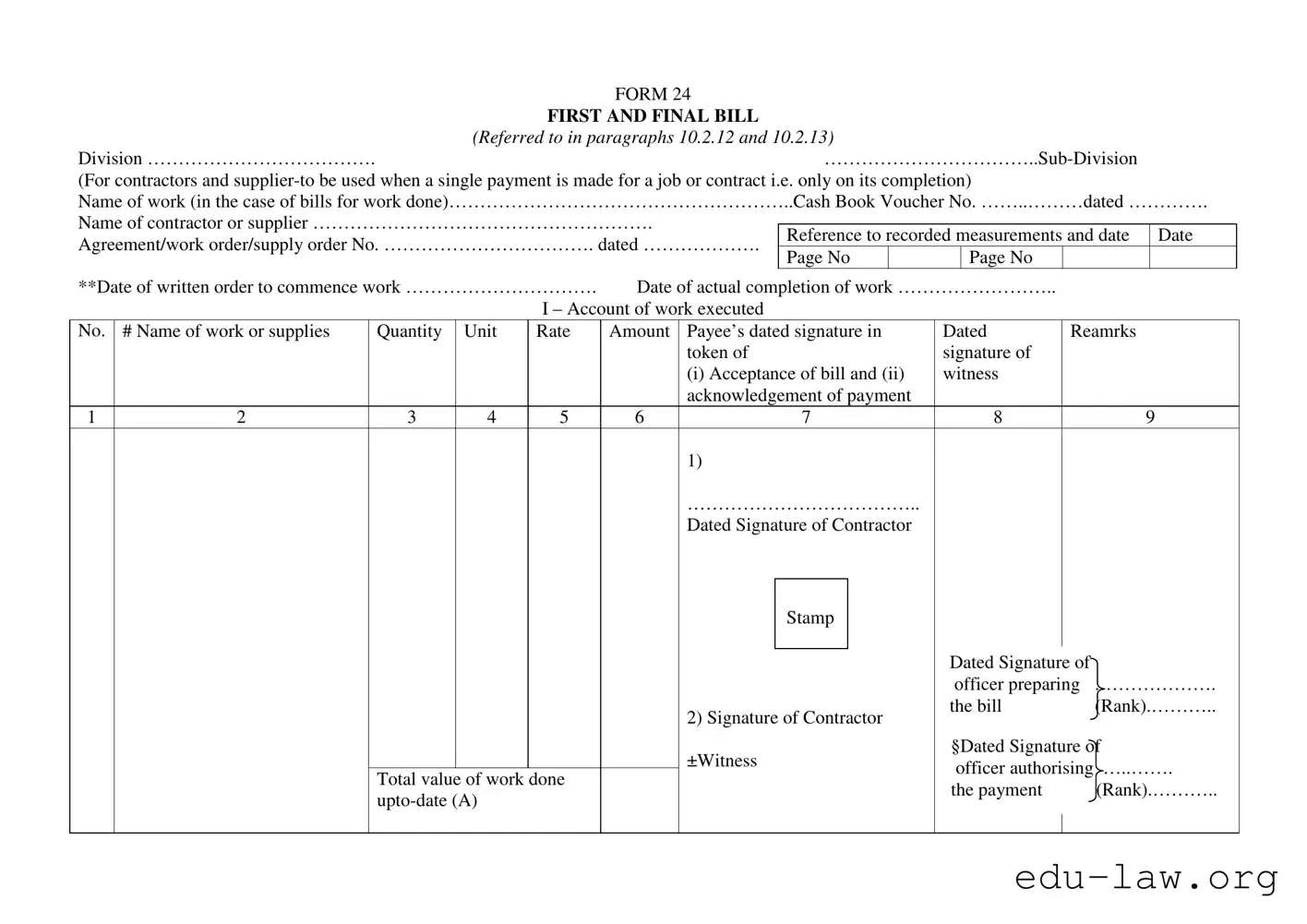
The Final Bill form, often referred to as Form 24, serves as a crucial document in the completion of a contract or job, particularly for contractors and suppliers. It is utilized when a single payment is made upon the full execution of the work, ensuring that all aspects of the project are accounted for before the final disbursement. Key sections of the form include details about the work performed, such as the name of the project, recorded measurements, and the dates of both the written order to commence and the actual completion of the work. Additionally, it outlines the financial aspects, including the total value of work done, payment details, and any recoveries related to the project. The form requires signatures from the contractor, as well as from various officers involved in the preparation and authorization of the bill, thereby providing a clear chain of accountability. Furthermore, it incorporates a memorandum of payments, detailing how funds will be disbursed, ensuring transparency in the financial transactions associated with the completed work. This comprehensive approach helps facilitate a smooth transition from project completion to payment, safeguarding the interests of all parties involved.
|
FORM 24 |
|
FIRST AND FINAL BILL |
|
(Referred to in paragraphs 10.2.12 and 10.2.13) |
Division ………………………………. |
(For contractors and
Name of work (in the case of bills for work done)………………………………………………..Cash Book Voucher No. ……..………dated ………….
Name of contractor or supplier ………………………………………………. |
|
|
|
|
|
|
|
|
|||||
|
Reference to recorded measurements and date |
|
Date |
||||||||||
Agreement/work order/supply order No. ……………………………. dated ………………. |
|
||||||||||||
Page No |
|
|
Page No |
|
|
|
|||||||
|
|
|
|
|
|
|
|
|
|
|
|
||
**Date of written order to commence work …………………………. |
Date of actual completion of work …………………….. |
|
|
|
|||||||||
|
|
|
|
I – Account of work executed |
|
|
|
|
|
|
|
||
No. |
# Name of work or supplies |
Quantity |
Unit |
Rate |
Amount |
Payee’s dated signature in |
Dated |
Reamrks |
|
|
|||
|
|
|
|
|
|
token of |
|
|
signature of |
|
|
|
|
|
|
|
|
|
|
(i) Acceptance of bill and (ii) |
witness |
|
|
|
|||
|
|
|
|
|
|
acknowledgement of payment |
|
|
|
|
|
||
1 |
2 |
3 |
4 |
5 |
6 |
|
7 |
|
8 |
|
9 |
||
|
|
|
|
|
|
1) |
|
|
|
|
|
|
|
|
|
|
|
|
|
……………………………….. |
|
|
|
|
|
||
|
|
|
|
|
|
Dated Signature of Contractor |
|
|
|
|
|
||
|
|
|
Stamp |
|
|
|
|
|
|
|
|
|
|
|
|
|
|
|
|
|
|
|
Dated Signature of |
|
|
|
|
|
|
|
|
officer preparing |
.………………. |
|
|
|
|
2) Signature of Contractor |
the bill |
(Rank).……….. |
|
|||
|
|
|
|
|
|
|||
|
|
|
|
|
|
|
|
|
|
|
±Witness |
§Dated Signature of |
|
||||
|
|
officer authorising …..……. |
|
|||||
|
Total value of work done |
|
|
|
|
|||
|
|
|
|
the payment |
(Rank).……….. |
|
||
|
|
|
|
|
||||
|
|
|
|
|
|
|
|
|
|
|
|
|
|
|
|
|
|
|
|
|
|
|
|
|
|
|

II – Memorandum of Payments
|
|
|
Rs. |
|
|
1. Total Value as per Account I Col 6 Entry (A)……………………… |
…………………….. |
* Pay Rs…………………………………………. |
|||
2. Payments now to be made as detailed below :- |
|
|
………………………………… (by cheque) |
||
By recovery of amounts credited to this work- |
|
|
|
|
|
(a) ……………………………………...……… |
(a) ………….….. |
…………………….. |
|
|
|
……………………………………...……… |
|
|
Dated initials of disbursing officer |
||
Total 2 (a) ………………….. |
Total 1- 2(a) ………………….(c) |
…………………….. |
§Paid by me vide cheque No………….. |
||
|
|
|
|
dt……….. |
|
By recovery of amounts credited to other work |
|
|
|
||
or head of accounts- |
|
|
|
|
|
(b) |
Rs…… |
|
|
Dated initials of person actually making the |
|
Rs.…… |
(b)………….….. |
|
payment |
|
|
Security Deposit…….. |
Rs.….. |
|
|
For use in Divisional Office |
|
Other recoveries |
Rs…… |
|
|
Checked |
|
Total 2 (b) ………………….. |
|
|
|
Accounts Clerk |
Divisional Accountant |
|
|
|
|
|
|
(c) By Cheque ……………………………………………………. |
|
For use in Pay & Accounts Office |
|||
|
Audited |
Reviewed |
|||
|
|
|
|
||
|
Total 2(b) +(c) …………….(G) |
………………………. |
Acctt./Jr.A.O./A.A.O |
Pay & Accounts Officer |
|
|
|
|
|
||
|
|
|
|
|
|
#In the case of payments to suppliers a red ink entry should be made across the page, above the entries relating thereto, in one of the following forms, applicable to the case : (1) “Stock”, (2) “Purchases for Stock”, (3) Purchases for direct issue to work ………….” (4) “Purchase for the work ……….. for issue to contractor ……………….”.
**Not required in the case of works done or supplies made under a
±Payment should be attested by some known person when the payee’s acknowledgement is given by a mark, seal or thumb impression. §The person actually making the payment should initial (and date) in this column against each payment.
(This signature is necessary only when the officer authorizing payment is not the officer who prepares the bill.)
* This figures should be tested to see that it agrees with the total of items
| Fact Name | Description | Governing Law(s) |
|---|---|---|
| Purpose | The Final Bill form is used for a single payment upon the completion of a job or contract. | State Contract Law |
| Components | The form includes sections for work details, payment breakdown, and signatures for acceptance and authorization. | State Procurement Regulations |
| Signature Requirements | Signatures from the contractor, disbursing officer, and an authorizing officer are required for validation. | State Payment Laws |
| Payment Verification | Payments must be verified against recorded measurements and documented agreements. | State Accounting Standards |
Filling out the Final Bill form is a straightforward process. Once completed, this form will serve as a record of the work done and the payment due. Follow these steps carefully to ensure accuracy.
What is the purpose of the Final Bill form?
The Final Bill form, also known as FORM 24, is primarily used by contractors and suppliers to request a single payment upon the completion of a job or contract. It serves as a comprehensive record of the work executed, detailing the quantities, rates, and total amounts due for payment. This ensures that all parties have a clear understanding of the transaction and helps facilitate a smooth payment process.
Who should use the Final Bill form?
This form is intended for contractors and suppliers who are completing a job or contract. It is specifically designed for situations where a final payment is made only after the completion of the work. If you are a contractor or supplier looking to receive payment for services rendered, this form is essential for documenting your work and facilitating payment.
What information is required on the Final Bill form?
The form requires several key pieces of information, including the name of the work, cash book voucher number, contractor or supplier name, agreement or work order number, dates of commencement and completion, and a detailed account of the work executed. Additionally, it includes sections for signatures of the contractor, the officer preparing the bill, and the officer authorizing payment, ensuring accountability at each step.
How do I fill out the account of work executed section?
In the account of work executed section, you will need to list each item of work or supplies provided, along with the corresponding quantity, unit rate, and total amount. This section is crucial as it summarizes the work done and the payment due. Be sure to double-check your calculations to ensure accuracy, as any discrepancies could delay payment.
What should I do if I need to make corrections on the Final Bill form?
If corrections are necessary, it’s best to make them clearly and neatly. Cross out the incorrect information and write the correct details next to it. Avoid using white-out or erasing, as this can lead to confusion. Always initial and date any changes to maintain transparency and accountability.
Is there a specific format for signatures on the Final Bill form?
Yes, the form requires several signatures for validation. The contractor must sign to acknowledge the bill, while a witness should also sign if the contractor uses a mark, seal, or thumb impression. Additionally, the officer preparing the bill and the officer authorizing payment must sign as well. This multi-signature requirement helps ensure that the payment process is properly documented and authorized.
What happens after I submit the Final Bill form?
Once you submit the Final Bill form, it will go through a review and approval process. The designated officers will verify the information provided, confirm the completion of the work, and authorize payment. Depending on the organization’s procedures, this may take some time. It’s advisable to follow up to ensure that your bill is being processed and to address any potential issues promptly.
Can the Final Bill form be used for partial payments?
No, the Final Bill form is specifically designed for a single payment made upon the completion of a job or contract. If you need to request partial payments, other forms or agreements should be utilized. Always check with your organization’s policies to ensure you are using the appropriate documentation for your payment requests.
Incomplete Information: Many individuals fail to provide all required details, such as the name of the contractor or supplier, or the cash book voucher number. Omitting these crucial elements can lead to delays in processing the bill.
Incorrect Dates: Entering the wrong dates for the commencement of work or actual completion can create confusion. This mistake may result in disputes regarding the timeline of the project.
Miscalculations: Errors in calculating the total value of work done or payments to be made are common. Double-checking these figures is essential to ensure accuracy and prevent financial discrepancies.
Missing Signatures: Failing to obtain necessary signatures from the contractor, officer preparing the bill, or the officer authorizing payment can invalidate the form. All required signatures must be present for the bill to be processed.
Improper Documentation: Not attaching supporting documents, such as written orders or measurements, can hinder the approval process. Ensure all relevant documentation is included to facilitate a smooth review.
The Final Bill form serves as a crucial document in the completion of a contract, particularly for contractors and suppliers. However, it is often accompanied by several other forms and documents that help streamline the payment process and ensure all contractual obligations are met. Below is a list of commonly used forms that complement the Final Bill form.
Each of these documents plays a vital role in ensuring that the contractual relationship between the parties remains clear and well-documented. Together, they facilitate a smoother payment process and help mitigate misunderstandings that may arise during or after the completion of a project.
The Final Bill form shares similarities with the Invoice, a document commonly used in business transactions. Like the Final Bill, an Invoice outlines the details of goods or services provided, including descriptions, quantities, and prices. Both documents serve as requests for payment, summarizing the financial obligations of the buyer to the seller. While the Final Bill is often associated with the completion of a specific project, an Invoice can be issued at various stages of a transaction, making it a versatile tool for businesses. Each serves to document the financial exchange, ensuring clarity and accountability in financial dealings.
Another document akin to the Final Bill form is the Receipt. A Receipt provides proof of payment made for goods or services rendered. Similar to the Final Bill, it contains essential details such as the date of transaction, the amount paid, and a description of the items or services. However, while the Final Bill is primarily a request for payment upon completion of a project, a Receipt confirms that payment has been received. Both documents play crucial roles in financial transactions, helping to maintain accurate records for both parties involved.
The Purchase Order (PO) is yet another document that resembles the Final Bill form. A Purchase Order is a formal request issued by a buyer to a seller, detailing the items or services requested, their quantities, and agreed-upon prices. Both the Final Bill and the Purchase Order help to establish the terms of a transaction, although they serve different purposes in the procurement process. The Final Bill acts as a summary of completed work or delivered goods, while the Purchase Order initiates the transaction. Together, they create a clear trail of communication and agreement between the parties.
Lastly, the Work Order is similar to the Final Bill form in that it outlines specific tasks or services to be performed. A Work Order is typically generated before the work begins, detailing the scope of the project, timelines, and costs. While the Final Bill reflects the completion of work and requests payment, the Work Order serves as the initial agreement outlining what is to be done. Both documents are essential in project management, ensuring that all parties have a clear understanding of expectations and deliverables throughout the process.
When filling out the Final Bill form, it’s important to follow certain guidelines to ensure everything is completed correctly. Here’s a list of things you should and shouldn’t do:
Misconceptions about the Final Bill form can lead to confusion and errors in processing payments. Here are eight common misunderstandings that individuals often have:
Understanding these misconceptions can help streamline the payment process and ensure that all parties involved are on the same page. Accurate completion of the Final Bill form is crucial for maintaining clear records and facilitating timely payments.
Here are some key takeaways for filling out and using the Final Bill form: