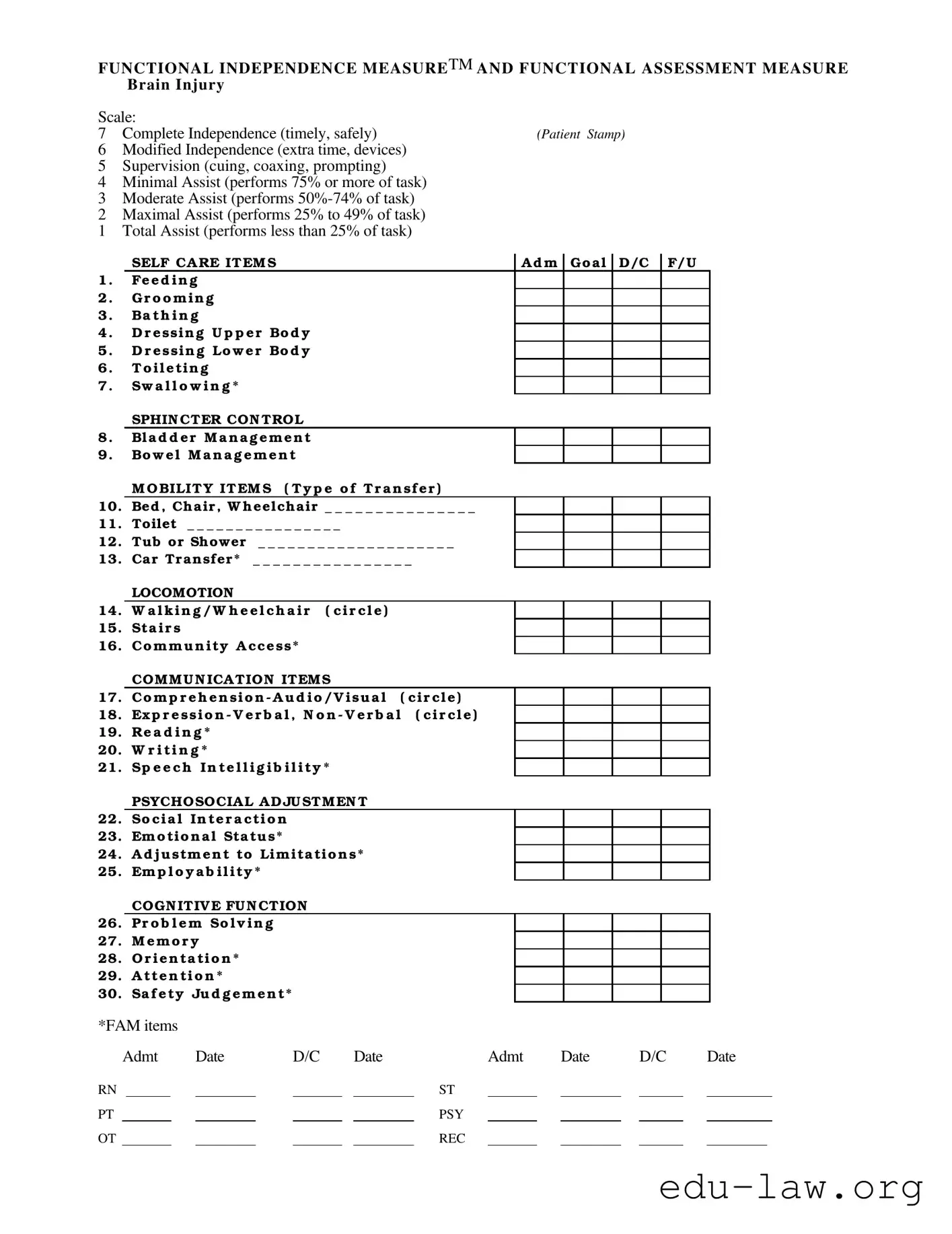
The FIM Scale, or Functional Independence Measure, is an essential tool used to assess an individual's level of independence in daily activities, particularly after a brain injury. This form evaluates various aspects of self-care, mobility, communication, psychosocial adjustment, and cognitive function. It consists of a series of items that measure the degree of assistance a person requires to perform tasks such as feeding, grooming, bathing, and dressing. Each task is rated on a scale from 1 to 7, where 7 indicates complete independence and 1 signifies total assistance. The scale also includes specific items related to bladder and bowel management, mobility transfers, and communication abilities, ensuring a comprehensive evaluation. Additionally, psychosocial factors like emotional status and social interaction are considered, along with cognitive skills such as problem-solving and memory. By using this structured approach, healthcare professionals can better understand a patient’s needs, track progress, and develop effective rehabilitation plans.

FUNCTIONAL INDEPENDENCE MEASURETM AND FUNCTIONAL ASSESSMENT MEASURE
BRAIN INJURY
Scale: |
|
7 Complete Independence (timely, safely) |
(Patient Stamp) |
6Modified Independence (extra time, devices)
5Supervision (cuing, coaxing, prompting)
4Minimal Assist (performs 75% or more of task)
3Moderate Assist (performs
2Maximal Assist (performs 25% to 49% of task)
1Total Assist (performs less than 25% of task)
|
SELF CA RE IT EM S |
|
A d m |
Go a l |
D/C |
F/U |
|
1 . |
Fe e d i n g |
|
|
|
|
|
|
2 . |
G r o o m i n g |
|
|
|
|
|
|
3 . |
Ba t h i n g |
|
|
|
|
|
|
4 . |
D r e ssin g U p p e r Bo d y |
|
|
|
|
|
|
5 . |
D r e ssi n g Lo w e r Bo d y |
|
|
|
|
|
|
6 . |
T o i l e ti n g |
|
|
|
|
|
|
7 . |
Sw a l l o w i n g * |
|
|
|
|
|
|
|
SPHIN CTER CON TROL |
|
|
|
|
|
|
8 . |
Bl a d d e r M a n a g e m e n t |
|
|
|
|
|
|
9 . |
Bo w e l M a n a g e m e n t |
|
|
|
|
|
|
|
M O BILIT Y IT EM S ( T y p e o f T r a n sf e r ) |
||||||
10. |
Bed , Ch air , W h eelch air _ _ _ _ _ _ _ _ _ _ _ _ _ _ _ |
|
|
|
|
||
11. |
Toilet _ _ _ _ _ _ _ _ _ _ _ _ _ _ _ _ |
|
|
|
|
||
12. |
Tub or Shower |
_ _ _ _ _ _ _ _ _ _ _ _ _ _ _ _ _ _ _ _ |
|
|
|
|
|
13. |
Car Tr ansfer * |
_ _ _ _ _ _ _ _ _ _ _ _ _ _ _ _ |
|
|
|
|
|
|
LOCOMOTION |
|
|
|
|
|
|
14. |
W a l k i n g / W h e e l c h a i r |
( c i r c l e ) |
|||||
15.Sta i r s
16.Co m m u n i ty A cce ss*
|
COM M U N ICA TION ITEM S |
17. |
Co m p r e h e n si o n - A u d i o / V i su a l ( ci r cl e ) |
18. |
Ex p r e s s i o n - V e r b a l , N o n - V e r b a l ( ci r cl e ) |
19.Re a d i n g *
20.W r i t i n g *
21.Sp e e c h I n t e l l i g i b i l i t y *
PSYCHOSOCIA L A D JU STM EN T
22.So ci a l In te r a cti o n
23.Em o tio n a l Sta tu s*
24.A d j u stm e n t to Lim ita tio n s*
25.Em p l o y a b i l i ty *
COGN ITIV E FU N CTION
26.Pr o b l e m So l v i n g
27.M e m o r y
28.O r i e n ta ti o n *
29.A tte n ti o n *
30.Sa f e ty Ju d g e m e n t*
*FAM items |
|
|
|
|
|
|
|
|
|
|
|
|
|
|
||||
|
Admt |
Date |
|
D/C |
|
Date |
|
Admt |
Date |
|
D/C |
|
Date |
|||||
RN |
|
|
|
|
|
|
|
ST |
|
|
|
|
|
|
|
|
||
PT |
|
|
|
|
|
|
|
PSY |
|
|
|
|
|
|
|
|
||
OT |
|
|
|
|
|
|
|
REC |
|
|
|
|
|
|
|
|
||
| Fact Name | Description |
|---|---|
| Purpose | The FIM Scale is designed to assess an individual's functional independence following a brain injury. |
| Scale Levels | The scale ranges from 1 (Total Assist) to 7 (Complete Independence), indicating varying levels of assistance required. |
| Self-Care Items | It includes items such as feeding, grooming, bathing, and toileting, which are critical for daily living. |
| Mobility Assessment | Mobility is evaluated through transfers (e.g., bed to chair) and locomotion (e.g., walking, stairs). |
| Communication Evaluation | Communication skills are assessed, including comprehension, expression, reading, and writing abilities. |
| Psychosocial Adjustment | The scale also measures social interaction, emotional status, and adjustment to limitations, highlighting the psychosocial aspect of recovery. |
| Cognitive Function | Cognitive skills such as problem-solving, memory, and attention are evaluated, emphasizing their importance in rehabilitation. |
| Governing Laws | The use of the FIM Scale may be governed by state-specific laws related to health assessments and rehabilitation practices. |
Completing the FIM Scale form is an important step in assessing functional independence. This process will involve evaluating various aspects of self-care, mobility, communication, psychosocial adjustment, and cognitive function. By following the steps outlined below, you will ensure that the form is filled out accurately and comprehensively.
What is the FIM Scale form?
The FIM Scale form, or Functional Independence Measure, is a standardized tool used to assess an individual's level of functional independence. It evaluates a person's ability to perform daily activities across various domains, including self-care, mobility, communication, psychosocial adjustment, and cognitive function. This assessment is particularly useful for patients recovering from brain injuries, as it helps healthcare providers determine the level of assistance a patient may need.
How is the FIM Scale scored?
The FIM Scale uses a scoring system ranging from 1 to 7. A score of 7 indicates complete independence, meaning the individual can perform a task timely and safely without assistance. A score of 1 signifies total assistance, where the person performs less than 25% of the task. The intermediate scores represent varying levels of independence, from modified independence with extra time or devices to different levels of assistance needed for task completion.
What types of activities are assessed in the FIM Scale?
The FIM Scale assesses a variety of activities categorized into self-care, mobility, communication, psychosocial adjustment, and cognitive function. Self-care items include feeding, grooming, bathing, dressing, toileting, and swallowing. Mobility items evaluate transfers (e.g., bed to chair) and locomotion (e.g., walking or using a wheelchair). Communication items assess comprehension, expression, reading, writing, and speech intelligibility. Psychosocial adjustment and cognitive function items evaluate social interaction, emotional status, problem-solving, memory, orientation, attention, and safety judgment.
Who typically administers the FIM Scale?
The FIM Scale is usually administered by trained healthcare professionals, such as occupational therapists, physical therapists, nurses, or rehabilitation specialists. These professionals have the expertise to evaluate the patient's abilities accurately and provide appropriate recommendations for care and rehabilitation based on the results.
Why is the FIM Scale important in rehabilitation?
The FIM Scale is crucial in rehabilitation settings as it provides a clear, objective measure of a patient's progress over time. By tracking changes in a patient's functional independence, healthcare providers can tailor treatment plans, set realistic goals, and facilitate effective communication among the care team. This assessment also aids in determining discharge planning and potential community reintegration for patients.
How often should the FIM Scale be administered?
The frequency of administering the FIM Scale can vary based on the patient's condition and rehabilitation goals. Typically, it is performed at admission, during the course of treatment, and at discharge. Regular assessments help monitor progress and adjust the rehabilitation plan as necessary, ensuring that the patient receives the most effective care throughout their recovery journey.
What should I expect during a FIM Scale assessment?
During a FIM Scale assessment, the healthcare professional will observe and evaluate your ability to perform specific tasks related to self-care, mobility, communication, and cognitive function. You may be asked to demonstrate certain activities, and the professional will note the level of assistance you require. The assessment is typically straightforward and focused on understanding your capabilities to support your rehabilitation effectively.
Inaccurate Scoring: One common mistake is misinterpreting the scale. Each number represents a specific level of independence. Ensure you understand what each score means before assigning it.
Omitting Important Information: Failing to fill out all relevant sections can lead to incomplete assessments. Every item is crucial for a comprehensive evaluation, so take the time to complete each part.
Not Considering Context: Sometimes, people forget to factor in the individual’s environment or support systems. Assess how external factors might influence the person’s ability to perform tasks independently.
Rushing the Process: Filling out the form too quickly can lead to errors. Take your time to evaluate each item carefully. A thorough assessment provides more accurate results.
Ignoring Team Input: Not collaborating with other healthcare professionals can result in a skewed perspective. Input from various team members can enhance the accuracy of the evaluation.
The Functional Independence Measure (FIM) Scale form is an essential document used to assess a patient's level of independence in various daily activities. Alongside this form, several other documents may be required to provide a comprehensive evaluation of a patient's functional capabilities. The following list outlines four commonly used forms and documents that complement the FIM Scale.
Utilizing these documents in conjunction with the FIM Scale form allows for a thorough assessment and effective planning of care for individuals recovering from brain injuries or other conditions affecting their functional independence. Timely and accurate documentation is crucial for optimizing patient outcomes.
The Barthel Index is a widely used tool for measuring an individual's ability to perform basic activities of daily living. Similar to the FIM Scale, it assesses functional independence through a series of tasks, including feeding, bathing, and dressing. The Barthel Index uses a scoring system that ranges from 0 to 100, where higher scores indicate greater independence. Both tools emphasize the importance of functional abilities in rehabilitation and care planning, making them essential for healthcare professionals in assessing patient progress.
The Katz Index of Independence in Activities of Daily Living (ADL) is another document that shares similarities with the FIM Scale. This index evaluates an individual's performance in six basic daily activities: bathing, dressing, toileting, transferring, continence, and feeding. Each activity is scored as either independent or dependent, allowing for a straightforward assessment of a person's functional status. Like the FIM Scale, the Katz Index is crucial for identifying areas where assistance may be needed and for monitoring changes in a patient's abilities over time.
The Lawton Instrumental Activities of Daily Living (IADL) Scale focuses on more complex daily tasks, such as managing finances, handling transportation, and shopping for groceries. While the FIM Scale assesses basic self-care and mobility, the Lawton Scale provides insight into an individual's ability to live independently in the community. Both scales are vital for comprehensive assessments, as they highlight different aspects of functional independence that are essential for effective care planning.
The Functional Assessment Staging Tool (FAST) is used primarily for assessing the stages of cognitive decline in individuals with dementia. It shares a similar goal with the FIM Scale in that both aim to evaluate functional capabilities. FAST stages range from normal functioning to severe cognitive impairment, providing a framework for understanding how cognitive issues impact daily living. Both tools assist healthcare providers in tailoring interventions to meet the specific needs of their patients.
The Mini-Mental State Examination (MMSE) is a brief 30-point questionnaire that assesses cognitive function, including aspects like memory, attention, and language. While the FIM Scale focuses on physical and functional independence, the MMSE evaluates cognitive abilities, making it a complementary tool. Both assessments are frequently used in clinical settings to gauge a patient’s overall functional status and to inform treatment plans.
The Denver Developmental Screening Test (DDST) is utilized primarily for assessing developmental milestones in children. Although it targets a different population, the DDST shares a similar framework with the FIM Scale by evaluating various domains of functioning, such as gross motor skills and language development. Both assessments aim to identify areas of need and facilitate early intervention, which is crucial for optimal outcomes in both children and adults.
When filling out the FIM Scale form, it’s essential to approach the task with care. Here’s a list of things you should and shouldn’t do to ensure accuracy and clarity.
By following these guidelines, you can help ensure that the FIM Scale form is filled out correctly and effectively. Your attention to detail can significantly impact the assessment process.
Misconception 1: The FIM Scale is only for patients with severe disabilities.
This is not true. The FIM Scale is designed for a wide range of functional abilities. It can be used to assess individuals with varying levels of independence, from those who are completely independent to those who require total assistance.
Misconception 2: The FIM Scale measures only physical abilities.
While the FIM Scale includes items related to mobility and self-care, it also assesses cognitive and psychosocial functions. This holistic approach provides a more comprehensive view of a patient's overall independence.
Misconception 3: Scores on the FIM Scale are absolute and cannot change.
Scores can and do change over time. As patients receive therapy and support, their functional independence can improve, leading to higher scores on the FIM Scale.
Misconception 4: The FIM Scale is only used in hospital settings.
In reality, the FIM Scale is applicable in various settings, including rehabilitation centers, nursing homes, and outpatient facilities. It is a versatile tool for assessing functional independence in different environments.
Misconception 5: The FIM Scale is only for adults.
This is a common misunderstanding. The FIM Scale can be utilized for patients of all ages, including children. Adaptations may be made to better suit younger patients, ensuring accurate assessments across age groups.
Misconception 6: The FIM Scale is too complicated to use effectively.
Many healthcare professionals find the FIM Scale to be user-friendly. With clear guidelines and a straightforward scoring system, it can be effectively implemented by trained staff to evaluate patient progress.
Understanding the FIM Scale form is essential for accurately assessing an individual's functional independence, especially after a brain injury. Here are some key takeaways to consider when filling out and using this form:
By keeping these points in mind, you can effectively utilize the FIM Scale form to support individuals in their journey toward greater independence.