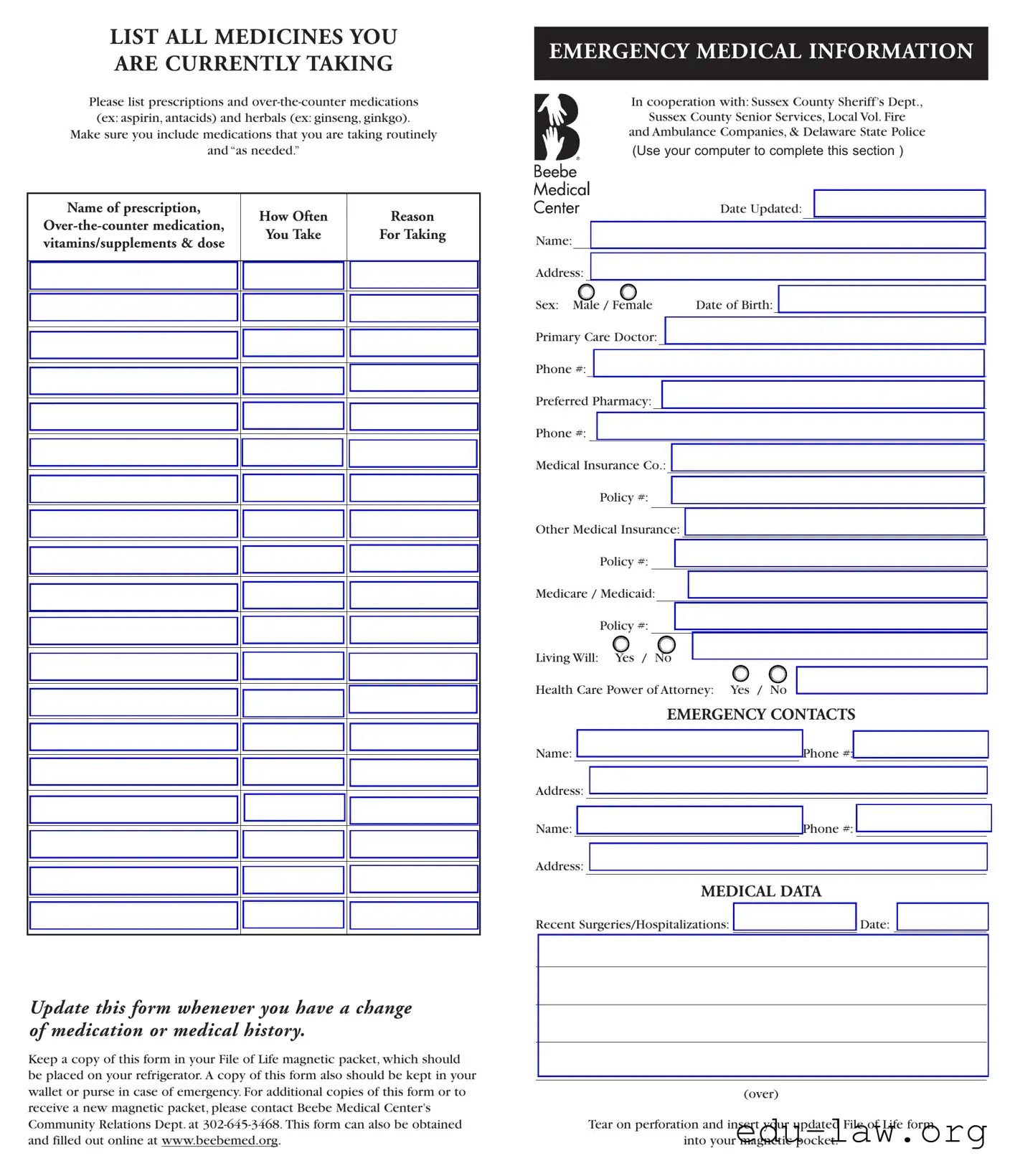
The File Of Life form is an essential tool designed to provide critical medical information during emergencies. This form captures a comprehensive overview of your current medications, including both prescriptions and over-the-counter drugs, as well as any herbal supplements you may be taking. It also includes important emergency medical information such as your personal details, primary care physician's contact, and insurance information. In addition, the form allows you to document your medical history, including recent surgeries and any ongoing medical conditions. Emergency contacts are also listed to ensure that the right people can be reached quickly. Keeping this form updated is crucial; it should be revised whenever there are changes to your medications or medical history. Once completed, place it in the magnetic packet provided and attach it to your refrigerator for easy access. It is also advisable to carry a copy in your wallet or purse. For convenience, additional copies of the form can be obtained from Beebe Medical Center or filled out online. This proactive approach ensures that first responders have the necessary information to provide you with the best possible care in an emergency situation.

LIST ALL MEDICINES YOU
ARE CURRENTLY TAKING
Please list prescriptions and
Make sure you include medications that you are taking routinely
and “as needed.”
Name of prescription, |
|
How Often |
Reason |
|
|
||||
|
You Take |
For Taking |
||
vitamins/supplements & dose |
|
|||
|
|
|
||
|
|
|
|
|
|
|
|
|
|
|
|
|
|
|
|
|
|
|
|
|
|
|
|
|
|
|
|
|
|
|
|
|
|
|
|
|
|
|
|
|
|
|
|
|
|
|
|
|
|
|
|
|
|
|
|
|
|
|
|
|
|
|
|
|
|
|
|
|
|
|
|
|
|
|
|
|
|
|
|
|
|
|
|
|
|
|
|
|
|
|
|
|
|
|
|
|
|
|
|
|
|
|
|
|
|
|
|
|
|
|
|
|
|
|
|
|
|
|
|
|
|
|
|
|
|
|
|
|
|
|
|
|
|
|
|
|
|
|
|
|
|
|
|
|
|
|
|
|
|
|
|
|
|
|
|
|
|
|
|
|
|
|
|
|
|
|
|
|
|
|
|
|
|
|
|
|
|
|
|
|
|
|
|
|
|
|
|
|
|
|
|
|
|
|
|
|
|
|
|
|
|
|
|
|
|
|
|
|
|
|
|
|
|
|
|
|
|
|
|
|
|
|
|
|
|
|
|
|
|
|
|
|
|
|
|
|
|
|
|
|
|
|
|
|
|
|
|
|
|
|
|
|
|
|
|
|
|
|
|
|
|
|
|
|
|
|
|
|
|
EMERGENCY MEDICAL INFORMATION
In cooperation with: Sussex County Sheriff’s Dept.,
Sussex County Senior Services, Local Vol. Fire
and Ambulance Companies, & Delaware State Police
(Use your computer to complete this section )
Date Updated:
Name:
Address:
Sex: Male / Female |
Date of Birth: |
Primary Care Doctor:
Phone #:
Preferred Pharmacy:
Phone #:
Medical Insurance Co.:
Policy #:
Other Medical Insurance:
Policy #:
Medicare / Medicaid:
Policy #:
Living Will: Yes / No
Health Care Power of Attorney: Yes / No
EMERGENCY CONTACTS
Name: Phone #:
Address:
Name: |
|
|
|
Phone #: |
|
|
|
|
|
Address:
MEDICAL DATA
Recent Surgeries/Hospitalizations: |
|
Date: |
|
|
|
Update this form whenever you have a change of medication or medical history.
Keep a copy of this form in your File of Life magnetic packet, which should be placed on your refrigerator. A copy of this form also should be kept in your wallet or purse in case of emergency. For additional copies of this form or to receive a new magnetic packet, please contact Beebe Medical Center’s Community Relations Dept. at
(over)
Tear on perforation and insert your updated File of Life form
into your magnetic pocket.

MEDICAL CONDITIONS
(check all that apply)
|
HEART DISEASE |
LUNG DISEASE |
KIDNEY |
||||
|
|
|
|
|
|
DISEASE |
|
|
|
|
CHF/Heart Failure |
|
COPD/Emphysema |
|
Failure |
|
|
|
|
|
|
|
|
|
|
|
High Blood Pressure |
|
Asthma |
|
Insufficiency |
|
|
|
|
|
|||
|
|
|
|
|
|
|
|
|
|
|
Low Blood Pressure |
|
Fibrosis |
|
Dialysis |
|
|
|
High Cholesterol |
|
Pneumonia |
|
Kidney Stones |
|
|
|
|
|
|||
|
|
|
|
|
|
|
|
|
|
|
Irregular Heart Beat |
|
Bronchitis |
|
Infections |
|
|
|
|
|
|||
|
|
|
Pacemaker |
|
Shortness of Breath |
|
|
|
|
|
|
|
|
|
|
|
|
|
Heart Attack |
|
Coughing |
|
|
|
|
|
|
|
|
||
|
|
|
|
|
|
||
|
|
|
|
|
|
|
|
|
|
|
Angina or Chest Pain |
|
Lung Pain |
|
|
|
|
|
|
|
|
||
|
|
|
|
|
|
||
|
|
|
|
|
|
|
|
|
|
|
Heart Surgery/ |
|
|
|
|
|
|
|
|
|
|
|
|
|
|
|
|
|
|
|
|
|
|
|
ByPass/Stent |
|
|
|
|
|
|
|
|
|
|
|
|
|
|
|
|
|
|
|
|
STOMACH |
NEUROLOGICAL |
MALIGNANCY/ |
DISEASE |
DISEASE |
CANCER |
Bowel Obstruction |
Stroke |
Lung |
Bleeding |
Bleeding in Brain |
Liver |
Diverticulitis |
Seizures |
Breast |
Hiatal Hernia |
Multiple Sclerosis |
Stomach |
|
|
GERD/Reflux |
|
|
Parkinson |
|
|
Leukemia |
|
|
Diarrhea |
|
Headaches |
|
|
Colon |
|
|
|
|
|
|
|
|
|
|
|
|
Blood in Stools |
|
Alzheimers or |
|
|
Skin |
|
|
|
|
|
|
||||
|
|
|
|
|
|
|
|
|
|
|
|
|
|
|
|
|
|
|
|
|
|
|
|
|
|
|
|
Memory Loss |
Other: |
ENDOCRINE |
OTHER |
|
DISEASE |
|
|
Diabetes |
Arthritis |
Vision |
Thyroid: |
Back Problem |
Problems |
High |
HIV |
Other |
Low |
Sickle Cell |
|
Weight Gain
Weight Loss
ALLERGIES
(check all that apply)
|
|
|
Aspirin |
|
|
Laytex |
|
|
Tetracycline |
|
|
|
|
|
|
|
|
|
|
|
|
|
Barbiturates |
|
|
Lidocaine |
|
|
|
|
|
|
|
|
|
|
|||
|
|
|
|
|
|
|
|
|
|
|
|
|
Codeine |
|
|
Morphine |
|
|
No Known Allergy |
|
|
|
|
|
|
|
|||
|
|
|
|
|
|
|
|||
|
|
|
|
|
|
|
|
|
|
|
|
|
Demerol |
|
|
Novocain |
|
|
Other: |
|
|
|
|
|
|
|
|||
|
|
|
Insect Stings |
|
|
Penicillin |
|
|
|
|
|
|
|
|
|
|
|
|
|
|
|
|
Horse Serum or |
|
|
Sulfa |
|
|
|
|
|
|
|
|
|
|
|
|
|
|
|
|
|
|
|
|
|
|
|
|
|
|
Vaccines |
|
|
|
|
|
|
|
|
|
|
|
|
|
|
|
|
Update this form whenever you have a change of medication or medical history.
Keep a copy of this form in your File of Life magnetic packet, which should be placed on your refrigerator. A copy of this form also should be kept in your wallet or purse in case of emergency. For additional copies of this form or
to receive a new magnetic packet, please contact Beebe Medical Center’s Community Relations Dept. at
UNIVERSAL MEDICATION FORM
(Use pencil on this form to allow for easy changing)
Date Updated:
Name:
Address:
Sex: Male / Female |
Date of Birth: |
|
|
|
|
|
|
Primary Care Doctor:
Phone #:
Preferred Pharmacy:
Phone #:
Medical Insurance Co.:
Policy #:
Other Medical Insurance:
Policy #:
Medicare / Medicaid:
Policy #:
MEDICINE ALLERGIES/REACTIONS (describe reaction)
Drug:Reaction:
| Fact Name | Description |
|---|---|
| Purpose | The File of Life form is designed to provide essential medical information during emergencies. |
| Medication Listing | It includes a section for listing all current medications, both prescription and over-the-counter. |
| Emergency Contacts | The form allows individuals to specify emergency contacts, ensuring quick communication in critical situations. |
| Medical Conditions | Users can check off various medical conditions, making it easier for responders to assess health risks. |
| Allergies | Allergies can be documented, helping medical personnel avoid harmful substances during treatment. |
| Living Will | The form includes a section to indicate the existence of a living will, guiding medical decisions. |
| Updates | It is recommended to update the form whenever there are changes in medications or medical history. |
| Accessibility | The File of Life form can be obtained online or through local medical centers, ensuring widespread access. |
| Storage | Individuals are advised to keep the form in a magnetic packet on their refrigerator and a copy in their wallet. |
| State-Specific Forms | In Delaware, the form is supported by local laws and partnerships with emergency services. |
Filling out the File Of Life form is an important step in ensuring that emergency responders have access to your medical information when needed. This form collects essential details about your medications, medical history, and emergency contacts. Following the steps below will help you complete the form accurately.
What is the File of Life form?
The File of Life form is a crucial document designed to provide emergency responders with essential medical information about an individual. This form includes details about medications, medical conditions, allergies, and emergency contacts. Keeping this information readily accessible can significantly improve the quality of care during emergencies.
How do I fill out the File of Life form?
To complete the File of Life form, you should list all medications you are currently taking, including prescriptions, over-the-counter drugs, and herbal supplements. Additionally, provide personal information such as your name, address, date of birth, and contact details for your primary care doctor and preferred pharmacy. Be sure to check all applicable medical conditions and allergies. Regularly update this form whenever there are changes in your health status or medication regimen.
Where should I keep the File of Life form?
It is recommended to keep the completed File of Life form in a magnetic packet on your refrigerator. This location is often the first place emergency responders check when they arrive at a home. Additionally, having a copy in your wallet or purse ensures that you can provide this critical information if needed outside your home.
Why is it important to update the File of Life form?
Updating the File of Life form is essential to ensure that emergency responders have the most current information about your health. Changes in medications, medical conditions, or emergency contacts should be reflected on the form. Regular updates can help prevent potential medical errors and ensure appropriate treatment during emergencies.
What should I do if I need additional copies of the File of Life form?
If you require more copies of the File of Life form or a new magnetic packet, you can contact Beebe Medical Center’s Community Relations Department at 302-645-3468. Additionally, the form is available online at www.beebemed.org, where you can fill it out digitally.
Can I include my health care power of attorney information on the File of Life form?
Yes, you can include information about your health care power of attorney on the File of Life form. Indicating whether you have a health care power of attorney and providing the relevant contact details ensures that your wishes regarding medical treatment can be honored in emergencies.
What types of medical conditions should I list on the File of Life form?
It is important to list any medical conditions you have, including chronic illnesses such as diabetes, heart disease, or lung conditions. You should also note any recent surgeries or hospitalizations. This information helps emergency responders understand your health background and tailor their care accordingly.
How can I ensure my allergies are accurately noted on the File of Life form?
To accurately note your allergies, carefully check all relevant boxes on the form. If you have experienced specific reactions to medications or substances, describe those reactions in detail. Providing comprehensive information about your allergies can help prevent adverse reactions during emergency medical treatment.
Inadequate Listing of Medications: Individuals often fail to include all medications they are currently taking. This includes prescriptions, over-the-counter drugs, and herbal supplements. Omitting even one medication can lead to serious health risks during emergencies.
Incorrect Personal Information: Some people mistakenly provide inaccurate personal details, such as their name, address, or date of birth. This can hinder emergency responders from accessing vital information quickly and accurately.
Neglecting to Update the Form: Many forget to update their File of Life form when there are changes in their medical history or medications. Regular updates are crucial for ensuring that the information remains current and relevant.
Inadequate Emergency Contacts: Individuals sometimes list only one emergency contact or fail to include complete information. Having multiple contacts with accurate phone numbers and addresses is essential for effective communication during emergencies.
The File of Life form serves as a crucial tool for individuals to communicate vital medical information in emergencies. Alongside this form, several other documents can enhance the effectiveness of emergency medical response. Each of these documents plays a unique role in ensuring that medical personnel have access to comprehensive and accurate information about a patient's health status.
Incorporating these documents along with the File of Life form can significantly improve the quality of care provided during emergencies. By ensuring that all relevant information is easily accessible, individuals can help medical professionals deliver timely and appropriate treatment.
The File of Life form shares similarities with a Personal Health Record (PHR). A PHR is a comprehensive document that individuals maintain to track their medical history, medications, and health-related information. Like the File of Life, a PHR allows users to list medications, allergies, and medical conditions. Both documents serve as vital resources during medical emergencies, ensuring that healthcare providers have immediate access to critical information. The PHR can be updated regularly, just as the File of Life form encourages updates whenever there are changes in medication or health status.
Another document comparable to the File of Life form is the Medication Administration Record (MAR). This document is primarily used in healthcare settings to track the administration of medications to patients. Similar to the File of Life, the MAR includes details about each medication, such as dosage and frequency. While the MAR is typically used by healthcare professionals, the File of Life empowers individuals to manage their own medication records, promoting personal responsibility in health care.
The Emergency Medical Services (EMS) Patient Care Report is another relevant document. EMS personnel use this report to document the care provided to patients during emergency situations. Like the File of Life form, it captures essential medical information, including medications and allergies. Both documents aim to ensure that medical personnel have access to critical health information quickly, which can significantly impact patient outcomes during emergencies.
A Health Care Proxy form is also similar in that it provides important information about a person's medical preferences and decision-makers. While the File of Life focuses on medical history and current medications, the Health Care Proxy designates someone to make healthcare decisions on behalf of an individual if they are unable to do so. Both documents serve to communicate essential health-related information, ensuring that an individual’s wishes are respected in critical situations.
The Advance Directive is another document that aligns with the principles of the File of Life form. An Advance Directive outlines an individual's preferences for medical treatment in the event they are unable to communicate those wishes. Like the File of Life, it is designed to guide healthcare providers in making decisions that align with the patient’s desires. Both documents emphasize the importance of having clear, accessible health information available during emergencies.
A Patient Information Sheet is also comparable to the File of Life form. This sheet typically contains basic information about a patient, including contact details, medical history, and current medications. Similar to the File of Life, it is intended to provide healthcare professionals with quick access to essential information. Both documents facilitate better communication between patients and providers, enhancing the quality of care received.
Finally, the Health History Questionnaire is similar in that it collects detailed information about an individual’s medical background. This questionnaire often includes sections on medications, allergies, and past medical events, mirroring the structure of the File of Life form. Both documents are instrumental in gathering comprehensive health data, which can inform treatment decisions and improve patient care in emergencies.
When filling out the File Of Life form, it is essential to ensure that the information provided is accurate and comprehensive. Below is a list of things to do and avoid during this process.
Here are some common misconceptions about the File Of Life form:
Filling out and using the File of Life form is an important step in ensuring your health information is readily available in emergencies. Here are some key takeaways: