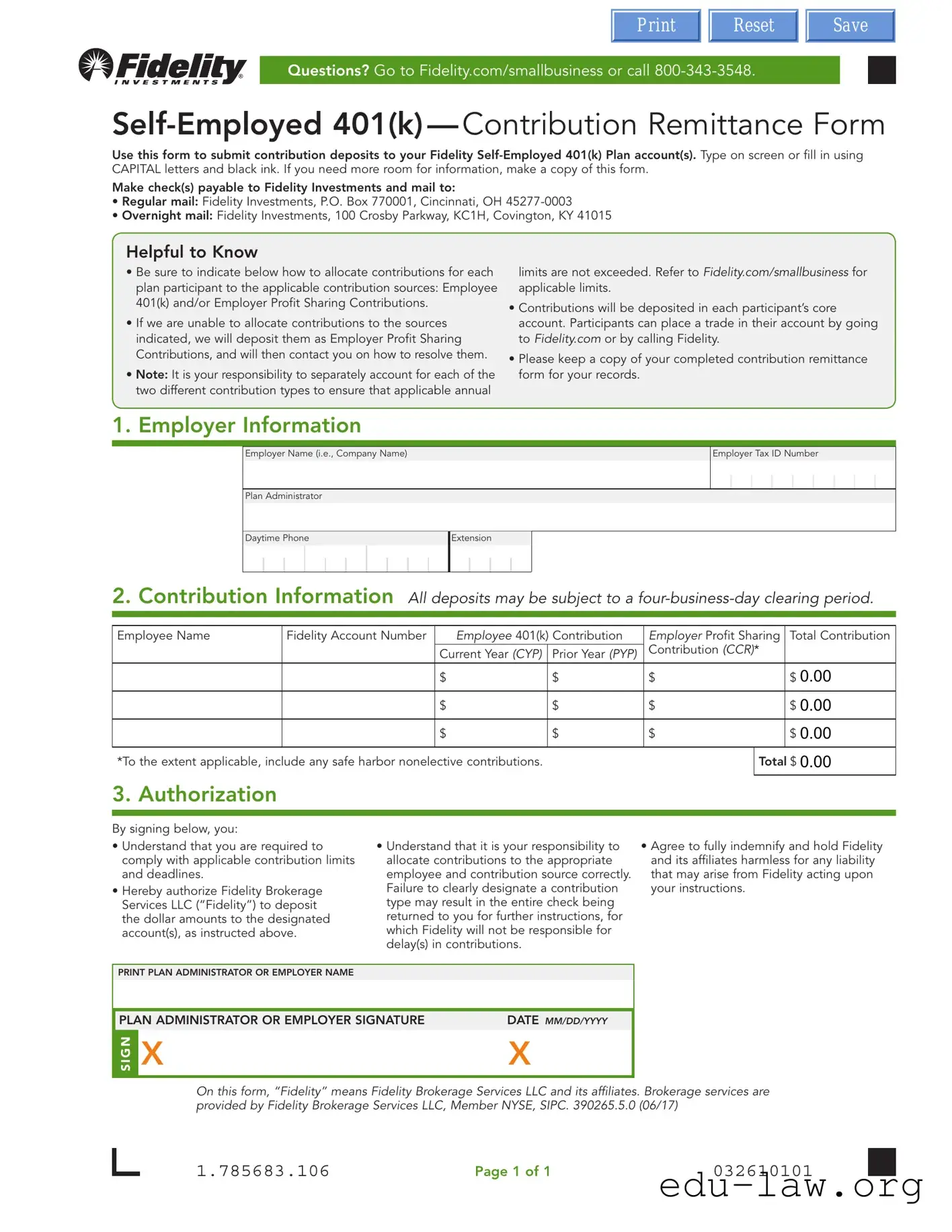
The Fidelity Self Employed 401(k) Contribution Remittance Form is a crucial tool for individuals managing their own retirement plans. This form allows self-employed individuals to submit their contribution deposits directly to their Fidelity Self-Employed 401(k) Plan accounts. It is essential to fill out the form accurately, using capital letters and black ink, to ensure that all information is clear and legible. Contributors should also be aware of the importance of indicating how to allocate their contributions between employee 401(k) and employer profit-sharing contributions. This allocation must be done carefully to avoid exceeding annual contribution limits. The form provides space for employer information, contribution details, and an authorization section that requires a signature. It is vital to keep a copy of the completed form for personal records. Additionally, understanding the clearing period for deposits and the responsibilities associated with contribution limits is necessary to avoid any complications. For assistance, Fidelity offers resources online and via phone, ensuring that users have support throughout the process.
Print Reset Save
Questions? Go to Fidelity.com/smallbusiness or call
Use this form to submit contribution deposits to your Fidelity
Make check(s) payable to Fidelity Investments and mail to:
•Regular mail: Fidelity Investments, P.O. Box 770001, Cincinnati, OH
•Overnight mail: Fidelity Investments, 100 Crosby Parkway, KC1H, Covington, KY 41015
Helpful to Know
• Be sure to indicate below how to allocate contributions for each |
limits are not exceeded. Refer to Fidelity.com/smallbusiness for |
plan participant to the applicable contribution sources: Employee |
applicable limits. |
401(k) and/or Employer Profit Sharing Contributions. |
• Contributions will be deposited in each participant’s core |
|
|
• If we are unable to allocate contributions to the sources |
account. Participants can place a trade in their account by going |
indicated, we will deposit them as Employer Profit Sharing |
to Fidelity.com or by calling Fidelity. |
Contributions, and will then contact you on how to resolve them. |
• Please keep a copy of your completed contribution remittance |
|
|
• Note: It is your responsibility to separately account for each of the |
form for your records. |
two different contribution types to ensure that applicable annual |
|
1. Employer Information
Employer Name (i.e., Company Name)
Employer Tax ID Number
Plan Administrator
Daytime Phone
Extension
2.Contribution Information All deposits may be subject to a
Employee Name |
Fidelity Account Number |
Employee 401(k) Contribution |
Employer Profit Sharing |
Total Contribution |
||
|
|
|
|
Contribution (CCR)* |
|
|
|
|
Current Year (CYP) |
Prior Year (PYP) |
|
||
|
|
$ |
$ |
$ |
|
$ 0.00 |
|
|
|
|
|
|
|
|
|
$ |
$ |
$ |
|
$ 0.00 |
|
|
|
|
|
|
|
|
|
$ |
$ |
$ |
|
$ 0.00 |
|
|
|
|
|
|
|
*To the extent applicable, include any safe harbor nonelective contributions. |
|
|
Total $ 0.00 |
|||
|
|
|
|
|
|
|
3. Authorization
By signing below, you:
•Understand that you are required to comply with applicable contribution limits and deadlines.
•Hereby authorize Fidelity Brokerage Services LLC (“Fidelity”) to deposit the dollar amounts to the designated account(s), as instructed above.
•Understand that it is your responsibility to allocate contributions to the appropriate employee and contribution source correctly. Failure to clearly designate a contribution type may result in the entire check being returned to you for further instructions, for which Fidelity will not be responsible for delay(s) in contributions.
•Agree to fully indemnify and hold Fidelity and its affiliates harmless for any liability that may arise from Fidelity acting upon your instructions.
PRINT PLAN ADMINISTRATOR OR EMPLOYER NAME
PLAN ADMINISTRATOR OR EMPLOYER SIGNATURE
SIGN |
X |
|
|
DATE MM/DD/YYYY
X
On this form, “Fidelity” means Fidelity Brokerage Services LLC and its affiliates. Brokerage services are provided by Fidelity Brokerage Services LLC, Member NYSE, SIPC. 390265.5.0 (06/17)
1.785683.106 |
Page 1 of 1 |
032610101 |
|
| Fact Name | Description |
|---|---|
| Purpose | This form is used to submit contribution deposits to a Fidelity Self-Employed 401(k) Plan account. |
| Submission Method | Contributions can be submitted via regular mail or overnight mail to specified Fidelity addresses. |
| Contribution Types | Contributions can be categorized as Employee 401(k) or Employer Profit Sharing Contributions. |
| Clearing Period | All deposits are subject to a four-business-day clearing period before they are available for trading. |
| Allocation Responsibility | It is the responsibility of the plan administrator to allocate contributions correctly to avoid processing delays. |
| Record Keeping | Participants should keep a copy of the completed contribution remittance form for their records. |
| Contact Information | For questions, individuals can visit Fidelity.com/smallbusiness or call 800-343-3548. |
| Governing Law | The form is governed by federal laws applicable to retirement plans, with specific state regulations varying by jurisdiction. |
Filling out the Fidelity Self Employed 401(k) form is a straightforward process. This form is essential for submitting contribution deposits to your account. Make sure to have all necessary information ready before you begin. Follow these steps to complete the form accurately.
What is the purpose of the Fidelity Self Employed 401(k) Contribution Remittance Form?
This form is used to submit contribution deposits to your Fidelity Self-Employed 401(k) Plan account. It helps ensure that your contributions are accurately allocated to the appropriate accounts and that you comply with contribution limits.
How should I fill out the form?
You can either type on the screen or fill it out by hand using capital letters and black ink. If you need more space for information, feel free to make a copy of the form. Be sure to provide all required details, including your employer information and contribution amounts.
Where do I send my completed form?
Mail your completed form and any checks to Fidelity Investments. For regular mail, use P.O. Box 770001, Cincinnati, OH 45277-0003. If you are using overnight mail, send it to 100 Crosby Parkway, KC1H, Covington, KY 41015.
What happens if I don’t allocate my contributions correctly?
If you fail to designate the contribution type clearly, Fidelity will deposit the funds as Employer Profit Sharing Contributions. They will then contact you for further instructions, which may delay your contributions.
Are there any clearing periods for contributions?
Yes, all deposits may be subject to a four-business-day clearing period. This means that it may take some time before your contributions are reflected in your account.
What should I do if I need assistance with the form?
If you have questions or need help, you can visit Fidelity.com/smallbusiness or call 800-343-3548 for support.
Is it necessary to keep a copy of the completed form?
Absolutely. It is important to keep a copy of your completed contribution remittance form for your records. This will help you track your contributions and ensure compliance with contribution limits.
What are the responsibilities of the plan administrator?
The plan administrator is responsible for ensuring compliance with applicable contribution limits and deadlines. They must also accurately allocate contributions to the correct employee and contribution source.
What does signing the form indicate?
By signing the form, you acknowledge that you understand your responsibilities regarding contribution limits and authorize Fidelity to deposit the specified amounts into the designated accounts. You also agree to indemnify Fidelity for any liabilities arising from their actions based on your instructions.
Not Using CAPITAL Letters and Black Ink: It's crucial to fill out the form using CAPITAL letters and black ink. Failing to do so can lead to misinterpretation of your information.
Ignoring Contribution Limits: Each contribution type has specific limits. Not adhering to these limits can result in complications with your account and potential penalties.
Failing to Allocate Contributions Properly: Clearly indicate how you want to allocate your contributions. If this is not done, Fidelity may default to Employer Profit Sharing, which might not align with your intentions.
Not Keeping a Copy of the Form: Always retain a copy of your completed contribution remittance form for your records. This can be essential for future reference or in case of discrepancies.
Providing Incorrect Employer Information: Ensure that the employer name and tax ID number are accurate. Mistakes here can lead to delays in processing your contributions.
Missing Signature and Date: Forgetting to sign the form or include the date can cause the submission to be invalid. Always double-check that these fields are completed.
Not Understanding the Clearing Period: Be aware that all deposits may take up to four business days to clear. Planning your contributions accordingly can help avoid cash flow issues.
Neglecting to Contact Fidelity for Assistance: If you have questions or need clarification, don’t hesitate to reach out to Fidelity. Their support can help you navigate the process smoothly.
When setting up a Fidelity Self Employed 401(k), several other documents may be required to ensure compliance and proper management of the plan. Each of these forms serves a specific purpose in the administration of your retirement plan. Below is a list of essential forms and documents that often accompany the Fidelity Self Employed 401(k) form.
Each of these documents plays a vital role in the effective management of your Fidelity Self Employed 401(k). By ensuring that all necessary forms are completed and maintained, you can help secure your retirement savings and comply with regulatory requirements. Always keep copies of your completed forms for your records and consult with a financial advisor if you have questions about any specific document.
The Fidelity Self Employed 401(k) Contribution Remittance Form shares similarities with the Individual Retirement Account (IRA) Contribution Form. Both documents serve the purpose of facilitating contributions to retirement accounts. The IRA form allows individuals to make tax-deferred contributions, while the Fidelity form focuses on self-employed individuals. Each form requires personal and financial information to ensure proper allocation and compliance with contribution limits.
Another related document is the 401(k) Plan Enrollment Form. This form is used by employees to enroll in an employer-sponsored 401(k) plan. Like the Fidelity form, it requires personal details and specifies contribution amounts. Both forms emphasize the importance of adhering to contribution limits and deadlines, ensuring that participants can maximize their retirement savings.
The SIMPLE IRA Contribution Form is also comparable. This document allows small businesses to facilitate employee contributions to a SIMPLE IRA plan. Both forms require clear indication of contribution amounts and participant information. They aim to streamline the process of making contributions while ensuring compliance with IRS regulations regarding retirement savings.
The SEP IRA Contribution Form is another similar document. It is used by self-employed individuals and small business owners to make contributions to a Simplified Employee Pension (SEP) IRA. Both the SEP and Fidelity Self Employed 401(k) forms require the employer to manage contributions and maintain accurate records, ensuring that limits are not exceeded.
The 403(b) Contribution Form is relevant as well. This form is used by employees of non-profit organizations to contribute to a 403(b) retirement plan. Similar to the Fidelity form, it requires participant information and contribution amounts. Both documents aim to ensure that contributions are allocated correctly and comply with applicable limits.
The Retirement Plan Loan Request Form bears resemblance too. This document allows participants to request loans from their retirement accounts. While the Fidelity form focuses on contributions, both documents require careful attention to detail and adherence to plan rules, highlighting the importance of managing retirement funds responsibly.
The Rollover Contribution Form is another document that aligns with the Fidelity Self Employed 401(k) form. This form is used to transfer funds from one retirement account to another. Both documents require accurate information to ensure that contributions are processed correctly and comply with IRS guidelines, emphasizing the importance of maintaining the tax-advantaged status of retirement savings.
The 401(k) Distribution Request Form is also similar in nature. This document is used by participants to request distributions from their 401(k) accounts. Like the Fidelity form, it requires personal information and specifies amounts. Both forms require careful completion to ensure compliance with tax implications and plan rules.
Lastly, the Beneficiary Designation Form is pertinent. This document allows account holders to designate beneficiaries for their retirement accounts. While it focuses on the distribution of assets rather than contributions, both forms emphasize the importance of clear communication and accurate record-keeping to ensure that retirement benefits are managed effectively.
When filling out the Fidelity Self-Employed 401(k) form, it is essential to follow certain guidelines to ensure accuracy and compliance. Here are seven important dos and don'ts:
By adhering to these guidelines, individuals can facilitate a smoother process for their contributions to the Fidelity Self-Employed 401(k) plan.
Understanding the Fidelity Self Employed 401(k) form can be challenging, and several misconceptions often arise. Here are six common misunderstandings that individuals may have:
By addressing these misconceptions, individuals can better navigate the Fidelity Self Employed 401(k) form and ensure they are making the most of their retirement savings opportunities.
Filling out the Fidelity Self Employed 401(k) form correctly is essential for managing your retirement contributions. Here are some key takeaways to help guide you through the process:
Following these guidelines will help ensure that your contributions are processed smoothly and in accordance with regulations.