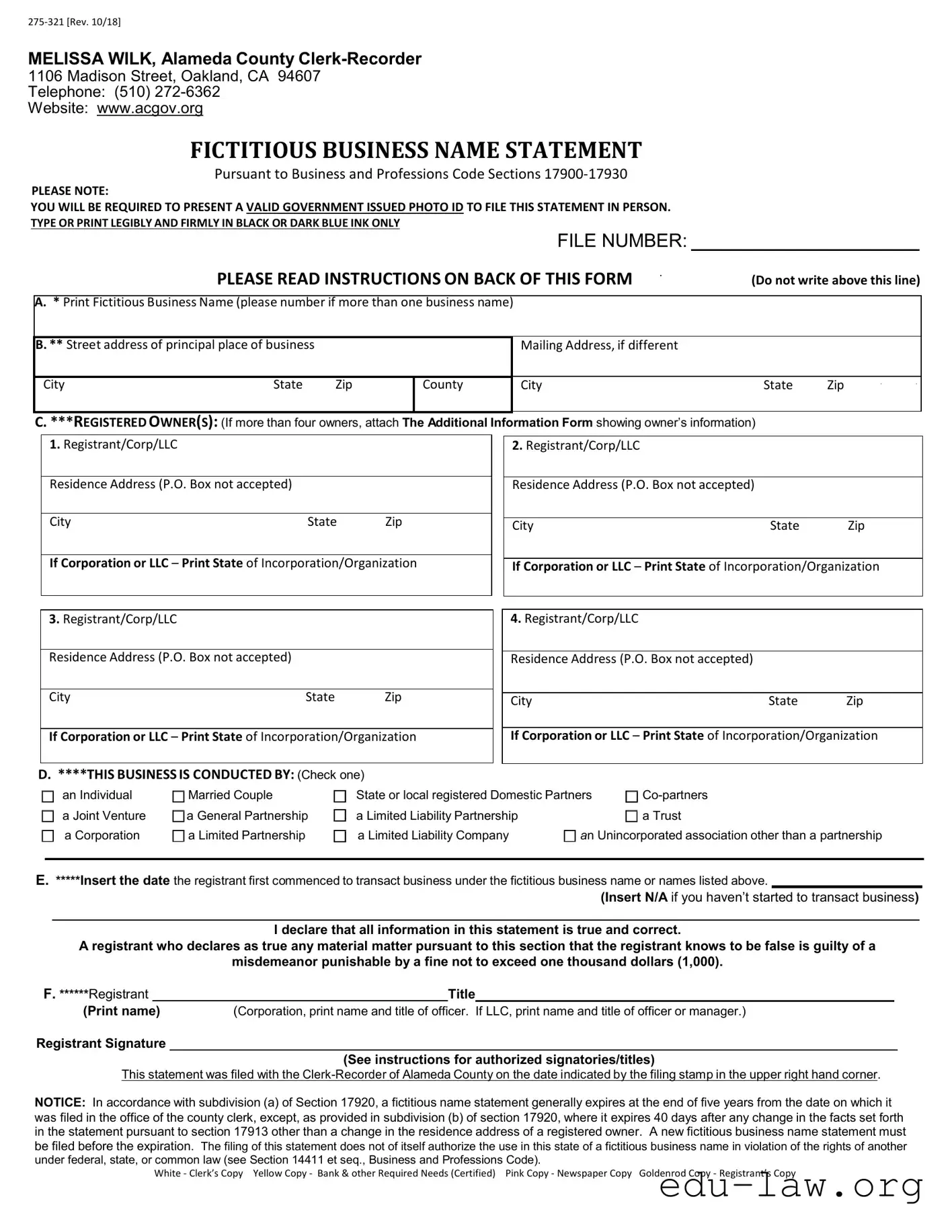
The Fictitious Business Name Statement form is an essential document for anyone looking to operate a business under a name that is not their own legal name. This form, filed with the county clerk's office, serves to inform the public of the identity of the business owner and the name under which the business operates. It requires specific information, including the fictitious business name, the principal business address, and the names and addresses of the registered owners. The form also necessitates a declaration regarding the nature of the business entity, whether it be an individual, partnership, corporation, or other forms of organization. Additionally, the registrant must indicate when they commenced business under the fictitious name and provide a signature affirming the accuracy of the information. Filing this statement is not only a legal requirement but also a step toward establishing credibility in the marketplace. It is important to note that the statement must be filed within 40 days of commencing business and must be renewed every five years to remain valid. Failure to comply with these requirements can lead to penalties, including fines for false statements. This form is a critical component in maintaining transparency and legality in business operations.
275‐321 [Rev. 10/18]
MELISSA WILK, Alameda County
1106 Madison Street, Oakland, CA 94607
Telephone: (510)
Website: www.acgov.org
FICTITIOUS BUSINESS NAME STATEMENT
Pursuant to Business and Professions Code Sections 17900‐17930
PLEASE NOTE:
YOU WILL BE REQUIRED TO PRESENT A VALID GOVERNMENT ISSUED PHOTO ID TO FILE THIS STATEMENT IN PERSON.
TYPE OR PRINT LEGIBLY AND FIRMLY IN BLACK OR DARK BLUE INK ONLY
|
FILE NUMBER: |
|
|
PLEASE READ INSTRUCTIONS ON BACK OF THIS FORM |
(Do not write above this line) |
||
|
|
|
|
A. * Print Fictitious Business Name (please number if more than one business name) |
|
|
|
|
|
|
|
B. ** Street address of principal place of business
City |
State |
Zip |
County |
|
|
|
|
Mailing Address, if different
City |
State |
Zip |
C. ***REGISTERED OWNER(S): (If more than four owners, attach The Additional Information Form showing owner’s information)
1.Registrant/Corp/LLC
Residence Address (P.O. Box not accepted)
City |
State |
Zip |
If Corporation or LLC – Print State of Incorporation/Organization
3.Registrant/Corp/LLC
Residence Address (P.O. Box not accepted)
City |
State |
Zip |
If Corporation or LLC – Print State of Incorporation/Organization
2.Registrant/Corp/LLC
Residence Address (P.O. Box not accepted)
City |
State |
Zip |
If Corporation or LLC – Print State of Incorporation/Organization
4.Registrant/Corp/LLC
Residence Address (P.O. Box not accepted)
City |
State |
Zip |
If Corporation or LLC – Print State of Incorporation/Organization
D. ****THIS BUSINESS IS CONDUCTED BY: (Check one)
|
|
an Individual |
|
Married Couple |
|
State or local registered Domestic Partners |
|
|
|||
|
|
a Joint Venture |
|
a General Partnership |
|
a Limited Liability Partnership |
|
|
|
|
a Trust |
|
|
|
|
|
|
|
|
||||
|
|
a Corporation |
|
a Limited Partnership |
|
a Limited Liability Company |
|
An Unincorporated association other than a partnership |
|||
|
|
|
|
|
|||||||
|
|
|
|
|
|
|
|
|
|
|
|
E.*****Insert the date the registrant first commenced to transact business under the fictitious business name or names listed above.
(Insert N/A if you haven’t started to transact business)
I declare that all information in this statement is true and correct.
A registrant who declares as true any material matter pursuant to this section that the registrant knows to be false is guilty of a
misdemeanor punishable by a fine not to exceed one thousand dollars (1,000).
F. ******Registrant |
|
Title |
|
||
(Print name) |
(Corporation, print name and title of officer. If LLC, print name and title of officer or manager.) |
|
|||
Registrant Signature |
|
|
|
|
|
|
|
(See instructions for authorized signatories/titles) |
|
||
This statement was filed with the
NOTICE: In accordance with subdivision (a) of Section 17920, a fictitious name statement generally expires at the end of five years from the date on which it was filed in the office of the county clerk, except, as provided in subdivision (b) of section 17920, where it expires 40 days after any change in the facts set forth in the statement pursuant to section 17913 other than a change in the residence address of a registered owner. A new fictitious business name statement must be filed before the expiration. The filing of this statement does not of itself authorize the use in this state of a fictitious business name in violation of the rights of another under federal, state, or common law (see Section 14411 et seq., Business and Professions Code).
White ‐ Clerk’s Copy Yellow Copy ‐ Bank & other Required Needs (Certified) Pink Copy ‐ Newspaper Copy Goldenrod Copy ‐ Registrant’s Copy
275‐321 [Rev. 10/18]
INSTRUCTIONS FOR COMPLETION OF FICTITIOUS BUSINESS NAME STATEMENT
THE INFORMATION BELOW IS NOT TO BE PUBLISHED (SEC. 17924, B&P)
REQUIREMENTS FOR FILING THE STATEMENT
Every person or entity who regularly transacts business in this state for profit using a fictitious business name shall file a fictitious business name (FBN) statement not later than 40 days from the date such business commences. The registrant shall file a new statement on or before the date of expiration of each FBN statement. The statement shall be filed in the county in which the principal place of business is located. If the principal place of business is outside this state, the statement shall be filed with the Clerk of Sacramento County.
CONTENTS OF THE STATEMENT (BUSINESS AND PROFESSIONS CODE SECTION 17913)
A. * Where one asterisk appears in the form:
(a)Insert the fictitious business name or names. (For additional business names use The Additional Information Form.)
(b)Only those businesses operated at the same address and under the same ownership may be listed on one statement.
(c)If the fictitious name includes Corporation, Corp, Incorporated, INC., PC, Limited Liability Company, LLP, or LLC, the registrant must also submit a state endorsed copy of the articles of incorporation or articles of organization for such name or for such registrant.
B.** Where two asterisks appear in the form:
(a)If the registrant has a place of business in this state, insert the street address and county of his or her principal place of business in this state.
(b)P.O. Box, postal drop box, mailing suite, or c/o addresses are not acceptable.
(c)If the registrant has no place of business in this state, insert the street address and county of his or her principal place of business outside this state and file with the Clerk of Sacramento County (B&P 17915).
PERSONS REQUIRED ON STATEMENT (BUSINESS AND PROFESSIONS CODE SECTION 17913)
C. *** Where three asterisks appear in the form:
(a)If the registrant is an individual, insert his or her full name and residence address.
(b)If the registrants are a married couple, insert the full name and residence address of both parties to the marriage.
(c)If the registrant is a general partnership,
(d)If the registrant is a limited partnership, insert the full name and residence address of each general partner.
(e)If the registrant is a limited liability company, insert the name and address of the limited liability company, as set out in its articles of organization on file with the CA Secretary of State, and the state of organization.
(f)If the registrant is a trust, insert the full name and residence address of each trustee
(g)If the registrant is a corporation, insert the name and address of the corporation, as set out in its articles of incorporation on file with the CA Secretary of State, and the state of incorporation.
(h)If the registrants are state or local registered domestic partners, insert the full name and residence address of each domestic partner.
D.**** Where four asterisks appear in the form:
(a)Check whichever of the terms listed on the front of the form best describes the nature of the business.
E.***** Where five asterisks appear in the form:
(a)Insert the date on which the registrant first commenced to transact business under the fictitious business name or names listed, if already transacting business under that name or names.
(b)Insert N/A if you have not yet commenced to transact business under the fictitious business name or names listed.
PERSONS REQUIRED TO SIGN STATEMENT (BUSINESS AND PROFESSIONS CODE SECTION 17914)
F. ****** Where six asterisk appears in the form:
The statement shall be signed as follows:
(a)If the registrant is an individual, by the individual.
(b)If the registrants are a married couple, by either party to the marriage.
(c)If the registrant is a general partnership, limited partnership, limited liability partnership,
(d)If the registrant is a limited liability company, by a manager or officer. (Ex: Managing Member, Member, or Principal)
(e)If the registrant is a trust, by a trustee.
(f)If the registrant is a corporation, by an officer. (Ex: CEO, President, Secretary, Treasurer, Vice President)
(g) If the registrant is a state or local registered domestic partnership, by one of the domestic partners.
PLACE OF FILING STATEMENT (BUSINESS AND PROFESSIONS CODE SECTION 17915)
The fictitious business name statement shall be filed with the clerk of the county in which the registrant has his or her principal place of business in this state or, if the registrant has no place of business in this state, with the Clerk of Sacramento County. Nothing in this chapter shall preclude a person from filing a fictitious business name statement in a county other than that where the principal place of business is located, as long as the requirements of this subdivision are also met.
PUBLICATION OF NOTICE (BUSINESS AND PROFESSIONS CODE SECTION 17917)
Publication for Original, New Filings (renewal with change in facts from previous filing), or Refile
(a)Within 30 days after a fictitious business name statement has been filed, the registrant shall cause it to be published in a newspaper of general circulation in the county where the fictitious business name statement was filed or, if there is no such newspaper in that county, in a newspaper of general circulation in an adjoining county. The publication must be once a week for four successive weeks and an affidavit of publication must be filed with the county clerk where the fictitious business name statement was filed within 30 days after the completion of the publication.
(b)If a refiling is required because the prior statement has expired, the refiling need not be published, unless there has been a change in the information required in the expired statement, provided the refiling is filed within 40 days of the date the statement expired.
EXPIRATION OF FICTITIOUS BUSINESS NAME STATEMENT (BUSINESS AND PROFESSIONS CODE SECTION 17920)
(a)Unless the statement expires earlier under (b) or (c) below, a fictitious business name statement expires five years from the date it was filed.
A NEW STATEMENT MUST BE FILED BEFORE THE EXPIRATION DATE.
(b)A fictitious business name statement expires 40 days after any change in the facts set forth in the statement, except (1) a change in the residence address of an individual, general partner, or trustee does not cause the statement to expire prior to the end of the five year term; and
(2)the filing of a statement of withdrawal from partnership by a withdrawing partner does not cause the statement to expire prior to the end of the five year term. A NEW STATEMENT MUST BE FILED WITHIN 40 DAYS AFTER A CHANGE IN THE FACTS.
(c)A fictitious business name statement expires when the registrant files a statement of abandonment of the fictitious business name described
in the statement.
PENALTY FOR EXECUTION, FILING OR PUBLICATION OF FALSE STATEMENT (BUSINESS AND PROFESSIONS CODE SECTION 17930)
Any person who executes, files, or publishes any statement under this chapter, knowing that such statement is false, in whole or in part, shall be guilty of a misdemeanor and upon conviction thereof shall be punished by a fine not to exceed one thousand dollars ($1,000).
| Fact Name | Details |
|---|---|
| Governing Law | This form is governed by the California Business and Professions Code Sections 17900-17930. |
| Filing Requirement | All businesses using a fictitious name must file this statement within 40 days of starting business. |
| Expiration Period | The statement expires five years after filing, unless there are changes in the business details. |
| Change Notification | A new statement must be filed within 40 days of any change in the information provided. |
| Photo ID Requirement | A valid government-issued photo ID is required to file the statement in person. |
| Publication Requirement | The statement must be published in a local newspaper within 30 days of filing. |
| Signature Requirement | The statement must be signed by the registrant or an authorized representative. |
| Address Requirement | P.O. Box addresses are not acceptable for the principal place of business. |
| Multiple Names | Multiple fictitious names can be listed, but they must be under the same ownership and address. |
| Penalty for False Statements | Filing false information can result in a misdemeanor and fines up to $1,000. |
Filling out the Fictitious Business Statement form is a straightforward process. It requires some basic information about your business and its owners. Make sure to have a valid government-issued photo ID ready if you plan to file in person. Follow these steps to complete the form accurately.
After completing the form, you will need to file it with the appropriate county clerk. Remember to publish a notice in a local newspaper within 30 days of filing. This is an important step to ensure your business name is recognized legally.
What is a Fictitious Business Name Statement?
A Fictitious Business Name Statement is a document that allows a person or business to operate under a name that is different from their legal name. This form is required in California for anyone who conducts business for profit under a fictitious name. It helps to inform the public about the true owners of a business.
Who needs to file a Fictitious Business Name Statement?
Anyone who regularly conducts business in California under a name that is not their own legal name must file this statement. This includes individuals, partnerships, corporations, and limited liability companies. If you have multiple business names, you need to list them all on the form.
How do I file a Fictitious Business Name Statement?
You can file the statement in person at the Clerk-Recorder's office in Alameda County. You will need to bring a valid government-issued photo ID. The form must be filled out clearly, using black or dark blue ink. If your principal place of business is outside California, you must file with the Clerk of Sacramento County.
What information is required on the form?
The form requires several pieces of information. You must provide the fictitious business name, the principal place of business address, and the names and addresses of the business owners. If you are a corporation or LLC, you also need to include the state of incorporation. Make sure to fill out all sections accurately.
What happens after I file the statement?
After filing, you must publish the statement in a newspaper of general circulation in the county where you filed. This must be done within 30 days of filing and should occur once a week for four consecutive weeks. You will need to submit an affidavit of publication to the county clerk after the publication is complete.
How long is the Fictitious Business Name Statement valid?
The statement is generally valid for five years from the date it is filed. However, if there are any changes to the information provided, such as a change in ownership or business address, you must file a new statement within 40 days of that change.
What are the penalties for providing false information?
Providing false information on the Fictitious Business Name Statement can lead to serious consequences. If a person knowingly files or publishes false information, they may be charged with a misdemeanor and face a fine of up to $1,000.
Where can I find more information or assistance?
For additional questions or assistance, you can contact the Alameda County Clerk-Recorder’s office at (510) 272-6362 or visit their website at www.acgov.org. They can provide guidance on completing the form and the filing process.
Illegible handwriting: Filling out the form in a way that is hard to read can lead to errors or rejection. Use black or dark blue ink and print clearly.
Incorrect address: Make sure to provide the correct street address of the principal place of business. P.O. Boxes are not acceptable.
Missing owner information: All registered owners must be listed. If there are more than four, attach an additional information form.
Failure to check the correct business type: Selecting the wrong option for the nature of the business can cause confusion and delays.
Not providing the commencement date: It's essential to include the date when the business began operating under the fictitious name. If you haven't started yet, write "N/A."
Improper signatures: Ensure the statement is signed by the correct person. An individual, partner, or officer must sign based on the business structure.
Filing in the wrong location: The statement must be filed in the county where the principal place of business is located. Double-check this before submitting.
Ignoring publication requirements: After filing, you must publish the statement in a local newspaper within 30 days. Failing to do so can lead to penalties.
Not updating the statement: If there are changes in the business information, a new statement must be filed within 40 days. This ensures compliance and avoids penalties.
When filing a Fictitious Business Name Statement, several other forms and documents may also be necessary to ensure compliance with local regulations. Below is a list of common documents that you might encounter during this process. Each serves a specific purpose in the business registration and operation framework.
Gathering these documents can streamline the process of establishing your business. Each document plays a crucial role in ensuring compliance and protecting your business interests. By being well-prepared, you can focus more on building your business and less on paperwork.
The Business License Application is a crucial document for any business operating within a specific jurisdiction. This application requires information about the business structure, ownership, and location. Similar to the Fictitious Business Statement, it ensures that local authorities are aware of businesses operating in their area. Both documents aim to promote transparency and accountability in business operations, helping to protect consumers and maintain regulatory standards.
The Assumed Name Registration is another document closely related to the Fictitious Business Statement. This registration allows a business to operate under a name that differs from its legal name. Like the Fictitious Business Statement, it requires the submission of the business name, owner's information, and sometimes a filing fee. Both documents serve the purpose of informing the public about the true ownership of a business and preventing misleading practices.
The Partnership Agreement outlines the terms and conditions under which partners operate a business together. While it is not filed with a government agency, it is essential for establishing the rights and responsibilities of each partner. Similar to the Fictitious Business Statement, it requires detailed information about the partners and the business operations. Both documents help clarify the business structure and protect the interests of all parties involved.
The Articles of Incorporation is a foundational document for corporations. It officially establishes a corporation's existence and includes important details such as the business name, purpose, and registered agent. Like the Fictitious Business Statement, it is filed with the state and requires accurate information to ensure compliance with legal requirements. Both documents are vital for maintaining transparency and legal standing in business operations.
The Operating Agreement is specific to Limited Liability Companies (LLCs) and outlines the management structure and operational procedures. This document is similar to the Fictitious Business Statement in that it must include details about ownership and management. Both documents aim to provide clarity on the business's operational framework, helping to avoid disputes among members.
The Trade Name Registration is another document that allows businesses to operate under a name that is not their legal name. This registration is similar to the Fictitious Business Statement in that it requires disclosure of the business owner’s identity and the name under which the business will operate. Both documents help to ensure that consumers can identify the true owners of a business, thereby enhancing trust and accountability.
The DBA (Doing Business As) Certificate is a document that businesses file to register their trade name. This certificate serves a similar purpose as the Fictitious Business Statement by providing public notice of the business's operating name. Both documents require the owner's name and address, ensuring that the public can easily find out who is behind a business operating under a fictitious name.
The Nonprofit Organization Registration is essential for any group looking to operate as a nonprofit entity. This registration requires detailed information about the organization’s purpose, structure, and governance. Similar to the Fictitious Business Statement, it aims to provide transparency and accountability, ensuring that the public is aware of the organization’s operations and leadership.
The Certificate of Good Standing is a document that verifies a business's compliance with state regulations. It is similar to the Fictitious Business Statement in that it confirms the legitimacy of a business entity. Both documents serve to assure customers, partners, and investors that the business is properly registered and in good standing with the appropriate authorities.
When filling out the Fictitious Business Name Statement form, it is essential to follow certain guidelines to ensure a smooth process. Here are six important dos and don'ts to keep in mind:
By adhering to these guidelines, you can help ensure that your Fictitious Business Name Statement is processed without unnecessary complications.
Understanding the Fictitious Business Statement form can be tricky, and there are several misconceptions that often arise. Here are nine common misunderstandings, along with clarifications to help clear things up.
By understanding these misconceptions, you can navigate the process of filing a Fictitious Business Statement more effectively. Always ensure that you have the correct information and follow the necessary steps to avoid any legal issues down the line.