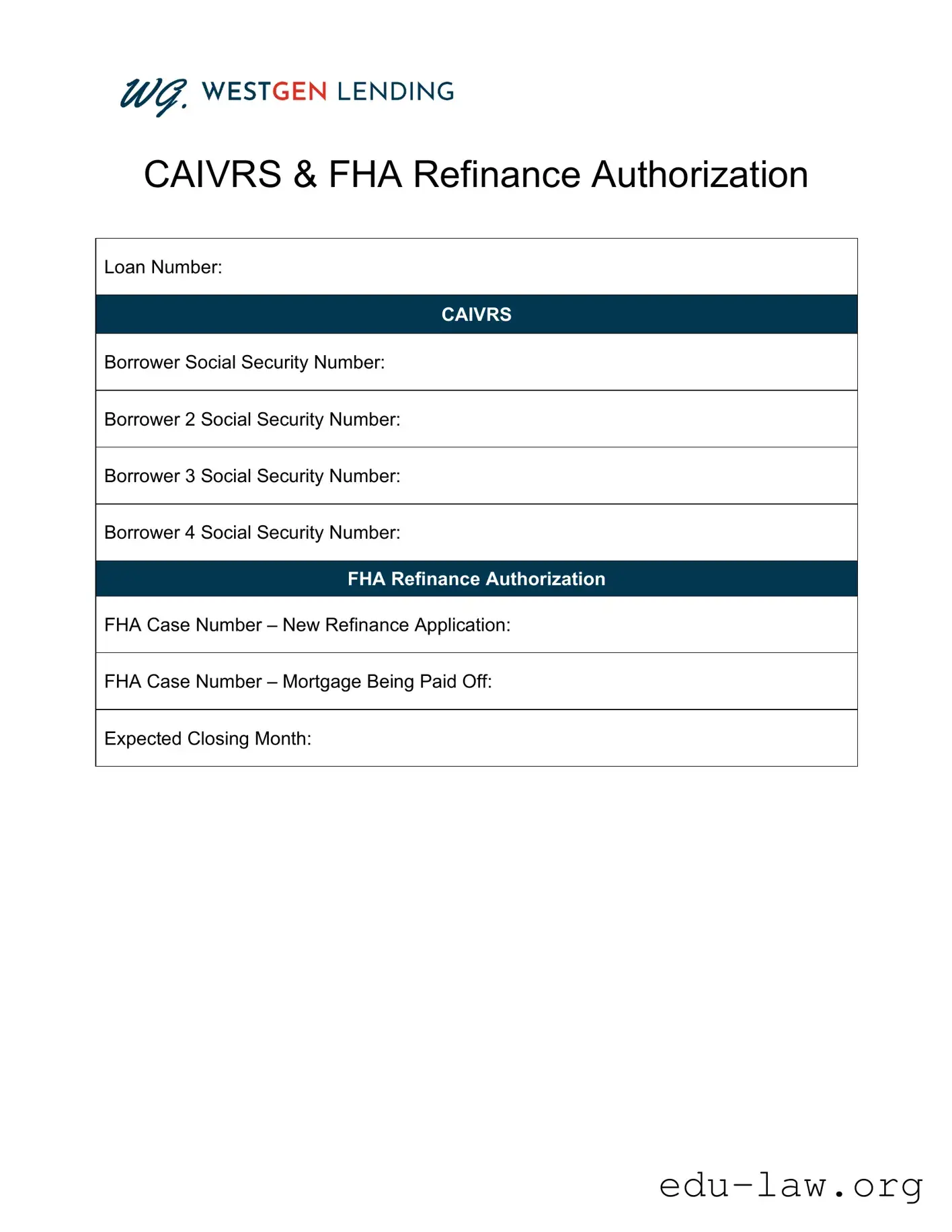
The FHA Refinance Authorization form plays a crucial role in the refinancing process for homeowners seeking to take advantage of Federal Housing Administration (FHA) loan programs. This form is essential for lenders to verify the borrower's eligibility and to ensure compliance with FHA guidelines. Key components include the loan number and various Social Security numbers for all borrowers involved. Additionally, the form requires FHA case numbers for both the new refinance application and the mortgage being paid off. It also captures the expected closing month, which helps in planning the refinancing timeline. By gathering this information, the form streamlines the process and helps to avoid delays, making it a vital document for anyone looking to refinance their FHA-backed mortgage.
CAIVRS & FHA Refinance Authorization
Loan Number:
CAIVRS
Borrower Social Security Number:
Borrower 2 Social Security Number:
Borrower 3 Social Security Number:
Borrower 4 Social Security Number:
FHA Refinance Authorization
FHA Case Number – New Refinance Application:
FHA Case Number – Mortgage Being Paid Off:
Expected Closing Month:
| Fact Name | Description |
|---|---|
| Loan Number | The FHA Refinance Authorization form requires a unique loan number for tracking purposes. |
| CAIVRS Requirement | Borrowers must be verified against the Credit Alert Verification Reporting System (CAIVRS) to ensure they are not in default on federal loans. |
| Social Security Numbers | The form requires the Social Security numbers of all borrowers involved in the refinance process. |
| FHA Case Numbers | Two FHA case numbers are necessary: one for the new refinance application and another for the mortgage being paid off. |
| Expected Closing Month | Borrowers must indicate the expected month for closing the refinance transaction, which is crucial for scheduling and processing. |
After completing the FHA Refinance Authorization form, you will submit it to your lender for processing. This form is essential for moving forward with your refinance application. Follow the steps below to ensure you fill it out correctly.
What is the FHA Refinance Authorization form?
The FHA Refinance Authorization form is a document that allows borrowers to authorize the use of their personal information for the purpose of refinancing an existing FHA loan. This form is necessary to initiate the refinancing process and to ensure that all parties involved have the necessary permissions to access relevant data.
Who needs to fill out the FHA Refinance Authorization form?
All borrowers involved in the refinance process must complete the FHA Refinance Authorization form. This includes primary borrowers as well as any co-borrowers. Each borrower must provide their Social Security number to facilitate the process.
What information is required on the form?
The form requires several pieces of information, including the loan number, Social Security numbers for all borrowers, the FHA case number for the new refinance application, the FHA case number for the mortgage being paid off, and the expected closing month.
Why is the CAIVRS information included in the form?
CAIVRS stands for the Credit Alert Verification Reporting System. This information is included to check if the borrower has any delinquent federal debts, which may affect their eligibility for refinancing. The lender uses this information to assess risk and compliance with FHA guidelines.
How does the FHA Refinance Authorization form affect my credit?
Filling out the FHA Refinance Authorization form itself does not directly affect your credit score. However, the refinancing process may involve a credit check, which can have a temporary impact on your credit score. Lenders will assess your creditworthiness based on the information provided in the form and other financial documents.
What happens after I submit the FHA Refinance Authorization form?
After submission, the lender will review the information provided on the form. They will verify the details, check CAIVRS, and begin processing your refinance application. The lender may reach out for additional information or documentation if needed.
Is there a deadline for submitting the FHA Refinance Authorization form?
While there is no specific deadline for submitting the form, it is advisable to complete it as soon as possible to avoid delays in the refinancing process. The timing of submission may also depend on the lender's requirements and the expected closing date.
Can I make changes to the FHA Refinance Authorization form after submission?
Once the FHA Refinance Authorization form is submitted, changes may be challenging. If you need to make corrections or updates, contact your lender immediately. They will guide you on the appropriate steps to take to ensure that your information is accurate.
What should I do if I have questions about the form?
If you have questions about the FHA Refinance Authorization form, it is best to consult your lender or a mortgage professional. They can provide specific guidance and clarify any concerns you may have regarding the form and the refinancing process.
Is there a fee associated with the FHA Refinance Authorization form?
There is typically no fee specifically for submitting the FHA Refinance Authorization form. However, refinancing may involve other costs, such as closing costs, appraisal fees, and lender fees. It is important to discuss these potential costs with your lender during the refinancing process.
Incorrect Loan Number: Borrowers often enter the wrong loan number. This can lead to delays or even denial of the refinance application.
Missing Social Security Numbers: Failing to provide all required Social Security numbers for all borrowers is a common mistake. Each borrower's information is essential for processing.
Incorrect FHA Case Numbers: Entering the wrong FHA case number for either the new refinance application or the mortgage being paid off can cause significant issues. Double-checking these numbers is crucial.
Omitting the Expected Closing Month: Some borrowers forget to fill in the expected closing month. This information helps lenders plan and process the application efficiently.
Inconsistent Information: Providing information that doesn’t match other documents can raise red flags. Consistency is key in all financial documents.
Not Reviewing the Form: Skipping a final review of the form before submission is a frequent error. A thorough check can catch mistakes that might otherwise lead to complications.
The FHA Refinance Authorization form is an essential document for anyone looking to refinance their mortgage through the Federal Housing Administration. However, it is often accompanied by several other forms and documents that help streamline the process and ensure all necessary information is collected. Below is a list of common documents you may encounter during this process.
Gathering these documents can seem overwhelming, but each one plays a crucial role in the refinancing process. By understanding what is needed, you can prepare effectively and move forward with confidence in your refinancing journey.
The FHA Refinance Authorization form shares similarities with the VA Loan Authorization form. Both documents serve as a means for borrowers to obtain approval for refinancing their existing loans. The VA Loan Authorization specifically caters to veterans and active-duty service members, ensuring that they can access favorable loan terms. Like the FHA form, it requires personal identification details, including Social Security numbers, and information regarding the loan being refinanced.
Another related document is the USDA Rural Development Loan Authorization form. This form is designed for borrowers seeking refinancing options through USDA programs. Similar to the FHA Refinance Authorization, it collects essential borrower information, including Social Security numbers and loan details. Both forms aim to facilitate the refinancing process while ensuring that borrowers meet specific eligibility criteria set forth by the respective programs.
The Conventional Loan Refinance Authorization form is also comparable. This document is used for refinancing conventional loans, which are not backed by government agencies. Like the FHA form, it requires the borrower to provide personal information and details about the existing mortgage. Both forms focus on verifying the borrower’s identity and the loan being refinanced to streamline the approval process.
The Home Equity Line of Credit (HELOC) Authorization form is another document with similar characteristics. Borrowers looking to tap into their home equity for refinancing purposes may use this form. It collects information about the borrower and the property, akin to the FHA Refinance Authorization. Both documents aim to assess the borrower’s financial situation and the property’s value to determine eligibility for refinancing options.
The Loan Modification Request form also bears resemblance to the FHA Refinance Authorization. While primarily aimed at modifying existing loan terms rather than refinancing, both forms require borrowers to disclose personal information and details about their current mortgage. Each document helps lenders assess the borrower’s financial circumstances and make informed decisions about loan adjustments.
The Mortgage Application form is another similar document. This form is utilized when applying for a new mortgage or refinancing an existing one. It requires comprehensive information about the borrower, including Social Security numbers and financial details. Like the FHA Refinance Authorization, the Mortgage Application seeks to gather necessary data to facilitate the loan process efficiently.
The Borrower’s Authorization for Credit Report form is closely related as well. This document allows lenders to obtain a credit report, which is crucial for evaluating a borrower’s creditworthiness. Similar to the FHA Refinance Authorization, it requires the borrower’s consent and personal information, ensuring that lenders have the necessary data to proceed with the refinancing process.
The Loan Estimate form is another document that aligns with the FHA Refinance Authorization. This form provides borrowers with a detailed estimate of the costs associated with their refinance. Both documents require information about the borrower and the loan, and they serve to inform the borrower of their financial obligations and options before finalizing the refinancing agreement.
The Closing Disclosure form is also relevant. This document outlines the final terms of the loan, including costs and fees, and is provided to the borrower before closing. Like the FHA Refinance Authorization, it requires detailed information about the borrower and the loan being refinanced. Both forms play a critical role in ensuring transparency and understanding of the financial commitments involved in refinancing.
Finally, the Debt-to-Income Ratio Calculation form can be considered similar. This document helps determine a borrower’s ability to manage monthly payments based on their income and debts. Like the FHA Refinance Authorization, it collects essential financial information to assess the borrower’s overall financial health and eligibility for refinancing options.
When filling out the FHA Refinance Authorization form, it's important to follow certain guidelines to ensure accuracy and compliance. Here are ten things to keep in mind:
When it comes to the FHA Refinance Authorization form, there are several common misconceptions that can lead to confusion. Understanding these misconceptions can help borrowers navigate the refinancing process more effectively.
This is not true. The form is designed for anyone looking to refinance their existing FHA loan, regardless of whether they are first-time buyers or not.
While the form is an important step in the refinancing process, it does not guarantee that the loan will be approved. Lenders will still evaluate the borrower's financial situation and creditworthiness.
Each borrower's situation is unique, and the information required may vary. For instance, multiple borrowers may need to provide their Social Security numbers, but the specific details can differ based on individual circumstances.
This misconception overlooks the fact that the FHA Refinance Authorization form is also necessary for certain stages of the refinancing process. It can be used to facilitate communication between lenders and borrowers throughout the loan's life.
When filling out the FHA Refinance Authorization form, it’s essential to pay attention to several key aspects. Here are the main takeaways: