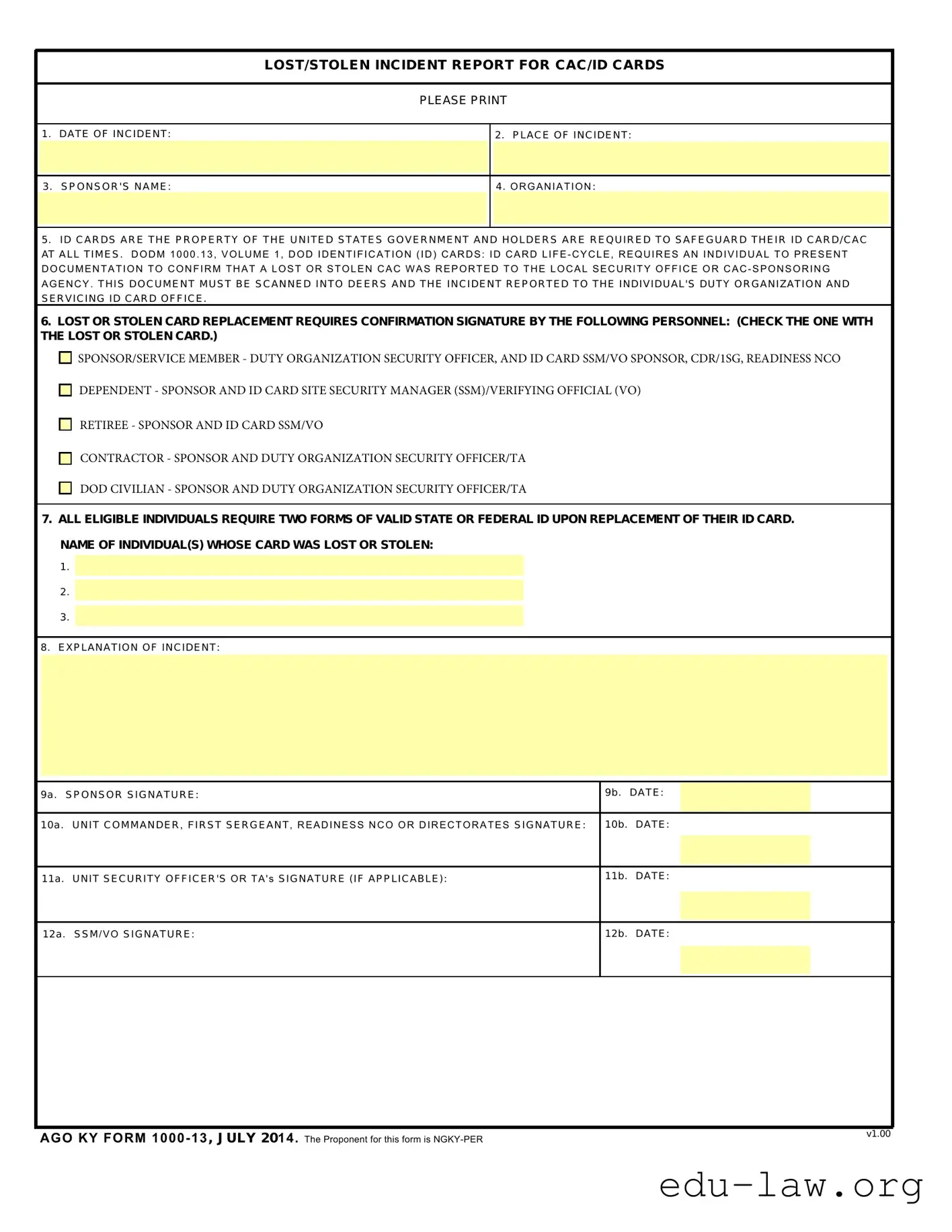
The FH 7006 form serves a crucial purpose in the realm of military identification and security. Designed specifically for reporting lost or stolen Common Access Cards (CAC) and ID cards, this form outlines a systematic approach to ensure that individuals promptly address such incidents. When a CAC or ID card goes missing, it is essential for the holder to report the incident to the appropriate authorities, including the local security office and the sponsoring agency. The form requires key details such as the date and place of the incident, the name of the sponsor, and the organization involved. Additionally, it emphasizes the importance of safeguarding these cards, which are considered property of the United States government. Replacing a lost or stolen card involves obtaining confirmation signatures from designated personnel, ensuring that proper protocols are followed. Eligible individuals must also present two forms of valid identification when seeking a replacement. This thorough process not only helps maintain security but also reinforces the responsibility of cardholders in managing their identification assets.

LOST/STOLEN INCIDENT REPORT FOR CAC/ID CARDS
PLEASE PRINT
1. DATE OF INCIDENT:
3 . SPONSOR'S NAME:
2. PLACE OF INCIDENT:
4 . ORGANIATION :
5 . ID CARDS ARE THE PROPERTY OF THE UNITED STATES GOVERNMENT AND HOLDERS ARE REQUIRED TO SAFEGUARD THEIR ID CARD/CAC
AT ALL TIMES . DODM 1000 . 13, VOLUME 1, DOD IDENTIFICATION (ID) CARDS: ID CARD LIFE - CYCLE, REQUIRES AN INDIVIDUAL TO PRESENT DOCUMENTATION TO CONFIRM THAT A LOST OR STOLEN CAC WAS REPORTED TO THE LOCAL SECURITY OFFICE OR CAC - SPONSORING AGENCY . THIS DOCUMENT MUST BE SCANNED INTO DEERS AND THE INCIDENT REPORTED TO THE INDIVIDUAL'S DUTY ORGANIZATION AND SERVICING ID CARD OFFICE.
6.LOST OR STOLEN CARD REPLACEMENT REQUIRES CONFIRMATION SIGNATURE BY THE FOLLOWING PERSONNEL: (CHECK THE ONE WITH THE LOST OR STOLEN CARD.)
SPONSOR/SERVICE MEMBER - DUTY ORGANIZATION SECURITY OFFICER, AND ID CARD SSM/VO SPONSOR, CDR/1SG, READINESS NCO DEPENDENT - SPONSOR AND ID CARD SITE SECURITY MANAGER (SSM)/VERIFYING OFFICIAL (VO)
RETIREE - SPONSOR AND ID CARD SSM/VO
CONTRACTOR - SPONSOR AND DUTY ORGANIZATION SECURITY OFFICER/TA
DOD CIVILIAN - SPONSOR AND DUTY ORGANIZATION SECURITY OFFICER/TA
7. ALL ELIGIBLE INDIVIDUALS REQUIRE TWO FORMS OF VALID STATE OR FEDERAL ID UPON REPLACEMENT OF THEIR ID CARD.
NAME OF INDIVIDUAL(S) WHOSE CARD WAS LOST OR STOLEN:
1.
2.
3.
8. EXPLANATION OF INCIDENT:
9a . SPONSOR SIGNATURE:
9b . DATE:
10a . UNIT COMMANDER , F IRST SERGEANT , READINESS NCO OR DIRECTORATES SIGNATURE:
10b. DATE:
11a. UNIT SECURITY OFFICER'S OR TA's SIGNATURE (IF APPLICABLE):
11b. DATE:
12a . SSM /VO SIGNATURE:
12b. DATE:
AGO KY FORM |
The Proponent for this form is |
v1.00 |
|
| Fact Name | Details |
|---|---|
| Purpose | The FH 7006 form is used to report lost or stolen Common Access Cards (CAC) and ID cards. |
| Date of Incident | Users must provide the date when the incident occurred, which is crucial for record-keeping. |
| Eligibility Requirements | Individuals replacing a lost or stolen card must present two forms of valid state or federal identification. |
| Signature Requirements | Replacement requests require signatures from specific personnel, including the sponsor and security officers. |
| Governing Law | This form is governed by DODM 1000.13, Volume 1, which outlines ID card lifecycle management. |
| Reporting Process | After reporting the loss to the local security office, the incident must be documented in the Defense Enrollment Eligibility Reporting System (DEERS). |
| Form Version | The current version of this form is AGO KY FORM 1000-13, dated July 2014. |
Filling out the Fh 7006 form is a straightforward process. This form is essential for reporting a lost or stolen ID card. After completing the form, it must be submitted to the appropriate authorities for processing. Ensure that all required signatures are obtained to facilitate the replacement of the ID card.
What is the FH 7006 form?
The FH 7006 form is an official document used to report lost or stolen Common Access Cards (CAC) or ID cards. It serves as an incident report that individuals must complete to notify relevant authorities about the loss or theft of their identification. The form ensures that proper documentation is in place for the replacement of the card and compliance with security protocols.
Who needs to fill out the FH 7006 form?
Any individual who has lost or had their CAC or ID card stolen must complete the FH 7006 form. This includes service members, dependents, retirees, contractors, and DOD civilians. Each category of individuals has specific requirements for completing the form, including signatures from sponsors or designated security personnel.
What information is required on the FH 7006 form?
The form requires several key pieces of information, including the date and place of the incident, the sponsor's name, and the organization associated with the individual. Additionally, it asks for an explanation of the incident, the names of individuals whose cards were lost or stolen, and various signatures from authorized personnel for verification and approval.
What should I do if my CAC or ID card is lost or stolen?
If your CAC or ID card is lost or stolen, you should immediately complete the FH 7006 form. After filling out the form, report the incident to your local security office or CAC-sponsoring agency. It is also important to inform your duty organization and servicing ID card office to ensure proper tracking and replacement of your identification.
What is required for replacing a lost or stolen ID card?
To replace a lost or stolen ID card, individuals must present the completed FH 7006 form along with two forms of valid state or federal identification. The form must be signed by the appropriate personnel, including the sponsor, security officer, and ID card site security manager or verifying official, depending on the individual's status.
How does the FH 7006 form ensure security?
The FH 7006 form is designed to maintain security by documenting the loss or theft of ID cards and requiring multiple signatures for verification. This process helps to prevent unauthorized use of lost or stolen cards and ensures that individuals are held accountable for safeguarding their identification. The documentation is also scanned into the Defense Enrollment Eligibility Reporting System (DEERS) for tracking purposes.
What happens if I do not report a lost or stolen card?
Failing to report a lost or stolen CAC or ID card can lead to security risks, including unauthorized access to sensitive information or facilities. Additionally, individuals may face disciplinary actions for not adhering to the requirements set forth by the Department of Defense. Reporting the incident promptly is crucial for protecting both personal and organizational security.
Where can I obtain the FH 7006 form?
The FH 7006 form can typically be obtained from your local security office or CAC-sponsoring agency. It may also be available online through official military or government websites. Ensure that you are using the most current version of the form to comply with all requirements.
Failing to provide the date of the incident accurately. This information is crucial for tracking and processing the report.
Omitting the place of incident. Without this detail, it can be challenging to assess the circumstances surrounding the loss or theft.
Not including the sponsor's name. This is essential for identifying who is responsible for the ID card.
Neglecting to check the appropriate box for the type of individual (e.g., sponsor, dependent, retiree, contractor, DOD civilian). This affects the processing of the replacement.
Forgetting to gather the required two forms of valid ID. All eligible individuals must present these documents for a successful replacement.
Leaving the explanation of the incident section blank or incomplete. Providing a clear account helps clarify the situation for the reviewing authority.
Not obtaining the necessary signatures from the sponsor, security officer, or other required personnel. Signatures validate the report and facilitate processing.
Submitting the form without the correct dates next to each signature. Accurate dates are important for record-keeping and verification purposes.
When dealing with a lost or stolen Common Access Card (CAC), several other forms and documents may be necessary to complete the process effectively. Each of these documents serves a specific purpose and helps ensure that all relevant information is accurately recorded and submitted. Below is a list of these essential forms and documents.
Gathering these documents alongside the FH 7006 form will streamline the process of replacing a lost or stolen CAC. Each piece plays a vital role in ensuring that the individual’s identity and eligibility are confirmed, maintaining security and compliance with regulations.
The DD Form 1172-2, Application for Identification Card/DEERS Enrollment, serves a similar purpose to the FH 7006 form by facilitating the issuance of identification cards for military dependents and retirees. This form collects essential information about the individual applying for the ID card, including personal details and the relationship to the service member. Like the FH 7006, it requires verification from the sponsor, ensuring that the ID card is issued to the rightful person. The emphasis on safeguarding the ID card remains consistent across both documents, highlighting the importance of security in military identification.
The SF 86, Questionnaire for National Security Positions, is another document that shares similarities with the FH 7006 form. While the SF 86 is primarily used for security clearance applications, it also emphasizes the importance of reporting any incidents related to personal identification and security. Both forms require detailed information about the individual and their circumstances, reinforcing the need for transparency and accountability. The SF 86, like the FH 7006, involves a verification process to ensure that the information provided is accurate and trustworthy.
The DD Form 214, Certificate of Release or Discharge from Active Duty, is crucial for veterans and has parallels with the FH 7006 in terms of documenting military service. While the DD Form 214 does not specifically address lost or stolen ID cards, it serves as an official record of a service member's time in the military. Both documents require signatures from authorized personnel to validate the information provided. The emphasis on maintaining accurate records is a common thread between these two forms, underscoring their significance in military administration.
The DA Form 31, Request and Authority for Leave, also shares a connection with the FH 7006 form in terms of documentation and approval processes. While the DA Form 31 is used for requesting leave, it requires similar verification from a chain of command. Both forms necessitate signatures from appropriate personnel to confirm the validity of the request or incident reported. The attention to detail and the need for proper authorization in both documents highlight the structured nature of military procedures.
The AF Form 1168, Statement of Suspected Offense, is relevant in situations where a lost or stolen ID card may involve potential misconduct. This form is used to report incidents and gather information about the circumstances surrounding them. Like the FH 7006, it requires detailed accounts of events and may involve multiple parties in the verification process. Both forms aim to maintain security and accountability within the military community, ensuring that incidents are documented and addressed appropriately.
The NAVMC 11869, Lost or Stolen Identification Card Report, is specifically designed for reporting lost or stolen military identification cards. This document parallels the FH 7006 in its focus on the incident reporting process and the need for verification from authorized personnel. Both forms emphasize the importance of safeguarding military identification and require individuals to provide supporting documentation. The streamlined process for reporting incidents in both documents reflects the military's commitment to maintaining security and integrity.
Lastly, the DD Form 250, Material Inspection and Receiving Report, while primarily used for logistics and material acceptance, shares a procedural similarity with the FH 7006. Both forms involve the verification of information and require signatures from responsible parties to confirm the accuracy of the reported details. The structured approach to documentation in both cases highlights the military's emphasis on accountability and proper record-keeping, ensuring that all actions are traceable and verifiable.
When filling out the FH 7006 form, it is essential to ensure accuracy and completeness. Here are some important guidelines to follow:
Following these guidelines will help streamline the process and ensure that your report is processed efficiently. Taking the time to fill out the form correctly can save you from potential complications later on.
Understanding the FH 7006 form is essential for anyone involved in the management of CAC or ID cards. However, several misconceptions can lead to confusion. Here are seven common misconceptions:
This form is applicable to all eligible individuals, including dependents, retirees, and contractors, who have lost or had their ID cards stolen.
It is mandatory to report a lost or stolen card to the local security office or CAC-sponsoring agency. Failure to do so can lead to security risks.
Documentation confirming the report of the lost or stolen card must be presented. This documentation is scanned into DEERS.
The sponsor or designated personnel can also report the incident, ensuring that proper procedures are followed.
All eligible individuals are required to present two forms of valid state or federal identification when replacing their ID card.
Each time a card is lost or stolen, a new FH 7006 form must be completed to document the incident and initiate the replacement process.
Confirmation signatures from the appropriate personnel are required for the replacement process, ensuring accountability and security.
Filling out and using the FH 7006 form is an important process for reporting lost or stolen CAC/ID cards. Here are some key takeaways to keep in mind: