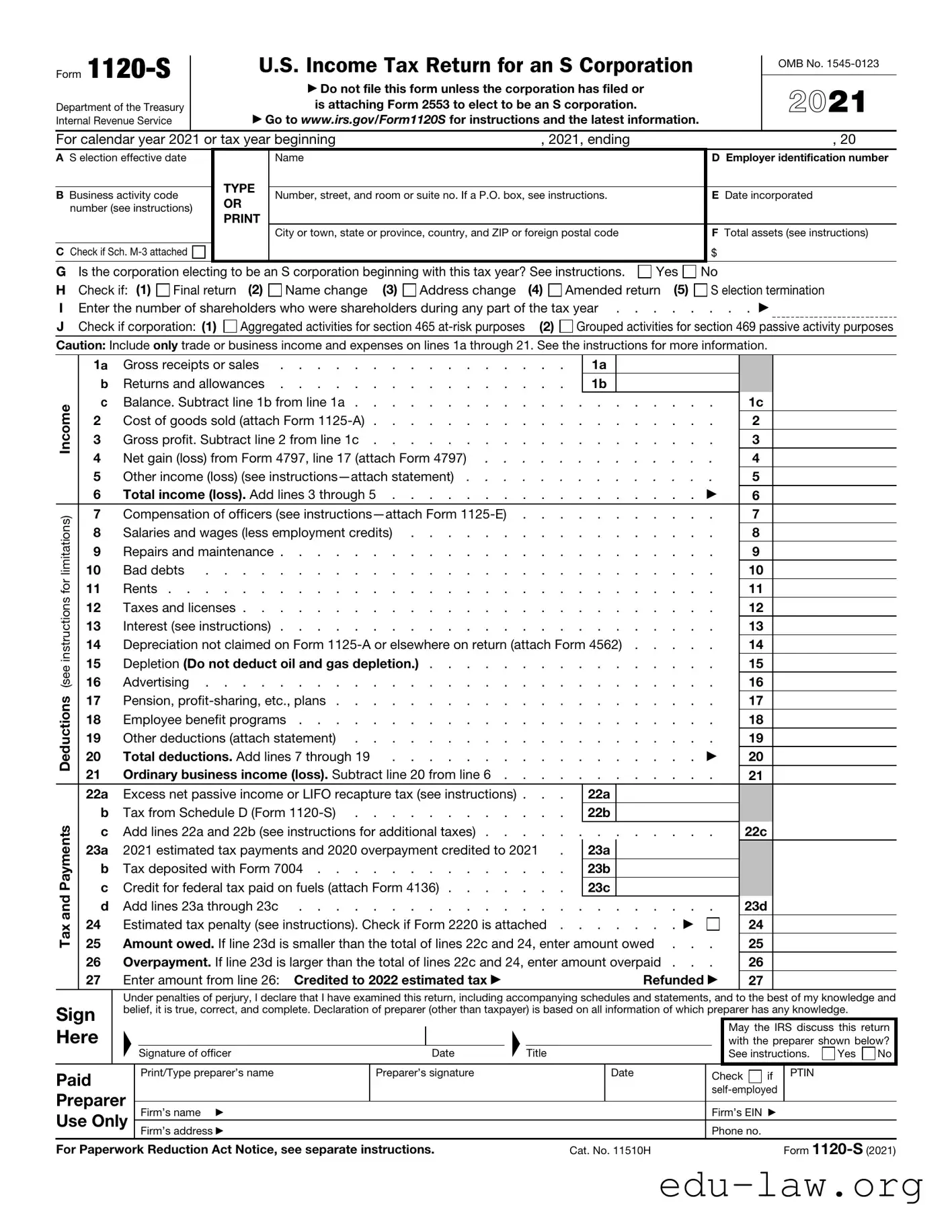
The Federal Supporting Form, specifically Form 1120-S, is essential for S corporations in the United States. This form allows these corporations to report their income, deductions, and other tax-related information to the Internal Revenue Service (IRS). To file this form, a corporation must first have submitted Form 2553, which is the election to be treated as an S corporation. The 1120-S captures various critical details, including the corporation's name, employer identification number, and business activity code. Additionally, it asks about the total assets and the number of shareholders. The form requires the corporation to detail its income and deductions, including gross receipts, cost of goods sold, and various expenses such as salaries, rents, and taxes. S corporations must also report any additional taxes and payments due, as well as any overpayments. Furthermore, the form includes schedules that provide further information about shareholders' pro-rata share items, balance sheets, and reconciliations of income. Completing this form accurately is crucial, as it ensures compliance with federal tax regulations and helps the IRS assess the corporation's tax liability.
Form |
|
|
|
|
|
U.S. Income Tax Return for an S Corporation |
|
|
OMB No. |
||||
|
|
|
|
|
|||||||||
|
|
|
|
|
|
|
|
|
|
|
|
|
|
|
|
|
|
|
|
|
|
▶ Do not file this form unless the corporation has filed or |
|
|
|
|
|
|
|
|
|
|
|
|
|
|
|
|
2021 |
||
Department of the Treasury |
|
|
|
|
|
|
is attaching Form 2553 to elect to be an S corporation. |
|
|
|
|||
Internal Revenue Service |
|
|
|
|
|
▶ Go to www.irs.gov/Form1120S for instructions and the latest information. |
|
|
|
||||
|
|
|
|
|
|
|
|
|
|
||||
For calendar year 2021 or tax year beginning |
, 2021, ending |
|
, 20 |
||||||||||
A S election effective date |
|
|
|
|
Name |
|
|
|
D Employer identification number |
||||
|
|
|
|
|
TYPE |
|
|
|
|
|
|
||
B |
Business activity code |
|
Number, street, and room or suite no. If a P.O. box, see instructions. |
|
|
E Date incorporated |
|||||||
|
OR |
|
|
|
|||||||||
|
number (see instructions) |
|
|
|
|
|
|
|
|
||||
|
|
|
|
|
|
|
|
||||||
|
|
|
|
|
|
|
|
|
|
|
|||
|
|
|
|
|
|
|
|
City or town, state or province, country, and ZIP or foreign postal code |
|
|
F Total assets (see instructions) |
||
|
|
|
|
|
|
|
|
|
|
|
|||
C Check if Sch. |
|
|
|
|
|
|
|
|
$ |
|
|||
G Is the corporation electing to be an S corporation beginning with this tax year? See instructions. |
Yes |
No |
|||||||||||
H |
Check if: (1) Final return |
|
(2) Name change (3) Address change |
(4) Amended return (5) |
|
S election termination |
|||||||
I |
Enter the number of shareholders who were shareholders during any part of the tax year |
|
. . . ▶ |
||||||||||
J |
Check if corporation: (1) |
|
Aggregated activities for section 465 |
(2) Grouped activities for section 469 passive activity purposes |
|||||||||
Caution: Include only trade or business income and expenses on lines 1a through 21. See the instructions for more information.
Tax and Payments Deductions (see instructions for limitations) Income
1a |
Gross receipts or sales |
|
1a |
|
|
|
|
|
|
b |
Returns and allowances |
|
1b |
|
|
|
|
|
|
c |
Balance. Subtract line 1b from line 1a |
. . . . . . . . |
1c |
|
|||||
2 |
Cost of goods sold (attach Form |
. . . . . . . . |
2 |
|
|||||
3 |
Gross profit. Subtract line 2 from line 1c |
. . . . . . . . |
3 |
|
|||||
4 |
Net gain (loss) from Form 4797, line 17 (attach Form 4797) |
. . . . . . . . |
4 |
|
|||||
5 |
Other income (loss) (see |
. . . . . . . . |
5 |
|
|||||
6 |
Total income (loss). Add lines 3 through 5 |
. . . . |
. |
. . |
▶ |
6 |
|
||
7 |
Compensation of officers (see |
. . . . . . . . |
7 |
|
|||||
8 |
Salaries and wages (less employment credits) |
. . . . . . . . |
8 |
|
|||||
9 |
Repairs and maintenance |
. . . . . . . . |
9 |
|
|||||
10 |
Bad debts |
. . . . . . . . |
10 |
|
|||||
11 |
Rents |
. . . . . . . . |
11 |
|
|||||
12 |
Taxes and licenses |
. . . . . . . . |
12 |
|
|||||
13 |
Interest (see instructions) |
. . . . . . . . |
13 |
|
|||||
14 |
Depreciation not claimed on Form |
14 |
|
||||||
15 |
Depletion (Do not deduct oil and gas depletion.) |
. . . . . . . . |
15 |
|
|||||
16 |
Advertising |
. . . . . . . . |
16 |
|
|||||
17 |
Pension, |
. . . . . . . . |
17 |
|
|||||
18 |
Employee benefit programs |
. . . . . . . . |
18 |
|
|||||
19 |
Other deductions (attach statement) |
. . . . . . . . |
19 |
|
|||||
20 |
Total deductions. Add lines 7 through 19 |
. . . . |
. |
. . |
▶ |
20 |
|
||
21 |
Ordinary business income (loss). Subtract line 20 from line 6 . . . . |
. . . . . . . . |
21 |
|
|||||
22a |
Excess net passive income or LIFO recapture tax (see instructions) . . . |
|
22a |
|
|
|
|
|
|
b |
Tax from Schedule D (Form |
|
22b |
|
|
|
|
|
|
c |
Add lines 22a and 22b (see instructions for additional taxes) |
. . . . . . . . |
22c |
|
|||||
23a |
2021 estimated tax payments and 2020 overpayment credited to 2021 . |
|
23a |
|
|
|
|
|
|
b |
Tax deposited with Form 7004 |
|
23b |
|
|
|
|
|
|
c |
Credit for federal tax paid on fuels (attach Form 4136) |
|
23c |
|
|
|
|
|
|
d |
Add lines 23a through 23c |
. . . . . . . . |
23d |
|
|||||
24 |
Estimated tax penalty (see instructions). Check if Form 2220 is attached . |
. . . . |
. |
. ▶ |
|
24 |
|
||
25 |
Amount owed. If line 23d is smaller than the total of lines 22c and 24, enter amount owed . . . |
25 |
|
||||||
26 |
Overpayment. If line 23d is larger than the total of lines 22c and 24, enter amount overpaid . . . |
26 |
|
||||||
27 |
Enter amount from line 26: Credited to 2022 estimated tax ▶ |
|
|
|
Refunded ▶ |
27 |
|
||
|
|
|
|
|
|
|
|
|
|
Sign Here
Under penalties of perjury, I declare that I have examined this return, including accompanying schedules and statements, and to the best of my knowledge and belief, it is true, correct, and complete. Declaration of preparer (other than taxpayer) is based on all information of which preparer has any knowledge.
▲ |
|
|
▲ |
|
|
May the IRS discuss this return |
||
|
|
|
||||||
|
|
|
|
with the preparer shown below? |
||||
Signature of officer |
Date |
Title |
|
See instructions. |
Yes |
No |
||
|
|
|
|
|
|
|
|
|
Paid |
Print/Type preparer’s name |
Preparer’s signature |
|
Date |
Check |
if |
PTIN |
|
|
|
|
|
|
|
|||
|
|
|
|
|
|
|
||
Preparer |
|
|
|
|
|
|
||
|
|
|
|
|
|
|
|
|
Firm’s name ▶ |
|
|
|
Firm’s EIN ▶ |
|
|
||
Use Only |
|
|
|
|
|
|||
Firm’s address ▶ |
|
|
|
Phone no. |
|
|
|
|
|
|
|
|
|
|
|
||
For Paperwork Reduction Act Notice, see separate instructions. |
Cat. No. 11510H |
|
|
Form |
|
|||
Form |
Page 2 |
|
Schedule B |
|
Other Information (see instructions) |
1 Check accounting method: a |
Cash |
b |
Accrual |
c Other (specify) ▶
2 See the instructions and enter the:
a Business activity ▶ |
b Product or service ▶ |
3At any time during the tax year, was any shareholder of the corporation a disregarded entity, a trust, an estate, or a nominee or similar person? If “Yes,” attach Schedule
4At the end of the tax year, did the corporation:
aOwn directly 20% or more, or own, directly or indirectly, 50% or more of the total stock issued and outstanding of any foreign or domestic corporation? For rules of constructive ownership, see instructions. If “Yes,” complete (i) through (v)
below . . . . . . . . . . . . . . . . . . . . . . . . . . . . . . . . . . . .
Yes No
(i)Name of Corporation
(ii)Employer Identification
Number (if any)
(iii)Country of Incorporation
(iv)Percentage of Stock Owned
(v)If Percentage in (iv) Is 100%, Enter the Date (if applicable) a Qualified Subchapter
S Subsidiary Election Was Made
bOwn directly an interest of 20% or more, or own, directly or indirectly, an interest of 50% or more in the profit, loss, or capital in any foreign or domestic partnership (including an entity treated as a partnership) or in the beneficial interest of a trust? For rules of constructive ownership, see instructions. If “Yes,” complete (i) through (v) below . . . . . . .
(i)Name of Entity
(ii)Employer Identification
Number (if any)
(iii)Type of Entity
(iv)Country of Organization
(v)Maximum Percentage Owned in Profit, Loss, or Capital
5a At the end of the tax year, did the corporation have any outstanding shares of restricted stock? . . . . . . . .
If “Yes,” complete lines (i) and (ii) below.
(i) |
Total shares of restricted stock |
▶ |
(ii) |
Total shares of |
▶ |
bAt the end of the tax year, did the corporation have any outstanding stock options, warrants, or similar instruments? . If “Yes,” complete lines (i) and (ii) below.
(i) |
Total shares of stock outstanding at the end of the tax year |
. ▶ |
(ii)Total shares of stock outstanding if all instruments were executed ▶
6Has this corporation filed, or is it required to file, Form 8918, Material Advisor Disclosure Statement, to provide
|
information on any reportable transaction? |
. . . . . . . . . . . . . . . . . . . . . . . . |
7 |
Check this box if the corporation issued publicly offered debt instruments with original issue discount . . . . ▶ |
|
|
If checked, the corporation may have to file Form 8281, Information Return for Publicly Offered Original Issue Discount |
|
|
Instruments. |
|
8If the corporation (a) was a C corporation before it elected to be an S corporation or the corporation acquired an asset with a basis determined by reference to the basis of the asset (or the basis of any other property) in the hands of a C corporation, and
(b) has net unrealized
gain reduced by net recognized
9Did the corporation have an election under section 163(j) for any real property trade or business or any farming business
in effect during the tax year? See instructions . . . . . . . . . . . . . . . . . . . . . . . .
10 Does the corporation satisfy one or more of the following? See instructions . . . . . . . . . . . . . .
aThe corporation owns a
bThe corporation’s aggregate average annual gross receipts (determined under section 448(c)) for the 3 tax years preceding the current tax year are more than $26 million and the corporation has business interest expense.
cThe corporation is a tax shelter and the corporation has business interest expense.
If “Yes,” complete and attach Form 8990.
11 Does the corporation satisfy both of the following conditions? . . . . . . . . . . . . . . . . . .
aThe corporation’s total receipts (see instructions) for the tax year were less than $250,000.
bThe corporation’s total assets at the end of the tax year were less than $250,000. If “Yes,” the corporation is not required to complete Schedules L and
Form

Form |
Page 3 |
|
Schedule B |
Other Information (see instructions) (continued) |
Yes No |
12During the tax year, did the corporation have any
terms modified so as to reduce the principal amount of the debt? . . . . . . . . . . . . . . . . .
If “Yes,” enter the amount of principal reduction . . . . . . . . . . . . . . ▶ $
13During the tax year, was a qualified subchapter S subsidiary election terminated or revoked? If “Yes,” see instructions .
14a Did the corporation make any payments in 2021 that would require it to file Form(s) 1099? |
|
|||||||||||
b |
If “Yes,” did the corporation file or will it file required Form(s) 1099? |
|
||||||||||
15 |
Is the corporation attaching Form 8996 to certify as a Qualified Opportunity Fund? |
|||||||||||
|
If “Yes,” enter the amount from Form 8996, line 15 |
. . . . ▶ $ |
|
|
|
|
||||||
Schedule K |
Shareholders’ Pro Rata Share Items |
|
|
|
|
|
|
|
Total amount |
|||
|
|
1 |
Ordinary business income (loss) (page 1, line 21) |
. . . . . . |
. . |
1 |
|
|
||||
|
|
2 |
Net rental real estate income (loss) (attach Form 8825) |
. . . . . . |
. . |
2 |
|
|
||||
|
|
3a |
Other gross rental income (loss) |
|
3a |
|
|
|
|
|
||
|
|
b |
Expenses from other rental activities (attach statement) |
. . . . |
|
3b |
|
|
|
|
|
|
|
|
c |
Other net rental income (loss). Subtract line 3b from line 3a . . . |
. . . . . . |
. . |
3c |
|
|||||
(Loss) |
|
4 |
Interest income |
. . . . . . |
. . |
4 |
|
|
||||
|
5 |
Dividends: a Ordinary dividends |
. . . . . . |
. . |
5a |
|
|
|||||
|
|
|
||||||||||
Income |
|
|
b Qualified dividends |
|
5b |
|
|
|
|
|
||
|
6 |
Royalties |
. . . . . . |
. . |
6 |
|
|
|||||
|
|
|
|
|||||||||
|
|
7 |
Net |
. . . . . . |
. . |
7 |
|
|
||||
|
|
8a |
Net |
. . . . . . |
. . |
8a |
|
|||||
|
|
b |
Collectibles (28%) gain (loss) |
|
8b |
|
|
|
|
|
||
|
|
c |
Unrecaptured section 1250 gain (attach statement) |
|
8c |
|
|
|
|
|
||
|
|
9 |
Net section 1231 gain (loss) (attach Form 4797) |
. . . . . . |
. . |
9 |
|
|
||||
|
|
10 |
Other income (loss) (see instructions) . . . |
Type ▶ |
|
|
|
|
|
10 |
|
|
Deductions |
|
11 |
Section 179 deduction (attach Form 4562) |
. . . . . . |
. . |
11 |
|
|
||||
|
12a |
Charitable contributions |
. . . . . . |
. . |
12a |
|
|
|||||
|
|
|
||||||||||
|
|
b |
Investment interest expense |
. . . . . . |
. . |
12b |
|
|||||
|
|
c |
Section 59(e)(2) expenditures |
Type ▶ |
|
|
|
|
|
12c |
|
|
|
|
d |
Other deductions (see instructions) . . . . |
Type ▶ |
|
|
|
|
|
12d |
|
|
|
|
13a |
. . . . . . |
. . |
13a |
|
||||||
|
|
b |
. . . . . . |
. . |
13b |
|
||||||
Credits |
|
c |
Qualified rehabilitation expenditures (rental real estate) (attach Form 3468, if applicable) |
. . |
13c |
|
||||||
|
d |
Other rental real estate credits (see instructions) |
Type ▶ |
|
|
|
|
|
13d |
|
|
|
|
|
|
|
|
|
|
|
|||||
|
|
e |
Other rental credits (see instructions) . . . |
Type ▶ |
|
|
|
|
|
13e |
|
|
|
|
f |
Biofuel producer credit (attach Form 6478) |
. . . . . . |
. . |
13f |
|
|||||
|
|
g |
Other credits (see instructions) |
Type ▶ |
|
|
|
|
|
13g |
|
|
International Transactions |
|
14 |
Attach Schedule |
|
|
|
||||||
|
|
|
|
|
||||||||
|
|
|
check this box to indicate you are reporting items of international tax relevance . . . |
▶ |
|
|
|
|||||
|
|
|
|
|
|
|
|
|||||
Alternative MinimumTax Items(AMT) |
15a |
. . . . . . |
. . |
15a |
|
|||||||
b |
Adjusted gain or loss |
. . . . . . |
. . |
15b |
|
|||||||
c |
Depletion (other than oil and gas) |
. . . . . . |
. . |
15c |
|
|
||||||
|
|
|
||||||||||
|
|
d |
Oil, gas, and geothermal |
. . . . . . |
. . |
15d |
|
|||||
|
|
e |
Oil, gas, and geothermal |
. . . . . . |
. . |
15e |
|
|||||
|
|
f |
Other AMT items (attach statement) |
. . . . . . |
. . |
15f |
|
|||||
ItemsAffecting ShareholderBasis |
|
16a |
. . . . . . |
. . |
16a |
|
||||||
|
f |
Foreign taxes paid or accrued |
. . . . . . |
. . |
16f |
|
||||||
|
|
b |
Other |
. . . . . . |
. . |
16b |
|
|||||
|
|
c |
Nondeductible expenses |
. . . . . . |
. . |
16c |
|
|||||
|
|
d |
Distributions (attach statement if required) (see instructions) . . . |
. . . . . . |
. . |
16d |
|
|||||
|
|
e |
Repayment of loans from shareholders |
. . . . . . |
. . |
16e |
|
|||||
|
|
|
|
|
|
|
|
|
|
|
|
|
|
|
|
|
|
|
|
|
|
|
|
Form |
|

Form |
|
|
Page 4 |
|||
Schedule K |
|
Shareholders’ Pro Rata Share Items (continued) |
|
Total amount |
||
|
Information |
17a |
Investment income |
17a |
||
Other |
d |
Other items and amounts (attach statement) |
|
|
||
|
|
b |
Investment expenses |
17b |
||
|
|
c |
Dividend distributions paid from accumulated earnings and profits |
17c |
||
|
|
|
|
|
|
|
Recon- |
ciliation |
18 |
|
Income (loss) reconciliation. Combine the amounts on lines 1 through 10 in the far right |
|
|
|
|
|
|
|
||
|
|
|
|
column. From the result, subtract the sum of the amounts on lines 11 through 12d and 16f . |
18 |
|
Schedule L |
Balance Sheets per Books |
|
Beginning of tax year |
|
|
End of tax year |
|||||
|
|
Assets |
|
(a) |
|
(b) |
|
(c) |
|
|
(d) |
1 |
Cash |
|
|
|
|
|
|
|
|
|
|
2a |
Trade notes and accounts receivable . . . |
|
|
|
|
|
|
|
|
|
|
b |
Less allowance for bad debts |
( |
|
) |
|
|
( |
) |
|
|
|
3 |
Inventories |
|
|
|
|
|
|
|
|
|
|
4 |
U.S. government obligations |
|
|
|
|
|
|
|
|
|
|
5 |
|
|
|
|
|
|
|
|
|
||
6 |
Other current assets (attach statement) . . . |
|
|
|
|
|
|
|
|
|
|
7 |
Loans to shareholders |
|
|
|
|
|
|
|
|
|
|
8 |
Mortgage and real estate loans |
|
|
|
|
|
|
|
|
|
|
9 |
Other investments (attach statement) . . . |
|
|
|
|
|
|
|
|
|
|
10a |
Buildings and other depreciable assets . . . |
|
|
|
|
|
|
|
|
|
|
b |
Less accumulated depreciation |
( |
|
) |
|
|
( |
) |
|
|
|
11a |
Depletable assets |
|
|
|
|
|
|
|
|
|
|
b |
Less accumulated depletion |
( |
|
) |
|
|
( |
) |
|
|
|
12 |
Land (net of any amortization) |
|
|
|
|
|
|
|
|
|
|
13a |
Intangible assets (amortizable only) . . . . |
|
|
|
|
|
|
|
|
|
|
b |
Less accumulated amortization |
( |
|
) |
|
|
( |
) |
|
|
|
14 |
Other assets (attach statement) |
|
|
|
|
|
|
|
|
|
|
15 |
Total assets |
|
|
|
|
|
|
|
|
|
|
|
Liabilities and Shareholders’ Equity |
|
|
|
|
|
|
|
|
|
|
16 |
Accounts payable |
|
|
|
|
|
|
|
|
|
|
17 |
Mortgages, notes, bonds payable in less than 1 year |
|
|
|
|
|
|
|
|
|
|
18 |
Other current liabilities (attach statement) . . |
|
|
|
|
|
|
|
|
|
|
19 |
Loans from shareholders |
|
|
|
|
|
|
|
|
|
|
20 |
Mortgages, notes, bonds payable in 1 year or more |
|
|
|
|
|
|
|
|
|
|
21 |
Other liabilities (attach statement) . . . . |
|
|
|
|
|
|
|
|
|
|
22 |
Capital stock |
|
|
|
|
|
|
|
|
|
|
23 |
Additional |
|
|
|
|
|
|
|
|
|
|
24 |
Retained earnings |
|
|
|
|
|
|
|
|
|
|
25 |
Adjustments to shareholders’ equity (attach statement) |
|
|
|
|
|
|
|
|
|
|
26 |
Less cost of treasury stock |
|
|
|
( |
) |
|
|
( |
) |
|
27 |
Total liabilities and shareholders’ equity . . |
|
|
|
|
|
|
|
|
|
|
|
|
|
|
|
|
|
|
|
|
|
Form |

Form |
Page 5 |
|
Schedule |
Reconciliation of Income (Loss) per Books With Income (Loss) per Return |
|
Note: The corporation may be required to file Schedule
1 |
Net income (loss) per books . . . . |
|
|
5 |
|
Income recorded on books this year |
|
|
|||
2 |
Income included on Schedule K, lines 1, 2, |
|
|
|
|
not included on Schedule K, lines 1 |
|
|
|||
|
|
|
|
through 10 (itemize): |
|
|
|
||||
|
3c, 4, 5a, 6, 7, 8a, 9, and 10, not recorded |
|
|
|
|
|
|
|
|||
|
|
|
|
|
|
|
|
|
|
||
|
on books this year (itemize) |
|
|
a |
|
|
|
|
|||
3 |
Expenses recorded on books this year |
|
|
6 |
|
Deductions included on Schedule K, |
|
|
|||
|
|
|
|
|
|||||||
|
not included on Schedule K, lines 1 |
|
|
|
|
lines 1 through 12 and 16f, not charged |
|
|
|||
|
through 12 and 16f (itemize): |
|
|
|
|
against book income this year (itemize): |
|
|
|||
a |
Depreciation $ |
|
|
a |
|
Depreciation $ |
|
|
|
||
b |
Travel and entertainment $ |
|
|
7 |
|
Add lines 5 and 6 |
|
|
|||
|
|
|
|
|
|||||||
|
|
|
|
|
8 Income (loss) (Schedule K, line 18). |
|
|
||||
4 |
Add lines 1 through 3 |
|
|
|
|
Subtract line 7 from line 4 . . . . |
|
|
|||
Schedule |
Analysis of Accumulated Adjustments Account, Shareholders’ Undistributed Taxable Income |
|
|||||||||
|
|
Previously Taxed, Accumulated Earnings and Profits, and Other Adjustments Account |
|
||||||||
|
|
(see instructions) |
|
|
|
|
|
|
|
|
|
|
|
|
|
|
|
|
|
|
|
|
|
|
|
|
|
(a) Accumulated |
|
(b) Shareholders’ |
|
(c) Accumulated |
(d) Other adjustments |
|
|
|
|
|
|
adjustments account |
|
undistributed taxable |
|
earnings and profits |
account |
|
|
|
|
|
|
|
|
|
income previously taxed |
|
|
|
|
1 |
Balance at beginning of tax year |
|
|
|
|
|
|
|
|
||
|
|
|
|
|
|
|
|
||||
2 |
Ordinary income from page 1, line 21 . . . |
|
|
|
|
|
|
|
|
||
3 |
Other additions |
|
|
|
|
|
|
|
|
||
4 |
Loss from page 1, line 21 |
( |
|
) |
|
|
|
|
|
||
5 |
Other reductions |
( |
|
) |
|
|
|
( |
) |
||
6 |
Combine lines 1 through 5 |
|
|
|
|
|
|
|
|
||
7 |
Distributions |
|
|
|
|
|
|
|
|
||
8 |
Balance at end of tax year. Subtract line 7 from |
|
|
|
|
|
|
|
|
||
|
line 6 |
|
|
|
|
|
|
|
|
||
|
|
|
|
|
|
|
|
|
|
Form |
|
| Fact Name | Description |
|---|---|
| Form Purpose | This form is used to report income, deductions, and other tax-related information for S Corporations in the United States. |
| Eligibility Requirement | The corporation must have filed or be attaching Form 2553 to elect to be treated as an S Corporation. |
| Filing Deadline | Form 1120-S must be filed by the 15th day of the third month after the end of the corporation's tax year. |
| Shareholder Information | The form requires details about shareholders, including the number of shareholders during the tax year. |
| Income Reporting | Only trade or business income and expenses should be reported on the form, excluding personal income. |
| State-Specific Forms | States may have their own forms and requirements, governed by respective state laws. Always check local regulations. |
Filling out the Federal Supporting Form 1120-S requires careful attention to detail and accurate information. This form is essential for S Corporations to report their income, deductions, and other relevant information for the tax year. Below are the steps to successfully complete the form.
What is the Federal Supporting Form?
The Federal Supporting Form, specifically Form 1120-S, is the U.S. Income Tax Return for an S Corporation. It is used by S corporations to report income, deductions, and credits to the IRS. This form should only be filed if the corporation has already filed or is attaching Form 2553 to elect S corporation status.
Who needs to file Form 1120-S?
Any corporation that has elected to be treated as an S corporation must file Form 1120-S. This includes corporations that have filed Form 2553 to make the S election. If the corporation has not made this election, it should not file this form.
What information is required on Form 1120-S?
Form 1120-S requires various pieces of information, including the corporation's name, employer identification number, business activity code, total assets, and the number of shareholders. Additionally, it requires detailed income and deduction information, including gross receipts, compensation of officers, and other expenses.
When is Form 1120-S due?
Form 1120-S is generally due on the 15th day of the third month after the end of the corporation's tax year. For calendar year filers, this typically means the due date is March 15. If this date falls on a weekend or holiday, the due date is the next business day.
What happens if Form 1120-S is filed late?
If Form 1120-S is filed late, the corporation may face penalties. The IRS typically imposes a penalty for each month the return is late, up to a maximum amount. To avoid penalties, it’s best to file on time or request an extension if needed.
Can I amend Form 1120-S after it has been filed?
Yes, you can amend Form 1120-S by filing Form 1120-SX. This is necessary if you need to correct errors or make changes to previously reported information. Make sure to follow the instructions carefully when filing an amendment.
What is the significance of Schedule K on Form 1120-S?
Schedule K is an important part of Form 1120-S. It reports the shareholders' pro-rata share of income, deductions, and credits. This information is crucial for shareholders as it affects their individual tax returns. Each shareholder receives a Schedule K-1, which details their share of the corporation's income and deductions.
Are there any specific deductions I should be aware of when completing Form 1120-S?
Yes, there are specific deductions that S corporations can claim, including officer compensation, salaries and wages, and certain business expenses like rent and repairs. It’s important to review the instructions for limitations on these deductions to ensure compliance.
Where can I find more information about completing Form 1120-S?
For detailed instructions and the latest information about Form 1120-S, you can visit the IRS website at www.irs.gov/Form1120S. This site provides resources, including instructions and updates, to help you complete the form accurately.
Missing Information: One common mistake is not filling in all required fields. Ensure that every section is completed, especially crucial details like the corporation's name and Employer Identification Number (EIN).
Incorrect Dates: Entering the wrong tax year or incorporation date can lead to confusion. Double-check that the dates match the corporation's records.
Not Checking the Right Boxes: Failing to check relevant boxes, such as whether the corporation is electing S status, can cause issues. Review the checklist to confirm all applicable options are marked.
Inaccurate Financial Figures: Mistakes in reporting income or deductions can lead to significant problems. Carefully calculate figures and ensure they align with supporting documents.
Omitting Required Attachments: Not including necessary forms, like Form 2553 for S corporation election, can delay processing. Make sure all required attachments are submitted with the form.
Signature Issues: Forgetting to sign the form or having an unauthorized person sign can invalidate the submission. Ensure the correct person signs and dates the form before sending it.
The Federal Supporting form, specifically Form 1120-S, is a crucial document for S Corporations in the United States. It provides a comprehensive overview of the corporation's income, deductions, and other financial details. Along with this form, several other documents are often required to ensure compliance with tax regulations. Below is a list of these essential forms and a brief description of each.
Understanding these forms and their purposes is essential for S Corporations to maintain compliance with federal tax regulations. Properly completing and submitting these documents can help avoid penalties and ensure that the corporation operates smoothly within the legal framework. Always consider consulting with a tax professional to navigate these requirements effectively.
The Form 1120-S, U.S. Income Tax Return for an S Corporation, shares similarities with Form 1065, the U.S. Return of Partnership Income. Both forms are used by pass-through entities to report income, deductions, and credits. Like Form 1120-S, Form 1065 does not pay income tax at the entity level. Instead, it passes income and losses to partners, who report these amounts on their individual tax returns. This allows both S corporations and partnerships to avoid double taxation, which is a significant benefit for their owners.
Form 1040, the U.S. Individual Income Tax Return, is another document that shares a common purpose with Form 1120-S. While Form 1120-S is specifically for S corporations, Form 1040 is the primary form used by individuals to report personal income. Both forms require detailed reporting of income and deductions, and both ultimately determine tax liability. However, the key difference lies in the entity structure; Form 1120-S is for S corporations, while Form 1040 is for individual taxpayers.
Form 990, the Return of Organization Exempt from Income Tax, is similar in that it requires organizations to report financial information. Nonprofits use Form 990 to disclose their income, expenses, and activities, just as S corporations do with Form 1120-S. Both forms aim to ensure transparency and compliance with tax regulations. However, Form 990 is for tax-exempt organizations, while Form 1120-S is for S corporations that must still report income to the IRS.
Form 941, the Employer's Quarterly Federal Tax Return, also has parallels with Form 1120-S. Both forms deal with reporting tax information to the IRS, but they serve different purposes. Form 941 is used by employers to report wages paid and taxes withheld from employees, while Form 1120-S focuses on corporate income and expenses. Despite their different focuses, both forms are essential for maintaining compliance with federal tax laws.
Form 1065-B, the U.S. Return of Income for Electing Large Partnerships, is another document that resembles Form 1120-S. Both forms are utilized by pass-through entities, allowing income to be reported without taxation at the entity level. However, Form 1065-B is specifically for large partnerships that elect to file under this designation. This form also allows for a simplified reporting process, similar to the streamlined nature of Form 1120-S for S corporations.
Form 1120, the U.S. Corporation Income Tax Return, shares structural similarities with Form 1120-S. Both forms are used by corporations to report income and expenses to the IRS. However, the critical difference lies in the tax treatment; Form 1120 is for C corporations, which are subject to corporate income tax, while Form 1120-S is for S corporations, which are pass-through entities. This distinction impacts how income is taxed at the individual level.
Form 2553, Election by a Small Business Corporation, is closely related to Form 1120-S. This form is used by corporations to elect S corporation status, allowing them to benefit from pass-through taxation. Once Form 2553 is approved, the corporation must file Form 1120-S to report its income and expenses. Thus, Form 2553 serves as a precursor to Form 1120-S, setting the stage for the tax treatment that follows.
Form 4797, Sales of Business Property, has a functional relationship with Form 1120-S, particularly when it comes to reporting gains or losses from the sale of business assets. S corporations may need to attach Form 4797 to their Form 1120-S to report these transactions accurately. This ensures that any gains or losses from the sale of property are properly accounted for in the corporation's overall tax liability.
Lastly, Form 1125-A, Cost of Goods Sold, is another document that complements Form 1120-S. S corporations that sell products must report their cost of goods sold using Form 1125-A. This form provides detailed information on inventory costs, which is essential for calculating gross profit on Form 1120-S. Both forms work together to ensure accurate reporting of income and expenses related to the sale of goods.
This form is applicable to all S corporations, regardless of size. Any corporation that has elected to be an S corporation must file this form, regardless of its revenue or number of shareholders.
Filing Form 1120-S is mandatory for S corporations. If a corporation has elected S status by submitting Form 2553, it must file Form 1120-S annually to report its income, deductions, and other tax-related information.
While S corporations pass income through to their shareholders, not all income reported is taxable. Shareholders report their share of the corporation's income on their personal tax returns, but certain deductions and credits may apply that can reduce taxable income.
In addition to the corporation's officer, the preparer of the form must also sign it. This ensures that the information provided is verified and accurate, adding an additional layer of accountability.
When filling out and using the Federal Supporting Form 1120-S, consider the following key takeaways: