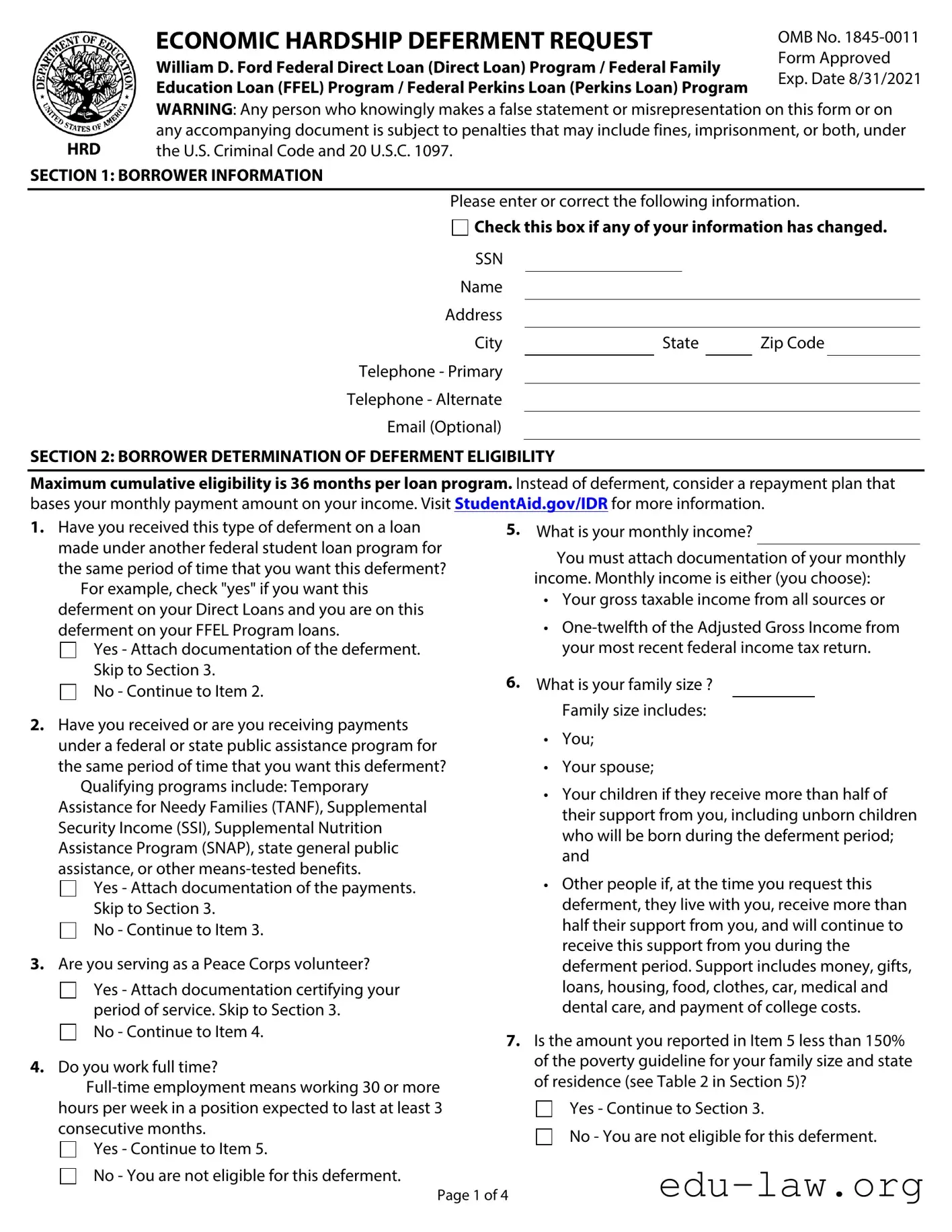
The Federal Loan Economic Hardship Request form serves as a crucial tool for borrowers facing financial difficulties. This form enables individuals to request a deferment on their federal student loans, including those under the William D. Ford Federal Direct Loan Program, the Federal Family Education Loan Program, and the Federal Perkins Loan Program. Borrowers must provide accurate personal information, including their Social Security number, name, and contact details, in the first section. The second section assesses eligibility for deferment based on various criteria, such as income level, family size, and participation in public assistance programs. It is essential to gather documentation that supports claims made in the application, particularly regarding monthly income and any existing deferments on other loans. The form also outlines the borrower's rights and responsibilities during the deferment period, including the potential for interest capitalization and the maximum eligibility duration. Clear instructions for completing and submitting the form ensure that borrowers can navigate the process effectively, while important notices highlight the significance of providing truthful information to avoid legal repercussions. Overall, this form is designed to support borrowers in managing their loan obligations during challenging times.

|
ECONOMIC HARDSHIP DEFERMENT REQUEST |
|
|
|
OMB No. |
|||
|
William D. Ford Federal Direct Loan (Direct Loan) Program / Federal Family |
Form Approved |
||||||
|
Exp. Date 8/31/2021 |
|||||||
|
Education Loan (FFEL) Program / Federal Perkins Loan (Perkins Loan) Program |
|||||||
|
|
|
|
|||||
|
WARNING: Any person who knowingly makes a false statement or misrepresentation on this form or on |
|||||||
HRD |
any accompanying document is subject to penalties that may include fines, imprisonment, or both, under |
|||||||
the U.S. Criminal Code and 20 U.S.C. 1097. |
|
|
|
|
|
|
||
SECTION 1: BORROWER INFORMATION |
|
|
|
|
|
|
||
|
|
|
|
|
|
|
||
|
Please enter or correct the following information. |
|||||||
|
Check this box if any of your information has changed. |
|||||||
|
SSN |
|
|
|
|
|
|
|
|
Name |
|
|
|
|
|
|
|
|
Address |
|
|
|
|
|
|
|
|
City |
|
State |
|
Zip Code |
|
|
|
|
Telephone - Primary |
|
|
|
|
|
|
|
Telephone - Alternate
Email (Optional)
SECTION 2: BORROWER DETERMINATION OF DEFERMENT ELIGIBILITY
Maximum cumulative eligibility is 36 months per loan program. Instead of deferment, consider a repayment plan that bases your monthly payment amount on your income. Visit StudentAid.gov/IDR for more information.
1. Have you received this type of deferment on a loan |
5. |
What is your monthly income? |
|||||
made under another federal student loan program for |
|
|
|
|
|
|
|
|
|
You must attach documentation of your monthly |
|||||
the same period of time that you want this deferment? |
|
|
|||||
|
income. Monthly income is either (you choose): |
||||||
For example, check "yes" if you want this |
|
||||||
|
• Your gross taxable income from all sources or |
||||||
deferment on your Direct Loans and you are on this |
|
||||||
|
• |
||||||
deferment on your FFEL Program loans. |
|
||||||
Yes - Attach documentation of the deferment. |
|
|
your most recent federal income tax return. |
||||
Skip to Section 3. |
6. |
What is your family size ? |
|||||
No - Continue to Item 2. |
|||||||
|
|
|
|
|
|
||
2. Have you received or are you receiving payments |
|
|
Family size includes: |
||||
|
• |
You; |
|||||
under a federal or state public assistance program for |
|
||||||
|
|
|
|
|
|
||
the same period of time that you want this deferment? |
|
• |
Your spouse; |
||||
Qualifying programs include: Temporary |
|
• Your children if they receive more than half of |
|||||
Assistance for Needy Families (TANF), Supplemental |
|
||||||
|
|
their support from you, including unborn children |
|||||
Security Income (SSI), Supplemental Nutrition |
|
|
|||||
|
|
who will be born during the deferment period; |
|||||
Assistance Program (SNAP), state general public |
|
|
|||||
|
|
and |
|||||
assistance, or other |
|
|
|||||
|
• Other people if, at the time you request this |
||||||
Yes - Attach documentation of the payments. |
|
||||||
Skip to Section 3. |
|
|
deferment, they live with you, receive more than |
||||
No - Continue to Item 3. |
|
|
half their support from you, and will continue to |
||||
3. Are you serving as a Peace Corps volunteer? |
|
|
receive this support from you during the |
||||
|
|
deferment period. Support includes money, gifts, |
|||||
Yes - Attach documentation certifying your |
|
|
loans, housing, food, clothes, car, medical and |
||||
period of service. Skip to Section 3. |
|
|
dental care, and payment of college costs. |
||||
No - Continue to Item 4. |
7. Is the amount you reported in Item 5 less than 150% |
||||||
|
|||||||
4. Do you work full time? |
|
of the poverty guideline for your family size and state |
|||||
|
of residence (see Table 2 in Section 5)? |
||||||
|
|||||||
|
|
|
|
|
|
||
hours per week in a position expected to last at least 3 |
|
|
Yes - Continue to Section 3. |
||||
consecutive months. |
|
|
No - You are not eligible for this deferment. |
||||
Yes - Continue to Item 5. |
|
|
|||||
|
|
|
|
|
|
||
No - You are not eligible for this deferment. |
|
|
|
|
|
|
|
Page 1 of 4
Borrower Name |
|
Borrower SSN |
|
|
|
SECTION 3: BORROWER REQUESTS, UNDERSTANDINGS, CERTIFICATIONS, AND AUTHORIZATION
Irequest:
•To defer repayment of my loans for the period during which I have an economic hardship, as described in Section 2.
•That my deferment begin on:
• |
If checked, to make interest |
payments on my |
loans during my deferment. |
I understand that:
•I am not required to make payments of loan principal or interest during my deferment.
•My deferment will begin on the later of the date I became eligible or the date that I requested.
•My deferment will end on the earlier of the date that I exhaust my maximum eligibility, the certified deferment end date, or when I am no longer eligible for the deferment for another reason.
•If I am a Perkins Loan borrower, I will receive a
•Unless I am a Peace Corps volunteer, my deferment will be granted in increments of 1 year. If I continue to be eligible for an Economic Hardship Deferment after 1 year, I may reapply, subject to the cumulative maximum.
•My loan holder may grant me a forbearance while processing my form or to cover any period of delinquency that exists when I submit my form.
•Unpaid interest may capitalize on my loans during or at the expiration of my deferment or forbearance, but interest never capitalizes on Perkins Loans.
I certify that:
•The information I have provided on this form is true and correct.
•I will provide additional documentation to my loan holder, as required, to support my deferment eligibility.
•I will notify my loan holder immediately when my eligibility for the deferment ends.
•I have read, understand, and meet the eligibility requirements in Section 2.
I authorize the entity to which I submit this request and its agents to contact me regarding my request or my loans at any cellular telephone number that I provide now or in the future using automated telephone dialing equipment or artificial or prerecorded voice or text messages.
Borrower's Signature |
|
Date |
SECTION 4: INSTRUCTIONS FOR COMPLETING THE DEFERMENT REQUEST
Type or print using dark ink. Enter dates as
SECTION 5: DEFINITIONS
The William D. Ford Federal Direct Loan (Direct |
The Federal Family Education Loan (FFEL) Program |
|
Loan) Program includes Federal Direct Stafford/Ford |
includes Federal Stafford Loans, Federal PLUS Loans, Federal |
|
(Direct Subsidized) Loans, Federal Direct Unsubsidized |
Consolidation Loans, and Federal Supplemental Loans for |
|
Stafford/Ford (Direct Unsubsidized) Loans, Federal |
Students (SLS). |
|
Direct PLUS (Direct PLUS) Loans, and Federal Direct |
The Federal Perkins Loan (Perkins Loan) Program |
|
Consolidation (Direct Consolidation) Loans. |
||
includes Federal Perkins Loans, National Direct Student Loans |
||
|
||
|
(NDSL), and National Defense Student Loans (Defense Loans). |
Page 2 of 4

SECTION 5: DEFINITIONS (CONTINUED)
|
Capitalization is the addition of unpaid interest to |
|
A forbearance is a period during which you are permitted |
||||||||||||||
the principal balance of your loan. Capitalization causes |
|
to postpone making payments temporarily, allowed an |
|||||||||||||||
more interest to accrue over the life of your loan and |
|
extension of time for making payments, or temporarily |
|||||||||||||||
may cause your monthly payment amount to increase. |
|
allowed to make smaller payments than scheduled. |
|||||||||||||||
Interest never capitalizes on Perkins Loans. |
|
|
|
The holder of your Direct Loans is the Department. The |
|||||||||||||
|
Table 1 (below) provides an example of the monthly |
|
holder of your FFEL Program loans may be a lender, guaranty |
||||||||||||||
payments and the total amount repaid for a $30,000 |
|
agency, secondary market, or the Department. The holder of |
|||||||||||||||
unsubsidized loan. The example loan has a 6% interest |
|
your Perkins Loans is an institution of higher education or the |
|||||||||||||||
rate and the example deferment or forbearance lasts for |
|
Department. Your loan holder may use a servicer to handle |
|||||||||||||||
12 months and begins when the loan entered |
|
billing and other communications related to your loans. |
|||||||||||||||
repayment. The example compares the effects of paying |
|
References to “your loan holder” on this form mean either |
|||||||||||||||
the interest as it accrues or allowing it to capitalize. |
|
your loan holder or your servicer. |
|
|
|||||||||||||
|
A |
|
A subsidized loan is a Direct Subsidized Loan, a Direct |
||||||||||||||
joint borrowers on a Direct or Federal Consolidation |
|
||||||||||||||||
|
Subsidized Consolidation Loan, a Federal Subsidized Stafford |
||||||||||||||||
Loan or a Federal PLUS Loan. Both |
|
||||||||||||||||
|
Loan, portions of some Federal Consolidation Loans, a Federal |
||||||||||||||||
responsible for repayment the full amount of the loan. |
|
||||||||||||||||
|
Perkins Loan, an NDSL, and a Defense Loan. |
|
|
||||||||||||||
|
A deferment is a period during which you are |
|
|
|
|||||||||||||
|
|
An unsubsidized loan is a Direct Unsubsidized Loan, a |
|||||||||||||||
entitled to postpone repayment of your loans. Interest is |
|
||||||||||||||||
|
Direct Unsubsidized Consolidation Loan, a Direct PLUS Loan, a |
||||||||||||||||
not generally charged to you during a deferment on |
|
||||||||||||||||
|
Federal Unsubsidized Stafford Loan, a Federal PLUS Loan, a |
||||||||||||||||
your subsidized loans. Interest is always charged to you |
|
||||||||||||||||
|
Federal SLS, and portions of some Federal Consolidation |
||||||||||||||||
during a deferment on your unsubsidized loans. On |
|
||||||||||||||||
|
Loans. |
|
|
|
|
|
|
|
|
|
|||||||
loans made under the Perkins Loan Program, all |
|
|
|
|
|
|
|
|
|
|
|||||||
|
|
|
|
|
|
|
|
|
|
|
|
||||||
deferments are followed by a |
|
|
|
|
|
|
|
|
|
|
|
|
|||||
period of 6 months, during which time you are not |
|
|
|
|
|
|
|
|
|
|
|
|
|||||
required to make payments. |
|
|
|
|
|
|
|
|
|
|
|
|
|
|
|
|
|
Table 1. Capitalization Chart |
|
|
|
|
|
|
|
|
|
|
|
|
|
|
|
|
|
|
|
|
|
|
|
|
|
|
|
|
|
|
|
|
|||
|
Treatment of Interest with |
Loan |
Capitalized |
Outstanding |
|
Monthly |
Number of |
Total |
|||||||||
|
Deferment/Forbearance |
Amount |
Interest |
|
Principal |
|
Payment |
Payments |
Repaid |
|
|||||||
|
|
|
|
|
|
|
|
|
|
|
|
|
|
|
|
|
|
|
Interest is paid |
$30,000 |
$0 |
|
|
$30,000 |
|
|
$333 |
120 |
$41,767 |
|
|||||
|
|
|
|
|
|
|
|
|
|
|
|
|
|
|
|
|
|
|
Interest is capitalized at the |
$30,000 |
$1,800 |
|
$31,800 |
|
|
$353 |
120 |
$42,365 |
|
||||||
|
end |
|
|
|
|
|
|
|
|
|
|
|
|
|
|
|
|
|
|
|
|
|
|
|
|
|
|
|
|
|
|
|
|
|
|
|
Interest is capitalized |
$30,000 |
$1,841 |
|
$31,841 |
|
|
$354 |
120 |
$42,420 |
|
||||||
|
quarterly and at the end |
|
|
|
|
|
|
|
|
|
|
|
|
|
|
|
|
|
|
|
|
|
|
|
|
|
|
|
|
|
|
||||
|
|
Table 2. 150% of the Poverty Guidelines for 2019 (Monthly) |
|
|
|||||||||||||
|
|
|
|
|
|
|
|
|
|
|
|
|
|
||||
|
|
|
Family Size |
|
Alaska |
|
Hawaii |
|
|
All Others |
|
|
|||||
|
|
|
|
|
|
|
|
|
|
|
|
|
|||||
|
|
|
|
1 |
|
$1,950.00 |
|
$1,797.50 |
$1,561.25 |
|
|
|
|||||
|
|
|
|
2 |
|
$2,641.25 |
|
$2,432.50 |
$2,113.75 |
|
|
|
|||||
|
|
|
|
3 |
|
$3,332.50 |
|
$3,067.50 |
$2,666.25 |
|
|
|
|||||
|
|
|
|
4 |
|
$4,023.75 |
|
$3,702.50 |
|
$3,218.75 |
|
|
|
||||
|
|
|
|
5 |
|
$4,715.00 |
|
$4,337.50 |
|
$3,771.25 |
|
|
|
||||
|
|
|
|
6 |
|
$5,406.25 |
|
$4,972.50 |
|
$4,323.75 |
|
|
|
||||
|
|
|
|
7 |
|
$6,097.50 |
|
$5,607.50 |
|
$4,876.25 |
|
|
|
||||
|
|
|
|
8 |
|
$6,788.75 |
|
$6,242.50 |
|
$5,428.75 |
|
|
|
||||
|
|
|
Each additional |
|
$691.25 |
|
$635.00 |
|
$552.50 |
|
|
|
|||||
|
|
|
person, add |
|
|
|
|
|
|
|
|
|
|
|
|
|
|
|
|
|
|
|
|
|
|
|
|||||||||
|
If you do not live in the United States, use the poverty guideline amount in |
|
|
||||||||||||||
|
|
|
|
the column labeled "All Others". |
|
|
|
|
|
|
|
||||||
Page 3 of 4

SECTION 6: WHERE TO SEND THE COMPLETED DEFERMENT REQUEST
Return the completed form and any documentation to: (If no address is shown, return to your loan holder.)
If you need help completing this form, call:
(If no phone number is shown, call your loan holder.)
SECTION 7: IMPORTANT NOTICES
Privacy Act Notice. The Privacy Act of 1974 (5 U.S.C. 552a) |
To assist program administrators with tracking refunds |
|
requires that the following notice be provided to you: |
and cancellations, disclosures may be made to guaranty |
|
The authorities for collecting the requested information |
agencies, to financial and educational institutions, or to |
|
federal or state agencies. To provide a standardized method |
||
from and about you are §421 et seq., §451 et seq., or §461 et |
||
for educational institutions to efficiently submit student |
||
seq. of the Higher Education Act of 1965, as amended (20 |
||
enrollment statuses, disclosures may be made to guaranty |
||
U.S.C. 1071 et seq., 20 U.S.C. 1087a et seq., or 20 U.S.C. 1087aa |
||
agencies or to financial and educational institutions. To |
||
et seq.) and the authorities for collecting and using your Social |
||
counsel you in repayment efforts, disclosures may be made |
||
Security Number (SSN) are §§428B(f) and 484(a)(4) of the HEA |
||
to guaranty agencies, to financial and educational |
||
(20 U.S.C. |
||
institutions, or to federal, state, or local agencies. |
||
Participating in the William D. Ford Federal Direct Loan (Direct |
||
|
||
Loan) Program, Federal Family Education Loan (FFEL) |
In the event of litigation, we may send records to the |
|
Program, or Federal Perkins Loan (Perkins Loan) Program and |
Department of Justice, a court, adjudicative body, counsel, |
|
giving us your SSN are voluntary, but you must provide the |
party, or witness if the disclosure is relevant and necessary |
|
requested information, including your SSN, to participate. |
to the litigation. If this information, either alone or with |
|
The principal purposes for collecting the information on |
other information, indicates a potential violation of law, we |
|
may send it to the appropriate authority for action. We may |
||
this form, including your SSN, are to verify your identity, to |
||
send information to members of Congress if you ask them |
||
determine your eligibility to receive a loan or a benefit on a |
||
to help you with federal student aid questions. In |
||
loan (such as a deferment, forbearance, discharge, or |
||
circumstances involving employment complaints, |
||
forgiveness) under the Direct Loan, FFEL, or Federal Perkins |
||
grievances, or disciplinary actions, we may disclose relevant |
||
Loan Programs, to permit the servicing of your loans, and, if it |
||
records to adjudicate or investigate the issues. If provided |
||
becomes necessary, to locate you and to collect and report on |
||
for by a collective bargaining agreement, we may disclose |
||
your loans if your loans become delinquent or default. We also |
||
records to a labor organization recognized under 5 U.S.C. |
||
use your SSN as an account identifier and to permit you to |
||
Chapter 71. Disclosures may be made to our contractors for |
||
access your account information electronically. |
||
the purpose of performing any programmatic function that |
||
The information in your file may be disclosed, on a case- |
||
requires disclosure of records. Before making any such |
||
disclosure, we will require the contractor to maintain Privacy |
||
parties as authorized under routine uses in the appropriate |
||
Act safeguards. Disclosures may also be made to qualified |
||
systems of records notices. The routine uses of this |
||
researchers under Privacy Act safeguards. |
||
information include, but are not limited to, its disclosure to |
||
Paperwork Reduction Notice. According to the |
||
federal, state, or local agencies, to private parties such as |
||
Paperwork Reduction Act of 1995, no persons are required |
||
relatives, present and former employers, business and |
||
to respond to a collection of information unless such |
||
personal associates, to consumer reporting agencies, to |
||
collection displays a valid OMB control number. The valid |
||
financial and educational institutions, and to guaranty |
||
OMB control number for this information collection is |
||
agencies in order to verify your identity, to determine your |
||
eligibility to receive a loan or a benefit on a loan, to permit the |
||
information is estimated to average 10 minutes per |
||
servicing or collection of your loans, to enforce the terms of |
||
response, including time for reviewing instructions, |
||
the loans, to investigate possible fraud and to verify |
||
searching existing data sources, gathering and maintaining |
||
compliance with federal student financial aid program |
||
the data needed, and completing and reviewing the |
||
regulations, or to locate you if you become delinquent in your |
||
collection of information. The obligation to respond to this |
||
loan payments or if you default. To provide default rate |
||
collection is required to obtain a benefit in accordance with |
||
calculations, disclosures may be made to guaranty agencies, |
||
34 CFR 674.34, 674.35, 674.36, 674.37, 682.210, or 685.204. |
||
to financial and educational institutions, or to state agencies. |
||
If you have comments or concerns regarding the |
||
To provide financial aid history information, disclosures may |
||
status of your individual submission of this form, please |
||
be made to educational institutions. |
||
contact your loan holder directly (see Section 6). |
||
|
Page 4 of 4
| Fact Name | Description |
|---|---|
| Purpose of the Form | This form allows borrowers to request a deferment of loan payments due to economic hardship. |
| Eligibility Duration | Borrowers can receive a maximum of 36 months of deferment across loan programs. |
| Documentation Requirement | Borrowers must attach documentation proving their monthly income and eligibility for deferment. |
| Full-Time Employment Definition | Full-time employment is defined as working 30 or more hours per week for at least three consecutive months. |
| State-Specific Guidelines | Borrowers must refer to the poverty guidelines specific to their state to determine eligibility based on income. |
| Peace Corps Volunteers | Peace Corps volunteers may qualify for deferment and must provide documentation of their service. |
| Interest During Deferment | Interest may accrue on unsubsidized loans during deferment, while subsidized loans do not accrue interest. |
| Signature Requirement | Borrowers must sign and date the form to certify the accuracy of the information provided. |
| Submission Instructions | Completed forms should be returned to the specified loan holder or the address provided in the form. |
Completing the Federal Loan Economic Hardship Request form is a crucial step for individuals seeking assistance with their student loans during challenging financial times. Once you have filled out the form, you will need to submit it along with any required documentation to your loan holder. This process ensures that your request for deferment is properly evaluated, allowing you to focus on your financial recovery.
What is the purpose of the Federal Loan Economic Hardship Request form?
The Federal Loan Economic Hardship Request form is designed for borrowers who are experiencing financial difficulties and wish to defer their student loan payments. By submitting this form, borrowers can request a temporary postponement of their loan repayment due to economic hardship, allowing them to manage their financial situation more effectively.
Who is eligible to use this form?
Eligibility for the Economic Hardship Deferment is based on specific criteria outlined in the form. Borrowers must demonstrate that their monthly income is less than 150% of the poverty guideline for their family size and state of residence. Additionally, those receiving public assistance or serving as Peace Corps volunteers may also qualify. It is important to review the eligibility requirements carefully to determine if you qualify.
What documentation is required when submitting this form?
When completing the Economic Hardship Request form, borrowers must provide documentation of their monthly income. This can include recent pay stubs, tax returns, or any other relevant financial statements. If applicable, documentation supporting eligibility for public assistance or Peace Corps service should also be attached. Ensure that all submitted documents include your name and account number for proper processing.
How long can the deferment last?
The maximum cumulative eligibility for an Economic Hardship Deferment is 36 months per loan program. Deferments are typically granted in one-year increments. If you continue to meet the eligibility requirements after one year, you may reapply for an additional deferment, subject to the maximum limit. It is crucial to monitor your eligibility and submit your request on time.
What happens after I submit the form?
After submitting the Economic Hardship Request form, your loan holder will review your application and documentation. They may grant a forbearance while processing your request or to cover any period of delinquency. You will be notified of the decision, and if approved, your deferment will begin based on the eligibility date. Keep in mind that unpaid interest may capitalize on your loans during or after the deferment period, affecting your total loan balance.
Incomplete Personal Information: Many individuals fail to fill out their personal information completely. This includes not providing a Social Security Number, address, or contact information. Missing this information can delay processing.
Incorrect Income Documentation: Some applicants do not attach the necessary documentation to verify their income. This could include recent pay stubs or tax returns. Without proper documentation, the request may be denied.
Misunderstanding Eligibility Criteria: A common mistake is misunderstanding the eligibility requirements for deferment. Applicants may not realize they must meet specific income thresholds or family size criteria. This can lead to unnecessary applications and denials.
Failure to Follow Submission Instructions: Many people overlook the instructions for submitting the form. Not sending the form to the correct loan holder or failing to include required documentation can cause delays or denials. Always double-check the submission guidelines.
The Federal Loan Economic Hardship Request form is a crucial document for borrowers seeking to defer loan payments due to financial difficulties. Along with this form, several other documents may be required to support the request and verify eligibility. The following list outlines four commonly used forms and documents that accompany the Economic Hardship Request.
In summary, submitting the Federal Loan Economic Hardship Request form along with the appropriate supporting documents is essential for borrowers seeking deferment. These additional documents help establish eligibility and ensure a smoother process for managing loan repayments during times of financial hardship.
The Federal Loan Economic Hardship Request form shares similarities with the Unemployment Deferment Request form. Both documents aim to provide relief to borrowers experiencing financial difficulties. While the Economic Hardship Request focuses on a broader range of economic challenges, the Unemployment Deferment specifically addresses the situation of individuals who are currently unemployed. Borrowers must demonstrate their eligibility by providing documentation of their unemployment status, much like the income verification required in the Economic Hardship Request.
Another related document is the Forbearance Request form. Like the Economic Hardship Request, the Forbearance Request allows borrowers to temporarily suspend or reduce their loan payments. However, forbearance can be granted for various reasons, including financial hardship or illness, and does not necessarily require the same level of documentation regarding income. Borrowers can choose to use forbearance when they face short-term financial issues, whereas the Economic Hardship Request is more focused on longer-term economic challenges.
The Income-Driven Repayment (IDR) Plan Request form is also similar to the Economic Hardship Request form. Both documents aim to assist borrowers in managing their loan payments based on their financial situations. The IDR Plan allows borrowers to cap their monthly payments at a percentage of their discretionary income, while the Economic Hardship Request seeks to defer payments entirely. Both forms require borrowers to provide detailed information about their income and family size to determine eligibility.
The Temporary Disability Deferment Request form parallels the Economic Hardship Request in that it provides relief for borrowers facing specific challenges. In this case, the challenges stem from temporary disabilities that hinder the ability to make loan payments. Both forms require documentation to support the request, but the Temporary Disability Deferment is more narrowly focused on medical conditions, whereas the Economic Hardship Request encompasses a wider range of financial difficulties.
Similar to the Economic Hardship Request is the Military Deferment Request form. This document is designed for service members who are experiencing financial difficulties due to their military obligations. Both forms allow for the postponement of loan payments, but the Military Deferment specifically caters to those in active duty or certain types of military service. Documentation requirements differ slightly, as the Military Deferment often necessitates proof of military service.
Lastly, the Public Service Loan Forgiveness (PSLF) Employment Certification form shares a connection with the Economic Hardship Request. While the PSLF form is primarily focused on certifying employment in a qualifying public service job for loan forgiveness, it also highlights the financial struggles faced by borrowers in lower-paying public service roles. Both forms aim to alleviate financial burdens, though the PSLF form ultimately seeks to provide loan forgiveness after a period of qualifying payments, while the Economic Hardship Request seeks immediate relief through deferment.
When filling out the Federal Loan Economic Hardship Request form, it's important to approach the process carefully. Here are ten things you should and shouldn't do to ensure your application is completed correctly.
By following these guidelines, you can navigate the process more effectively and increase your chances of a successful deferment request.
This form is designed for individuals facing financial difficulties, not just those without a job. Many people may be employed but still struggle to meet their monthly expenses, making them eligible for this deferment.
Previous deferments do not disqualify you from applying again. However, there are limits on the total time you can receive deferment across different loan programs.
The deferment is granted for a specific period, typically one year, after which you must reapply if you continue to meet the eligibility criteria.
Individuals can work while receiving a deferment. However, the income earned may affect eligibility if it exceeds the specified poverty guideline.
For subsidized loans, interest generally does not accrue during deferment. However, for unsubsidized loans, interest will continue to accumulate, which can lead to capitalization once the deferment ends.
While public assistance can demonstrate economic hardship, it is not a requirement. Borrowers can qualify based on their income level and other financial circumstances.
A forbearance may be granted by your loan holder during the processing of your deferment request. This can help prevent delinquency on your loans while you await a decision.