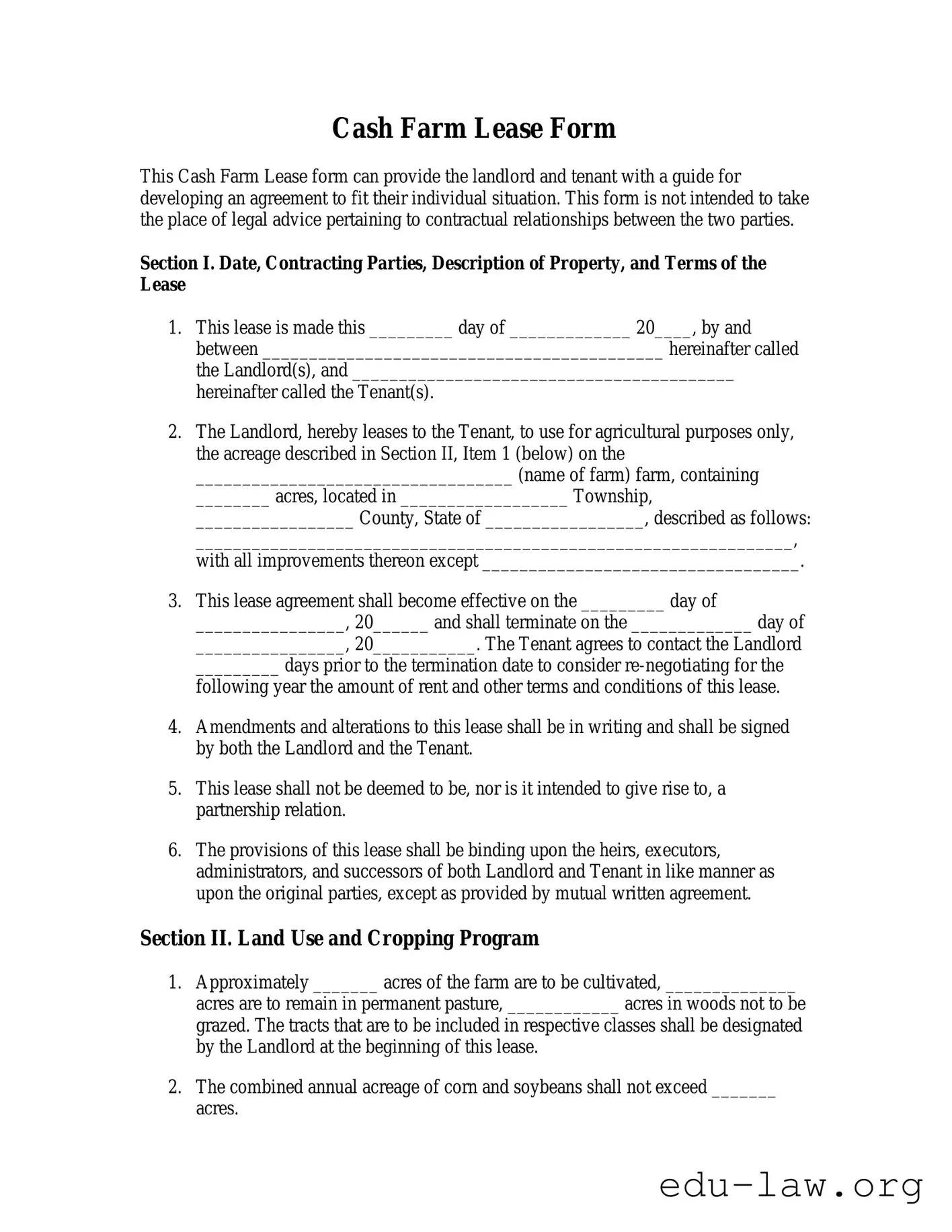
The Farm Lease Agreement 669 form serves as a crucial tool for landlords and tenants in the agricultural sector. This form lays out the essential terms of the lease, ensuring that both parties understand their rights and responsibilities. It begins with basic information, including the date, names of the landlord and tenant, and a detailed description of the property being leased. The agreement specifies the land's intended use, the amount of rent, and the payment schedule. Important sections address land use and cropping programs, outlining how much land will be cultivated and the types of crops that can be grown. The landlord's obligations, such as maintaining the property and covering certain costs, are clearly stated, alongside the tenant's responsibilities for farming practices and property upkeep. Provisions for amendments, rights of entry, and enforcement of agreements are also included, ensuring a comprehensive framework for both parties to follow. With this form, landlords and tenants can create a clear and effective lease that meets their unique needs while adhering to legal standards.
Cash Farm Lease Form
This Cash Farm Lease form can provide the landlord and tenant with a guide for developing an agreement to fit their individual situation. This form is not intended to take the place of legal advice pertaining to contractual relationships between the two parties.
Section I. Date, Contracting Parties, Description of Property, and Terms of the Lease
1.This lease is made this _________ day of _____________ 20____, by and between ___________________________________________ hereinafter called the Landlord(s), and _________________________________________
hereinafter called the Tenant(s).
2.The Landlord, hereby leases to the Tenant, to use for agricultural purposes only, the acreage described in Section II, Item 1 (below) on the
__________________________________ (name of farm) farm, containing
________ acres, located in __________________ Township,
_________________ County, State of _________________, described as follows:
________________________________________________________________, with all improvements thereon except __________________________________.
3.This lease agreement shall become effective on the _________ day of
________________, 20______ and shall terminate on the _____________ day of
________________, 20___________. The Tenant agrees to contact the Landlord
_________ days prior to the termination date to consider
4.Amendments and alterations to this lease shall be in writing and shall be signed by both the Landlord and the Tenant.
5.This lease shall not be deemed to be, nor is it intended to give rise to, a partnership relation.
6.The provisions of this lease shall be binding upon the heirs, executors, administrators, and successors of both Landlord and Tenant in like manner as upon the original parties, except as provided by mutual written agreement.
Section II. Land Use and Cropping Program
1.Approximately _______ acres of the farm are to be cultivated, ______________
acres are to remain in permanent pasture, ____________ acres in woods not to be grazed. The tracts that are to be included in respective classes shall be designated by the Landlord at the beginning of this lease.
2.The combined annual acreage of corn and soybeans shall not exceed _______
acres.
3.The extent of participation in government programs will be discussed and decided upon on an annual basis. The course of action agreed upon shall be placed in writing and signed by both parties. A copy of the course of action so agreed upon shall be made available to each party.
4.No permanent pasture shall be plowed without the written consent of the Landlord.
Section III. Amount of Rent and Time of Payment
1.The Tenant shall pay to the Landlord the sum of $_____________ annual rent for the entire acreage referred to in Section I, calculated as follows:
_____ acres of tillable land @ $______ per acre |
$________ |
_____ acres of |
$________ |
Building rent for: dwelling |
$________ |
grain bins |
$________ |
other ________________ |
$________ |
Total annual cash rent |
$________ |
The annual cash rent shall be paid as follows:
$______________ on or before __________________, 20_______
$______________ on or before __________________, 20_______
$______________ on or before __________________, 20_______
If rent is not paid when due, the Tenant agrees to pay interest on the amount of unpaid rent at the rate of _____ percent per annum from the due date until paid.
Section IV. The Landlord Agrees to:
1.Furnish the land and the fixed improvements referred to in Section I.
2.Pay all taxes and the assessments against the real estate and all taxes on the Landlord's personal property on the farm.
3.Furnish materials and labor for mutually agreed upon repairs, improvements, and construction of buildings, drains, and fences on the farm. To pay for materials purchased by the Tenant for purposes of repair and maintenance in an amount not to exceed $_________ in any one year, except as otherwise agreed upon. Reimbursement shall be made within ________ days after the Tenant submits the bill.
4.Furnish _______ % of the limestone used on the farm, together with ______ % of hauling and spreading costs. If the Tenant hauls and/or spreads the limestone furnished by the Landlord, the Landlord shall pay the Tenant the customary rate per ton for such work as agreed upon in writing before the work is done.
5.Replace or repair as promptly as possible the dwelling or any other building or equipment regularly used by the Tenant that may be destroyed or damaged by fire, flood, or other cause beyond the control of the Tenant and, until such replacement or repair is made, to compensate the tenant as follows:
_______________________________________________________________
________________________________________________________________
6.Other responsibilities of the Landlord:
Let the Tenant make minor improvements of a temporary or removable nature, which do not mar the condition or appearance of the farm, at the Tenant's expense. The Landlord further agrees to let the Tenant remove such improvements at any time this lease is in effect or within ________ days thereafter, provided the Tenant leaves in good condition that part of the farm from which such improvements are removed. The Tenant shall have no right to compensation for improvements that are not removed except as mutually agreed.
7.Reimburse the Tenant at the termination of this lease for field work done and for other crop costs incurred for crops to be harvested during the following year. Unless otherwise agreed, current custom rates for the operations involved will be used as a basis of settlement.
Section V. The Tenant Agrees to:
1.Follow the farming practices that are generally recommended for and that are best adapted to this type of farm and for this locality unless other practices are agreed upon.
2.Furnish all labor, power, machinery, and movable equipment and all related operation and maintenance expenses to operate the farm except as follows:
__________________________________________________________
3.Furnish all labor for minor repair and the minor improvement of buildings, fences, and drains with the material to be furnished by the Landlord. The buildings, fences, and other improvements on the farm are to be kept in as good condition as they are at the beginning of the lease, or in as good condition as they may be put in by the Landlord during the term of the lease; ordinary wear, depreciation, or unavoidable destruction excepted.
4.Keep livestock out of the fields when the soil is soft, and protect sod crops, especially new seedings, from too close grazing that might impair the following year's crop.
5.Follow NRCS and/or FSA recommendations and fulfill all other requirements necessary to maintain the rights of current and future tenants of this farm to participate in federal farm programs. Planted acreages and yields of crops shall be reported as required by FSA.
6.Store and use pesticides, fertilizers, and other chemicals, and dispose of containers in accordance with state and federal regulations and recommendations. Furnish the Landlord a written field by field record of the amount, kinds, and dates of applications of pesticides and fertilizers.
7.Store no motor vehicles, tractors, fuel, and chemicals on the farm in violation of restrictions in the Landlord's insurance policies.
8.Apply fertilizer as follows:
|
Corn |
Soybeans |
___________ |
Potash (K2O) no less than |
_______lb/a |
________lb/a |
_________lb/a |
Phosphate (P2O5) no less than |
_______lb/a |
________lb/a |
_________lb/a |
Nitrogen (N) no more than |
_______lb/a |
________lb/a |
_________lb/a |
9.Neither assign this lease to any person or persons nor sublet any part of the real estate for any purpose without the written consent of the Landlord.
10.Not to: a) erect or permit to be erected on the farm any permanent structure, b) incur any expense to the Landlord for such purposes, or c) add electrical wiring, plumbing, or heating to any building without written consent of the Landlord.
11.Control soil erosion according to a conservation plan approved by NRCS; keep in good repair all terraces, open ditches, inlets and outlets of tile drains; preserve all established watercourses or ditches including grassed waterways; and refrain from any operation or practice that will injure such structures.
12.When leaving the farm, to pay the Landlord reasonable compensation for any damages to the farm for which the Tenant is responsible. Any decrease in value due to ordinary wear and depreciation or damage outside the control of the Tenant is exempted.
13.Yield peaceable possession of the farm at the termination of this lease.
Section VI. Rights and Privileges
1.The Landlord or anyone designated by him shall have the right of entry at any mutually convenient time to inspect the property and/or the farming methods being used.
2.The Tenant shall have the right of entry for _______ days after the termination of the lease for the purpose of harvesting spring seeded crops. The Landlord or his designated agent shall have the right of entry to plant fall crops following harvest of the current year's crops.
3.If this lease is terminated before the Tenant shall have obtained the benefits from any other labor or expense he may have made in operating the farm, according to contract or agreement with the Landlord during the current lease year, the Landlord shall reimburse the Tenant for such labor and expense. The Tenant shall present, in writing to the Landlord, his claim for such reimbursement at least
_______ days before the termination of this lease.
4.Transfer of ownership of this farm shall be subject to the provisions of this lease.
Section VII. Enforcement of Agreements and Arbitration
1.Failure of either the Landlord or the Tenant to comply with the agreement set forth in this lease shall make that person liable for damages to the other party. Any claim by either party for such damages shall be presented, in writing to the other party, at least _______ days before the termination of this lease.
2.The provisions of this lease shall be binding on the heirs, executors, administrators, and assigns of the party or parties involved.
3.Any disagreements between the Landlord and the Tenant shall be referred to a board of three disinterested persons, one of whom shall be appointed by the Landlord, one by the Tenant, and the third by the two thus appointed. The decision of these three shall be considered binding by the parties to this lease unless a sum exceeding $________ is involved. Any cost for such arbitration shall be shared equally between the two parties of this lease.
Section VIII. Other Agreements and Provisions
_________________________________________________________________
_________________________________________________________________
_________________________________________________________________
_________________________________________________________________
_________________________________________________________________
_________________________________________________________________
_________________________________________________________________
_________________________________________________________________
Section IX. Signatures
_____________________________________ |
_______________________________________ |
||
(Tenant) |
(Date) |
(Landlord) |
(Date) |
____________________________________________ |
|
||
(Witness of Notary Public) |
|
(Date) |
|
Section XR1. Annual Renewal for Crop Year 20_____
1.Annual rent for crop year 20_____. shall be $____________.payable on the same dates and in the same proportion as specified in Section II.
2.All other agreements in the attached lease are hereby renewed for crop year
20_____. |
|
|
|
_____________________________ |
________________________________ |
||
(Tenant) |
(Date) |
(Landlord) |
(Date) |
Section XR2. Annual Renewal for Crop Year 20_____
1.Annual rent for crop year 20_____. shall be $____________.payable on the same dates and in the same proportion as specified in Section II.
2.All other agreements in the attached lease are hereby renewed for crop year 20_____.
_____________________________ |
________________________________ |
||
(Tenant) |
(Date) |
(Landlord) |
(Date) |
Section XR3. Annual Renewal for Crop Year 20_____
1.Annual rent for crop year 20_____. shall be $____________.payable on the same dates and in the same proportion as specified in Section II.
2.All other agreements in the attached lease are hereby renewed for crop year 20_____.
_____________________________ |
________________________________ |
||
(Tenant) |
(Date) |
(Landlord) |
(Date) |
Section XR4. Annual Renewal for Crop Year 20_____
1.Annual rent for crop year 20_____. shall be $____________.payable on the same dates and in the same proportion as specified in Section II.
2.All other agreements in the attached lease are hereby renewed for crop year 20_____.
_____________________________ |
________________________________ |
||
(Tenant) |
(Date) |
(Landlord) |
(Date) |

Section XR5. Annual Renewal for Crop Year 20_____
1.Annual rent for crop year 20_____. shall be $____________.payable on the same dates and in the same proportion as specified in Section II.
2.All other agreements in the attached lease are hereby renewed for crop year 20_____.
_____________________________ |
________________________________ |
||
(Tenant) |
(Date) |
(Landlord) |
(Date) |
Rev 2/02
It is the policy of the Purdue University Cooperative Extension Service, David C. Petritz, Director, Purdue University that all persons shall have equal opportunity and access to its programs and facilities without regard to race, color, sex, religion, national origin, age, or disability.
Purdue University is an Affirmative Action employer.
*Prepared by Agricultural Economists Craig L. Dobbins and J.H. Atkinson. This form was developed to provide an example that illustrates the items often included in a written lease. The reader should consult with appropriate legal council before finalizing their lease agreement.
| Fact Name | Details |
|---|---|
| Purpose | This Cash Farm Lease Agreement serves as a guide for landlords and tenants to create a tailored lease that meets their specific needs. |
| Governing Law | The lease is governed by state-specific agricultural laws, which vary by state. For instance, in Illinois, the Illinois Agricultural Lease Act applies. |
| Lease Duration | The lease specifies an effective date and a termination date, ensuring both parties are aware of the lease's timeframe. |
| Amendments | Any changes to the lease must be documented in writing and signed by both the landlord and tenant, ensuring clarity and mutual agreement. |
Filling out the Farm Lease Agreement 669 form requires careful attention to detail to ensure that all necessary information is accurately recorded. This process involves specifying the terms of the lease, the responsibilities of both the landlord and tenant, and the financial arrangements. Following the steps outlined below will help in completing the form effectively.
What is the purpose of the Farm Lease Agreement 669 form?
The Farm Lease Agreement 669 form serves as a guide for landlords and tenants to create a lease agreement tailored to their specific needs. It outlines the terms of the lease, including property details, rent amounts, and responsibilities of both parties. While this form provides a solid foundation, it is not a substitute for legal advice.
What information is required to complete the lease agreement?
To complete the lease agreement, you need to fill in several key details. This includes the date of the agreement, names of the landlord and tenant, description of the property, and the acreage involved. Additionally, you must specify the rent amount, payment schedule, and any other terms relevant to the lease. Clear communication between both parties is essential for a successful agreement.
How is the rent calculated and when is it due?
The rent is calculated based on the total acres leased, with separate rates for tillable and non-tillable land. The form allows you to break down the rent into specific amounts for different types of land and any buildings. Rent payments are typically divided into installments, with due dates specified in the agreement. If rent is not paid on time, interest may accrue on the unpaid amount.
What are the responsibilities of the landlord?
The landlord has several important responsibilities. They must provide the land and any fixed improvements, pay property taxes, and cover costs for agreed repairs and maintenance. The landlord is also responsible for replacing or repairing any buildings or equipment damaged by unforeseen events. Furthermore, they should allow the tenant to make minor improvements and reimburse them for specific crop costs upon lease termination.
What obligations does the tenant have under this agreement?
The tenant must follow recommended farming practices and provide all necessary labor, equipment, and maintenance expenses. They are also responsible for keeping the property in good condition and following regulations for chemicals and fertilizers. Additionally, the tenant should not sublet the property or make permanent changes without the landlord's consent. Maintaining soil health and managing livestock properly are also key obligations.
What happens if the lease is terminated before the tenant can harvest crops?
If the lease is terminated before the tenant can harvest any crops, the landlord is required to reimburse the tenant for any labor or expenses incurred. The tenant must present a written claim for reimbursement to the landlord within a specified time frame before the lease ends. This provision ensures that the tenant is compensated for their investments in the farming operation.
Leaving Sections Blank: Failing to fill in required fields, such as the names of the landlord and tenant or the property description, can lead to confusion and potential disputes.
Incorrect Dates: Entering incorrect lease start and end dates may create misunderstandings about the duration of the agreement.
Miscalculating Rent: Not accurately calculating the total annual rent based on the specified rates and acreage can result in financial issues later.
Ignoring Amendments: Forgetting to document any amendments or alterations in writing can make it difficult to enforce changes agreed upon verbally.
Not Following Land Use Guidelines: Failing to specify how many acres will be cultivated or left as pasture can lead to mismanagement of the land.
Overlooking Responsibilities: Not clearly defining the responsibilities of both the landlord and tenant regarding repairs and maintenance can create disputes down the line.
Missing Signatures: Forgetting to sign the lease agreement or have the other party sign can render the contract invalid.
Neglecting to Discuss Government Programs: Not addressing participation in government programs can lead to missed opportunities for financial support.
Failing to Comply with Regulations: Not adhering to state and federal regulations regarding the use of chemicals and fertilizers can result in legal issues.
Not Planning for Termination: Failing to communicate with the landlord before the lease termination date about re-negotiation can lead to misunderstandings regarding future agreements.
The Farm Lease Agreement 669 form serves as a foundational document outlining the terms between landlords and tenants in agricultural settings. However, several other forms and documents often accompany it to ensure clarity and compliance throughout the leasing process. Below is a list of these related documents, each with a brief description.
These documents work together with the Farm Lease Agreement 669 form to create a comprehensive framework for the leasing relationship. By ensuring that all parties understand their rights and obligations, these forms help prevent disputes and promote a successful farming operation.
The Cash Farm Lease Agreement is similar to the Crop Share Lease Agreement. Both documents serve to outline the terms and conditions under which agricultural land is rented. In a Crop Share Lease, the tenant pays rent in the form of a share of the crops produced, rather than a fixed cash amount. This arrangement can incentivize tenants to maximize crop yields, as their income is directly tied to the productivity of the land. Like the Cash Farm Lease, the Crop Share Lease also includes provisions regarding land use, responsibilities of both parties, and terms of termination.
Another document that resembles the Cash Farm Lease Agreement is the Farm Operating Agreement. This agreement focuses on the operational aspects of farming, detailing the management and decision-making processes between the parties involved. While the Cash Farm Lease primarily addresses rental terms and financial obligations, the Farm Operating Agreement emphasizes the day-to-day operations, including crop management, equipment use, and financial contributions. Both agreements aim to clarify the roles and responsibilities of each party, ensuring smooth operation and communication.
The Farm Partnership Agreement is also akin to the Cash Farm Lease Agreement. In this document, two or more parties agree to work together in farming activities, sharing profits, losses, and responsibilities. Unlike the Cash Farm Lease, which involves a landlord-tenant relationship, the Farm Partnership Agreement creates a joint venture where all parties have a stake in the farming operations. However, both agreements necessitate clear definitions of roles, financial arrangements, and management practices to prevent disputes and ensure successful collaboration.
Lastly, the Farm Purchase Agreement shares similarities with the Cash Farm Lease Agreement. This document is used when a buyer and seller agree on the terms of selling agricultural land. While the Cash Farm Lease outlines rental terms, the Farm Purchase Agreement details the sale price, financing options, and conditions of the transfer of ownership. Both agreements require a thorough understanding of the land's use, value, and any existing obligations, ensuring that all parties are informed and protected throughout the transaction process.
When filling out the Farm Lease Agreement 669 form, there are important dos and don’ts to keep in mind. Here’s a helpful list:
Misconceptions about the Farm Lease Agreement 669 form can lead to confusion and misunderstandings between landlords and tenants. Here are eight common misconceptions:
Understanding these misconceptions can help both landlords and tenants navigate their agreements more effectively and foster a positive working relationship.
When it comes to filling out and using the Farm Lease Agreement 669 form, there are several important points to keep in mind. Here are some key takeaways:
By keeping these takeaways in mind, both landlords and tenants can navigate the Farm Lease Agreement with greater confidence and clarity.