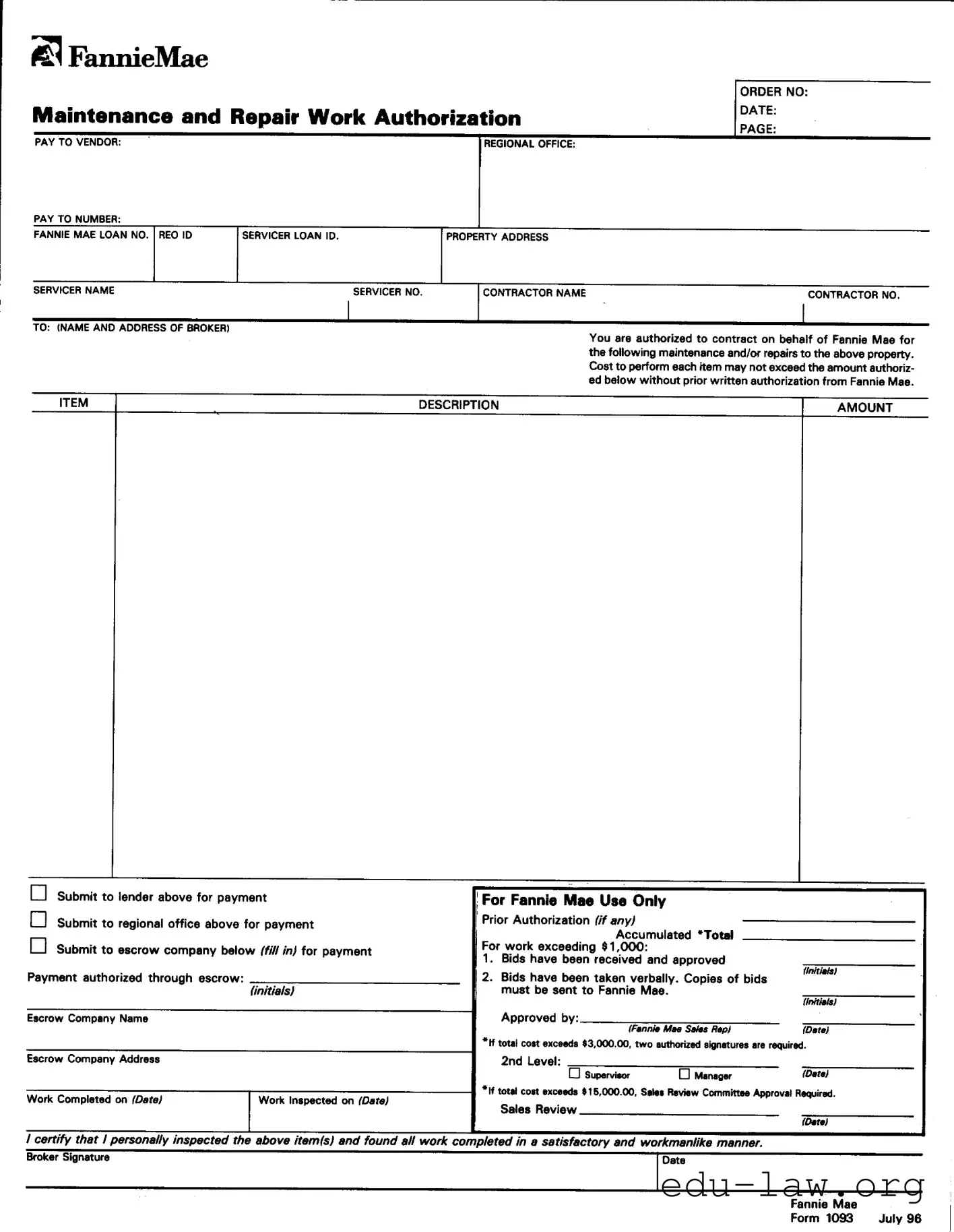
The Fannie Mae 1093 form plays a crucial role in the management of maintenance and repair work for acquired properties. This form serves as a written authorization for brokers or agents to undertake specific repair or maintenance tasks, ensuring that all necessary work is performed efficiently and in compliance with established guidelines. When a broker or agent incurs expenses for such work, they can use the 1093 form to request reimbursement from the servicer. The process involves submitting an original form along with three copies, as well as supporting documentation, including photographs, invoices, and any required lien releases. Upon completion of the work, the broker or agent is responsible for inspecting the results and certifying that the job meets the necessary standards. The servicer, in turn, is tasked with processing the reimbursement requests and ensuring that all payments are made promptly, provided that the expenses have been authorized and properly documented. This streamlined approach not only facilitates effective property management but also helps maintain transparency and accountability throughout the repair process.
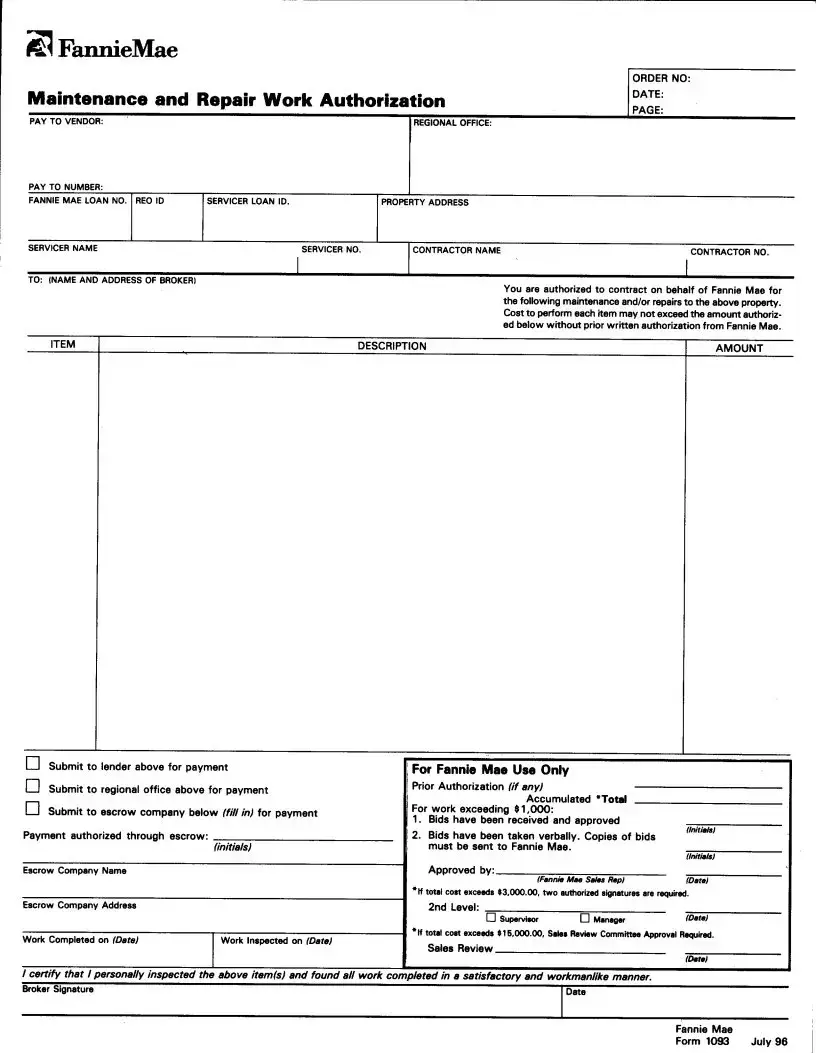

Instructions
Maintenance and Repair Work Authorization
We use this form to authorize brokers or agents to perform certain repair or maintenance work for an acquired property. The broker or agent uses this form to request a servicer to reimburse it for expenses incurred for the maintenance or repair work.
Copies
Original, plus three.
Printing Instructions
This form must be printed on letter size paper, using portrait format. When printing this form, you must use the "shrink to fit" option in the Adobe Acrobat print dialogue box.
Instructions
When we authorize a broker or agent to incur expenses related to repair or maintenance work, we send the broker or agent an original and one copy of this form.
When the work is completed, the broker or agent must inspect it, take photographs, obtain appropriate invoices, and obtain any needed lien releases. Once the broker or agent is satisfied with the completed work, he or she should sign the certification and submit the original and one copy of Form 1093 to the servicer indicated at the top of the
The servicer should pay all invoices that are attached to an original Form 1093, as long as they have been authorized by us and certified by the broker or agent. The servicer may request our verbal authorization if it believes that the broker or agent should be reimbursed before all supporting documentation is available.
To obtain reimbursement for expenses paid to brokers or agents, the servicer should submit a Cash Disbursement Request (Form 571) to us. The servicer should retain a copy of Form
Instructions Page
| Fact Name | Description |
|---|---|
| Purpose | The Fannie Mae 1093 form authorizes brokers or agents to perform maintenance or repair work on acquired properties. |
| Reimbursement Process | Brokers or agents use this form to request reimbursement from the servicer for expenses incurred during maintenance or repair work. |
| Copies Required | The form must be submitted in the original plus three copies. |
| Printing Instructions | This form should be printed on letter-size paper in portrait format, using the "shrink to fit" option in Adobe Acrobat. |
| Inspection Requirement | After completing the work, the broker or agent must inspect it, take photographs, and obtain appropriate invoices and lien releases. |
| Certification | Once satisfied with the work, the broker or agent must sign a certification and submit the original and one copy of Form 1093. |
| Servicer Payment | The servicer is responsible for paying all invoices attached to the original Form 1093 if they have been authorized and certified. |
| Verbal Authorization | The servicer may request verbal authorization for reimbursement if supporting documentation is not yet available. |
| Record Retention | Servicers must retain a copy of Form 1093 and its supporting documentation for their records. |
Completing the Fannie Mae 1093 form involves several specific steps to ensure that brokers or agents can effectively authorize maintenance or repair work and request reimbursement. Following these instructions will help streamline the process and facilitate timely payment for services rendered.
What is the purpose of the Fannie Mae 1093 form?
The Fannie Mae 1093 form is designed to authorize brokers or agents to perform maintenance or repair work on properties acquired by Fannie Mae. This form serves as a request for reimbursement of expenses incurred during the maintenance or repair process. By using this form, brokers and agents can ensure that they are compensated for their efforts in managing property upkeep.
How many copies of the Fannie Mae 1093 form are required?
When completing the Fannie Mae 1093 form, it is essential to prepare the original form plus three additional copies. This ensures that all necessary parties have the documentation they need for record-keeping and reimbursement purposes.
What are the printing instructions for the Fannie Mae 1093 form?
The form must be printed on letter-sized paper in portrait format. It is crucial to select the "shrink to fit" option in the Adobe Acrobat print dialogue box to ensure that the content fits correctly on the page. Proper formatting is vital for the form's acceptance and processing.
What steps should a broker or agent take after completing the repair work?
After the repair or maintenance work is completed, the broker or agent must conduct an inspection of the work. They should take photographs, obtain appropriate invoices, and secure any necessary lien releases. Once satisfied with the quality of the work, the broker or agent should sign the certification on the form and submit the original and one copy of Form 1093 to the designated servicer, along with the supporting documentation.
What happens to the invoices attached to the Fannie Mae 1093 form?
The servicer is responsible for paying all invoices attached to the original Form 1093, provided that these invoices have been authorized by Fannie Mae and certified by the broker or agent. This process ensures that expenses are managed effectively and that all parties are compensated as agreed.
Can a servicer request reimbursement before all supporting documentation is available?
Yes, the servicer may request verbal authorization from Fannie Mae if it believes that the broker or agent should be reimbursed before all necessary documentation is complete. This flexibility allows for timely payments while ensuring that proper procedures are still followed.
How does a servicer submit a request for reimbursement?
To obtain reimbursement for expenses paid to brokers or agents, the servicer must submit a Cash Disbursement Request using Form 571. This form is essential for tracking and processing reimbursement requests, ensuring that all financial transactions are documented and handled appropriately.
What should a servicer do with the Fannie Mae 1093 form and its supporting documentation?
The servicer should retain a copy of Form 1093 along with all supporting documentation for its records. This practice is important for maintaining accurate financial records and ensuring compliance with Fannie Mae's policies and procedures.
Inadequate Documentation: Failing to include necessary supporting documents such as photographs, invoices, and lien releases can lead to delays in reimbursement. Ensure all required documentation is submitted with the form.
Incorrect Copies: Submitting fewer than the required copies of the form can cause processing issues. Remember to send the original plus three copies of Form 1093.
Improper Printing: Not using letter size paper or neglecting to select the "shrink to fit" option in the print dialogue can result in an unreadable form. Always follow the specified printing instructions.
Missing Signatures: Forgetting to sign the certification section of the form can lead to rejection. Ensure that the broker or agent signs the form after inspecting the completed work.
Failure to Inspect: Not conducting a thorough inspection of the completed work before submitting the form can result in reimbursement issues. The broker or agent must be satisfied with the work performed.
Incorrect Servicer Information: Providing the wrong servicer name or contact information at the top of the form can delay processing. Double-check that the correct servicer is indicated.
The Fannie Mae 1093 form is utilized primarily for authorizing maintenance and repair work on acquired properties. Several other documents often accompany this form to ensure proper processing and reimbursement of expenses. Below is a list of these related documents, each described briefly.
These documents collectively support the processing of maintenance and repair requests, ensuring that all parties involved have the necessary information and approvals to facilitate reimbursement and maintain property standards.
The Fannie Mae 1093 form shares similarities with the HUD-1 Settlement Statement. Both documents are used in real estate transactions to outline costs and expenses. The HUD-1 provides a detailed breakdown of all charges related to a property closing, while the Fannie Mae 1093 focuses specifically on maintenance and repair costs incurred after property acquisition. Each form ensures that all parties involved are aware of the financial obligations associated with their respective transactions.
Another similar document is the 4506-T form, which is used to request tax return transcripts. While the Fannie Mae 1093 deals with property maintenance expenses, the 4506-T ensures that lenders can verify a borrower’s income. Both forms require signatures and are essential for processing requests, ensuring transparency and accountability in financial dealings.
The IRS Form 8821, which authorizes the release of tax information, also resembles the Fannie Mae 1093. Both documents require signatures from the involved parties to proceed with specific requests. The Form 8821 allows third parties to access tax information, similar to how the Fannie Mae 1093 authorizes brokers or agents to incur expenses on behalf of property owners.
The Cash Disbursement Request (Form 571) is another document that aligns with the Fannie Mae 1093. While the 1093 authorizes maintenance work and requests reimbursement, Form 571 is specifically used to request the actual disbursement of funds. Both forms are critical in ensuring that expenses are tracked and reimbursed properly within the real estate framework.
The Work Order form is also similar in function. It is used to authorize specific maintenance tasks on a property. Like the Fannie Mae 1093, it outlines the work to be done and may require approval from property owners. Both documents help manage and document maintenance activities, ensuring that all parties agree on the scope and costs involved.
The Contractor Agreement is another comparable document. This agreement details the terms between a property owner and a contractor for repair or maintenance work. While the Fannie Mae 1093 focuses on the reimbursement process after work is completed, the Contractor Agreement outlines the responsibilities and expectations before the work begins. Both documents are essential for clear communication and accountability in property maintenance.
The Invoice form is also similar, as it itemizes the costs of services rendered. While the Fannie Mae 1093 is used to request reimbursement for those costs, the Invoice serves as proof of the expenses incurred. Both documents are vital for financial record-keeping and ensure that all parties have a clear understanding of the costs associated with property maintenance.
Finally, the Property Management Agreement shares similarities with the Fannie Mae 1093. This agreement defines the relationship between a property owner and a management company, including maintenance responsibilities. While the Fannie Mae 1093 focuses on specific repair authorizations and reimbursements, both documents ensure that property management tasks are clearly defined and documented for accountability.
When filling out the Fannie Mae 1093 form, it is crucial to follow specific guidelines to ensure the process runs smoothly. Below are six important dos and don'ts to consider.
Adhering to these guidelines will facilitate the reimbursement process and help avoid potential delays. Proper documentation and attention to detail are essential in this procedure.
Misconceptions about the Fannie Mae 1093 form can lead to confusion and errors in the maintenance and repair process. Here are six common misunderstandings:
Understanding the Fannie Mae 1093 form is essential for anyone involved in property maintenance and repair work. Here are key takeaways regarding its use: