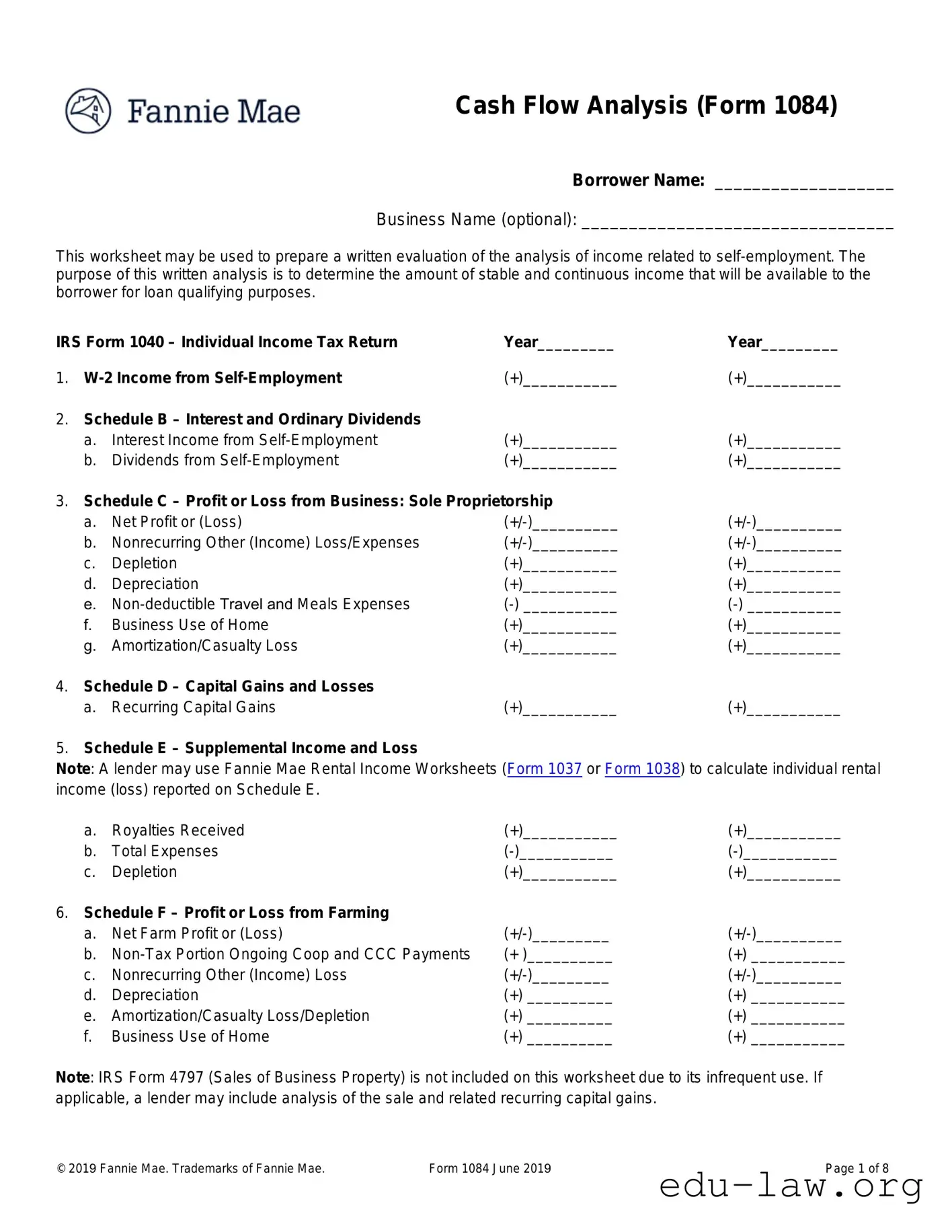
The Fannie 1084 form, officially known as the Cash Flow Analysis form, serves as a vital tool for lenders assessing the financial stability of self-employed borrowers. This comprehensive worksheet is designed to evaluate various income sources, ensuring that borrowers can demonstrate a stable and continuous income stream for loan qualification purposes. The form encompasses a wide array of financial documentation, including IRS forms like the 1040, 1065, and 1120S, which help in detailing income from self-employment, partnerships, and S corporations. Key sections of the form require borrowers to report W-2 income, interest and dividend income, as well as profits or losses from business activities, including sole proprietorships and farming operations. Additionally, it allows for adjustments to cash flow based on various deductions such as depreciation and non-deductible expenses. By capturing these details, the Fannie 1084 form not only aids lenders in making informed decisions but also helps borrowers present a clearer picture of their financial health.

Cash Flow Analysis (Form 1084)
Borrower Name: ___________________
Business Name (optional): _________________________________
This worksheet may be used to prepare a written evaluation of the analysis of income related to
IRS Form 1040 – Individual Income Tax Return |
Year_________ |
Year_________ |
||
1. |
(+)___________ |
(+)___________ |
||
2. |
Schedule B – Interest and Ordinary Dividends |
|
|
|
|
a. |
Interest Income from |
(+)___________ |
(+)___________ |
|
b. |
Dividends from |
(+)___________ |
(+)___________ |
3.Schedule C – Profit or Loss from Business: Sole Proprietorship
a. Net Profit or (Loss) |
|||
b. Nonrecurring Other (Income) Loss/Expenses |
|||
c. |
Depletion |
(+)___________ |
(+)___________ |
d. |
Depreciation |
(+)___________ |
(+)___________ |
e. |
|||
f. |
Business Use of Home |
(+)___________ |
(+)___________ |
g. |
Amortization/Casualty Loss |
(+)___________ |
(+)___________ |
4.Schedule D – Capital Gains and Losses
a. Recurring Capital Gains |
(+)___________ |
(+)___________ |
5.Schedule E – Supplemental Income and Loss
Note: A lender may use Fannie Mae Rental Income Worksheets (Form 1037 or Form 1038) to calculate individual rental income (loss) reported on Schedule E.
a. |
Royalties Received |
(+)___________ |
(+)___________ |
b. |
Total Expenses |
||
c. |
Depletion |
(+)___________ |
(+)___________ |
6.Schedule F – Profit or Loss from Farming
a. Net Farm Profit or (Loss) |
|||
b. |
(+ )__________ |
(+) ___________ |
|
c. Nonrecurring Other (Income) Loss |
|||
d. |
Depreciation |
(+) __________ |
(+) ___________ |
e. |
Amortization/Casualty Loss/Depletion |
(+) __________ |
(+) ___________ |
f. |
Business Use of Home |
(+) __________ |
(+) ___________ |
Note: IRS Form 4797 (Sales of Business Property) is not included on this worksheet due to its infrequent use. If applicable, a lender may include analysis of the sale and related recurring capital gains.
© 2019 Fannie Mae. Trademarks of Fannie Mae. |
Form 1084 June 2019 |
Page 1 of 8 |
Partnership or S Corporation
A
the income was actually distributed to the borrower, or
the business has adequate liquidity to support the withdrawal of earnings. If the Schedule
Note: See the Instructions for additional guidance on documenting access to income and business liquidity.
IRS Form 1065 - Partnership |
Income |
|
|
|
7. Schedule |
– Partner’s Share of Income |
Year__________ |
Year__________ |
|
a. |
Ordinary Income (Loss) |
|||
b. Net Rental Real Estate; Other Net Income (Loss) |
||||
c. |
Guaranteed Payments to Partner |
(+)____________ |
(+) ___________ |
|
8.Form 1065 - Adjustments to Business Cash Flow
a. Ordinary (Income) Loss from Other Partnerships |
|||
b. Nonrecurring Other (Income) Loss |
|||
c. |
Depreciation |
(+) __________ |
(+) ___________ |
d. |
Depletion |
(+) __________ |
(+) ___________ |
e. |
Amortization/Casualty Loss |
(+) __________ |
(+) ___________ |
f. Mortgages or Notes Payable in Less than 1 Year |
|||
g. |
|||
h. |
Subtotal |
____________ |
_____________ |
i. |
Total Form 1065 |
____________ |
_____________ |
|
(Subtotal multiplied by % of ownership) |
||
IRS Form 1120S – S Corporation Earnings |
Year__________ |
Year__________ |
9.Schedule
a. |
Ordinary Income (Loss) |
||
b. |
Net Rental Real Estate; Other Net Rental Income (Loss) |
||
10.Form 1120S - Adjustments to Business Cash Flow
a. Nonrecurring Other (Income) Loss |
|||
b. |
Depreciation |
(+)__________ |
(+)___________ |
c. |
Depletion |
(+)__________ |
(+)___________ |
d. |
Amortization/Casualty Loss |
(+)__________ |
(+)___________ |
e. Mortgages or Notes Payable in Less than 1 Year |
|||
f. |
|||
g. |
Subtotal |
____________ |
_____________ |
h. |
Total Form 1120S |
|
|
|
(Subtotal multiplied by % of ownership) |
____________ |
_____________ |
© 2019 Fannie Mae. Trademarks of Fannie Mae. |
Form 1084 June 2019 |
Page 2 of 8 |
IRS Form 1120 – Regular Corporation
Corporation earnings may be used when the borrower(s) own 100% of the corporation.
11. Form 1120 – Regular Corporation |
Year_________ |
Year_________ |
|
|
|
||
a. |
Taxable Income |
____________ |
_____________ |
b. |
Total Tax |
||
c. |
Nonrecurring (Gains) Losses |
||
d. Nonrecurring Other (Income) Loss |
|||
e. |
Depreciation |
(+)__________ |
(+)___________ |
f. |
Depletion |
(+)__________ |
(+)___________ |
g. |
Amortization/Casualty Loss |
(+)__________ |
(+)___________ |
h. Net Operating Loss and Special Deductions |
(+)__________ |
(+)___________ |
|
i. Mortgages or Notes Payable in Less than 1 Year |
|||
j. |
|||
k. |
Subtotal |
____________ |
_____________ |
l. Less: Dividends Paid to Borrower |
|||
m. Total Form 1120 |
____________ |
_____________ |
|
© 2019 Fannie Mae. Trademarks of Fannie Mae. |
Form 1084 June 2019 |
Page 3 of 8 |
CASH FLOW ANALYSIS (Fannie Mae Form 1084)
Instructions
Guidance for documenting access to income and business liquidity
If the Schedule
If the Schedule
IRS Form 1040 – Individual Income Tax Return
1.
2.Schedule B – Interest and Ordinary Dividends
Line 2a - Interest Income from
Line 2b - Dividends from
3.Schedule C – Profit or Loss from Business: Sole Proprietorship
Line 3a - Net Profit or Loss: Record the net profit or (loss) reported on Schedule C.
Line 3b - Nonrecurring Other (Income) Loss/ Expense: Other income reported on Schedule C represents income that is not directly related to business receipts. Deduct other income unless the income is determined to be recurring. If the income is determined to be recurring, no adjustment is required. Other loss may be added back when it is determined that the loss will not continue.
Line 3c - Depletion: Add back the amount of the depletion deduction reported on Schedule C.
Line 3d - Depreciation: Add back the amount of the depreciation deduction reported on Schedule C. Vehicle depreciation included as part of the standard mileage deduction may be added back by multiplying the business miles driven by the depreciation factor for the respective year.
Line 3e -
Line 3f - Business Use of Home: Add back the expenses deducted for the business use of home.
© 2019 Fannie Mae. Trademarks of Fannie Mae. |
Form 1084 June 2019 |
Page 4 of 8 |
Line 3g - Amortization/Casualty Loss: Add back the expense deducted for amortization along with the expense associated with
4.Schedule D – Capital Gains and Losses
Line 4a - Recurring Capital Gains: Identify the amount of recurring capital gains. Schedule D may report business capital gains passed through to the borrower on Schedule
Note: Business capital losses identified on Schedule D do not have to be considered when calculating income or liabilities, even if the losses are recurring.
5.Schedule E – Supplemental Income and Loss
Note: Use Fannie Mae Rental Income Worksheets (Form 1037 or Form 1038) to evaluate individual rental income (loss) reported on Schedule E. Refer to Selling Guide,
Partnerships and S corporation income (loss) reported on Schedule E is addressed below.
Line 5a - Royalties Received: Include royalty income which meets eligibility standards.
Line 5b - Total Expenses: Deduct the expenses related to royalty income used in qualifying the borrower.
Line 5c - Depletion: Add back the amount of the depletion deduction related to royalty income used in qualifying the borrower.
6.Schedule F – Profit or Loss from Farming
Line 6a - Net Farm Profit or (Loss): Record the net farm profit or (loss) reported on Schedule F.
Line 6b -
Line 6c - Nonrecurring Other (Income) Loss: Other income reported on Schedule F represents income received by a farmer that was not obtained through farm operations. Deduct other income unless the income is determined to be recurring. If the income is determined to be recurring, no adjustment is required. Other loss may be added back when it is determined that the loss will not continue.
Line 6d - Depreciation: Add back the amount of the depreciation deduction reported on Schedule F.
Line 6e - Amortization/Casualty Loss/Depletion: Add back the expense deducted for amortization/depletion along with the expense associated with
Line 6f - Business Use of Home: Add back the expenses deducted for the business use of home.
© 2019 Fannie Mae. Trademarks of Fannie Mae. |
Form 1084 June 2019 |
Page 5 of 8 |
Partnership or S Corporation
IRS Form 1065 – Partnership Income
7.Schedule
Line 7a - Ordinary Income (Loss): Record the amount of ordinary income (loss) reported to the borrower in Box 1 of Schedule
Line 7b - Net Rental Real Estate; Other Net Income (Loss): Record the amount of net rental real estate; other net income (loss) reported to the borrower in Box 2 and/or 3 of Schedule
Line 7c - Guaranteed Payments to Partner: Add guaranteed payments to partner when the borrower has a two- year history of receipt.
8.Adjustments to Business Cash Flow – Form 1065
When business tax returns are obtained by the lender, the following adjustments to business cash flow should be made.
Line 8a - Ordinary income (loss) from other Partnerships: In order to consider ordinary income from other partnerships, the lender must obtain additional documentation to confirm the income passed through from the other partnership to the borrower’s business meets partnership income eligibility standards. Deduct ordinary income passed through to the borrower’s business from other partnerships unless this additional action is taken. Losses passed through to the borrower’s business may be added back when the lender determines
Line 8b - Nonrecurring Other (Income) Loss: Other income reported on Form 1065 generally represents income that is not directly related to business receipts. Deduct other income unless the income is determined to be recurring. If the income is determined to be recurring, no adjustment is required. Other loss may be added back when it is determined that the loss will not continue.
Line 8c - Depreciation: Add back the amount of the depreciation deduction reported on Form 1065 and/or on Form 8825.
Line 8d - Depletion: Add back the amount of the depletion deduction reported on Form 1065.
Line 8e - Amortization/Casualty Loss: Add back the expense deducted for amortization/depletion along with the expense associated with
Line 8f - Mortgage or Notes Payable in Less than 1 Year: Subtract the amount of mortgage or note obligations payable in less than one year, as reported in Schedule L of Form 1120S, end of year column. This deduction is not required for lines of credit or if there is evidence that these obligations roll over regularly and/or the business has sufficient liquid assets to cover them.
Line 8g -
Line 8h - Subtotal: Total lines 8a – 8g.
Line 8i - Form 1065 Total: To arrive at the borrower’s proportionate share of adjustments to business cash flow, multiply the subtotal (line 8h) by the borrower’s percentage of ownership (the borrower’s ending percentage of capital ownership as reported on the Schedule
© 2019 Fannie Mae. Trademarks of Fannie Mae. |
Form 1084 June 2019 |
Page 6 of 8 |
IRS Form 1120S – S Corporation Earnings
9.Schedule
Line 9a - Ordinary Income (Loss): Record the amount of ordinary income (loss) reported to the borrower in Box 1 of Schedule
Line 9b - Net Rental Real Estate; Other Net Income (Loss): Record the amount of net rental real estate; other net income (loss) reported to the borrower in Box 2 and/or 3 of Schedule
10.Adjustments to Business Cash Flow – Form 1120S
When business tax returns are obtained by the lender, the following adjustments to business cash flow should be made.
Line 10a - Nonrecurring Other (Income) Loss: Other income reported on Form 1120S generally represents income that is not directly related to business receipts. Deduct other income unless the income is determined to be recurring. If the income is determined to be recurring, no adjustment is required. Other loss may be added back when it is determined that the loss will not continue.
Line 10b - Depreciation: Add back the amount of the depreciation deduction reported on Form 1120S and/or or Form 8825.
Line 10c - Depletion: Add back the amount of the depletion deduction reported on Form 1120S.
Line 10d - Amortization/Casualty Loss: Add back the expense deducted for amortization/depletion along with the expense associated with
Line 10e - Mortgage or Notes Payable in Less than 1 Year: Subtract the amount of mortgage or note obligations payable in less than one year, as reported in Schedule L of Form 1120S, end of year column. This deduction is not required for lines of credit or if there is evidence that these obligations rollover regularly and/or the business has sufficient liquid assets to cover them.
Line 10f -
Line 10g - Subtotal: Total lines 10a – 10f.
Line 10h - Form 1120S Total: To arrive at the borrower’s proportionate share of adjustments to business cash flow, multiply the subtotal (line 10g) by the borrower’s percentage of stock for tax year reported on the Schedule
IRS Form 1120 – Regular Corporation
11.Regular Corporation – Form 1120
When business tax returns are obtained by the lender, the following adjustments to business cash flow should be made.
Line 11a - Taxable Income: Record the taxable income reported by the business on the first page of Form 1120.
Line 11b - Total Tax: Deduct the corporation‘s tax liability identified on page 1 of Form 1120.
Line 11c - Nonrecurring Other (Gains) Losses: Deduct gains unless it is determined that the gains are likely to continue. Losses may be added back when it can be determined that the loss is a
© 2019 Fannie Mae. Trademarks of Fannie Mae. |
Form 1084 June 2019 |
Page 7 of 8 |
Line 11d - Nonrecurring Other (Income) Loss: Other income reported on Form 1120 generally represents income that is not directly related to business receipts. Deduct other income unless the income is determined to be recurring. If the income is determined to be recurring, no adjustment is required. Other loss may be added back when it is determined that the loss will not continue.
Line 11e - Depreciation: Add back the amount of the depreciation deduction reported on Form 1120.
Line 11f - Depletion: Add back the amount of the depletion deduction reported on Form 1120S.
Line 11g - Amortization/Casualty Loss: Add back the expense deducted for amortization/depletion along with the expense associated with
Line 11h - Net Operating Loss and Special Deductions: Add back the full amount of the deduction related to net operating loss and/or special deductions.
Line 11i - Mortgage or Notes Payable in Less than 1 Year: Subtract the amount of mortgage or note obligations payable in less than one year, as reported in Schedule L of Form 1120S, end of year column. This deduction is not required for lines of credit or if there is evidence that these obligations roll over regularly and/or the business has sufficient liquid assets to cover them.
Line 11j -
Line 11k - Subtotal: Total lines 11a – 11j.
Line 11l - Dividends Paid to Borrower: Dividends paid to stockholders are reported on Schedule
Line 11m - Form 1120 Total: Subtract 11l from 11k to determine the adjustments to business tax flow that may be considered when the borrower(s) own 100% of the corporation and the business has adequate liquidity to support the withdrawal of earnings.
© 2019 Fannie Mae. Trademarks of Fannie Mae. |
Form 1084 June 2019 |
Page 8 of 8 |
| Fact Name | Description |
|---|---|
| Purpose | The Fannie 1084 form is used to analyze the cash flow of self-employed borrowers, helping lenders assess stable income for loan qualification. |
| Components | This form includes various income sources such as W-2 income, Schedule C profits, and rental income, providing a comprehensive view of a borrower’s financial situation. |
| Documentation Requirements | Borrowers must provide documentation like IRS forms (1040, 1065, 1120S) and Schedule K-1 to verify income, ensuring lenders have adequate proof of earnings. |
| State-Specific Regulations | Each state may have unique laws governing the use of the Fannie 1084 form. It is essential for lenders to check local regulations to ensure compliance. |
| Version | The current version of the Fannie 1084 form was published in June 2019, and it includes updates relevant to self-employment income analysis. |
Completing the Fannie Mae Form 1084 requires careful attention to detail, as it serves as a tool for evaluating income related to self-employment. This form will help provide a clear picture of the stable income available to a borrower for loan qualification purposes. Below are the steps to effectively fill out the form.
What is the purpose of the Fannie 1084 form?
The Fannie 1084 form, also known as the Cash Flow Analysis form, is designed to help lenders evaluate the income of self-employed borrowers. Its primary goal is to determine the amount of stable and continuous income available for loan qualifying purposes. By analyzing various income sources, including self-employment income, dividends, and rental income, this form provides a comprehensive view of a borrower's financial situation. This analysis is crucial for lenders as it helps them make informed decisions about loan approvals and terms.
Who should use the Fannie 1084 form?
This form is primarily intended for self-employed individuals seeking to qualify for a loan. If you own a business, whether as a sole proprietor, partner, or shareholder in an S Corporation, the Fannie 1084 form can help present your income in a structured manner. Additionally, lenders may use this form to assess the financial viability of your business, ensuring that you have a stable income to support loan repayment. It is essential for anyone whose income may not be as straightforward as a traditional salary.
What information is required to complete the Fannie 1084 form?
To fill out the Fannie 1084 form, you will need various financial documents and details. This includes your IRS Form 1040, which outlines your individual income tax return, as well as any relevant schedules such as Schedule C for sole proprietorship income, Schedule E for rental income, and Schedule K-1 for partnership or S Corporation income. You will need to provide figures for net profits, dividends, interest income, and any adjustments related to business expenses. Gathering this information accurately is crucial for a thorough cash flow analysis.
How does the Fannie 1084 form impact loan approval?
The information provided on the Fannie 1084 form plays a significant role in the loan approval process. Lenders use the cash flow analysis to assess your income stability and ability to repay the loan. A clear and accurate representation of your financial situation can enhance your chances of approval. If the analysis shows a consistent income stream, it may lead to more favorable loan terms. Conversely, if the income appears unstable or insufficient, it could impact the lender's decision. Thus, it is vital to complete the form carefully and ensure that all income sources are documented accurately.
Incomplete Information: Many individuals fail to fill in all required fields. Leaving out the borrower's name or business name can cause delays in processing.
Incorrect Year Reporting: Users often enter the wrong tax years for their income documentation. This mistake can lead to miscalculations of income stability.
Misclassification of Income: Some people mislabel their income sources. For instance, failing to distinguish between ordinary income and nonrecurring income can skew the analysis.
Omitting Necessary Schedules: Skipping relevant schedules, such as Schedule C or Schedule K-1, may result in an incomplete financial picture, affecting loan eligibility.
Inaccurate Calculations: Errors in adding or subtracting income and expenses can lead to incorrect cash flow assessments. Double-checking figures is crucial.
Failure to Document Business Liquidity: Not providing adequate documentation for business liquidity can hinder the ability to include certain income sources in the analysis.
The Fannie Mae Form 1084 is essential for analyzing cash flow related to self-employment income. To complete this analysis accurately, several other forms and documents are often used in conjunction with the 1084. Below is a list of these documents, along with a brief description of each.
These documents collectively provide a comprehensive view of a borrower's income situation. Using them in conjunction with the Fannie Mae Form 1084 ensures a thorough cash flow analysis for self-employed individuals.
The IRS Form 1040 is a foundational document for individual income tax reporting. Similar to the Fannie 1084 form, it captures essential financial data that can be used to assess a borrower’s income stability. Both forms require detailed information on various income sources, including wages, dividends, and business profits. This comprehensive approach allows lenders to evaluate a borrower’s overall financial health, ensuring that all potential income streams are considered in the loan qualification process.
Schedule C, which details profit or loss from a sole proprietorship, parallels the Fannie 1084 in its focus on self-employment income. Both documents require a breakdown of income and expenses, allowing lenders to determine the net profit available for loan consideration. The inclusion of nonrecurring income and specific deductions in both forms helps ensure that only stable, continuous income is factored into the borrower’s cash flow analysis.
Schedule E, which reports supplemental income and loss, is another document similar to the Fannie 1084. It provides insights into various income sources, such as rental income and royalties, which are crucial for self-employed borrowers. The Fannie 1084 form leverages information from Schedule E to assess rental income, ensuring that all income types are adequately documented and evaluated for loan eligibility.
IRS Form 1065, which reports partnership income, shares similarities with the Fannie 1084 form in assessing income from partnerships or S corporations. Both forms require documentation of earnings and distributions to the borrower, ensuring that only verified income is included in the cash flow analysis. This process helps lenders confirm that borrowers have access to the income they claim, fostering a transparent evaluation of financial stability.
IRS Form 1120S, which outlines S corporation earnings, is also comparable to the Fannie 1084. Both documents require a detailed account of income and losses, allowing lenders to assess the financial health of self-employed borrowers who operate through S corporations. The requirement for Schedule K-1 documentation in both forms ensures that only actual distributions to the borrower are considered, reinforcing the integrity of the income assessment.
Finally, IRS Form 1120, which reports income for regular corporations, parallels the Fannie 1084 in its focus on corporate earnings. Both forms require a comprehensive breakdown of taxable income, nonrecurring gains, and losses. This consistency allows lenders to evaluate the financial performance of corporations wholly owned by the borrower, ensuring that all relevant income is considered for loan qualification purposes.
When filling out the Fannie 1084 form, attention to detail is crucial. Here are four important actions to take and avoid:
Understanding the Fannie 1084 form is crucial for self-employed individuals seeking loan qualification. Here are nine common misconceptions about this form:
Addressing these misconceptions can lead to a smoother loan application process. Understanding the details of the Fannie 1084 form is essential for accurate financial representation.
Filling out and using the Fannie 1084 form requires attention to detail and understanding of self-employment income. Here are key takeaways to consider: