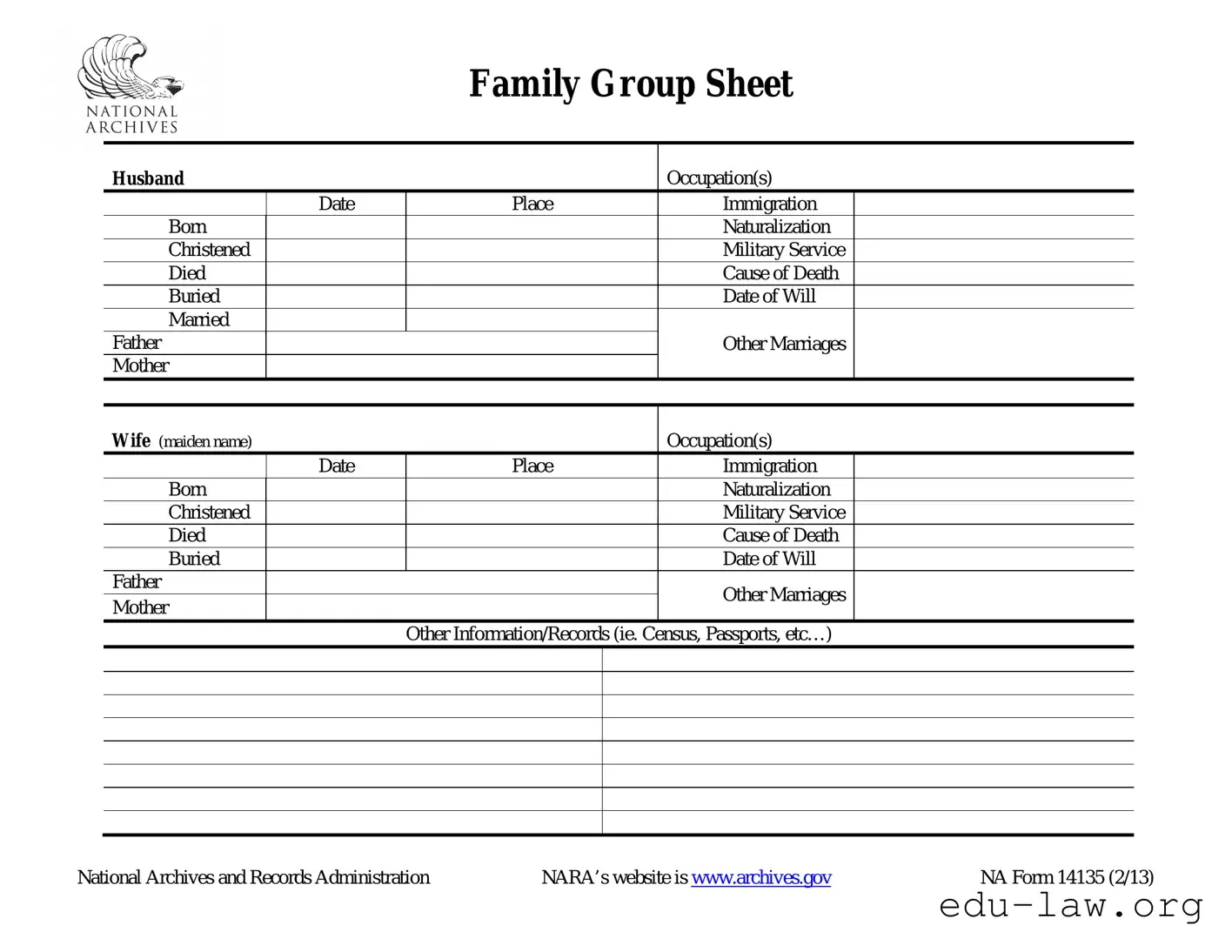
The Family Tree form serves as a vital tool for documenting family lineage and relationships. This comprehensive form captures essential details about each family member, including names, birth dates, and marriage information. It provides sections for both the husband and wife, detailing their occupations, immigration history, and military service, among other significant life events. The form also highlights the couple's children, allowing for a clear representation of direct ancestors and their respective details, such as birth dates and spouses. Additionally, it includes space for recording other relevant information or records, such as census data and passports, which can further enrich family history research. By organizing this information systematically, the Family Tree form aids individuals in tracing their ancestry and understanding their heritage, while the National Archives and Records Administration (NARA) offers guidance and resources to assist in this process.
Family Group Sheet
Husband |
|
|
Occupation(s) |
||
|
Date |
Place |
Immigration |
|
|
Born |
|
|
|
Naturalization |
|
Christened |
|
|
|
Military Service |
|
Died |
|
|
|
Cause of Death |
|
Buried |
|
|
|
Date of Will |
|
Married |
|
|
|
|
|
Father |
|
|
|
Other Marriages |
|
Mother |
|
|
|
|
|
|
|
|
|
||
Wife (maiden name) |
|
|
Occupation(s) |
||
|
Date |
Place |
Immigration |
|
|
Born |
|
|
|
Naturalization |
|
Christened |
|
|
|
Military Service |
|
Died |
|
|
|
Cause of Death |
|
Buried |
|
|
|
Date of Will |
|
Father |
|
|
|
Other Marriages |
|
Mother |
|
|
|
|
|
|
|
|
|
|
|
|
|
Other Information/Records (ie. Census, Passports, etc…) |
|||
|
|
|
|
|
|
|
|
|
|
|
|
|
|
|
|
|
|
|
|
|
|
|
|
|
|
|
|
|
|
|
|
|
|
|
|
|
|
|
|
|
|
|
|
|
|
|
|
National Archives and Records Administration |
NARA’s website is www.archives.gov |
NA Form 14135 (2/13) |

Children
* |
Sex |
Name |
|
Birth |
Date of first marriage |
Date of Death/ Cause |
|
M/F |
Date |
Place |
Name of Spouse |
Place |
|||
|
|
1
2
3
4
5
6
7
8
9
10
11
12
13
14
15
* = Direct Ancestor
National Archives and Records Administration |
NARA’s website is www.archives.gov |
NA Form 14135 (2/13) |
| Fact Name | Description |
|---|---|
| Form Purpose | The Family Tree form is designed to document family lineage and relationships. |
| Governing Law | In many states, the use of family tree forms may be governed by state laws related to genealogy and record-keeping. |
| Husband's Information | The form collects detailed information about the husband, including occupation, immigration, and military service. |
| Wife's Maiden Name | It is essential to include the wife's maiden name for accurate lineage tracking. |
| Children's Details | Information about children includes their sex, birth date, and details of their marriages. |
| Other Marriages | The form allows for the documentation of other marriages for both husband and wife. |
| National Archives | The form is associated with the National Archives and Records Administration (NARA). |
| Additional Records | Users can include other records such as census data and passports for comprehensive documentation. |
| Cause of Death | The form requests the cause of death for both parents and children, which can be important for medical history. |
| Form Version | This specific form is identified as NA Form 14135, with the version date of 2/13. |
Filling out the Family Tree form is a straightforward process that allows you to document your family's history. Once you have completed the form, you can use the information to explore your ancestry further, connect with relatives, or simply preserve your family's story for future generations.
What is the Family Tree form used for?
The Family Tree form is designed to help individuals document their family history and lineage. It serves as a structured way to record vital information about family members, including names, dates of birth, marriages, and other significant life events. This form is particularly useful for genealogical research, allowing families to trace their ancestry and understand their heritage more clearly.
Who should fill out the Family Tree form?
Anyone interested in documenting their family history can fill out the Family Tree form. It is especially beneficial for individuals conducting genealogical research or those wanting to preserve their family legacy for future generations. Family members, such as parents or grandparents, can also contribute to ensure that the information is accurate and comprehensive.
What information is required on the Family Tree form?
The form requires various details about family members, including names, birth dates, marriage dates, and places of significant events. It also asks for information about occupations, military service, immigration, and naturalization. Additionally, there is space to note any other records that may be relevant, such as census data or passports.
How do I obtain a Family Tree form?
The Family Tree form, specifically NA Form 14135, can be accessed online through the National Archives and Records Administration (NARA) website at www.archives.gov. You can download it directly from the site, ensuring you have the most up-to-date version.
Can I add more than one spouse or marriage on the form?
Yes, the Family Tree form allows you to document multiple marriages. There are designated spaces to record the names of spouses and the details of each marriage, ensuring that all relevant information is captured. This is particularly important for individuals with complex family histories.
What if I don't know all the information requested on the form?
It's perfectly fine if you don't have all the information. You can fill in what you know and leave blanks for the details you are unsure about. As you continue your research, you can update the form with new information. The goal is to create a starting point for your family history documentation.
Is the Family Tree form confidential?
The information you provide on the Family Tree form is generally considered private. However, if you choose to share your family tree with others or submit it to public archives, be mindful of how much personal information you disclose. It’s always a good idea to consider privacy concerns, especially regarding living relatives.
How can I use the Family Tree form for genealogical research?
The Family Tree form can serve as a foundational tool for genealogical research. By organizing your family’s information, you can easily identify gaps in your knowledge and areas that require further research. This structured approach can help you connect with historical records, such as census data, birth certificates, and immigration documents, ultimately enriching your family history narrative.
Where can I find additional resources for family history research?
In addition to the Family Tree form, the National Archives and Records Administration (NARA) website offers a wealth of resources for family history research. You can find guides, online databases, and links to other archival resources that can assist you in your journey to uncover your family’s past.
Failing to include full names of all individuals. It is important to provide first, middle, and last names to avoid confusion.
Omitting dates of key life events. Dates of birth, marriage, and death are crucial for establishing timelines.
Neglecting to specify places of significant events. Including cities, states, and countries helps in tracing lineage more accurately.
Using abbreviations or unclear terms. Full terms should be used to ensure clarity, especially regarding occupations and military service.
Leaving out spouse information. Each individual should have their spouse’s name and details listed to maintain complete records.
Not indicating direct ancestors clearly. Marking which individuals are direct ancestors helps in understanding the family structure.
Forgetting to include additional information or records. Details such as census data or immigration records can provide valuable context.
Inaccurate or incomplete occupational details. Providing accurate job titles and descriptions adds depth to each individual’s profile.
Neglecting to check for spelling errors. Mistakes in names or places can lead to difficulties in future research.
The Family Tree form serves as a foundational document for recording family history. Several other forms and documents complement this form by providing additional details about individuals and their relationships. Below is a list of commonly used documents that can enhance family research.
Using these documents in conjunction with the Family Tree form can provide a more comprehensive view of family history. Each document adds layers of understanding to the relationships and events that shape a family's story.
The Family Group Sheet is similar to a Pedigree Chart. Both documents serve to outline family relationships, but the Pedigree Chart focuses more on direct ancestors. It visually represents a person's lineage, typically going back several generations. This chart is often used in genealogical research to trace ancestry and can help identify family connections over time.
Ancestry Forms are another related document. These forms collect detailed information about an individual's ancestors, including names, birth dates, and places of residence. Like the Family Group Sheet, Ancestry Forms aim to document familial ties, but they often include more extensive historical context and may require additional documentation to verify claims.
Birth Certificates share similarities as well. They provide official proof of a person's birth, including details like the date, place, and parentage. While the Family Group Sheet summarizes family relationships, the Birth Certificate serves as a foundational document that can verify the existence of family members and their relationships.
Death Certificates are another important document. They record the details surrounding an individual's death, including the cause, date, and place of death. This document complements the Family Group Sheet by providing essential information about deceased family members, helping to complete the family narrative.
Obituaries serve a similar purpose in documenting family history. They provide a summary of a person's life, including family relationships, achievements, and details about their death. While the Family Group Sheet organizes information in a structured way, obituaries offer a more narrative form, often including personal anecdotes and community impact.
Wills and Testaments are also akin to the Family Group Sheet. These documents outline the distribution of a deceased person's assets and can provide insight into family relationships and dynamics. They often mention beneficiaries, which can help trace family connections and clarify the roles of various family members.
Census Records are another valuable resource. They collect demographic information about households, including names, ages, and relationships. Like the Family Group Sheet, Census Records document family structures but do so at specific points in time, allowing researchers to observe changes in family dynamics over the years.
Finally, Immigration Records are relevant. They provide information about when and where individuals entered a country, often listing family members who traveled together. These records can complement the Family Group Sheet by adding context to family origins and migration patterns, enhancing the understanding of a family's history.
When filling out the Family Tree form, attention to detail is crucial. Here are some important dos and don'ts to keep in mind:
By following these guidelines, you can create a comprehensive and accurate Family Tree that honors your family's history.
Understanding the Family Tree form can be challenging. Here are ten common misconceptions that often arise:
Being aware of these misconceptions can help individuals approach the Family Tree form with a clearer understanding, making the process of documenting family history more effective and enjoyable.
When filling out the Family Tree form, keep these key takeaways in mind: