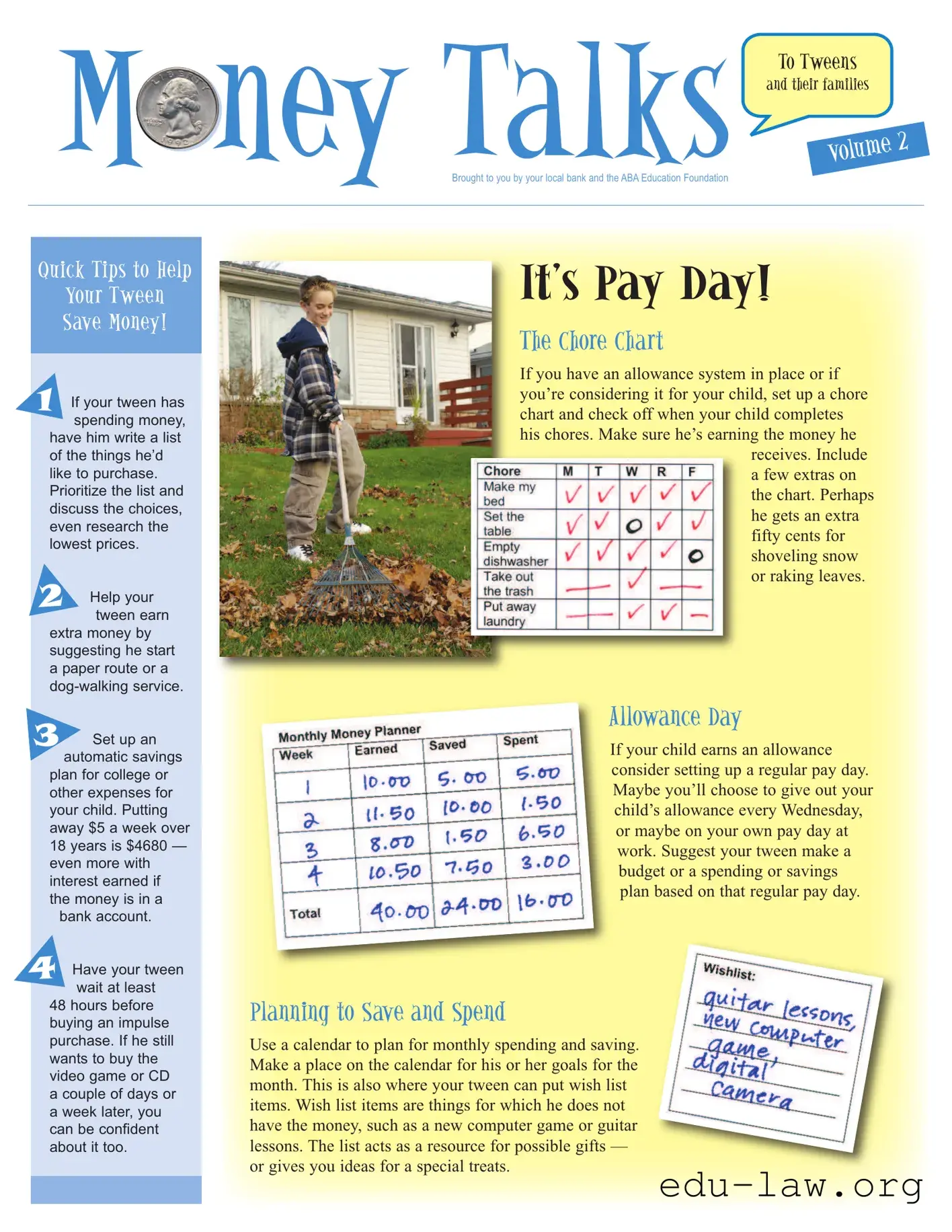
The Family Chore Chart serves as a practical tool designed to help tweens manage their responsibilities while learning essential money management skills. This chart not only outlines the chores that need to be completed but also ties them to an allowance system, reinforcing the idea that hard work leads to financial rewards. By checking off completed tasks, tweens can visually track their progress and feel a sense of accomplishment. The chart encourages parents to include additional tasks that can earn their children extra money, such as shoveling snow or raking leaves. Establishing a regular payday is another critical aspect, allowing tweens to anticipate when they will receive their allowance and plan their spending accordingly. The chart also promotes the importance of budgeting, urging tweens to set financial goals and prioritize their spending. Engaging with trusted adults outside of the family can further enhance learning, as these figures can share personal stories about saving and spending that resonate with tweens. Overall, the Family Chore Chart is a multifaceted approach to teaching financial literacy and responsibility, paving the way for better financial choices in the future.
Mney Talks To Tweens
and their families
Brought to you by your local bank and the ABA Education Foundation
Quick Tips to Help
Your Tween
Save Money!
1 If your tween has spending money, have him write a list of the things he’d like to purchase. Prioritize the list and discuss the choices, even research the lowest prices.
2 Help your tween earn extra money by suggesting he start a paper route or a
3 Set up an automatic savings plan for college or other expenses for your child. Putting away $5 a week over 18 years is $4680 — even more with interest earned if the money is in a bank account.
4 Have your tween wait at least
48 hours before buying an impulse purchase. If he still wants to buy the video game or CD a couple of days or a week later, you can be confident about it too.
It’s Pay Day!
The Chore Chart
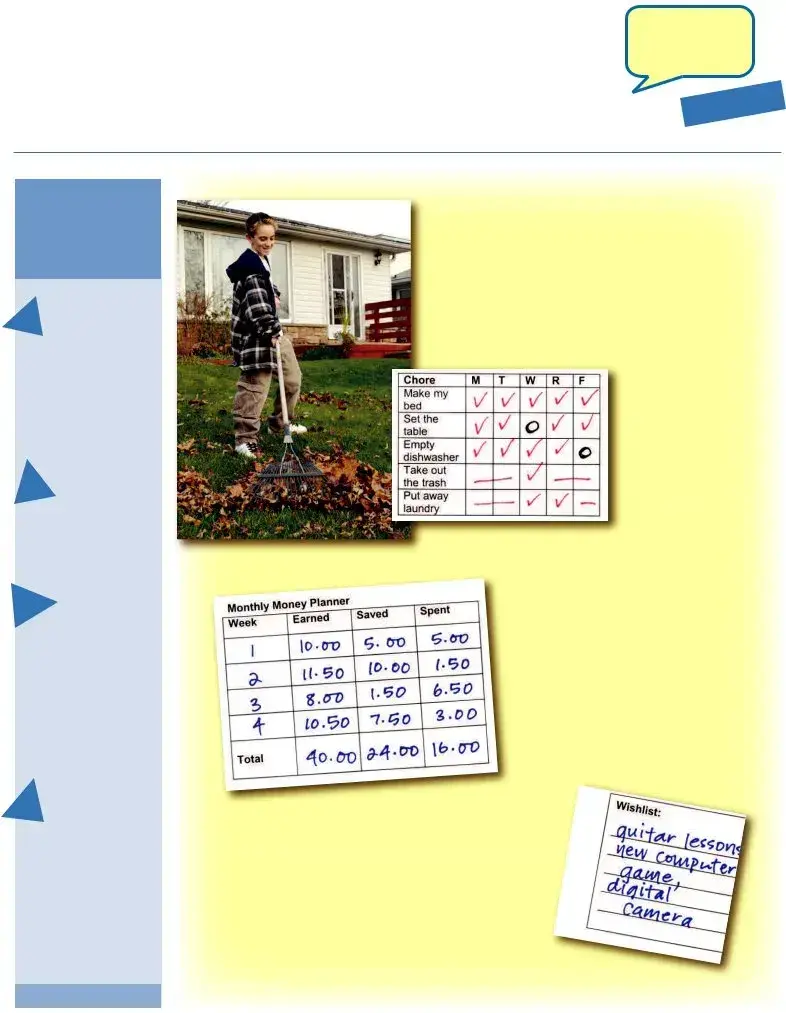
If you have an allowance system in place or if you’re considering it for your child, set up a chore chart and check off when your child completes his chores. Make sure he’s earning the money he
receives. Include a few extras on the chart. Perhaps he gets an extra fifty cents for shoveling snow or raking leaves.
Allowance Day
If your child earns an allowance consider setting up a regular pay day. Maybe you’ll choose to give out your child’s allowance everyWednesday, or maybe on your own pay day at work. Suggest your tween make a budget or a spending or savings plan based on that regular pay day.
Planning to Save and Spend
Use a calendar to plan for monthly spending and saving. Make a place on the calendar for his or her goals for the month.This is also where your tween can put wish list items.Wish list items are things for which he does not have the money, such as a new computer game or guitar lessons.The list acts as a resource for possible gifts — or gives you ideas for a special treats.
Enlist Someone Cool
Parents,guardiansandgrandparentsknowthattothetweenintheirlife,adults
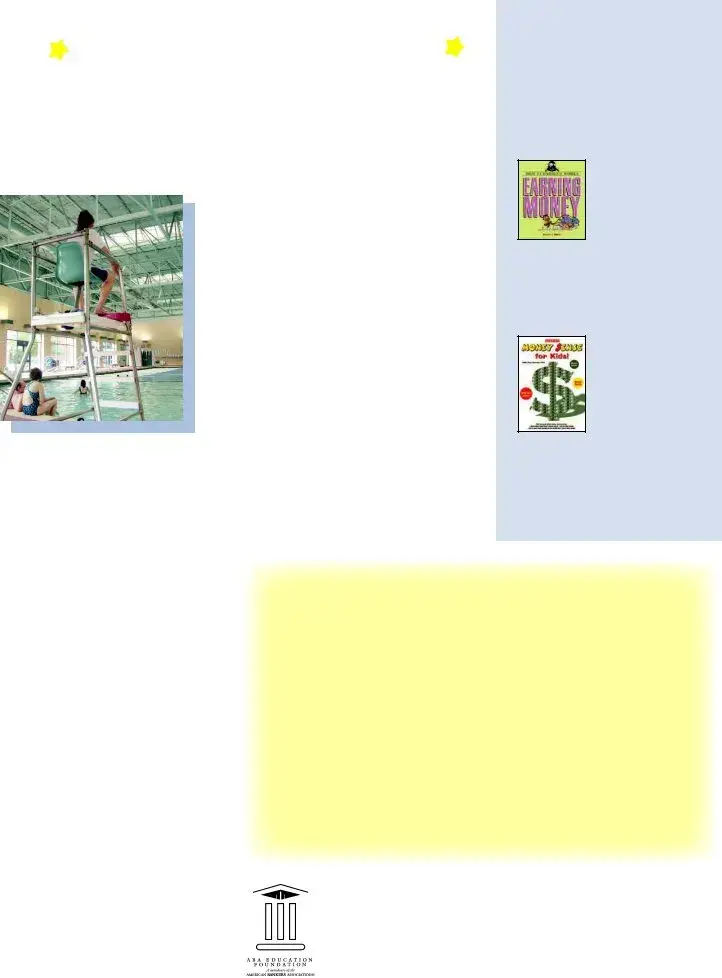
If all of your talking about the importance ofsavingandplanningforthefuturedoesn’t seemtobesinkinginwithyourtween spender,enlistsomeoneheorshethinksis cool.Maybeit’syourdaughter’sbabysitter, alifeguardatthepool,oryourson’ssoccer coach.Asksomeonewithwhomyourchild hasaconnection.
Encouragethatspecialpersoninyour child’slifetodiscussafewbasicmessages aboutsavingandbudgeting.Perhapsyour daughter’sbabysitterwillshareherstoryof savingforherschooltrip.Yourson’ssoccer coachmighthaveagreatstoryabouthowhe
madeextramoneydoingneighbors’chores.Thelifeguardatthepoolmightbe abletoshareacautionarystoryabouthowsheblewlastyear’ssummerwages onatriptothebeach,whenhewassupposedtousehissavingsforadown paymentonacar.WhetherthetalesarebasedonwhattodoorwhatNOTto do,theywillbeinstructive.
Check Out These Books!
Visit your local library or bookstore …
Earning Money: How
Economics Works
By Patricia J. Murphy
This book details how to earn money, either by
requesting an allowance or starting a
Money Sense for Kids
By Hollis Page Harman
This book introduces different types of U.S. currency, an explanation of the complicated path
that money takes from the mint to banks to the consumer, how to earn money and how to make it grow by investing in stocks and bonds. Clear,
Click Your Mouse Here
http://pbskids.org/dontbuyit
(Corporation for Public Broadcasting and Public Broadcasting Service)
Yet another site developed specifically for tweens, Don’t Buy It: Get Media Smart is a media literacy Web site for young people that encourages users to think critically about media and become smart consumers. Activities on the site are designed to provide users with some of the skills and knowledge needed to question, analyze, interpret and evaluate media messages.
www.plasticforkdiaries.com (Maryland Public Television)
This Web site especially for tweens follows six middle school students as they experience
The ABA Education Foundation, a
© 2007 American Bankers Association Education Foundation, Washington, DC. Permission to reprint granted.
| Fact Name | Description |
|---|---|
| Purpose | The Family Chore Chart is designed to help tweens manage their money and responsibilities effectively. |
| Allowance System | It is recommended to establish a regular allowance system tied to completed chores to promote financial responsibility. |
| Impulse Control | Encouraging a 48-hour waiting period before making impulse purchases helps tweens make more thoughtful decisions. |
| Automatic Savings | Setting up an automatic savings plan can significantly benefit a child's future expenses, including college. |
| Parental Guidance | Parents and guardians are encouraged to discuss financial topics with their tweens to instill good money management habits. |
| Cool Influences | Involving a trusted adult that the tween admires can enhance the learning experience regarding financial literacy. |
| Goal Setting | Using a calendar to track spending and saving goals helps tweens visualize their financial objectives. |
| Resource Availability | Books and websites are available to provide additional information on money management for tweens. |
| Educational Support | The ABA Education Foundation provides resources aimed at improving financial literacy among families. |
Filling out the Family Chore Chart form is a straightforward process that helps organize chores and allowances for your child. Follow these steps to ensure you complete the form accurately and effectively.
What is the Family Chore Chart form?
The Family Chore Chart form is a tool designed to help families manage chores and allowances effectively. It allows parents to track their child’s completion of chores, ensuring that children earn their allowance based on the work they do. This structured approach not only teaches responsibility but also instills financial literacy by linking chores to earning money.
How can I implement the chore chart in my home?
To implement the chore chart, start by listing the chores your child can complete. Include daily tasks, like making the bed or cleaning their room, as well as occasional extras, such as shoveling snow or raking leaves. Create a chart where you can check off completed chores. This visual representation helps children see their accomplishments and understand the relationship between work and money.
What are the benefits of using a chore chart?
Using a chore chart offers numerous benefits. It encourages children to take on responsibilities, teaches them the value of hard work, and helps them learn about money management. By associating chores with earning, children gain a sense of achievement and develop budgeting skills as they plan how to spend or save their allowance.
How should I determine the allowance amount?
Determining the allowance amount can depend on various factors, including your family’s financial situation and the chores assigned. Consider setting a base amount that reflects the chores completed regularly. Additionally, you might offer bonuses for extra tasks. This approach not only rewards effort but also helps children understand the connection between work and earnings.
What if my child does not complete their chores?
If your child fails to complete their chores, it’s important to address the situation calmly. Discuss the importance of responsibility and the consequences of not fulfilling their commitments. You might choose to withhold part of their allowance or have them complete the chores before receiving their payment. This reinforces accountability and helps them understand that actions have consequences.
How can I encourage my child to save money?
Encouraging your child to save money can be achieved through various strategies. One effective method is to set up a savings plan where a portion of their allowance goes directly into a savings account. Teach them about the benefits of saving for future goals, such as a new game or a special outing. Additionally, discussing the importance of waiting before making impulse purchases can help them make more thoughtful financial decisions.
What role do parents play in teaching financial literacy?
Parents play a crucial role in teaching financial literacy to their children. Open discussions about money, budgeting, and saving can significantly impact a child’s understanding of financial concepts. By sharing personal experiences and encouraging questions, parents can help their children develop a healthy attitude toward money management. Involving other trusted adults, like babysitters or coaches, can also reinforce these lessons in a relatable way.
Are there resources available to help with financial education?
Yes, there are numerous resources available to assist with financial education for children. Books like "Earning Money: How Economics Works" by Patricia J. Murphy and "Money Sense for Kids" by Hollis Page Harman provide valuable insights into earning, budgeting, and saving. Additionally, websites like PBS Kids’ "Don’t Buy It" offer interactive activities that promote critical thinking about money and media consumption. These resources can enhance your child’s understanding of financial concepts.
How can I make financial discussions engaging for my tween?
To make financial discussions engaging for your tween, incorporate real-life examples and relatable stories. Discussing how money is managed in everyday situations can spark interest. Encourage your child to share their thoughts and feelings about money, and consider using games or apps that simulate financial decision-making. Making these conversations fun and interactive will help your tween absorb important lessons about money management more effectively.
Incomplete Information: Many people forget to fill in all required fields. This can lead to confusion later on. Ensure that every section of the Family Chore Chart is completed.
Lack of Clarity: Using vague descriptions for chores can cause misunderstandings. Clearly define each chore so that everyone knows what is expected.
Ignoring Flexibility: Some families fail to adjust the chore chart as needed. Life can change quickly, so be open to modifying the chart to fit your family's schedule.
Not Involving the Tween: Parents sometimes complete the chart without involving their tween. Encourage your child to participate in creating and managing the chore chart. This fosters responsibility and ownership.
When managing family chores and finances, several documents can complement the Family Chore Chart form. Each of these tools serves a unique purpose, helping families to stay organized and promote good financial habits among children. Here’s a brief overview of some of the most useful forms and documents.
Using these documents alongside the Family Chore Chart can create a structured environment that promotes accountability and financial awareness. By working together, families can instill valuable lessons in money management and cooperation.
The Family Chore Chart form shares similarities with a household budget plan. Both documents aim to provide structure and accountability within a family setting. A household budget plan outlines income and expenses, helping families track their financial health. Similarly, the chore chart tracks tasks completed by children, often linked to allowances or rewards. Both tools encourage responsibility and foster discussions about financial and personal management, making them essential in teaching children valuable life skills.
Another document that mirrors the Family Chore Chart is a goal-setting worksheet. Goal-setting worksheets help individuals articulate their objectives, whether they are related to finances, education, or personal growth. Like the chore chart, which motivates children to complete tasks for rewards, a goal-setting worksheet encourages individuals to outline their aspirations and the steps needed to achieve them. Both documents serve as motivational tools, helping users visualize their progress and stay focused on their commitments.
The chore chart is also comparable to a reward system chart often used in educational settings. Reward system charts are designed to reinforce positive behavior and achievements in students, similar to how a chore chart rewards children for completing household tasks. Both documents use a point or check-off system to track progress, fostering a sense of accomplishment. This encourages children to engage in responsible behaviors, whether in school or at home, by linking actions to tangible rewards.
Additionally, the Family Chore Chart has similarities with a family meeting agenda. Family meeting agendas provide a structured format for discussing important topics, including chores, schedules, and responsibilities. Both documents promote communication within the family unit, ensuring everyone is aware of their roles and expectations. By using a chore chart, families can visualize the distribution of tasks, while a meeting agenda allows for open dialogue about any adjustments or concerns regarding those responsibilities.
Another related document is a savings plan template. Savings plan templates outline specific financial goals and the steps needed to reach them, much like how a chore chart outlines tasks that lead to earning an allowance. Both documents encourage proactive planning and accountability. A savings plan helps individuals manage their money effectively, while a chore chart teaches children the value of work and the rewards that come from completing tasks, reinforcing the importance of saving and spending wisely.
Lastly, the Family Chore Chart is akin to a time management planner. Time management planners help individuals prioritize tasks and allocate time effectively, similar to how a chore chart helps children manage their responsibilities at home. Both tools emphasize the importance of planning and organization. By using a chore chart, children learn to balance their chores with other activities, while a time management planner helps individuals stay on top of their commitments, fostering a sense of discipline and efficiency in both personal and family life.
When filling out the Family Chore Chart form, consider the following guidelines to ensure a smooth and effective process.
By following these dos and don'ts, families can create an effective chore chart that promotes responsibility and financial literacy among tweens.
Here are six common misconceptions about the Family Chore Chart form, along with explanations to clarify each one.
This is not true. While the chart is beneficial for younger children, tweens can also use it to learn responsibility and money management. It helps them track their chores and understand the value of earning money.
Although chores are a primary method for earning an allowance, there are other opportunities. Extra tasks, such as shoveling snow or raking leaves, can also provide additional earnings.
Flexibility is key. The chore chart can evolve based on your tween's growing responsibilities and interests. Adjusting the chart keeps it engaging and relevant.
Linking allowance to completed chores encourages accountability. It teaches tweens that money is earned through effort and responsibility.
The chore chart is a tool that can also support budgeting. By tracking earnings, tweens can create spending and savings plans, reinforcing financial literacy.
Involving tweens in managing the chore chart fosters independence. Encouraging them to take ownership of their chores and earnings builds confidence and decision-making skills.
Key Takeaways for Using the Family Chore Chart