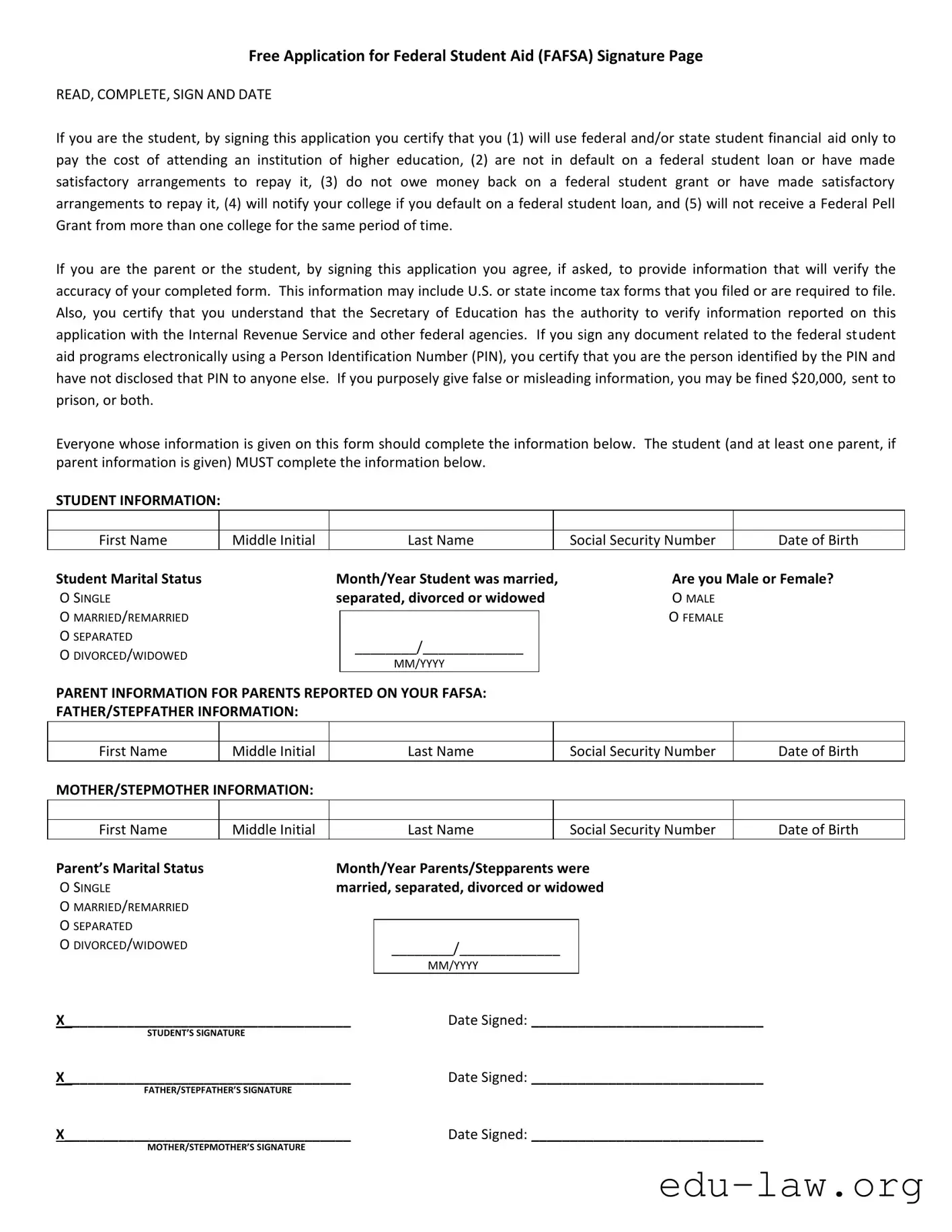
The FAFSA Signature Page is a crucial component of the Free Application for Federal Student Aid, serving as a formal acknowledgment of the information provided in the application. This document requires the student, and at least one parent if applicable, to read, complete, sign, and date it. By signing, the student certifies their commitment to using federal and state financial aid solely for educational expenses and confirms that they are not in default on any federal loans or grants. It also emphasizes the importance of honesty, warning that providing false information can lead to severe penalties. The form collects essential details, including the student’s name, Social Security number, and marital status, along with similar information for the parents. Additionally, it establishes the requirement for verification of the application details, which may involve submitting tax documents. This signature page not only validates the application but also ensures compliance with federal regulations, making it a vital step in securing financial assistance for higher education.

Free Application for Federal Student Aid (FAFSA) Signature Page
READ, COMPLETE, SIGN AND DATE
If you are the student, by signing this application you certify that you (1) will use federal and/or state student financial aid only to pay the cost of attending an institution of higher education, (2) are not in default on a federal student loan or have made satisfactory arrangements to repay it, (3) do not owe money back on a federal student grant or have made satisfactory arrangements to repay it, (4) will notify your college if you default on a federal student loan, and (5) will not receive a Federal Pell Grant from more than one college for the same period of time.
If you are the parent or the student, by signing this application you agree, if asked, to provide information that will verify the accuracy of your completed form. This information may include U.S. or state income tax forms that you filed or are required to file. Also, you certify that you understand that the Secretary of Education has the authority to verify information reported on this application with the Internal Revenue Service and other federal agencies. If you sign any document related to the federal student aid programs electronically using a Person Identification Number (PIN), you certify that you are the person identified by the PIN and have not disclosed that PIN to anyone else. If you purposely give false or misleading information, you may be fined $20,000, sent to prison, or both.
Everyone whose information is given on this form should complete the information below. The student (and at least one parent, if parent information is given) MUST complete the information below.
STUDENT INFORMATION:
First Name
Middle Initial
Last Name
Social Security Number
Date of Birth
Student Marital Status |
|
Month/Year Student was married, |
|
Are you Male or Female? |
|||||||
O SINGLE |
|
separated, divorced or widowed |
|
O MALE |
|
||||||
O MARRIED/REMARRIED |
|
|
|
|
|
|
|
|
O FEMALE |
|
|
|
|
|
|
|
|
|
|
||||
O SEPARATED |
|
|
|
________/_____________ |
|
|
|
|
|
|
|
O DIVORCED/WIDOWED |
|
|
|
|
|
|
|
|
|
||
|
|
|
|
MM/YYYY |
|
|
|
|
|
|
|
|
|
|
|
|
|
|
|
|
|
||
PARENT INFORMATION FOR PARENTS REPORTED ON YOUR FAFSA: |
|
|
|
|
|||||||
FATHER/STEPFATHER INFORMATION: |
|
|
|
|
|
|
|
|
|
|
|
|
|
|
|
|
|
|
|
|
|
|
|
First Name |
Middle Initial |
|
|
|
Last Name |
|
Social Security Number |
|
Date of Birth |
||
MOTHER/STEPMOTHER INFORMATION: |
|
|
|
|
|
|
|
|
|
|
|
|
|
|
|
|
|
|
|
|
|
|
|
First Name |
Middle Initial |
|
|
|
Last Name |
|
Social Security Number |
|
Date of Birth |
||
Parent’s Marital Status |
|
Month/Year Parents/Stepparents were |
|
||||||||
O SINGLE |
|
married, separated, divorced or widowed |
|
||||||||
O MARRIED/REMARRIED |
|
|
|
|
|
|
|
|
|
|
|
O SEPARATED |
|
|
|
|
|
|
|
|
|
|
|
|
|
|
|
|
|
|
|
|
|
|
|
O DIVORCED/WIDOWED |
|
|
|
|
________/_____________ |
|
|
|
|
||
|
|
|
|
|
|
|
|
|
|||
|
|
|
|
|
MM/YYYY |
|
|
|
|
||
X_____________________________________ |
|
Date Signed: ______________________________ |
|
||||||||
STUDENT’S SIGNATURE |
|
|
|
|
|
|
|
|
|
|
|
X_____________________________________ |
|
Date Signed: ______________________________ |
|
||||||||
FATHER/STEPFATHER’S SIGNATURE |
|
|
|
|
|
|
|
|
|
|
|
X_____________________________________ |
|
Date Signed: ______________________________ |
|
||||||||
MOTHER/STEPMOTHER’S SIGNATURE
| Fact Name | Description |
|---|---|
| Purpose | The FAFSA Signature Page confirms that the student and parent(s) agree to the terms for receiving federal and state financial aid. |
| Certification | By signing, the student certifies they will use the aid only for educational costs and are not in default on any federal loans. |
| Verification | The Secretary of Education may verify the information provided with the IRS and other federal agencies. |
| Legal Consequences | Providing false information can lead to fines up to $20,000, imprisonment, or both, under federal law. |
Completing the FAFSA Signature Page is an essential step in the financial aid process. After filling out this form, it must be signed and dated by both the student and at least one parent if parental information is included. This ensures that all parties agree to the terms outlined and that the application can proceed to the next stage.
What is the FAFSA Signature Page form?
The FAFSA Signature Page is a crucial document required for the Free Application for Federal Student Aid (FAFSA). It serves as a certification that the information provided in the application is accurate and that the student and their parents agree to the terms outlined in the form. Signing this page is necessary for the application to be processed.
Who needs to sign the FAFSA Signature Page?
The student applying for financial aid must sign the FAFSA Signature Page. Additionally, at least one parent must also sign if parent information is included in the application. Both signatures are essential for the application to be valid.
What does signing the FAFSA Signature Page certify?
By signing the FAFSA Signature Page, the student certifies several important points. These include the commitment to use financial aid only for educational costs, the acknowledgment of any federal loan defaults, and the understanding that providing false information can lead to severe penalties. Parents also agree to provide verification information if requested.
What information is required on the FAFSA Signature Page?
The FAFSA Signature Page requires basic information about the student and their parents. This includes names, Social Security numbers, dates of birth, and marital statuses. Each individual must provide their signature and the date they signed the form.
What if I cannot sign the FAFSA Signature Page electronically?
If you are unable to sign the FAFSA Signature Page electronically, you can print the page, sign it by hand, and then submit it. Ensure that all required signatures are included before sending it to the appropriate address. This method is acceptable and will not hinder your application process.
What happens if I provide false information on the FAFSA Signature Page?
Providing false or misleading information on the FAFSA Signature Page can have serious consequences. Individuals found to have intentionally misrepresented information may face fines of up to $20,000, imprisonment, or both. It is crucial to ensure that all information is accurate and truthful.
Can I submit the FAFSA without the Signature Page?
No, the FAFSA cannot be processed without the completed and signed Signature Page. The signatures are necessary to confirm the authenticity of the application and the agreement to the terms. Ensure that this page is signed before submission to avoid delays.
What should I do if I lose my FAFSA Signature Page?
If you lose your FAFSA Signature Page, you can print a new one from the FAFSA website. Fill it out again, ensuring all required information is included. Sign it and submit it as soon as possible to keep your application on track.
Is there a deadline for submitting the FAFSA Signature Page?
Yes, there are deadlines for submitting the FAFSA Signature Page. These deadlines can vary by state and institution. It is important to check the specific deadlines for your situation to ensure that your application is submitted on time.
How can I verify that my FAFSA has been processed after signing the Signature Page?
You can verify the status of your FAFSA application by logging into your FAFSA account online. After processing, you will receive a Student Aid Report (SAR) that summarizes your application information. This report indicates whether your application has been successfully processed.
Neglecting to Read Instructions: Many individuals skip the instructions entirely, leading to incomplete or incorrect information.
Missing Signatures: It's crucial for both the student and at least one parent to sign the form. Omitting any signature can delay processing.
Incorrect Social Security Numbers: Entering the wrong Social Security Number can result in significant delays and complications.
Not Using Full Names: Using nicknames or initials instead of full legal names can cause discrepancies in the application.
Inaccurate Dates of Birth: Providing incorrect birth dates can lead to confusion and may require additional verification.
Ignoring Marital Status: Failing to accurately report marital status can affect eligibility for financial aid.
Forgetting to Update Information: If personal circumstances change, such as a divorce or change in income, this must be reflected in the application.
Not Keeping a Copy: Failing to save a copy of the signed form can create issues if there are questions or discrepancies later.
Assuming Electronic Signatures are Valid: If signing electronically, ensure that the PIN is kept secure and not shared with anyone.
Providing False Information: Intentionally giving misleading information can result in severe penalties, including fines and imprisonment.
The FAFSA Signature Page is an important document for students seeking financial aid for higher education. However, it is often accompanied by several other forms and documents that help support the application process. Here’s a list of some common forms you may encounter.
Each of these documents plays a vital role in the financial aid process. Having them ready can help ensure a smoother application experience and increase the chances of receiving the necessary support for education expenses.
The FAFSA Signature Page is similar to a tax return form in that both require individuals to provide accurate personal and financial information. When filing taxes, individuals must sign their returns, affirming that the information provided is true and complete. Just as the FAFSA requires a signature to validate the application for federal student aid, tax returns also necessitate a signature to ensure accountability and compliance with tax laws. Both documents carry serious implications if false information is provided, including potential legal consequences.
Another document that shares similarities with the FAFSA Signature Page is the loan application form. When applying for a loan, whether for personal use or for education, applicants must provide detailed financial information and sign the application. This signature signifies that the borrower understands the terms of the loan and agrees to repay it. Like the FAFSA, the loan application emphasizes the importance of honesty in the information provided, as discrepancies can lead to denial or legal repercussions.
The college enrollment agreement is yet another document akin to the FAFSA Signature Page. This agreement outlines the terms and conditions of a student's enrollment at a college or university. By signing this document, students confirm their understanding of the institution's policies, including financial obligations and academic expectations. Similar to the FAFSA, this agreement requires a signature to validate the student's commitment to the terms laid out by the educational institution.
In addition, the scholarship application form bears resemblance to the FAFSA Signature Page. When applying for scholarships, students often need to provide personal information, academic records, and financial details. A signature is required to certify that the information is accurate and that the applicant agrees to abide by the scholarship's terms. Both documents serve to establish eligibility for financial assistance, emphasizing the importance of honesty in the information submitted.
The rental lease agreement also shares common ground with the FAFSA Signature Page. When individuals sign a lease, they commit to the terms of the rental agreement, which may include payment obligations and maintenance responsibilities. The signature signifies that the renter understands and agrees to the conditions set forth by the landlord. Just as the FAFSA requires a signature to affirm the applicant's commitment to the financial aid process, a lease agreement requires a signature to validate the rental arrangement.
Moreover, the health insurance application form is similar in nature to the FAFSA Signature Page. When applying for health insurance, individuals must provide personal information and sometimes financial details. A signature is required to confirm that the information is accurate and to authorize the insurance company to process the application. Both documents emphasize the importance of providing truthful information, as inaccuracies can lead to denial of coverage or other legal issues.
The employment application form is another document that parallels the FAFSA Signature Page. Job seekers must complete an application that includes personal and professional information, often requiring a signature to verify the accuracy of the details provided. By signing the application, the individual affirms that they understand the implications of providing false information, similar to the responsibilities outlined in the FAFSA Signature Page.
Additionally, the consent form for medical treatment is akin to the FAFSA Signature Page. When patients seek medical care, they often need to sign a consent form that outlines the procedures and potential risks involved. This signature indicates that the patient understands and agrees to the treatment plan. Just as the FAFSA requires a signature to affirm the applicant's commitment to the financial aid process, a consent form requires a signature to validate the patient's agreement to proceed with medical care.
The credit card application also resembles the FAFSA Signature Page in terms of the information required and the necessity of a signature. When applying for a credit card, individuals must provide personal and financial details, and their signature indicates their agreement to the terms and conditions of the credit card issuer. Both documents are designed to ensure that the applicant understands their obligations and the potential consequences of providing inaccurate information.
Lastly, the wills and estate planning documents share similarities with the FAFSA Signature Page. Individuals preparing a will must provide personal information and often sign the document to affirm their intentions regarding the distribution of their assets. The signature serves to validate the document and confirm that the individual understands the implications of their decisions. Like the FAFSA, these documents carry significant weight and require honesty in the information provided, as any discrepancies could lead to legal disputes after the individual's passing.
When filling out the FAFSA Signature Page form, there are important dos and don’ts to keep in mind. Following these guidelines can help ensure your application is processed smoothly.
When it comes to the FAFSA Signature Page, many people have misunderstandings that can lead to confusion or mistakes. Here are four common misconceptions:
Understanding these points can help ensure that your FAFSA submission goes smoothly and that you receive the financial aid you need.
Here are some key takeaways about filling out and using the FAFSA Signature Page form: