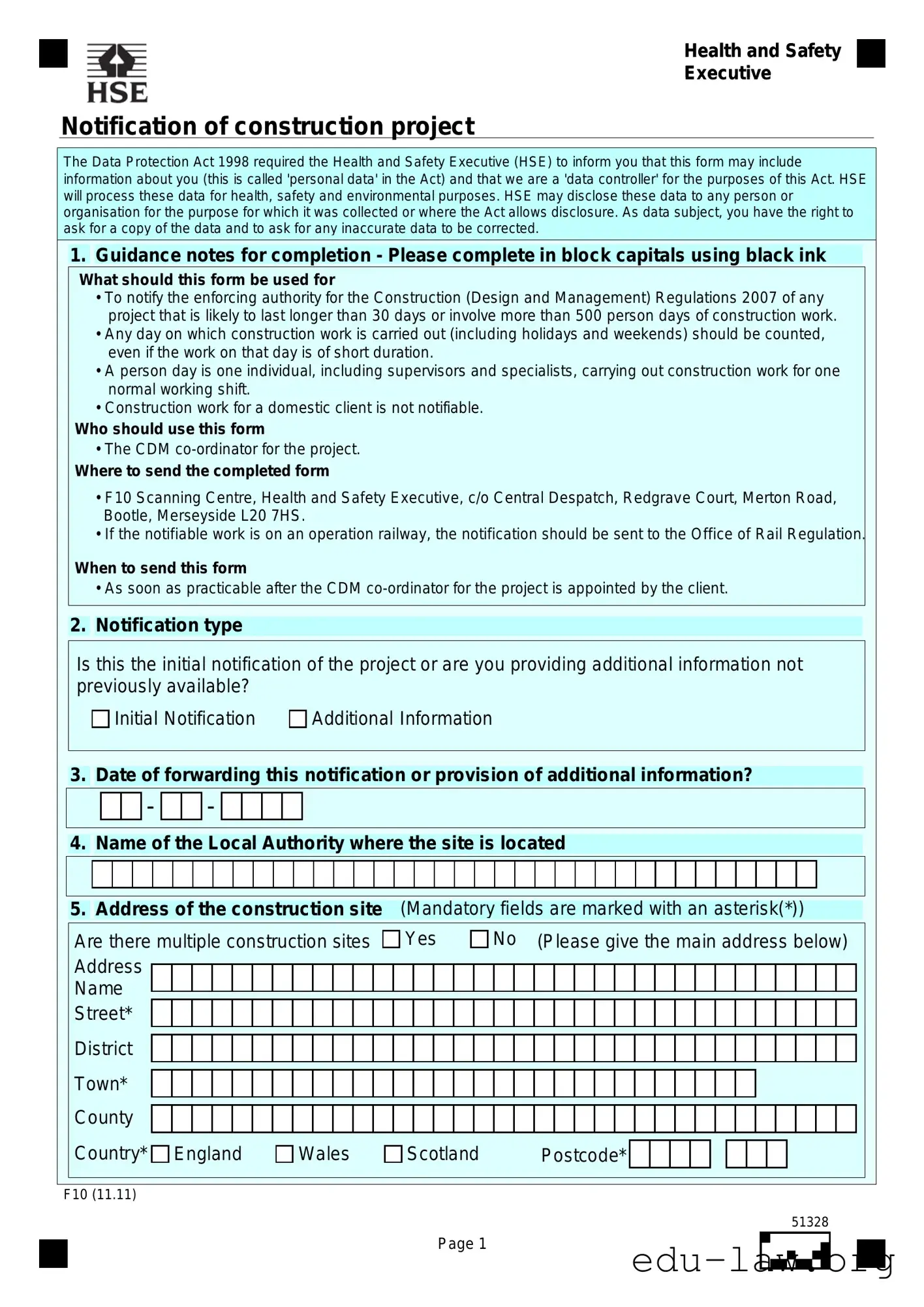
The F10 form is a crucial document designed to ensure compliance with health and safety regulations in construction projects across the UK. This form serves as a notification to the Health and Safety Executive (HSE) regarding any construction project that is expected to last longer than 30 days or involve more than 500 person days of construction work. It is important to note that every day of construction, including weekends and holidays, counts towards this threshold, emphasizing the need for thorough planning and communication. The form is primarily to be completed by the CDM co-ordinator, who plays a vital role in managing health and safety throughout the project lifecycle. Additionally, the F10 form requires specific information, such as the project type, contact details for key personnel involved, and an overview of the construction work being undertaken. The HSE processes the data collected for health, safety, and environmental purposes, and individuals have the right to access their personal data as stipulated by the Data Protection Act. By adhering to the guidelines outlined in the F10 form, project stakeholders can contribute to a safer working environment, ultimately protecting the health and well-being of all individuals involved in the construction process.
Health and Safety
Executive
Notification of construction project
The Data Protection Act 1998 required the Health and Safety Executive (HSE) to inform you that this form may include information about you (this is called 'personal data' in the Act) and that we are a 'data controller' for the purposes of this Act. HSE will process these data for health, safety and environmental purposes. HSE may disclose these data to any person or organisation for the purpose for which it was collected or where the Act allows disclosure. As data subject, you have the right to ask for a copy of the data and to ask for any inaccurate data to be corrected.
1. Guidance notes for completion - Please complete in block capitals using black ink
What should this form be used for
•To notify the enforcing authority for the Construction (Design and Management) Regulations 2007 of any project that is likely to last longer than 30 days or involve more than 500 person days of construction work.
•Any day on which construction work is carried out (including holidays and weekends) should be counted, even if the work on that day is of short duration.
•A person day is one individual, including supervisors and specialists, carrying out construction work for one normal working shift.
•Construction work for a domestic client is not notifiable.
Who should use this form
•The CDM
Where to send the completed form
•F10 Scanning Centre, Health and Safety Executive, c/o Central Despatch, Redgrave Court, Merton Road, Bootle, Merseyside L20 7HS.
•If the notifiable work is on an operation railway, the notification should be sent to the Office of Rail Regulation.
When to send this form
•As soon as practicable after the CDM
2.Notification type
Is this the initial notification of the project or are you providing additional information not previously available?
Initial Notification |
|
Additional Information |
|
3. Date of forwarding this notification or provision of additional information?
- -
4.Name of the Local Authority where the site is located
5.Address of the construction site (Mandatory fields are marked with an asterisk(*))
Are there multiple construction sites |
|
|
|
|
Yes |
|
|
No (Please give the main address below) |
||||||||||||||||||||||||||||||||||||||||||
|
|
|
|
|||||||||||||||||||||||||||||||||||||||||||||||
|
|
|
|
|||||||||||||||||||||||||||||||||||||||||||||||
Address |
|
|
|
|
|
|
|
|
|
|
|
|
|
|
|
|
|
|
|
|
|
|
|
|
|
|
|
|
|
|
|
|
|
|
|
|
|
|
|
|
|
|
|
|
|
|
||||
|
|
|
|
|
|
|
|
|
|
|
|
|
|
|
|
|
|
|
|
|
|
|
|
|
|
|
|
|
|
|
|
|
|
|
|
|
|
|
|
|
|
|
|
|
|
|
|
|
|
|
Name |
|
|
|
|
|
|
|
|
|
|
|
|
|
|
|
|
|
|
|
|
|
|
|
|
|
|
|
|
|
|
|
|
|
|
|
|
|
|
|
|
|
|
|
|
|
|
|
|
|
|
|
|
|
|
|
|
|
|
|
|
|
|
|
|
|
|
|
|
|
|
|
|
|
|
|
|
|
|
|
|
|
|
|
|
|
|
|
|
|
|
|
|
|
|
|
|
|
|
|
|
|
Street* |
|
|
|
|
|
|
|
|
|
|
|
|
|
|
|
|
|
|
|
|
|
|
|
|
|
|
|
|
|
|
|
|
|
|
|
|
|
|
|
|
|
|
|
|
|
|
|
|
|
|
|
|
|
|
|
|
|
|
|
|
|
|
|
|
|
|
|
|
|
|
|
|
|
|
|
|
|
|
|
|
|
|
|
|
|
|
|
|
|
|
|
|
|
|
|
|
|||||
District |
|
|
|
|
|
|
|
|
|
|
|
|
|
|
|
|
|
|
|
|
|
|
|
|
|
|
|
|
|
|
|
|
|
|
|
|
|
|
|
|
|
|
|
|
|
|
|
|
|
|
|
|
|
|
|
|
|
|
|
|
|
|
|
|
|
|
|
|
|
|
|
|
|
|
|
|
|
|
|
|
|
|
|
|
|
|
|
|
|
|
|
|
|
|
|
|
|||||
Town* |
|
|
|
|
|
|
|
|
|
|
|
|
|
|
|
|
|
|
|
|
|
|
|
|
|
|
|
|
|
|
|
|
|
|
|
|
|
|
|
|
|
|
|
|
|
|
|
|
|
|
County |
|
|
|
|
|
|
|
|
|
|
|
|
|
|
|
|
|
|
|
|
|
|
|
|
|
|
|
|
|
|
|
|
|
|
|
|
|
|
|
|
|
|
|
|
|
|
|
|
|
|
|
|
|
|
|
|
|
|
|
|
|
|
|
|
|
|
|
|
|
|
|
|
|
|
|
|
|
|
|
|
|
|
|
|
|
|
|
|
|
|
|
|
|
|
|
|
|
|
|
|
|
|
|
|
|
|
|
|
|
|
|
|
|
|
|
|
|
|
|
|
|
|
|
|
|
|||||||||||||||||||||||||||
Country* |
|
England |
|
|
Wales |
|
|
|
|
Scotland |
|
|
Postcode* |
|
|
|
|
|
|
|
|
|
|
|
|
|
|
|
|
|
|
|
|
|||||||||||||||||
|
|
|
|
|
|
|
|
|
|
|
|
|
|
|
|
|
|
|
|
|
|
|
|
|
|
|
|
|
|
|
|
|
|
|
|
|
|
|
|
|
|
|
|
|
|
|
|
|
|
|
F10 (11.11)
51328
Page 1
Health and Safety
Executive
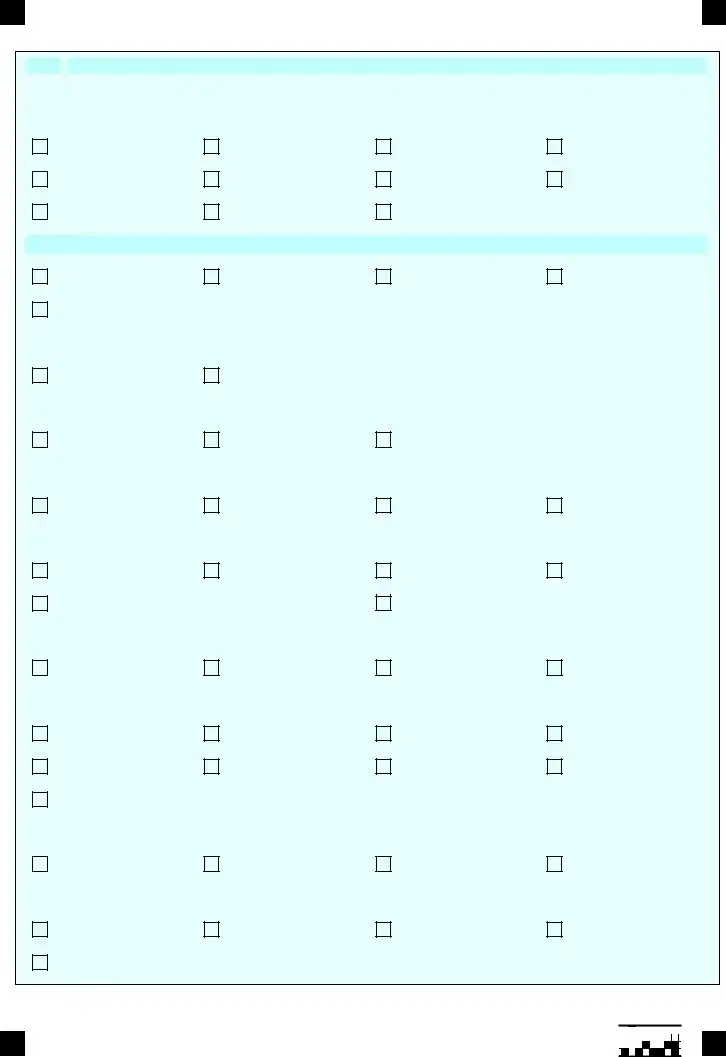
6 a. Project type - IMPORTANT: Please select ONE checkbox only from this page
For mixed projects please tick the box that reflects the primary element of the work. Additional information may be provided on the following page in section 6 b.
|
|
Not Required |
|
Asbestos |
|
Building Services |
|
Utilities Work |
|
|
|
|
|
||||
|
|
Painting&Decorating |
|
Road & Path |
|
Site Investigation |
|
Telecomm. Towers |
|
|
|
|
|
||||
|
|
Tunnel |
|
Water Project |
|
Other |
|
|
|
|
|
|
|
|
|||
|
|
|
|
|
|
|
|
|
Demolition/Dismantling
|
|
House |
|
Factory |
|
Chimney |
|
Railways |
|
|||||||||
|
|
|
|
|
|
|||||||||||||
|
|
Other |
|
|
|
|
|
|
|
|
|
|
|
|
|
|
||
|
|
|
|
|
|
|
|
|
|
|
|
|
|
|
|
|||
|
|
|
|
|
|
|
|
|
|
|
|
|
|
|
|
|
|
|
|
|
|
|
|
|
|
|
|
|
|
|
|
|
|
|
|||
Mechanical & Electrical (M & E) |
|
|
|
|
|
|
|
|
|
|||||||||
|
|
|
|
|
|
|
|
|
|
|
|
|
|
|
|
|
|
|
|
|
Installation |
|
Repair |
|
|
|
|
|
|
|
|
|
|||||
|
|
|
|
|
|
|
|
|
|
|
|
|||||||
|
|
|
|
|
|
|
|
|
|
|
|
|
|
|
|
|
|
|
|
|
|
|
|
|
|
|
|
|
|
|
|
|
|
|
|
||
Roofwork Repair |
|
|
|
|
|
|
|
|
|
|
|
|
|
|
||||
|
|
|
|
|
|
|
|
|
|
|
|
|
|
|
|
|
|
|
|
|
Residential |
|
Commercial |
|
Other |
|
|
||||||||||
|
|
|
|
|
|
|||||||||||||
|
|
|
|
|
|
|
|
|
|
|
|
|
|
|
|
|
|
|
|
|
|
|
|
|
|
|
|
|
|
|
|
|
|
|
|
||
Groundworks |
|
|
|
|
|
|
|
|
|
|
|
|
|
|
||||
|
|
|
|
|
|
|
|
|
|
|
|
|
|
|
|
|
|
|
|
|
Piling |
|
Tunnelling |
|
Underpinning |
|
Other |
|
|||||||||
|
|
|
|
|
|
|||||||||||||
|
|
|
|
|
|
|
|
|
|
|
|
|
|
|
|
|
|
|
|
|
|
|
|
|
|
|
|
|
|
|
|
|
|
|
|||
New Build - Civil Engineering |
|
|
|
|
|
|
|
|
|
|||||||||
|
|
|
|
|
|
|
|
|
|
|
|
|
|
|
|
|
|
|
|
|
Bridge |
|
Road |
|
Waterway |
|
Docks |
|
|||||||||
|
|
|
|
|
|
|||||||||||||
|
|
New Build - Railways |
|
|
|
|
|
|
New Build - Other |
|
|
|||||||
|
|
|
|
|
|
|
|
|
|
|||||||||
|
|
|
|
|
|
|
|
|
|
|
|
|
|
|
|
|
|
|
|
|
|
|
|
|
|
|
|
|
|
|
|
|
|
|
|||
New Build - Commercial Premises |
|
|
|
|
|
|
|
|
|
|||||||||
|
|
|
|
|
|
|
|
|
|
|
|
|
|
|
|
|
|
|
|
|
Shop |
|
Warehouse |
|
Factory |
|
Other |
|
|||||||||
|
|
|
|
|
|
|||||||||||||
|
|
|
|
|
|
|
|
|
|
|
|
|
|
|
|
|
|
|
|
|
|
|
|
|
|
|
|
|
|
|
|
|
|
|
|||
New Build - Residential Premises |
|
|
|
|
|
|
|
|
|
|||||||||
|
|
|
|
|
|
|
|
|
|
|
|
|
|
|
|
|
|
|
|
|
Houses |
01 - 5 |
|
Houses |
56 - 10 |
|
Houses |
101 |
- 20 |
|
Houses > 20 |
|
|||||
|
|
Flats |
01 - 5 storey |
|
Flats |
56 |
- 10 storey |
|
Flats |
110 |
- 20 storey |
|
Flats > 20 storey |
|
||||
|
|
|
|
|
|
|||||||||||||
|
|
Other |
|
|
|
|
|
|
|
|
|
|
|
|
|
|
||
|
|
|
|
|
|
|
|
|
|
|
|
|
|
|
|
|||
|
|
|
|
|
|
|
|
|
|
|
|
|
|
|
|
|
|
|
|
|
|
|
|
|
|
|
|
|
|
|
|
|
|||||
Refurbishment (including Repair & Redecoration) |
|
|
||||||||||||||||
|
|
|
|
|
|
|
|
|
|
|
|
|
|
|
|
|
|
|
|
|
Commercial |
|
Residential |
|
Railway |
|
Other |
|
|||||||||
|
|
|
|
|
|
|||||||||||||
|
|
|
|
|
|
|
|
|
|
|
|
|
|
|
|
|
|
|
|
|
|
|
|
|
|
|
|
|
|
|
|
|
|||||
Refurbishment (including Repair & Redecoration) - Civil Engineering |
|
|
||||||||||||||||
|
|
|
|
|
|
|
|
|
|
|
|
|
|
|
|
|
|
|
|
|
Bridge |
|
Road |
|
Waterway |
|
Docks |
|
|||||||||
|
|
|
|
|
|
|||||||||||||
|
|
Other |
|
|
|
|
|
|
|
|
|
|
|
|
|
|
||
|
|
|
|
|
|
|
|
|
|
|
|
|
|
|
|
|||
|
|
|
|
|
|
|
|
|
|
|
|
|
|
|
|
|
|
|
51328 Page 2
| Fact Name | Details |
|---|---|
| Purpose | The F10 form notifies the Health and Safety Executive about construction projects lasting longer than 30 days or involving over 500 person days of work. |
| Data Protection | Under the Data Protection Act 1998, the HSE processes personal data for health, safety, and environmental purposes. |
| Who Uses It | The form should be completed by the CDM coordinator for the project. |
| Submission Address | Completed forms must be sent to the F10 Scanning Centre at Health and Safety Executive, Bootle, Merseyside. |
| Notification Timing | Submit the form as soon as possible after the CDM coordinator is appointed by the client. |
| Local Authority | The form requires the name of the local authority where the construction site is located. |
| Project Types | Various project types can be indicated, including residential, commercial, and civil engineering works. |
| Client Details | Mandatory fields must be completed for client, contractor, and designer contact details. |
| Time Allowed | The form includes a section for the client to specify the time allowed for planning and preparation for construction work. |
Completing the F10 form is essential for notifying the appropriate authorities about construction projects that meet specific criteria. Follow the steps outlined below to ensure accurate and complete submission of the form.
What is the purpose of the F10 form?
The F10 form is used to notify the Health and Safety Executive (HSE) about construction projects that are likely to last longer than 30 days or involve more than 500 person days of construction work. This ensures that the project complies with the Construction (Design and Management) Regulations 2007, promoting health and safety on construction sites.
Who is responsible for completing the F10 form?
The CDM co-ordinator for the project is responsible for completing the F10 form. This individual ensures that all necessary information is provided and that the form is submitted to the appropriate authorities.
When should the F10 form be submitted?
The F10 form should be submitted as soon as practicable after the CDM co-ordinator is appointed by the client. Timely submission is crucial to ensure compliance with health and safety regulations.
Where should the completed F10 form be sent?
The completed F10 form should be sent to the F10 Scanning Centre at the Health and Safety Executive. The address is: F10 Scanning Centre, Health and Safety Executive, c/o Central Despatch, Redgrave Court, Merton Road, Bootle, Merseyside L20 7HS. If the work is on an operational railway, it should be sent to the Office of Rail Regulation instead.
What information is required on the F10 form?
The F10 form requires several details, including the project type, the address of the construction site, contact information for the CDM co-ordinator, principal contractor, client, and any engaged designers or contractors. Mandatory fields must be completed for every contact provided.
What constitutes a 'person day' in construction work?
A person day is defined as one individual, including supervisors and specialists, carrying out construction work for one normal working shift. This metric is essential for determining whether a project meets the criteria for notification.
Can domestic construction projects be notified using the F10 form?
No, construction work for a domestic client is not considered notifiable under the regulations. The F10 form is specifically intended for larger projects that may pose greater health and safety risks.
What rights do individuals have regarding their personal data on the F10 form?
What should be done if there are multiple construction sites?
If there are multiple construction sites, the main address of the project should be provided in the F10 form. It is important to clearly indicate whether there are multiple sites to ensure proper notification and compliance.
What additional information can be provided on the F10 form?
The F10 form allows for additional information to be provided, particularly in relation to mixed projects. This can include a brief description of the project and details about the construction work involved, which helps clarify the scope of the project.
Not using block capitals: It’s important to fill out the form in block capitals. This ensures that the information is clear and easy to read.
Using the wrong ink color: Always use black ink when completing the form. Other colors can make it difficult to scan or read.
Skipping mandatory fields: Make sure to fill in all mandatory fields marked with an asterisk (*). Missing these can delay processing.
Incorrect project type selection: Select only one checkbox that best reflects the primary element of the project. Choosing multiple options can cause confusion.
Not providing a project description: A brief description of the project is required. Failing to include this can lead to incomplete information.
Incorrect contact details: Ensure that all contact details for the CDM co-ordinator, principal contractor, and client are accurate. Incorrect information can lead to communication issues.
Failing to estimate time allowed: Provide an estimate of the time allowed by the client for planning and preparation. This information is essential for project management.
Not counting all construction days: Remember to count every day construction work is carried out, including weekends and holidays, to determine the project duration.
Missing the submission deadline: Submit the form as soon as possible after the CDM co-ordinator is appointed. Delays can lead to regulatory issues.
Not checking for additional addresses: If there are additional contacts, be sure to fill out those sections. Missing contacts can hinder project coordination.
The F10 form serves as a crucial document for notifying the Health and Safety Executive (HSE) about construction projects that meet specific criteria. Along with the F10 form, several other documents are often utilized to ensure compliance with regulations and to facilitate effective communication among all parties involved in a construction project. Below is a list of these documents, each with a brief description.
By utilizing these documents in conjunction with the F10 form, stakeholders can foster a safer construction environment. Each document plays a vital role in ensuring compliance with health and safety regulations while promoting effective communication among all parties involved in the project.
The F10 form serves a specific purpose in notifying the Health and Safety Executive (HSE) about construction projects, similar to the OSHA 300 Log. The OSHA 300 Log is used by employers to record workplace injuries and illnesses. Both documents require detailed information about the project or workplace, ensuring that relevant authorities are informed about safety concerns. While the F10 focuses on construction projects, the OSHA 300 Log emphasizes maintaining a safe work environment by tracking incidents that could affect workers' health and safety.
Another document comparable to the F10 form is the Construction Safety Plan. This plan outlines the safety measures and protocols that will be implemented during a construction project. Like the F10, it aims to ensure compliance with safety regulations and protect workers. The Construction Safety Plan includes specific details about the project, similar to the project type and contact information required in the F10 form, thus promoting a safe construction environment.
The Project Notification Form is also similar to the F10 form. This document is used to inform relevant authorities about the start of a construction project. Both forms require basic project details, including the location and duration of the work. The Project Notification Form, like the F10, helps ensure that all stakeholders are aware of ongoing construction activities, facilitating better communication and coordination among parties involved.
The Site Safety Inspection Report shares similarities with the F10 form in that it documents safety conditions at a construction site. This report is typically filled out by safety inspectors and includes information about potential hazards and compliance with safety regulations. Both documents emphasize the importance of maintaining safety standards and require accurate reporting to ensure a safe working environment.
Another related document is the Risk Assessment Form. This form identifies potential risks associated with a construction project and outlines measures to mitigate those risks. Like the F10, the Risk Assessment Form is essential for compliance with safety regulations. Both documents require detailed information about the project and its potential hazards, ensuring that safety is prioritized throughout the construction process.
The Permit to Work is also akin to the F10 form, as it is used to ensure that specific tasks are carried out safely. This document outlines the safety precautions necessary for high-risk activities within a construction project. Similar to the F10, the Permit to Work requires detailed information about the project and the individuals involved, reinforcing the importance of safety and compliance in construction activities.
Lastly, the Environmental Impact Assessment (EIA) is comparable to the F10 form in that it evaluates the potential environmental effects of a construction project. While the F10 focuses on health and safety, the EIA assesses environmental risks. Both documents require comprehensive information about the project, ensuring that all aspects of safety and compliance are addressed before construction begins.
When filling out the F10 form, there are several important dos and don’ts to keep in mind. Following these guidelines will help ensure that your submission is accurate and complete.
By adhering to these guidelines, you can facilitate a smoother process and contribute to the safety and compliance of your construction project.
Misconceptions about the F10 form can lead to confusion and errors in the notification process. Here are ten common misunderstandings, along with clarifications to help clear them up.
This is not true. The form must be completed for any project lasting longer than 30 days or involving more than 500 person days of construction work, regardless of the project's overall size.
In fact, the CDM co-ordinator for the project is responsible for submitting the form. The client plays a role in appointing the co-ordinator, but the submission falls to the co-ordinator.
While construction work for a domestic client is generally not notifiable, if the project meets the criteria of lasting longer than 30 days or involving more than 500 person days, the form must still be submitted.
The form should be submitted as soon as practicable after the CDM co-ordinator is appointed. Delays can lead to compliance issues.
Accuracy is essential. The information provided must be correct, as it may be subject to checks and corrections can be requested by data subjects.
There is a specific address for submission: the F10 Scanning Centre at the Health and Safety Executive. If the work is on an operational railway, the form must go to the Office of Rail Regulation.
While the primary purpose is to notify the HSE, the data may also be disclosed to other organizations as allowed by law for health and safety purposes.
The guidance clearly states that the form must be completed in block capitals using black ink to ensure legibility.
It can be necessary to provide additional information later. If new details arise, they should be submitted as additional information through the same form.
Under the Data Protection Act 1998, the Health and Safety Executive is a data controller and must handle personal data responsibly, ensuring individuals can request corrections if needed.
Filling out the F10 form can seem daunting, but understanding its purpose and requirements makes the process smoother. Here are some key takeaways to keep in mind:
By keeping these points in mind, you can navigate the F10 form with confidence and ensure that your project meets legal requirements.